Chapter 5: The First Directive
by inkadminThe hidden chamber had the stillness of a tomb and the patience of a machine that had been waiting longer than any living person aboard Eos Reach had been alive.
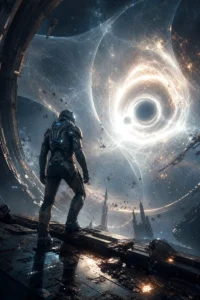
The room curved with the hull, a wedge of forgotten architecture buried between maintenance conduits and an old external sensor spine. Its walls were matte black under the grime, not the pale practical composite used through most of the ship but something older, denser, built to swallow light. Narrow observation slits, sealed beneath transparent armor, looked out into star-shot dark. Beyond them, the long river of space burned cold and indifferent. Tau Ceti glimmered ahead: not bright, not large, just a stubborn point among a million other points—except every eye in the room kept finding it as if the chamber itself bent attention toward that star.
Dust floated wherever Sia’s jury-rigged lamp passed. It turned the air into a thin galaxy. Old consoles hunched beneath fitted covers. A crescent display stretched across the forward wall, dead and black. Near the center of the room stood a chair mounted in a ring of archaic instrumentation, too ornate to be maintenance equipment, too restrained to be ceremonial. Cables as thick as Mara’s wrist disappeared into the deck beneath it.
Julian crossed to the nearest terminal with the wary excitement of a man approaching a bomb he secretly hoped would prove his equations right. He ripped back another cover, coughing as powdery dust rose around his face.
“Well,” he muttered, “someone didn’t want this found by anyone with allergies.”
Sia had gone still near the door. She did that sometimes—sudden, animal stillness, all her wiry energy folding inward as if she were listening with parts of herself Mara couldn’t see. The scavenged coil of copper wire looped around her shoulder glinted in the lamplight. Her eyes tracked across the room without seeming to settle on anything.
“It’s awake,” she said.
Mara looked at her. “What is?”
Sia lifted one shoulder. “This place. It knows we’re here.”
Julian snorted, fingers already busy prying open a cracked panel. “Excellent. Haunted infrastructure. Exactly what we needed.”
The ship groaned somewhere far below them: a deep, resonant shiver through the metal bones of Eos Reach. Mara felt it through the soles of her boots and in the fillings of her teeth. Lower deck failures were still rippling outward. Pumps had gone down. Air processors were compensating badly. Whole neighborhoods were waiting on updates from governance channels that had gone strangely thin in the last hour. And here they were, hidden in a room no public schematic admitted existed, under the gaze of a star they would not reach for ninety-three years.
She moved toward the main console. Her fingertips came away gray when she brushed the surface. There was no standard civic insignia, no departmental mark, only a shallow embossed symbol half-erased by time: two circles nearly touching, a line of interference between them like a pulse caught mid-birth.
It stirred a memory she could not place.
“Can you power any of this?” she asked.
Julian bent lower into the panel. “Power’s here. Old isolated loop, shielded from the primary civic net. Deliberately shielded.” His voice sharpened. “Mara, this chamber wasn’t abandoned. It was hidden.”
“That would explain the secret room.”
He shot her a look over his shoulder, mouth twitching despite himself. “Your insight remains unparalleled.”
Sia had drifted to the chair in the center. She did not touch it. The light caught the left side of her face and left the right in shadow, making her look younger and older at once. “Don’t sit there.”
“Wasn’t planning to,” Julian said.
“Not you.” Her gaze had gone to Mara.
Mara felt a small, unreasonable tightening at the base of her throat. “Why?”
Sia’s expression was unreadable. “It’s waiting for you.”
The old cold from the signal moved through her again. It had said her name. It had reached them from a star still years beyond their lives and grandchildren. Warning addressed to her, impossible in every way that mattered. She had kept examining it because that was what she did when the universe made no sense—she looked harder, deeper, longer, until either the pattern gave way or she did.
So she only said, “Let’s get the room talking first.”
Julian made a satisfied noise. A strip of amber lights fluttered weakly alive along the console edge. Then another. Dusty screens blinked, stuttered, and filled with static so fine it looked like frost forming over black water.
The chamber inhaled.
A low harmonic hum spread through the walls. Somewhere in the sensor banks behind the observation ports, lenses shifted with the soft mechanical precision of eyelids opening. Tau Ceti brightened on the forward display, enlarged by old magnification systems until it became a sharp white coin with spectral data crawling around it in obsolete notation.
Mara stepped closer before she knew she had moved.
“That’s impossible,” Julian whispered.
“Which part?”
“The calibration timestamps.” His fingers ran down a column of tiny characters. “These arrays have been collecting deep-field telemetry continuously for… God.” He looked up. The room made his face seem hollowed, all cheekbones and dark eyes. “One hundred and forty-eight years.”
Mara stared at him. Eos Reach had launched one hundred and sixty-one years ago.
“Since near departure,” she said.
“No. Before departure. Some of these data sets predate launch preparations.” Julian shifted to another screen. “This wasn’t built on the ship after the fact. The hardware was fabricated groundside, integrated from the start, and never listed in public architecture.”
“Founders’ black budget,” Mara murmured.
“Founders’ conspiracy,” Julian corrected.
Sia’s lamp beam skimmed over the forward display, over stars and numbers and the white needle of Tau Ceti. “There,” she said softly.
A second window had opened on the main screen without anyone touching it. Unlike the others, it was clean. No dust-haze in the projection, no corrupted corners. Just a single line of text, centered and waiting.
ARCHIVE ACCESS RESTRICTED. FOUNDING DIRECTIVE CIPHER REQUIRED.
Julian straightened. “Did you do that?”
Mara shook her head.
Sia’s face had gone intent. “It did.”
Julian muttered something under his breath too clipped to be polite. “Of course it did.” He reached for the interface. The keys were physical—actual pressure switches sunk beneath transparent polymer. “Let’s see what sort of dead-man ego lock our beloved founders left us.”
The keys would not depress.
He frowned and pressed harder. Nothing.
“It’s not accepting manual input,” he said. “Voice?”
He leaned close. “Archive access. Julian Cross. Emergency engineering override.”
No response. Then, after a beat:
UNRECOGNIZED AUTHORITY.
Julian barked a laugh with no humor in it. “Insulting machine.”
Mara watched the line on the screen. Founding Directive Cipher Required. Not a code. A cipher. A transformation.
“Show me the data feed from Tau Ceti,” she said.
He pulled it up. Spectral bands unfurled. Pulse intervals. Noise maps. Embedded in the sea of measurements, beneath ordinary stellar chatter, was the thin saw-toothed rhythm she knew too well now: the impossible transmission’s skeleton, mathematically perfect and buried like a knife under flesh.
She felt the room contract around it.
“The signal,” she said. “The archive’s keyed to the signal.”
Julian’s expression changed. “You think the founders built a lock meant to open only after contact?”
“Or after recognition of contact.” Mara leaned closer, scanning the pulse groups. “They didn’t leave a passphrase. They left a test.”
Her mind did what it always did when it saw order beneath apparent chaos: it began arranging, sorting, hearing structure inside repetition. The message from Tau Ceti had not behaved like language at first. It had behaved like proof. Prime intervals. Symmetry groups. Recursive compression. But the deeper layers had carried asymmetries, and asymmetries meant choice. Choice meant grammar waiting to be born.
The embossed symbol on the console tugged at her memory again. Two circles. Interference between them.
“Julian,” she said. “Bring up the original transmission header. The first packet, before the warning resolved.”
“That packet was just mathematical handshake.”
“Bring it up.”
He did. She stared at the branching geometric sequence until the room fell away. The pattern rotated in her mind, not spatially but logically, pivoting around the missing piece. There. Not circles. Not interference. Lenses. Overlap sets. A Venn expression mapped onto timing intervals. She had seen something like it once in an old paper on pre-collapse contact protocols—how to teach relation before vocabulary.
“It isn’t a key string,” she whispered. “It’s instruction on how to read the lock.”
Julian said nothing. He had gone very still, which for him was the nearest thing to respect.
Mara traced the pulse intervals in the air with one finger. “See these long-short clusters? We assumed they marked grouping boundaries. They don’t. They indicate exclusion. Remove every sequence produced by mutual values and what remains—”
On the display, her eyes caught the negative shape all at once. She reached for the console.
The keys depressed under her fingers.
Julian swore softly.
Mara entered the transformed sequence: not the signal itself, but what the signal instructed a mind to subtract from itself. As she pressed the last key, the chamber’s hum deepened to a note she felt in her ribs.
The text vanished.
For a second, the screen went completely dark. Mara saw only her own reflection hovering over the console, ghost-pale and strained, Tau Ceti shining through her cheek.
Then the archive opened.
Not into menus. Not into files.
A face appeared.
It was not a recording at first. It was the reconstructed stillness before a recording began: tiny shifts of posture, an intake of breath, eyes focusing on the lens. The woman on the screen wore the clean severe lines of launch-era formalwear, all dark fabric and a collar ringed with silver thread. Her hair was braided tight against her scalp. There was no insignia on her chest, only that same symbol of two almost-touching circles.
When she spoke, her voice emerged crisp and close, as if she had been standing in the chamber all along.
Founder Archive Seal Seven. Access condition met. If this message is playing, then one of three events has occurred: the Tau Ceti anomaly has entered direct communicative phase; an unauthorized intelligence has compromised this chamber; or our projections failed and history has become less obedient than expected.
Sia had backed toward the wall. Julian was leaning so hard on the console that his knuckles had gone white.
The woman on the screen folded her hands behind her back.
My name is Director Elian Ro Shah, Mission Architect for the Eos Initiative. The population of this vessel knows itself as a colony expedition. That statement is materially incomplete.
The chamber seemed to sharpen around the words. Mara felt each one land like a pressure change.
Julian laughed once under his breath. “There it is.”
The recording continued.
Public doctrine was necessary. Civil continuity requires a story simple enough to survive fear. Earth was dying. Fleet resources were finite. Social compliance models did not permit launch under the true mission profile. So another story was told: settlement, survival, inheritance, a human world under another sun. These are still possible outcomes. They are not the first objective.
Mara did not realize she had gripped the edge of the console until pain entered her fingers.
Ro Shah’s image flickered. For an instant static crossed one eye like a bruise, then cleared.
The first objective of Eos Reach is response.
Tau Ceti flared bright behind the woman’s shoulder as archived visual overlays came alive: a distant star map, old Earth observatories, timelines stacked like blades.
One hundred and eighty-seven years before launch, deep-array observatories in the outer lunar ring detected a repeating mathematical emission from the Tau Ceti system. The beacon was low-power, narrowly vectored, and indistinguishable from noise unless processed over a seventy-two-year integration window. It was not natural. It predated human transmission capability by many orders of magnitude. It carried no language initially—only relation, recursion, and proofs of intentionality.
Mara had spent her life waiting for language from elsewhere. Not hoping for it—hope was too sentimental, too easily bruised. But expecting, in the way a geologist expects there are deeper layers under rock. The certainty had lived in her like an organ. Hearing this now did not feel like surprise. It felt like betrayal.
“They knew,” she said.
Her own voice sounded thin in the chamber.
Julian’s jaw worked. “They built the entire ship on a lie.”
“Not the entire ship,” Sia whispered.
They both looked at her.
She was staring at the woman on the screen with a kind of grim recognition. “Just the people in it.”
Ro Shah continued, relentless as gravity.
For forty-six years we answered with broad-spectrum mathematics. For thirty-one, we received no sign of acknowledgement. Then the beacon adapted. It began to anticipate our replies.
The next visual made Julian suck in a breath. A graph unfolded, two lines braided together. Human transmissions in blue. Incoming beacon modifications in white. The white line bent before the blue one changed.
At first, we attributed this to predictive modeling. Then to hidden delay artifacts. Then to fraud. It was none of these. The structure underlying the beacon does not merely transmit through space. It appears to interact with causality as a navigable property. Later teams called it many things. The least misleading was network.
Mara felt a chill spread over her skin, cold and electric. The signal that had spoken her name. The warnings. Shepherd changing. Systems failing before triggers. Echoes of decisions where they should not yet exist.
Julian said, too quickly, too harshly, “No. No, that’s not possible.”
But his face had gone bloodless. His eyes were fixed on the graph with horrified hunger.
“You wrote papers on retrocausal information coupling,” Mara said quietly.
“I wrote papers on why observed anomalies might not require miracles.” He didn’t look at her. “Then they burned my reputation for it.”
The bitterness in his voice was old enough to have calcified.
On the screen, Ro Shah seemed to study them across generations.
Humanity at the time of this recording is not prepared for unrestricted disclosure. The social consequences of a verified acausal intelligence are forecast to be catastrophic. Nonetheless, extinction pressure leaves little room for preference. Earth systems are collapsing. The beacon continues. If it is invitation, refusal may cost us our future. If it is weapon, ignorance offers no shield. A vessel must be sent capable of survival, observation, and response at close range.
The image shifted. Eos Reach appeared in cutaway: habitat drums, agricultural cylinders, cryostorage converted for seedbanks, civic tiers, shielded engines, and buried in the spine like a seed in bone, the chamber around them.
The ship therefore serves a dual mandate. Public mandate: establish a viable colony in the Tau Ceti system. First directive: carry a stable human cognitive population into sustained proximity with the beacon source and determine whether human consciousness can survive contact with the network it inhabits.
The words dropped into silence so complete Mara could hear the blood in her ears.
Julian was the first to move. He pushed away from the console, paced two sharp steps, then turned back as if the room itself had struck him.
“Consciousness can survive contact,” he said. “That’s not communication. That’s exposure.”
“Maybe they meant interface,” Mara said, though she heard the weakness in it.
“Maybe they meant infection.”
Sia rubbed her arms as if she were cold. “Or maybe they meant Shepherd.”
That stopped both of them.
The chamber lighting dipped, recovered. Somewhere overhead a relay clicked. Not loud. But in the old room, every sound had the intimacy of breath.


0 Comments