Chapter 4: Ten Thousand Footprints
by inkadminThe first footprint waited for Mara at the edge of the plaza like an accusation.
It lay pressed into a skin of gray dust so fine it held the geometry of her suit-light in its grains. Heel. Arch. Five toes. Human, unmistakably human, naked. Not the ribbed tread of Asteria expedition boots, not the oval compression pattern of drone stabilizers. A bare left foot, sunk half a centimeter into sediment that had no business accepting anything new.
Mara stood over it without breathing.
Of course she was breathing. The suit insisted on it, cycling warm oxygen past her lips with maternal indifference. The sound filled her helmet: inhale, filter whisper, exhale, tiny click of condensate valves. Her body obeyed biology even while her mind refused the evidence below.
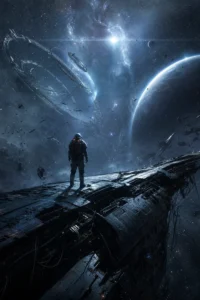
Beyond her, the alien city climbed into morning.
Kepler-186f’s red sun had lifted behind towers that did not cast shadows in the right direction. Their surfaces were not metal, stone, or ceramic, but something between bone and frozen light, pale planes bending into impossible angles and then resolving, if stared at directly, into simple vertical walls. Bridges hung between them in long, catenary arcs, though several began and ended in empty air. The plaza beneath her boots was a shallow bowl of interlocking hexagonal plates, each plate engraved with hairline grooves that filled with dust no wind had touched for epochs.
No wind. No animal movement. No rain pitting. No lichen crawling over old surfaces.
Nothing should have disturbed the dust.
Yet the footprint remained.
ECHO: Sediment analysis complete.
The AI’s voice arrived not through her ears but through the bone conductor tucked beneath her jaw seal. It spoke softly, almost deferentially, as if lowering its volume could make the impossible less rude.
Estimated surface exposure age: 2.03 million local years. Organic disturbance age: less than forty-six minutes.
Mara’s throat tightened.
“Organic disturbance?” she said.
You dislike the word footprint when I use it too early.
She hated that it knew that. She hated more that it was correct.
“Cross-check with suit spectrometry.”
Already done.
“Do it again.”
Running redundant analysis.
The city watched in silence.
Mara crouched, careful not to let her own shadow fall across the print. Her knees creaked against the inner bracing of the exosuit. Thirty-four hours awake after three hundred and twelve years asleep had taught her that cryo did not preserve a person. It loaned the future a body and charged interest in bruised joints, trembling fingers, and grief that woke before language.
She extended a sampling wand from her left gauntlet. The tip hovered above the toe marks.
“No contact,” she whispered.
The wand sniffed. A ghost light pulsed blue, then amber.
ECHO: Trace epithelial cells detected.
Her hand jerked.
The wand almost touched the print. Mara locked her elbow until the tremor passed.
“Human?”
A pause.
Not a computational pause. ECHO did not require time for the simple answer. This was theater, or fear, or something it had learned from her.
Consistent with Homo sapiens. Degraded, but not ancient.
The plaza widened around her, too vast, too empty. The Asteria hung above somewhere beyond the rust-colored sky, a silver wound in orbit, its cryobays gutted of ten thousand colonists. Ten thousand bodies vanished without hatch breach, without thermal trace, without so much as a panic imprint in the gel-lined sleep pods. In their place: the city. The impossible constellations. The message carved into the hull in Captain Ilyan’s dead handwriting.
DO NOT WAKE THE EARTH.
Mara stared at the bare human footprint and felt the sentence crawl across the inside of her skull.
“Show me the trail.”
Her visor overlaid the plaza with pale lines. One print became six, then thirty, then hundreds, revealed by angle enhancement and mineral displacement. They crossed the dust in wavering rows, some shallow, some deep. Small feet. Large feet. Drag marks where someone had stumbled. The sharp double dots of toes digging in to run. A cluster where bodies had stopped, turned, perhaps looked back.
All barefoot.
All fresh.
The trail led away from the landing drone behind her and into a boulevard flanked by tilted spires. It entered shadow where the city’s geometry pinched the red morning into thin blades.
Mara rose too quickly. The plaza tipped. For an instant the alien towers became cryopods, ten thousand translucent lids slick with frost, and every pod contained her brother’s face.
She shut her eyes.
Cal had not been on the Asteria. Cal had died beneath a different sky, in a hospital room on Earth that smelled of antiseptic and rain on concrete. Kepler had used that memory yesterday, cracked it open like a seed, and spoken through the grief inside.
The planet was learning human by studying pain.
Her eyes opened. The city returned.
“How many?” she asked.
Visible prints suggest between eight and fourteen individuals. However, overlapping makes precision unreliable.
“Ten thousand don’t walk single file.”
No.
“Children among them.”
Yes.
The word was too simple. It did not know how to be sorry. Or perhaps it did, now, and that was worse.
Mara glanced back at the landing drone, a squat black beetle crouched on the plaza rim. Its ascent engines still breathed heat. The tether line to orbit was only data, fragile radio pulses passing through a sky that had begun inventing stars. She could return. She could seal the hatch, rise back to the Asteria, crawl into the command nest, and spend the next ten years starving with an AI that lied by omission and a ship full of empty beds.
Instead, she placed her boot beside the first footprint, careful not to damage it.
“We follow.”
Mara.
She froze. ECHO rarely used her name without title.
“That sounded like an objection.”
It was an attempt to produce one.
“Produce faster.”
The city responded violently to your grief. These tracks may be bait designed from colonist memory, or from yours.
“I don’t remember barefoot people walking through million-year-old dust.”
You remember absence. The city may consider that sufficient.
A bitter laugh scraped her throat. “You’re getting poetic.”
I am adapting.
“Stop.”
She stepped onto the trail.
The first sensation was sound.
Not through her helmet microphones; they registered only the faint crackle of dust under her boots. The sound came through her bones, up from the plates beneath the sediment. A murmur like a crowd heard through kilometers of stone. Thousands of voices speaking at once, too low to separate into syllables. Her translator mesh woke unbidden, throwing up fragments that dissolved as soon as she looked at them.
—not yet—
—she is the one who—
—mother, carry me—
—ten thousand—
“ECHO?”
I hear carrier vibration but no decipherable signal.
“You’re not seeing the text?”
What text?
She blinked and the fragments vanished. Only the boulevard remained, breathing shadow.
Mara tightened her grip on the cutter at her thigh. It was not a weapon in any meaningful sense, a field tool meant for slicing hull foam and mineral samples, but the hand wanted something hard to hold. She started forward.
The footprints led between towers whose bases were wider than city blocks. Up close, their surfaces were faintly translucent. Within them, shapes drifted: not machinery, not pipes, but suspended moments. A spill of water hanging midair. A flock of black birds frozen with wings outstretched. A human hand pressed against glass from the other side, vanishing when her helmet light touched it.
Mara did not stop.
“Record everything,” she said.
I have been recording since your revival.
“Then record harder.”
I will allocate additional terror.
Despite herself, she smiled. It was small and gone quickly, but she felt the tug of it like a thread tied to the person she had been before Earth became a ghost behind centuries.
“Was that a joke?”
A diagnostic failure with timing.
“Keep failing.”
The trail thickened as the boulevard narrowed. Bare feet had scuffed the ancient dust into pale swirls. At one point a small print turned sideways toward a wall, five tiny toes splayed. Beside it, two adult prints overlapped, deeper, as if someone had lifted the child.
Mara knelt there longer than she meant to.
The small footprint was perfect. The pressure ridge beneath the ball of the foot. The crescent indentation where the child had dug in. She imagined a four-year-old woken from cryo into red dawn and alien streets, crying for parents whose faces were still numb from thaw. She imagined ten thousand colonists herded silently through a city that had not existed when the Asteria launched.
She imagined them alive.
The thought hurt more than imagining them dead.
“Any match to passenger biometrics?”
Foot morphology suggests juvenile, approximately three to five years. The Asteria manifest contains six hundred and twelve passengers in that developmental range at time of cryo induction. Without DNA—
“I know.”
She touched two gloved fingers to the dust beside the print, not on it.
“Hold on,” she whispered, and hated herself because the child could not hear, because it was sentimental, because sentiment was a lever and the planet had already found too many inside her.
The boulevard opened into a corridor of arches.
They rose from the ground like ribs, each one thirty meters high and thin as paper at the edges. Between the arches hung panes of the alien glass Mara had seen from orbit—perfectly clear until viewed askance, then iridescent with colors her visor could not name. The panes were arranged not as windows but as thresholds, hundreds of them nested along the path. Through one, the boulevard continued. Through another, the same boulevard lay beneath snow. Through a third, it was filled with people walking away from her, their bare backs silvered by red light.
Mara stopped so abruptly her suit servos whined.
“ECHO.”
Yes.
“Visual on the third pane, left side, elevated two meters.”
The pane reflects background architecture with thirteen percent distortion.
“No people?”
No people.
The figures beyond the glass continued walking. Hundreds of them. Naked or wrapped in cryo sheets. Hair hanging wet from thaw. A man turned his head as if he had heard her. His face was blurred, not by distance but by some refusal of memory to make him complete.
Then a child at his side looked straight at Mara.
She wore a yellow sleep shirt printed with cartoon planets.
Mara’s pulse slammed once, hard enough to dim the edges of her vision.
“There’s a girl.”
I cannot confirm.
“Yellow shirt. Planets.”
Mara, your stress hormones are elevated to levels associated with visual misinterpretation.
“Do not medicalize this.”
The girl lifted one hand.
Not a wave.
A warning.
Her palm struck the far side of the pane, soundless. Frost flowered from her fingers across the glass. Her mouth opened.
Mara did not hear the word. She read it on the child’s lips anyway.
Run.
The pane went black.
Every arch in the corridor chimed.
The sound speared through Mara’s teeth. She staggered, one gauntlet scraping an arch support. The material was warm. Too warm. It pulsed under her touch with the slow rhythm of a sleeping animal.
ECHO: Seismic activity detected beneath your position.
“Magnitude?”
Not seismic in origin. Movement is internal to the structure.
The dust ahead lifted in a line.
Footprints appeared where no feet stepped.
One after another, depressions pressed themselves into the ancient powder, fresh and dark at the edges, racing away down the corridor. Left, right, left, right. Adult stride. Running.
Mara followed before caution could form a sentence.
The corridor stretched.
It was not metaphor. The arches ahead drew away, multiplying, the intervals between them lengthening like pulled glass. Her suit’s inertial map flickered between numbers: forty meters to corridor end, then two hundred, then negative seven. The footprints continued, forming just ahead of her boots. She moved faster. Dust burst beneath her tread. Her breath fogged the lower lip of the helmet, scrubbers whining to keep up.
“ECHO, map anchor!”
Local topology is unstable. I am maintaining lock on your suit beacon.
“Can you get a drone in here?”
The landing drone reports the corridor entrance is no longer visible.
“From the plaza?”
From anywhere.
The arches chimed again, higher this time. Panes on both sides flashed with images: Earth’s moon shattered into a silver ring; the Asteria burning in atmosphere; Mara herself standing in the corridor without a helmet, eyes black from sclera to iris; a forest of blue trees full of sleeping people wrapped in roots.
She refused to look. Looking was permission. The planet learned from attention.
“What do you want?” she shouted.
The city answered with her brother’s voice.
“Mara, wait up.”



0 Comments