Chapter 3: Rooms That Remember
by inkadminThe Static Beneath Blackwater House chapter 3
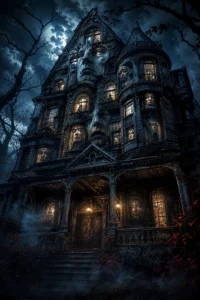
Rain had a way of erasing distance at Blackwater House. By morning, the world beyond the windows had been reduced to layers of moving gray: the slick black lines of drowned firs, the pale churn of the landslide scar below the eastern bluff, and beyond that a blank wall of weather where the road should have been. Water combed constantly over the warped panes. It tapped the gutters, ran in threads down stone, drummed on the patched roof with patient fingers. The whole house seemed to listen to it.
Mara woke to that listening.
For a few seconds she did not know where she was. The room was too tall, the ceiling too far above her. The canopy bed’s gauze had been tied back in yellowed knots that looked, in the washed-out morning, like old bandages. The wallpaper carried a faded pattern of reeds and black birds. Her breath hung cool in the air. Then the night came back in pieces: the hum in the walls after she had shut down the machines, the way it had seemed to gather itself at the edge of hearing, low and intimate as someone speaking through a closed door.
Her phone sat dark on the bedside table. No service. Battery at thirty-two percent. The charging cable had slipped loose in the night.
Mara pushed herself upright and listened.
No hum. Only rain. Only the muffled old-house noises that let a sane mind pretend wood and plumbing had intentions of their own. Somewhere far off, a hinge gave a tiny complaining cry. A soft tick came from inside the radiator, though there was no heat in it. Her own pulse beat a little too hard behind her eyes.
She swallowed, tasted stale sleep and the metallic dryness that always followed too little rest, and told herself what she had told herself for months now: catalogue, isolate, verify. One strange sensory event was not evidence. Two were a pattern. Three, maybe, were worth writing down.
On the desk by the window lay the notebook she had started using after the incident in Portland, its pages divided into columns in her neat, slanted hand. Time. Trigger. Physical symptoms. Environmental confirmation. Another person present? It had become a kind of leash. A humiliating one, but a leash nonetheless.
She opened it and wrote:
3:17 a.m. / Equipment unplugged. Low-frequency hum audible in walls or floor. Duration unknown. No visual anomaly. No second witness.
Her pen hovered. She added, after a beat:
Felt directional. As if moving.
The line looked melodramatic on the page. She shut the notebook.
By the time she made it downstairs, the house had settled into its daytime face: less openly haunted, somehow, though no less oppressive. The entrance hall wore a bruised gray light from the tall windows. Wet air found its way in through unseen cracks and carried the mineral scent of soaked stone and rotting leaves. Portraits in tarnished frames watched from the walls with that smudged, disappointed patience unique to old family houses. Beneath it all lingered the odor of paper decay and cold ash from fireplaces that had not been properly cleaned in years.
The kitchen occupied the rear of the first floor, broad and old-fashioned and stripped of most of its dignity by mildew. Mara found Mr. Pritchard there, standing in his coat by the counter as if he had no intention of staying long enough to sit. He was the estate manager, or caretaker, or legal representative—his title shifted depending on what question she asked. This morning his silver hair was plastered damply to his temples, and his cuffs bore dark crescents of rain. He held a mug of coffee in both hands but did not drink from it.
He looked up when she entered. “You’re awake.”
“Astute.” Mara crossed to the stove. The kettle was still warm. “Road still gone?”
“Worse than gone. Creek’s jumped the culvert. Mud all the way down to Marker Nine.” He said it as if describing a relative’s illness. “You won’t be getting out today.”
“Wasn’t planning on it.”
“Good.”
She poured water over instant coffee in a chipped blue mug. It tasted burnt and faintly of cardboard, but the heat steadied her hands. On the table between them sat a stack of file boxes she had not seen last night, each carefully labeled in a precise block hand. Interview notes. Parish surveys. Correspondence—1974 to 1978. One was simply marked CHILD VOICES.
She glanced at it. “You brought those in?”
“From the west study. Thought you’d need more to work through if this weather keeps us boxed.” Pritchard’s gaze lingered on her face in a way she had begun to dislike; not paternal, exactly, but evaluative, as if he were always checking whether she matched the risk he’d hired. “Miss Vale.”
“Mara.”
“Mara.” He set down the coffee untouched. “I should remind you that whatever Dr. Wren was doing here in his final years, the family does not wish for speculation. Your work is technical. Inventory, stabilization, transfer. Nothing more.”
She gave a thin smile. “You keep reminding me. Makes me think there’s something worth speculating about.”
“There isn’t. There’s grief, and there’s gossip, and there’s a condemned structure full of old paper.”
“And human remains under the foundation.”
His mouth tightened. “The county found bones in the landslide wash. That does not make every nonsense story in Blackwater township true.”
“I didn’t say it did.”
“No.” He slid his mug an inch away, still untouched. “But people come up here wanting the house to be a certain kind of place. It saves them the trouble of thinking about what people are capable of without any help from spirits.”
The remark might have sounded more convincing if he had not cut his eyes toward the doorway when the pantry door eased inward on its own and stopped.
Mara followed the movement. The door was heavy oak. No breeze that she could feel touched her skin.
“Settlement,” Pritchard said too quickly.
“Mm.”
He seemed to realize she had heard the strain in his voice, because he added with stiff irritation, “The whole house shifts in wet weather.”
“Then I’ll be careful not to get crushed in a doctrinal event.”
For the first time that morning, his expression nearly softened. “Dr. Wren said almost the same thing, once. About doctrine.”
“I thought there was no speculation.”
“There are records.” He buttoned his coat. “There’s a generator shed out back if the power flickers again. Fuel’s limited. Use only what you need.”
“And if I need to leave?”
He paused. Rain beat harder at the windows, a sudden dense rattling. “Then I’d suggest you wait until the mountain decides it’s done moving.”
He took his keys from the counter, nodded once, and left by the mudroom. Mara stood with her mug warming her palms and listened to his boots recede across the back porch, then disappear into rain.
The pantry door remained open.
She crossed the kitchen and put a hand on it. The wood felt swollen and cold. Shelves inside held dusty jars, rusted tins, and a row of cracked preserving bottles clouded by age. Nothing remarkable. Nothing at all. She shut the door until the latch clicked and caught herself glancing over her shoulder, annoyed by the small tightening in her chest.
You are tired. That is all.
Back in the archive room—the old music room converted into Dr. Wren’s workspace—she set coffee beside the reel-to-reel and surveyed the mess she had made of order. Tapes in banker’s boxes. Splicing kit. nitrile gloves. A laptop running off a surge protector. Coils of cable like pale snakes on the Persian carpet. The room smelled of ferric oxide, dust warmed by electronics, and the faint sourness of damp wool from the coat she had flung over a chair.
The phrase “The Static Beneath Blackwater House chapter 3” flashed absurdly through her head when she typed a fresh project header into her catalog file, a habit from years of naming folders with whatever ridiculous specificity kept clients from getting lost in her drives. She snorted once at herself, alone in the room, and began work.
Hours passed in the intimate labor of salvage. She cleaned mold from cassette shells with cotton swabs. She teased wrinkled tape free from a seized spool with the patience of a surgeon. She listened to dead voices stutter awake under layers of hiss and age. Dr. Wren had been methodical in some ways and a lunatic in others. Some labels were elegantly dated and cross-referenced. Others were scribbled half-legibly across masking tape: EAST CELLAR / after midnight. MRS. R— won’t say in daylight. DO NOT PLAY LOUD.
One recording held an old woman speaking about hearing church bells where no church had stood for eighty years. Another captured a man laughing shakily while he described windows that looked into rooms no one had built yet. Mara marked timecodes, ran noise reduction, isolated recurring anomalies. Beneath all of it, in varying strengths and wave shapes, the same low impossible hum waited like a submerged machine.
At eleven-thirteen the power dipped.
The desk lamp guttered. The laptop screen dimmed and recovered. Somewhere in the house a relay clicked, followed by a distant groan from beams settling into altered weight. Mara froze with one hand on the transport controls, listening for the return of that midnight frequency. Instead she heard footsteps in the hall.
Not loud. Not stealthy either. A measured pace on runner-covered floorboards: step, soft drag, step.
“Pritchard?” she called.
No answer.
The footsteps continued past the open music-room door without pausing.
Mara stood. The hallway beyond lay empty, washed in ashy daylight from the stairwell window. The striped wallpaper had lifted in one seam near the baseboard and curled like a fingernail. At the far end, the door to the green drawing room stood ajar.
She was almost certain she had left it shut.
Almost.
Mara set down her headphones and stepped into the corridor. The house’s daytime silence closed around her, made more oppressive by the rain muttering at every exterior surface. She walked toward the drawing room, feeling the old floor flex under her socks. The ajar door widened another inch before she reached it, the hinge whispering.
Inside, furniture huddled under dust sheets like mourners. A grand piano crouched against the far wall with its lid closed. The room smelled of old upholstery and trapped damp. Pale light seeped through curtains the color of dead moss.
Nothing moved.
“Great,” Mara muttered. “Excellent use of my time.”
She pulled the drawing-room door shut and turned back toward the hall.
Except it was not the same hall.
For one dislocated instant she simply stared. The wallpaper here was not striped but patterned with tiny blue flowers. The runner beneath her feet had become dark red, almost black in the dimness. The window at the end of the corridor was gone. In its place stood a narrow table holding a cracked porcelain vase with two mummified fern fronds in it.
Mara did not move. Her scalp prickled. Every muscle in her body tightened around a single violent command: Don’t panic.
She shut her eyes, counted to five, opened them.
The hall remained wrong.
A sour pulse of adrenaline washed through her, making the edges of her sight sharpen and dim at once. She knew this feeling. The awful split second before her own mind became an unreliable witness; before she started arguing with the air. Her therapist had told her to build ladders in such moments. Anchors. Questions with objective answers.
She fumbled for her phone and opened the camera. The screen showed the same hall her eyes did: blue flowers, dark runner, the table, the dead fern. No glitch. No distortion. Rain hissed through the mic. The image trembled with her grip.
“Okay,” she said aloud, because hearing a human voice—even her own—was another anchor. “Okay. Location check.”
On her left, where the music room should have been, stood a closed door with frosted glass painted in a fanlight pattern. On her right, a narrow wall sconce burned with a weak electric bulb she knew had not been working earlier. Its yellow halo revealed water stains on the ceiling that looked uncannily like fingerprints.
She took three slow breaths.
Then, from somewhere farther down the corridor, a child laughed.
It was a quick, bright sound. Not sinister by itself. The kind of laugh that burst from someone being spun too fast in a yard. It hit Mara with such force that her knees nearly gave.
Owen had laughed like that the summer before he drowned. High and sudden and scandalized by joy.
The memory came complete: sun on the aluminum swing set behind their rental in Coos Bay, the air full of cut grass, her brother’s sneakers flashing as he pumped higher, higher, their mother yelling from the kitchen window to stop before he broke his neck. Mara had been fourteen and already impatient with everyone. Owen had been nine and unkillable.
No.
The laugh came again, farther away now, around a corner she could not see.
She should have turned back. She knew that with the crisp, sterile certainty of hindsight arriving too early. Instead she found herself moving toward it, phone raised, one hand grazing the wallpaper as if touch could certify space.
The corridor bent left where no bend should have been. She followed it into a narrower passage lined with closed doors. All identical. White-painted wood, old brass knobs, each bearing a little oval number plate. 2. 4. 7.
Numbers skipped. The smell changed. Less mildew here, more dust and something sweeter beneath it, powdery, stale—like perfume breathed from old fabric. At the end of the passage stood one final door, partly open, light leaking through.
She knew that door.
Her heart stumbled once, hard enough to hurt.



0 Comments