Chapter 9: Playback
by inkadminMara did not remember climbing back up from the sinkhole.
Afterward there was only mud under her nails, blood drying in a brown fan across her wrist where stone had split the skin, and the taste of pennies in the back of her throat. Rain stitched cold lines down her face. Behind her, in the widening mouth of earth below the house, the cavern kept answering long after she had stopped speaking. Not with words. With a patient, submerged vowel that made the roots around it tremble.
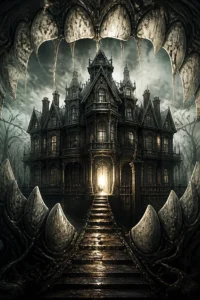
Blackwater House loomed above the scar of the landslide like something half unearthed and annoyed by it. Its windows held no light. The roofline vanished and returned in the storm. Water ran from the gutters in black ropes. Every board in its skin looked swollen, listening.
Mara stood in the yard with her chest heaving and understood, with the absolute clarity of panic, that she had been wrong to think the archive lived on shelves.
But she ran for the house anyway.
The front door resisted her for one wet second, then opened inward with a groan that seemed to begin somewhere deep in the walls instead of at the hinges. The air inside smelled of soaked plaster, old smoke, mold, and the sour metallic tang of overheated tape heads. She slammed the door, threw the bolt, and the house answered with a soft descending creak overhead, as if something had shifted its weight to hear her better.
“No,” she said aloud, already moving.
Her boots slipped over the warped hall runner. The flashlight beam bucked in her shaking hand. Every corridor had become suspect since Thorne’s theory clicked into place in her head. The house did not merely preserve what entered it. It revised. It held copies in sound and fed the world back to itself slightly wrong until the wrongness took.
If the recordings were the source, then the recordings could burn.
The archive room door stood ajar. She shoved into it hard enough that it hit the wall. Rows of shelves leaned over her under the cone of the flashlight, packed with bankers’ boxes, labeled cassettes, wax-sleeved reels, mini-discs in cracked jewel cases, field notebooks gone soft at the edges with damp. The reel-to-reel deck on the worktable was dark. The cassette machine beside it showed no power. Nothing moved.
Yet the room was full of murmur.
Not from speakers. From the boxes themselves. From the tape packed inside them. The sound was faint as breath under blankets, but now that she had heard the cavern answer her, she could not mistake the same architecture in it—that low impossible foundation under the hiss, like something vast clearing its throat in another room of the world.
Mara crossed to the nearest shelf and swept both arms through a row of cassettes.
Plastic clattered across the floor. Cases shattered. A few split and bled loops of brown tape that writhed over the boards like wet ribbon. She kept going. Her shoulder slammed the metal shelving hard enough to ring it. Boxes toppled. Reels rolled in widening circles and struck one another with a sound like coins on a tombstone.
“You’re not real,” she said, and hated how pleading it came out. “You’re media. You’re material. That’s all you are.”
She seized an armful of tapes, pressed them against her chest, and ran them to the fireplace in the study because it was closest and because she had already stacked kindling there two days ago, intending comfort she had never used. She dumped the tapes on the brick hearth, turned, ran back for more.
The second armful was heavier. Open-reel boxes, field cassettes, a recorder with its battery door hanging open like a broken jaw. Her breathing had become a raw mechanical thing. She did not try to sort. She wanted volume. Fuel. Erasure.
On her third trip something whispered very clearly from ankle height as she crossed the threshold.
Mara.
She stopped so hard the boxes in her arms slid and nearly spilled.
The flashlight beam jittered downward over broken cases and ribboned tape on the floor. Nothing human there. Just the collapsed lower shelf and the dark gap behind it where the wall’s baseboard had pulled away from damp plaster.
Then the gap spoke again, in a dozen overlapping mouths so quiet she would have missed them a week ago.
Don’t stack them there.
We put him in water because she wouldn’t stop asking.
Play it back.
Mara.
She made a sound she did not recognize, a bitten-off animal noise, and hurled the boxes at the hearth. Cardboard burst. Reels jumped free and spun across brick. She snatched the poker from its stand and brought it down on the nearest cassette until the shell exploded under the iron tip. A spray of ferric-brown dust puffed up and coated her knuckles.
The dust smelled hot.
She froze, poker raised.
Not metaphorically hot. Actually hot, as if the particles had been waiting at some friction point and her strike had awakened it. A thin thread of smoke lifted from the crushed spool.
Mara dropped the poker and lunged for the box of fireplace matches. On the second strike one lit. Sulfur burned sharp in her nose. She fed the flame to paper labels, to old cardboard sleeves, to a knot of spilled tape.
It caught greedily.
Fire ran over the archive in blue-orange lines. The labels curled black. Plastic popped. Tape shrank and twisted like tendons on a grill. For one wild second relief almost knocked her knees loose.
Then the sound began.
Not from the fire. Not exactly. The flames hissed in the normal way of moisture and varnish and old dust. Under that hiss another layer rose, modulated and rhythmic, voices emerging from the combustion the way images rise in a darkroom tray. Too many to separate. Some weeping. Some laughing softly. One singing a church hymn on only three notes. The low frequency did not diminish. It strengthened, using the crackle as if fire were just another speaker.
Mara backed away until the backs of her legs hit the desk.
The cassette machine across the room was still dark. Its play button depressed itself with a dry click.
She stared.
The reels did not turn. No power. No tape loaded. Yet from the machine’s unlit speaker grille came a burst of static so loud it made her bite her tongue.
[PLAYBACK ERROR]
The words did not appear on any screen. She heard them in the exact flat cadence of old editing software, the clipped system voice she had worked beside for half her life.
[SOURCE NOT FOUND]
“Stop.”
[SOURCE EVERYWHERE]
The voice was hers.
Mara lurched forward and ripped the machine off the desk. It hit the floor corner-first and cracked open. Springs jumped. A wheel spun free and whirred under a cabinet. The speaker grille dented inward. Silence fell for half a breath.
Then the radiator beside the window took over with a throat-deep drone.
The lamp glass on the desk chimed in sympathy. Rain on the pane sharpened, each drop a bead on a shaken drumhead. Under her soles the floor vibrated in tiny insectile pulses. The joists. The pipes. The wet lath in the walls. The nails. All of it passing the signal hand to hand through the structure.
Her own teeth answered.
Mara clapped both hands over her ears and staggered into the hall. The fire had spread enough now to throw orange bars across the wallpaper and make the framed photographs along the corridor look fevered. Smoke climbed the ceiling in a dark lid. Somewhere in the back rooms old plaster was starting to tick from heat.
Good, she thought savagely. Burn.
She went for the breaker panel in the service corridor anyway, because instinct wanted one clean causal line—kill the power, kill the sound. She yanked the rusted metal door open and hauled switches down with the side of her fist. The house snapped into thicker darkness. The hum of the refrigerator in the kitchen died. So did the little standby lights she hadn’t realized she’d been measuring herself against.
The frequency remained.
Without electric noise around it, it slid closer.
It was not in the air now so much as in the conduction of her body. Behind her eyes. In the bruises flowered along her ribs where she had hit the banister yesterday. In the old silver scar at her chin from childhood. It moved through her with obscene familiarity, finding pathways already laid.
Mara opened her mouth and felt the shape of the sound trying to use it.
She bit the inside of her cheek until fresh blood flooded her tongue. Pain scattered it for a second.
“No,” she whispered.
The hallway ahead of her buckled in the flashlight beam—not physically, not enough for a carpenter to measure, but acoustically, like a tape stretched by heat. She heard her own footsteps half a second before she took them. Pre-echo. Print-through. Sound leaking from one layer into the next before the playhead reached it.
Her next three steps arrived in her ears before her feet made them. The fourth came with a child’s laugh threaded under it.
Mara stopped moving.
It’s in me.
The thought landed whole and cold. She had been treating herself as witness, operator, contamination risk maybe—but still separate. That last idea stripped away.
She was not hearing an infection from outside. Some part of her nervous system already knew this pattern. It was why the first night in Blackwater had felt less like discovering a language than remembering one badly. Why the restored fragments had slotted into her skull with the click of old furniture finding old grooves. Why the recent breakdown in Portland had not been random collapse but recognition violent enough to shatter what forgetting had built.
Through the dark, over the pulse in the walls, she heard paper turning.
The sound came from the study.
Firelight strobed there now, stronger, throwing moving bars across the doorframe. Mara went back because there was nowhere else for her to go and because the page-turning was deliberate, patient, like a person waiting for her to finish panicking.
The blaze in the hearth had spread to a fallen stack of cardboard boxes and was licking at the edge of the rug. Smoke rolled low. She coughed hard enough to feel something tear in her throat.
On the desk, illuminated by the fire and her shaking flashlight, lay a notebook she did not remember leaving there.
Thorne’s field journal. The black oilcloth cover had swelled with damp. It had been in a locked drawer upstairs; she was sure of that. Yet there it sat, opened to the middle, pages lifting one by one in the hot draft as if by invisible fingers.
Mara snatched it up.
Thorne’s handwriting crabbed across the paper in furious diagonals, growing less stable as the entries went on. She flipped past sketches of floor plans, resonance diagrams, family names from town records. A line jumped at her from the margin of one page, underlined until the nib had nearly cut through:
Not stored in apparatus. Apparatus only teaches you where to listen.
On the next page:
Wood remembers stress. Stone remembers pressure. Water remembers shape. Bone remembers vibration longest of all.
Her pulse stumbled.
There were names underneath, a list in two columns. Missing townspeople. House staff. Children. Several she had heard on the tapes. One name circled so many times the paper had gone soft at the center.
Mara Vale.
Below it, in smaller script, squeezed into the margin as if Thorne had added it later while trying not to admit what he was writing:
She was here before. Ask about the brother. Ask what was changed.
The study tilted. For one bad instant the fire seemed to rush sideways across the room instead of up. Mara gripped the desk edge hard enough for splinters to drive into her palm.
“No,” she said again, but this time it was not refusal. It was dread finding its proper target.
The notebook slipped from her numb fingers and fell open on the floor.
Tucked into the back cover was a child’s cassette. Clear plastic, cloudy with age. One side bore no label. On the other, in faded blue marker, someone had written two words in careful block capitals:
MARA — HOME
She did not remember ever owning it.
The plastic was warm when she picked it up.
There was no functioning machine left in the room, but the moment her thumb brushed the pressure pad the world around her gave a tiny elastic tug, as if a tape had seated against spinning heads.
The rain vanished.



0 Comments