Chapter 8: When the Walls Open
by inkadminThe Tithe Below Blackwater House chapter 8
The ledger hit the cellar floor with a wet slap that was too heavy for paper.
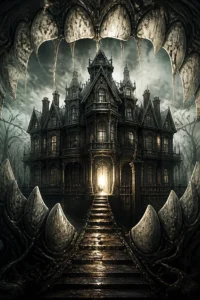
Mara staggered back from it, breath snagging in her throat, the beam of her flashlight shaking over warped planks, salt-whitened stone, and the barnacled spine of the book lying open where she had dropped it. Her family name remained there on the unfinished page as if written in fresh ink, though she had watched the letters emerge pale and blistered through damp. Vale. Date: the night Elise died. Under the column marked Tithe, there was only a ragged blank, as though the house had been interrupted while deciding what it had taken.
Above her, Blackwater House groaned.
Not the ordinary complaint of old beams and settling weight. This was a deeper convulsion, a strain that traveled through the stone under her boots and into her bones. Dust sifted from the ceiling. Somewhere overhead, glass exploded inward with a sound like a scream bitten in half.
“No,” Mara said, though she did not know whether she meant the name on the ledger, the sound from above, or the cold thought opening in her chest. “No, no, no.”
The storm had finally reached the house.
Wind punched down the cellar stairwell in a hard, wet gust carrying rain, salt, and the rank iron smell that always thickened before blood. The single bulb overhead swung wildly. Its light skimmed the shelves of cloudy jars and old preserves, caught on a cluster of hanging tools, and made them seem for one terrible second like the silhouettes of dangling limbs.
Mara snatched up the ledger. The cover was slick as skin. She shoved it under one arm, grabbed her recorder with the other hand, and ran for the stairs.
Each step up felt steeper than the last. The wood flexed beneath her weight like a tongue. The house shuddered around her again, and somewhere inside the walls there came a long inhalation.
At the cellar door she stopped so abruptly her shoulder struck the frame.
The kitchen beyond had changed while she had been below.
Rain blew through the shattered window over the sink, needling across the room in silver lines. The old curtains snapped like torn flags. Water sheeted down the wallpaper, darkening its yellow roses into bruised flesh tones. The table had skidded several feet from where she remembered leaving it, as if the room had lurched. Crockery lay broken across the floor in a crescent around the legs.
And the wallpaper seams were moving.
At first she thought the wind was teasing them. Then one split wider with a soft, sticky sound. The paper peeled back from the wall in two damp lips. Behind it was not plaster, not lath, not wood. There was only a dark, wet slit lined with the suggestion of teeth—small and grain-white, like shell fragments embedded in gums.
It opened.
“Mara,” it whispered.
Another seam split beside the stove. Then another near the pantry door. Around the room the old paper flowered into mouths. Some were thin as wounds. Others sagged open, huge and desperate. Wind and rain hissed through the broken window, but beneath it she heard the soft chorus of them trying to form her name.
“Don’t leave us alone again.”
The voices layered over each other like damp pages. Some were child-thin. Some sounded old enough to crumble. One, horribly, was her own.
Mara backed into the stairwell, clutching the ledger to her ribs.
“You’re not real,” she said.
A mouth by the sink smiled. It had no business smiling. “Then why did you come back?”
The phrase struck the exact place under her sternum where guilt had lived for years, patient as rot.
She raised the recorder with trembling fingers and thumbed it on from pure instinct, as if red light and captured sound might pin any of this to the world she understood. “This is Mara Vale,” she heard herself say, voice thin and breathless. “If anyone ever hears this— if this gets uploaded— this is Blackwater House. The storm’s breached it. The walls are…”
One of the mouths laughed wetly. “Tell them the title again.”
For one absurd second the practiced podcaster part of her, the ruined professional reflex that still twitched under panic, almost complied. She had once sat in studios and borrowed apartments and motel bathrooms and repeated episode intros until they sounded inevitable. The Tithe Below Blackwater House chapter 8 would have been the kind of meta gimmick listeners used to love, back when they still believed her voice meant accuracy rather than appetite.
“Shut up,” she snapped.
The house answered by slamming the kitchen door behind her with enough force to rattle the windows throughout the floor.
Mara flinched and ran.
The back hall was dim, lit only by intermittent flashes through the storm-black windows. Shadows climbed the walls between bursts of lightning. The floor tilted under her feet—not enough to send her falling, but enough to make every stride uncertain, as if she were running across the deck of a ship. Water tracked after her from the kitchen, spreading in narrow fingers through cracks in the boards. It was black where no light touched it.
At the corner leading toward the front staircase, she nearly plowed into Abigail Thorne.
The old woman seemed to have formed out of darkness and salt. Her shawl was soaked through. White hair had come loose from its knot and plastered itself against the sharp map of her skull. In one hand she held a rusted boat hook. In the other was a hurricane lantern whose yellow flame fluttered blue at the edges.
“You fool girl,” Abigail hissed. “What did you take?”
Mara stared, still moving enough that she had to grab the wall to keep her balance. “What are you doing in my house?”
“What did you take?” Abigail repeated, voice rising over a peal of thunder. “Because it’s awake now.”
Mara held up the ledger. Rainwater and sweat slicked her fingers. “This. From the cellar. It has my family’s name in it. It has Elise’s—”
Abigail’s face changed at the name. Not surprise. Recognition, edged with a kind of exhausted pity Mara had started to hate in islanders.
“You should’ve left the dead where they were keeping still,” Abigail said.
From the walls on either side of them came a rustle like many people turning over in bed.
Mara swallowed. “You knew about this. All of you knew. The ledger— infants, names, confessions. You fed this house for generations.”
Abigail’s grip tightened on the boat hook until her knuckles shone in the lantern light. “Fed what slept beneath it, so it would stay beneath.”
Another violent shudder ran through the hall. A framed seascape tumbled from the wall and shattered. Behind the torn wallpaper where it had hung, a seam puckered open into an oval mouth. Milky lips worked around words.
“Abigail,” it said sweetly. “You promised.”
The old woman did not look at it. “Not a word to it,” she snapped at Mara. “Do you hear me? Not your name. Not a prayer. Not a plea. It cannot take hold proper unless it’s answered.”
“What is it?” Mara said.
“A hunger. An old one. Older than any house men built over it.” Abigail shoved the lantern at Mara. “Take this. If the lights go, don’t trust anything that glows back.”
Mara took it automatically. The metal was hot. “Abigail—”
“Listen.” The old woman stepped close enough that Mara smelled brine, diesel, and the medicinal tang of camphor on her skin. “It can press against the world through stone and timber and memory, but it cannot cross into flesh without leave. That’s the law of it. It needs an invitation, and blood is the surest door.”
Mara heard only pieces at first. The storm battered the windows. The mouths in the walls had begun whispering to one another. Somewhere upstairs something heavy dragged slowly across the floor.
“Blood?” Mara said. “You mean sacrifice.”
“I mean kin. I mean lineage. I mean a threshold opened from the right side.” Abigail’s eyes flashed toward the ledger under Mara’s arm. “That book keeps the bindings straight. The bargains. The names that count. If your family page was unfinished, then what was owed wasn’t settled.”
The implication landed like ice water down Mara’s spine. “My sister died in a car crash.”
Abigail said nothing.
“It wasn’t here,” Mara said. “She drowned in a river off Route Nine after she drove through the guardrail. It was snowing. They found her two days later.”
Still nothing. Only that pity, hard and unbearable.
“Say something,” Mara whispered.
Abigail’s mouth flattened. “You’ve always remembered it with water.”
Lightning flashed. For an instant the hall glared white. In that instant Mara saw every split seam in the wallpaper from floor to ceiling, all of them stretched open in listening delight.
Then darkness slammed back down.
The mouths began to whisper together. “Water. Water. Water.”
At the far end of the corridor, the front parlor door drifted open.
Something stood there.
It was a woman in the dark blue dress Elise had been buried in, though Mara had only seen photographs of the body before the casket was closed. The figure’s hair hung in soaked ropes. Her skin had the gray, swollen translucence of river death. Water streamed steadily from her sleeves and hem, pooling around bare feet that left black prints on the floorboards. Her face was tipped downward as if her neck had softened. When she lifted it, one eye was clouded white. The other was entirely Mara’s.
Mara forgot how to breathe.
“You left me in the cold,” Elise said.
The voice was wrong. It had Elise’s cadence—lazy on the consonants, almost teasing—but under it moved the slippery drag of something speaking through a mouth not made for it.
Abigail moved first. “Run,” she barked.
The old woman lunged with the boat hook, jamming the curved end into the parlor door and yanking it hard. The swollen-faced thing struck the closing wood with enough force to splinter the panel. Water burst through the cracks. Abigail slammed the latch down and drove the hook through it for good measure.
“Run!” she shouted again.
Mara did.
She fled with the lantern banging against her knee and the ledger clamped under her arm, through the front hall and toward the grand staircase where portraits watched from cracked gilt frames. The house was louder now, almost jubilant. Doors thudded open and shut in distant rooms. Pipes clanged in the walls like laughter in metal throats. Rain had found its way into impossible places; droplets fell from the ceiling in the center of the hall though the roof was three stories above.
Behind her came a splintering crash.
Abigail shouted something she couldn’t make out, followed by a sound wet enough to turn Mara’s stomach inside out.
She looked back anyway.
The parlor door hung off one hinge. Water streamed into the hall as though from a broken dam, carrying with it scraps of wallpaper and a smell like long-shut crypts. In the lantern’s unsteady glow Mara saw Abigail on one knee, the boat hook skittering from her hand. The thing in Elise’s shape was bent over her, one swollen cheek resting almost tenderly against the old woman’s forehead.
“Tell her,” it murmured.
Abigail looked up and met Mara’s eyes. Blood ran from a cut at her temple into the deep creases beside her mouth. “Third floor,” she rasped. “Nursery. There’s—”
The creature’s head snapped around so fast its neck crackled. It smiled at Mara with lips gone bluish and split. “There’s a key in the cradle,” it said in Abigail’s voice.
Mara ran harder.
She took the staircase in lunging bounds, one hand skidding along the banister slick with condensation. Portraits lined the wall beside her ascent: Blackwater ancestors in oils gone dim with age. As lightning flashed through the stairwell window, each face seemed subtly altered. Eyes overbright. Mouths wet. One child in a sailor suit had turned his head farther than the human neck allowed, following her progress upward.
At the second-floor landing the hallway had lengthened.
She knew it had. The rational part of her, though ragged and shrinking, still knew the layout she had studied and cursed and memorized while trying to document this place. Yet the corridor stretched away far beyond where the east bedrooms should have ended, lined with doors under wallpaper that pulsed gently in and out. The house was breathing.
Behind her, footsteps landed on the stairs with slow, dragging certainty.
“Mara,” Elise called softly.
Mara did not turn. She ran down the impossible hallway, lantern throwing wild shadows that made the doors seem to bulge inward as she passed. The wallpaper seams had all split. Mouths lined the corridor at shoulder height, knee height, close to the floor. Some cried. Some laughed. Some mouthed the same plea over and over: don’t leave us alone again.
One opened directly beside her ear and whispered in her own voice, “She didn’t die on the road.”
Mara slammed the lantern into it. Flame guttered blue. The mouth recoiled, paper curling black around its edges, and shrieked with delighted pain.
She reached a door she knew should have been the linen closet. Instead it stood open onto the nursery.
The room smelled of old talc, mildew, and something coppery sunk deep beneath both. Moon-pale light strobed through the high windows when lightning forked over the sea. The wallpaper here still bore faded rabbits and crescent moons, though many had been rubbed featureless by time or moisture. The crib—no, the cradle, she thought with a spike of nausea, remembering Abigail’s warning—rocked gently in the far corner all by itself.
Mara shoved the door shut behind her and dropped the latch.


0 Comments