Chapter 10: Queen of the Drowning House
by inkadminThe chapel door gave way with a scream of old wood and iron, and a gust of smoke-laden air tore through the ruin like a beast finally loosed from its chain.
Elena flinched as sparks flew past her face. The storm outside had not broken; it had worsened. Rain slashed through the cracked stained glass in silver knives, hissing against the spreading fire. Somewhere beyond the narrow stone corridor, Blackwater Hall groaned like something alive and wounded.
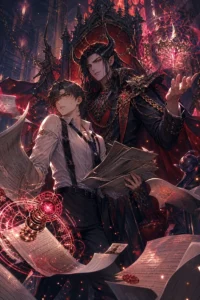
Lucien stood in the threshold, one hand braced against the arch, blood drying black at his temple, his coat dark with rain and soot. The chapel’s ruined candles painted him in gold and shadow, half-devil, half-savior, exactly as he had always been.
“The west passage is still clear,” he said. His voice was steady, but only because he forced it to be. “It leads down to the old boathouse. You can reach the cove before the front grounds are overrun.”
Elena stared at him. “Overrun by whom?”
A bitter, humorless smile touched his mouth. “Everyone.”
As if the house itself wanted to prove him right, the chapel floor trembled under their feet. Dust rained from the carved saints. From somewhere overhead came the deep, splitting roar of a beam collapsing.
Lucien crossed to her in two strides and pressed something cold into her palm. A key. Old, iron, heavy enough to bruise.
“The launch is chained beneath the boathouse. This opens it.”
She looked down at the key, then up at him. “You’re not coming.”
He did not lie to her. Not now. “No.”
The answer hit harder than the smoke in her lungs.
“Lucien—”
“Listen to me.” He caught her wrist, and the grip was not cruel, only desperate enough to be honest. “Rathborne has the magistrates with him. He has the papers, the witnesses he bought, the servants he frightened. By dawn, every church bell in the city will be tolling my name like a death sentence. If they do not drag me from this house, they will burn it over my body.”
“Then let them try.”
Something changed in his eyes at that. Not surprise. Pain. The kind that came from wanting too much.
“Elena.” He lowered his head until his forehead nearly touched hers. “You asked me once if I meant to ruin you.”
“You did ruin me.”
His thumb brushed the inside of her wrist, over the furious beat of her pulse. “Yes. But I will not let them bury you with me.”
Go.
He had offered her freedom in a chapel full of ghosts, while the house burned above them and the truth of him stood raw between them like an opened vein. Freedom should have tasted sweet. It should have felt like the end of a nightmare.
Instead it tasted like ash.
“What have you done?” she whispered.
The thunder swallowed half the question. The rest he answered with his silence.
Then, at last, he said, “Enough that the city will call me monster and not be entirely wrong.”
He released her wrist and stepped back, as if distance would make the choice easier. “Take the passage. Do not let anyone see you leave.”
“And if I refuse?”
“Then I will carry you there myself.”
It should have sounded like one of his threats from the first weeks of their marriage, when every locked door in Blackwater Hall had felt like a warning and every soft word from his mouth had carried its own danger. Tonight it sounded like grief.
Elena lifted her chin. “You think I would run because this city spits your name? They spat mine long before I ever wore your ring.”
“That ring is why they’ll tear you apart if they can.”
She looked at the diamond blazing pale on her hand, once worn by a dead woman, then by the wife who had been purchased, cornered, and slowly made faithless to her own resolve.
“You should have told me everything.”
“I know.”
“At the beginning.”
His laugh was low and terrible. “At the beginning, I barely trusted myself to stand in the same room with you without wanting too much. Telling you the truth would have meant handing you the knife to my throat.”
“Perhaps I would have used it.”
“Perhaps.”
He did not say it with fear. He said it like a man who had considered that possibility, desired her anyway, and never once regretted it.
Another crash rolled through the house. This one closer. The chapel door burst wider, carrying a sheet of smoke that turned the air black.
Lucien seized her hand. “Move.”
They plunged into the passage.
The corridor behind the hidden altar ran narrow and steep, built into the walls of the old house where priests and servants once moved unseen. Stone sweated around them. The air was cooler at first, wet with salt and age, but smoke curled through the cracks in ugly gray ribbons. Elena gathered her skirts in both hands and ran, her shoulder brushing damp masonry, Lucien’s body a hard heat beside her whenever the passage narrowed enough to force them close.
Above them, Blackwater Hall died by inches.
The manor had always sounded alive—the mutter of old pipes, the settling creak of beams, the sea gnawing endlessly at the cliff beneath its foundations. Tonight every sound had become violence. Glass shattering. Men shouting. Bells clanging from the servants’ court. Wind battering shutters open. The hungry crackle of flame finding velvet, dry wood, portraits, secrets.
At a bend in the passage, Lucien shoved open a concealed panel.
They emerged into the long gallery.
Heat struck Elena so hard she reeled. One entire end of the corridor blazed. Portraits of dead Vales blackened and split in their frames, their painted faces blistering under the fire. Molten wax streamed from the candelabra. The carpet beneath their feet was already smoking.
At the far end, two footmen were dragging a trunk toward the stairs while Mrs. Corbett, gray-faced and wild-eyed, shouted orders no one could hear over the storm.
She saw them and went still.
For one suspended second, the old housekeeper’s lined face broke open with naked relief.
“Sir.” Her voice shook. “My lady.”
“Get the staff out,” Lucien said. “Use the south courtyard. Not the front.”
Mrs. Corbett’s eyes flicked toward the windows. Even through rain and firelight Elena could see movement beyond the glass—lanterns, riders, a dark mass gathering at the gates.
“Too late for that,” the housekeeper whispered.
Then she reached into her apron and thrust a leather packet at Lucien. “From the study safe. Before they broke the doors.”
His jaw tightened as he took it. “Who broke them?”
“Mr. Pike let them in.”
Lucien went still in a way that was more dangerous than rage. Pike—the steward who had served the house since Lucien’s father lived, who bowed too low and watched too carefully.
“Where is he?”
Mrs. Corbett swallowed. “Gone. With the magistrate’s men.”
“Of course he is.” Lucien tucked the packet inside his coat. “Go.”
She hesitated, and her gaze shifted to Elena with a strange, searching intensity. “My lady,” she said softly, “the house remembers who stands for it.”
Then she was gone, her skirts vanishing into smoke.
Elena turned to Lucien. “What is in the packet?”
He looked at her for a beat too long. “The records that could hang half the city.”
“And you were going to face them without it?”
“I was going to make certain you escaped with it.”
The answer filled her with such furious tenderness she could have struck him.
Instead she said, “You insufferable man.”
For the first time that night, his mouth almost softened.
“Frequently,” he said.
A shot cracked from below.
Both of them froze. The sound echoed up the stairwell, followed by shouting from the entrance hall. Not frightened shouting. Triumphant.
Rathborne had entered the house.
Lucien’s expression hardened into the cold, exquisite blankness he wore when blood was about to spill. “Change of course.”
He caught Elena’s elbow and pulled her toward the eastern stairs. They descended through a choking well of smoke into the central hall, where the great chandelier hung crooked above a floor glittering with broken glass.
The front doors stood wide. Rain hammered the marble threshold. Beyond it, the lanterns of the gathered crowd swayed in the dark like a field of malignant stars.
And at their center stood Silas Rathborne.
Even drenched by storm and lit by fire, he looked every inch the city’s chosen son—silver at the temples, immaculate black coat, gloves too fine for weather like this. He held himself with the polished ease of a man who had ruined lives from velvet chairs and called it governance.
Magistrates clustered at his shoulders. Constables spread across the steps. Behind them packed the city: dockworkers, gawking socialites, creditors, wives with shawls clutched tight, men whose fortunes had risen or sunk under Lucien Vale’s hand.
Someone in the mob shouted, “Murderer!”
Another voice answered, “Burn him out!”
Rathborne lifted one gloved hand, and the noise dimmed to a vicious murmur.
“Lucien Vale,” he called, his voice carrying neatly through rain and smoke. “By authority of the magistracy, you are charged with fraud, blackmail, extortion, unlawful confinement, and the murder of your first wife.”
He paused, letting that settle over the crowd like oil on water.
“Surrender yourself, and perhaps your current wife may yet be spared from association with your crimes.”
Elena felt Lucien go cold beside her.
“How generous,” he said.
Rathborne smiled. “I have always been accused of it.”
“You have been accused of many things. Usually by the dead.”
A ripple moved through the crowd. Rathborne’s smile sharpened.
“And what would a man like you know of the dead, Mr. Vale? You have made them your household gods.”
Lucien stepped forward into the center of the hall. Rain blew in across the floor, plastering his dark hair to his forehead, catching along the scar that cut through one eyebrow. He looked less like a lord of old money than the executioner of one.
“You set the fire,” he said.
“Did I?” Rathborne spread his hands. “Your household seems tragically combustible. One wife lost already. Now perhaps the house itself.”
Elena saw Lucien’s hand flex at his side. He wanted to kill him. The knowledge was almost visible.
She also saw the magistrates waiting for exactly that.
The trap gleamed plainly now. Burn the house. Loose the city’s hatred. Corner the monster in his own doorway and let him become what they claimed.
Lucien started forward.
Elena caught his sleeve.
He looked at her, and in that instant the noise of the storm seemed to thin around them. She saw the calculation in him, the weary acceptance under it, the brutal impulse to end this in blood before they could drag her through the filth with him.
She understood, suddenly and completely, what freedom he had offered in the chapel.
Not mercy.
A sacrifice.
He would give her a life unstained by his name if he had to purchase it with the ruin of his own.
It was the cruelest tenderness anyone had ever shown her.
If you walk away now, he dies alone.
She let go of his sleeve and stepped past him.
The movement was so unexpected that even the crowd faltered. Rain struck her face, cold as a slap. Her skirts soaked black at the hem. Diamonds flashed in her ears like little captured fires.
Rathborne’s eyes narrowed. “Lady Vale,” he said, with a smooth inclination of his head. “You have suffered enough. Come down from that house and no one will mistake you for his accomplice.”
Elena gave him a smile he would recognize too late—the smile of a woman at the edge of a ballroom before she slit reputations open with a sentence.
“No one?” she asked. “How comforting.”
She turned so the lantern light caught her face and carried her voice to the crowd.
“This man says my husband murdered his first wife.” Her hand lifted to the diamond at her finger. “He says Lucien Vale blackmailed your families, extorted your judges, bought your votes, and locked your daughters behind these walls.”
A murmur surged.
“Some of that,” she said, “is even true.”
The silence that followed was absolute.
Rathborne’s composure cracked for the first time. “Lady Vale, be careful.”
“No,” Elena said softly. “I think all of you have had enough of me being careful.”
She held out her hand without looking back. Lucien placed the leather packet in it after the briefest hesitation.
Good.
He understood.
Elena untied the strap and withdrew the contents—ledgers warped by damp, folded letters, pages of signatures, account books dense with names. She lifted them high enough for the magistrates to see.



0 Comments