Chapter 7: A Lesson in Ruin
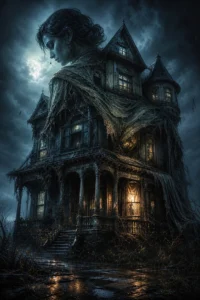
by inkadminThe house had gone quiet in the way old houses did when they were listening.
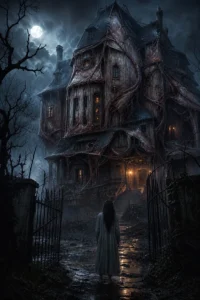
Blackwater Hall held storms inside its walls. They lived in the grain of the banisters and the cracks in the marble and the drafts that slipped beneath doors like cautious fingers. By dawn, the rain had weakened to a fine gray mist that furred the windows and turned the cliffs beyond them into ghosts. Elena stood in the center of Lucien’s bedchamber with her pulse beating hard enough to make her vision shimmer.
His fire had burned low. His coat lay over the chair where he had thrown it in the night. The room smelled of extinguished candlewax, clean linen, and the sharper scent of the truth he had given her too late.
Lucien Vale was not Vale.
The man she had begun, against all reason, to understand had looked at her with those cold, impossible eyes and handed her ruin in his own voice. He had belonged to the bloodline that had eaten her mother alive. The family name her mother had never spoken above a whisper. The house of polished monsters whose money bought newspapers, judges, graves, and silence.
He had told her as if confession absolved him.
She reached for her gloves with hands that trembled once and then steadied. Anger did that for her. It arranged the bones. It sharpened the edges.
Do not cry for him. Do not stay because he bleeds beautifully.
She had not slept. She had sat rigid in the velvet chair until the sky turned from black to slate. Lucien had left before dawn, called away by some urgent word from one of his men, or perhaps he had simply decided to give her time to swallow the knife. He had not locked the door.
That, more than anything, felt like arrogance.
Elena crossed to the wardrobe and pulled on the plainest dress she owned, dark wool instead of silk, a serviceable cloak instead of one fit for dinner. No jewels. No scent. She twisted her hair into a knot and pinned it tight. The wedding ring remained on her finger because it would not come off; his ring had settled there like a threat.
On the escritoire by the window sat a silver letter opener, slim as a stiletto. She slid it into her sleeve.
Then she left without looking back.
The servant passages behind the east corridor were colder than the rest of the house. Their stone sweated in the morning damp. Elena moved through them by memory now, counting turns, skimming her fingers over walls, passing closed doors behind which the household still slept or pretended to. Mrs. Whitmore had once told her these corridors were built so that noble guests need never see labor. Blackwater had a thousand ways to move people unseen.
At the end of the passage, a narrow staircase led down to the old kitchens and the yard beyond. Her boots made almost no sound on the worn steps. Somewhere overhead a door slammed and the sound rolled through the hidden spaces like distant thunder. Elena paused, heart punching, then went on.
The kitchen was empty except for banked coals and a single copper pot hanging over them. The back door yielded beneath her hand with a groan that made her teeth clench. Cold salt air rushed in, carrying the cry of gulls and the briny rot of the sea.
Freedom smelled like wet earth and iron gates.
She crossed the rear yard with her head down against the mist, skirts darkening where they brushed soaked rosemary hedges. The stables loomed to her left, the paddock beyond a smudge of fence and breath. No stable boy emerged. No one shouted her name. The estate lay hushed beneath the weather, too vast to notice one woman slipping through it.
At the side gate, she stopped only long enough to lift the latch.
The road down the cliffside unwound before her in slick switchbacks, descending toward the city and its clustered roofs. Beyond, the harbor spread like tarnished silver beneath a sky the color of old bruises. Bell towers and smokestacks rose through the mist. Somewhere in that maze were crowds, noise, choices. Somewhere beyond Blackwater Hall there had to be one place untouched by Lucien’s hand.
She started walking.
By the time she reached the lower road, the hem of her dress was soaked through and mud had climbed halfway to her knees. A market cart rattled past, the driver glancing at her once and then very quickly away. Two fishwives on foot stared outright. Elena knew what she looked like: too well dressed for the road, too pale, too obviously a woman traveling alone. In this city, isolation was not anonymity. It was an invitation.
Still, she kept going.
At the first inn on the edge of the dock quarter, she asked for a hired carriage.
The innkeeper, a red-cheeked man with thinning hair and a wedding band crusted in flour, looked her over and frowned. “None available this hour, miss.”
“I’ll pay double.”
“Wouldn’t matter if you offered me the moon. Drivers won’t take the cliff road in this weather till noon.” His eyes flicked to the ring on her hand, then to the lane behind her. He lowered his voice. “You should go home.”
“I don’t intend to.”
He held her gaze for one uneasy second too long, then wiped his hands on his apron. “Then don’t stand in the doorway. You’re blocking the heat.”
She almost laughed. It came out like a breath with broken edges. Elena stepped back into the street and drew her cloak tighter.
The city swallowed people by degrees. First the road narrowed between warehouses blackened by salt and smoke. Then came the cries of hawkers and gulls, the smack of ropes against masts, the stink of fish blood sluiced into gutters. Sailors moved in knots. Boys darted barefoot between drays. Women with baskets on their hips spoke in clipped bursts over the clamor. Wheels hissed through puddles. Church bells tolled the hour somewhere inland.
And over all of it, Elena felt it—the drag of a gaze between her shoulder blades.
She did not turn immediately. Panic was prey’s language. Instead she paused at a stall selling newspapers gone limp in the damp and pretended to scan the day’s scandal sheet. The vendor, missing two front teeth, announced some council dispute to no one in particular. Reflected in the rain-sheened shop window opposite, three men stood beneath the awning of a tobacconist across the street.
Too still. Too attentive.
Not dockworkers. Their coats were plain but well cut. One had a pale scar puckering his jaw. Another wore kid gloves despite the filth of the street. They were not speaking to each other, which made them a unit more surely than conversation would have.
Elena set the newspaper down and walked.
Not faster. Merely differently. She veered off the market lane into a narrower street where laundry sagged overhead like surrender flags and drainwater trickled black between cobbles. The smell changed there—less sea, more coal, old urine, yeast from the bakery at the far corner. She heard footsteps behind her after half a block.
One pair. Then two.
Her mouth dried.
At the next turn she cut sharply left, then right into a covered arcade lined with shuttered storefronts. Glass panes filmed with moisture reflected her in fragments. Her own face looked strange to her, too white beneath the hood, eyes dark with fury and fear she refused to name.
The footsteps followed.
Elena slid the letter opener from her sleeve into her palm.
At the far end of the arcade a carriage waited, black lacquer gleaming wetly, horses steaming. No crest on the door. The coachman sat with his hat pulled low, not moving. Something in the rigid angle of his shoulders made her stop cold.
The men behind her quickened.
“Mrs. Vale,” one of them called, voice smooth as damp velvet. “No need to make a scene.”
She turned then.
Scar-jaw smiled with only one side of his mouth. Up close she saw the bulge of a pistol beneath his coat. The gloved man spread his hands in a parody of civility.
“You are expected,” he said.
“By whom?” Elena asked.
“A gentleman with an interest in your welfare.”
“Then he should have sent flowers.”
The third man laughed. Scar-jaw did not. “Come quietly, and no one gets hurt.”
Elena backed one step. The carriage door opened behind her with a soft click.
A hand shot out of the dark interior and caught her wrist.
She drove the letter opener backward on instinct. It glanced off bone, tore cloth, and a man swore viciously inside the carriage. Elena twisted free, stumbled, and Scar-jaw lunged.
Everything shattered at once.
A gunshot slammed through the arcade, deafening in the enclosed space. Glass exploded overhead. Scar-jaw jerked sideways and collapsed hard enough to skid across the wet stone. The horses screamed. The coachman yanked the reins, but before the carriage could lurch forward, another figure came out of the mist like a blade being drawn.
Lucien hit the carriage door with his shoulder, wrenching it wider. The man inside brought up a pistol. Lucien caught his wrist, slammed it against the frame until bone cracked audibly, and drove him backward with such elegant violence Elena’s breath caught in her throat. He was coatless, black shirt clinging damply to the breadth of him, hair rain-dark, face carved in fury so cold it looked almost calm.
The gloved man seized Elena around the waist and dragged her back against him. A knife flashed against her throat.
“Drop it,” he barked at Lucien.
Lucien turned his head.
His gaze landed on the blade at Elena’s skin and changed.
Not widened. Not panicked. It simply went dead in a way that frightened her more than shouting would have.
“You won’t use that,” Lucien said softly.
“Try me.”
“If you cut her, Gideon will skin you himself for damaging the goods.”
The name struck the air between them like another shot.
Elena felt the man behind her hesitate.
Lucien moved.
Later she could not have said how. One heartbeat he stood six paces away. In the next he had crossed the distance, a dark rush of force and intention, his hand closing around the attacker’s knife wrist while his other arm hooked Elena and tore her out of reach. The blade nicked her throat anyway, a hot thin line. The gloved man shouted, twisted, and Lucien drove his head into a brick column with a crack that echoed down the arcade. The man dropped bonelessly.
For a second all Elena heard was the wild stamp of horses and her own breathing.
Lucien’s hand spread over the back of her neck. “Look at me.”
She did.
Rain jeweled on his lashes. His pupils were blown wide, his expression so tightly controlled it trembled at the edges. He looked less like a gentleman than some old brutal thing the house had raised from its cellars and dressed in human skin.
“Are you hurt?” he asked.
“No.” Then, because the cut at her throat stung and her wrist throbbed where the carriage man had grabbed her: “Not badly.”
His thumb came away from her neck with a smear of red on it.
Something terrible flickered across his face.
“Damn you,” he said very quietly.
Elena shoved at his chest. “Do not speak to me as if this is my fault.”
“You left the house alone.”
“Because my husband lied to me about his name, his blood, and whatever else he finds convenient to hide behind those lovely locked doors.”
Two of Lucien’s men appeared at the arcade entrance, armed and breathing hard. One took in the scene and swore. Another bent over Scar-jaw’s body, then shook his head.
Lucien never looked away from Elena. “We are leaving.”
“I am not going back there.”
“You are if you prefer living.”
“Perhaps I should decide that for myself.”
“You nearly did,” he said, and now there was heat under the ice, dangerous and raw. “If I had been two minutes later—”
“If you had told me the truth two weeks earlier, I might not have needed rescuing at all.”
The words landed. She saw them land. Lucien’s jaw flexed once. Then he stepped aside and gestured toward the waiting motorcar his men had brought to the street.
“Fight with me in the car,” he said. “Or here, if you’d rather the next set of kidnappers enjoy the entertainment.”
Elena hated that he had made reason sound like surrender.
She walked past him before he could offer help. Her legs trembled only once, when they cleared the arcade and the morning wind hit the cut on her throat. Lucien came beside her without touching her. His restraint felt more intimate than a hand would have.
Inside the motorcar, leather creaked beneath them. Lucien shut the door himself and gave an order through the speaking hatch. The engine coughed alive. The city began to slide past in gray streaks beyond the rain-stippled glass.
For a stretch of road, neither of them spoke.
Lucien took out a handkerchief and folded it once before offering it to her. Elena looked at it, then at him.
“This is the part where I ask if you arranged that little lesson in street safety to frighten me into obedience?” she said.
His eyes sharpened. “If I wanted to frighten you, Elena, I would not outsource it.”
She pressed the linen to her throat anyway. It smelled faintly of smoke and cedar. “Who is Gideon?”
Lucien leaned back, rain-shadowed light cutting hard lines across his face. “My brother.”
The word settled with poisonous grace.
“Your brother,” she repeated.
“Half-brother.”
“The distinction seems morally irrelevant.”
“I agree.”
She studied him. There was blood on his cuff, not all of it his. A bruise darkened over one set of knuckles where skin had split. His mouth was set in a way she had begun to recognize—not coldness, not exactly, but effort. Restraint drawn so tight it cut.
“Why would he want me?” she asked.
Lucien looked out the window as if the answer might be easier addressed to rain than to her. “Because your mother did not only suffer at Ashdown hands. She took something when she fell.”
“What?”
“Proof.”
Her pulse stumbled. “Of what?”
“Fraud. Bribery. Illegitimate transfers of city land after the fever fires. Enough to fracture half the council if it surfaced in the right hands.” He turned back to her. “Enough to hang Gideon, if this city still hanged men who could buy judges.”
Elena stared. “My mother had that?”
“She had part of it. The rest she hid.”
“And you know this how?”
“Because my mother found out too late. Because my father spent twenty years trying to recover it. Because when you married me, Gideon stopped guessing where your mother might have left it and started assuming I had finally found the answer.”
“You thought marrying me would protect me.”
“Yes.”
“By chaining me to the very family that destroyed her.”
Something flinched behind his eyes. “By placing you where I could keep you alive.”
“Alive is not the same as free.”
“No.” The admission came low and rough. “It isn’t.”
The car turned sharply, climbing. Blackwater’s cliffs would be ahead soon, the estate crouched above the sea like a dark thought that refused to die.
Elena tightened the blood-flecked handkerchief at her throat. “No more half-truths.”
“Agreed.”
“No locked doors if what’s behind them concerns me.”
A pause. “As much as possible.”
“That is not the answer I gave.”
“It is the only honest one.”
She should have hated him more than she did in that moment. Instead she hated that honesty could look so much like pain on his face.
“Then let me be honest as well,” Elena said. “I will not sit in your house and wait to be hunted. If Gideon wants something tied to my mother, we take the offensive.”
Lucien’s gaze narrowed. “You are in no condition—”
“Do not finish that sentence unless you wish me to open the door and throw myself into the sea out of spite.”
A muscle jumped in his cheek. And then, unexpectedly, his mouth almost curved.
“There she is,” he murmured.
“Do not sound relieved.”
“I’m furious,” he said. “Relief and fury are not mutually exclusive.”
“Good. Be furious on the way to Gideon.”
He watched her for a long moment. Outside, the cliffs rose around them and the first black iron of the estate gates appeared through the mist.
“Not Gideon,” Lucien said at last. “His countinghouse.”
“Why there?”
“Because men like my brother don’t keep their dirtiest work in family drawing rooms. They keep it near the money.” His voice cooled into strategy, smooth and dangerous. “If he sent men for you this morning, there will be records of payment, correspondence, names. Perhaps something that tells us what he thinks your mother hid.”
Elena looked at him steadily. “Then we go.”
“Tonight.”
“You mean you go.”
“I mean you don’t.”
“Lucien.”


0 Comments