Chapter 6: What the Servants Won’t Say
by inkadminBy morning, Blackwater Hall had put on its innocent face.
The rain had washed the windows clean enough to show the sea in strips of pewter between the cypress branches. Gulls wheeled above the cliffs, white as torn paper. Somewhere below the house, waves beat the rocks with the patient violence of something that knew stone would give way eventually.
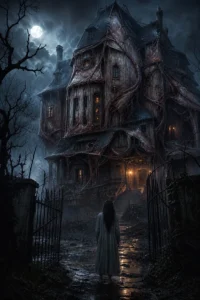
Elena stood at the window in her dressing robe, one hand resting against the cold glass. In daylight the Hall looked less like a threat and more like a relic of money gone old and mean. Its terraces stepped down the cliffside in black stone slick with rain. Narrow windows stared from every angle. Chimneys smoked. Garden walls cut the grounds into disciplined squares, and beyond them lay the town crouched under the estate’s shadow, roofs shining damply in the weak light.
It would have been easier if the house had looked haunted.
It was harder, somehow, that it looked merely inhabited.
Behind her, the maid assigned to her this morning moved quietly about the room, laying out stockings and a dark blue day dress with a high throat. She was a different girl than the one from yesterday. Younger. Brown-haired, broad-faced, with hands reddened by soap.
So. They were changing them.
That, too, was an answer.
Elena turned. “What is your name?”
The girl startled as if spoken to too sharply, though Elena’s voice had been mild. “Martha, ma’am.”
“Have you been long in service here, Martha?”
Martha kept her eyes on the dress she was smoothing. “Since Michaelmas, ma’am.”
Not long enough to know much, or chosen because she knew too little. Elena filed it away.
“And the maid from yesterday?”
Martha hesitated. It was small, but Elena saw it. “Annie is in the linen room this morning.”
“Has she displeased someone?”
“No, ma’am.”
Lie.
Elena smiled faintly, and Martha’s shoulders tightened. The house had been training them, then: answer quickly, reveal nothing, survive.
She knew something of houses under pressure. Ruin taught economies that gentler fortunes never learned. Which creditor could be mollified with charm, which with delay, which must be met with coin on the table because pride alone would only make him crueler. Blackwater Hall was no different. Only richer. Only more dangerous.
If they will not speak to me as mistress, they may yet speak as hungry people, frightened people, lonely people.
She let Martha button her into the dress and asked no more questions. The best lies ripened when left unpicked.
Breakfast was sent upstairs: coffee black as ink, toast, a soft-boiled egg, and sliced pear on silver too heavy for elegance. Adrian did not appear.
That suited her.
After she ate, Elena took inventory of what remained hers. Not much. A velvet jewelry roll tucked deep in the false bottom of her trunk held three pairs of earrings, a thin gold bracelet from her mother, a mourning brooch, and two rings she had not sold when the rest of her old life had gone piece by piece into pawnbrokers’ hands. One was nearly worthless, a garnet set in a bent band. The other was a slim opal ring her grandmother had once called unlucky because the stone held too many colors at once, as if it could not decide what truth to tell.
Elena slipped the garnet ring into her pocket.
She spent the next hour moving through the house with the kind of aimlessness that was only convincing if one committed to it fully. She paused to admire paintings she barely saw, touched carved banisters, looked out at courtyards, drifted where a bored bride might drift. But under the softness of her pace there was measurement. Which passages were busiest. Which doors remained locked. Which servants lowered their eyes from habit and which from fear.
The servants’ staircase near the south hall smelled of beeswax and steam and cabbage. Heat rose up it from below. Voices echoed from the kitchen level, bright in patches, then abruptly cut when someone noticed her.
By the time Elena reached the last turn, silence had dropped over the place like a sheet.
The kitchen itself was immense, all copper pans and black ranges and scarred wooden tables. A fire burned high under an iron spit. Two kitchen maids stood elbow-deep in pastry at a sideboard; a boy in livery was plucking herbs from a basket; a cook with forearms like hams supervised a pot of something fragrant and rich enough to make Elena realize how little breakfast she had eaten.
Every eye found her, then fled.
“Please,” Elena said, as if she had interrupted a hymn, “do continue. I only came in search of tea.”
The cook curtsied badly, as women do when they have spent too much time carrying heavy things to care for grace. “Of course, ma’am. We would have sent it up.”
“I preferred to stretch my legs.” Elena glanced toward the window over the sink. From here the sea was visible only as a smudge of silver light. “One can forget there is weather in a house this size.”
No one answered.
A younger maid, freckles bright across her nose, hurried to fetch a teapot. She could not have been more than sixteen.
Elena leaned against the table nearest her. “What is your name?”
The girl almost dropped a spoon. “Cora, ma’am.”
“Thank you, Cora.”
“Yes, ma’am.”
The tea arrived in a plain cup rather than porcelain. Elena accepted it with a smile and took a sip. Strong. Over-brewed. Honest.
“The house is difficult to learn,” she said lightly. “I went walking yesterday and found myself turned around.”
A stillness rippled through the room. The cook’s wooden spoon stopped mid-stir.
“Did you?” the woman said.
“Yes. I came to a corridor with locked doors.” Elena blew over the tea as though the matter bored her. “The ironwork was quite beautiful.”
Cora’s face had lost all its color.
The cook resumed stirring. “There are many old rooms shut up in houses like this, ma’am.”
“So I have heard.” Elena set her cup down. “And yet everyone behaves as if those rooms have teeth.”
The kitchen boy made a small strangled sound and immediately bent lower over his herbs.
The cook’s eyes lifted to Elena’s, dark and flat. “Best not to ask what a house keeps locked, ma’am. It offends it.”
There it was—not merely fear, but superstition soaked so deeply into daily life it flavored the air.
“Does the house also object to good manners?” Elena asked. “Because no one has yet told me which room was my husband’s first wife’s.”
Cora dropped the teapot lid. It clattered against the stone floor.
The sound seemed to ring forever.
Then the cook crossed herself so quickly it might have been a twitch. “Enough,” she said, not to Elena but to the room. “Back to work.”
Elena reached into her pocket and drew out the garnet ring. The dull red stone flashed once in the firelight. “Cora,” she said.
The girl looked at it before she looked at Elena.
“Walk with me to the herb room. I know very little about kitchens and would like to learn what grows on the cliff in winter.”
The cook began, “Ma’am—”
Elena turned her head, smiling still. “Surely that is harmless.”
It was not harmless at all, and everyone knew it. That was why the cook said nothing more.
The herb room was narrow and cool, lined with hanging bunches of rosemary, thyme, sage, bay, and lavender gone dusty with drying. Their scents layered thickly in the air. Light filtered through a high window and painted the stone wall in pale green.
Cora stood by the door, hands twisting into her apron.
Elena held out the ring on her palm. “For a story.”
“I don’t know stories, ma’am.”
“Then sell me a fact.”
Cora stared at the ring as if it might bite. “If Mrs. Wren learns I took—”
“Mrs. Wren needn’t learn anything. Unless, of course, you prefer I ask Mrs. Wren why her staff cannot answer simple questions from the lady of the house.”
The girl’s throat moved. Fear, then. Fear had a use.
Elena softened her voice. “I am not asking you to betray anyone. I only wish not to walk blind in a place where everyone else can see.”
That reached her. Cora’s shoulders sagged a fraction.
“They say not to speak of her,” she whispered.
“Who says?”
“Everyone.”
“That is not a person.”
“Mr. Pike. Mrs. Wren. Old Nan if she catches us talking. Father Bell if he hears.” Cora lowered her eyes. “And Mr. Blackwood never says her name, so no one else does.”
Elena closed her fingers around the ring, not giving it over yet. “What was her name?”
Cora shook her head at once. “I can’t.”
“Can’t, or don’t know?”
Silence.
“How long ago did she die?”
“Three years, maybe. I wasn’t here then.”
“How did she die?”
That made Cora look up sharply, and for one startled second the answer sat naked in her face before caution pulled it away.
“Fell ill,” she said too quickly.
“No.”
The girl swallowed. “That’s what they say.”
“And what do the servants say when the masters are not listening?”
Cora’s voice dropped until it was nearly swallowed by the hanging herbs. “That the sea took her.”
The words chilled the room despite the dried lavender and summer trapped in the rafters.
“Drowned?” Elena asked.
Cora nodded once.
“At the cliffs?”
“I don’t know.”
“In the harbor?”
“I don’t know.”
“In the house?”
This time Cora’s silence was answer enough.
Elena’s skin prickled. “In the house,” she repeated softly.
“Please, ma’am.” Cora’s eyes had gone glassy. “Please don’t ask me more.”
Elena placed the ring in the girl’s shaking hand. “Then one last question. Who keeps the keys to the locked wing?”
Cora stared down at the garnet as if stunned by its weight. “Mrs. Wren keeps most keys. Not those.”
“Who, then?”
“Mr. Blackwood.”
“Always?”
Cora whispered, “And Mr. Finch.”
“Who is Mr. Finch?”
“His valet.”
Of course.
A man allowed near the master’s clothes knew more than priests and often lied better.
Elena stepped back and took up her cup. “You have been very helpful.”
“Please don’t let them send me away,” Cora blurted.
The naked panic in the plea made Elena pause.
“Would they?” she asked.
“If they thought I talked.”
“Then we shall both pretend you instructed me only on rosemary.” Elena moved to the door, then looked back. “And Cora?”
The girl clutched the ring into her palm.
“If anyone asks, say I was dissatisfied with the tea. Servants are safer when ladies are petty.”
For the first time, Cora almost smiled.
Mrs. Wren was in the morning room when Elena found her, writing in a ledger at a side table with the posture of a woman who had never once in her life leaned for comfort. She was all angles and gray silk and severe cuffs, her iron-colored hair pulled back so tightly it looked painful.
She rose at once. “Mrs. Blackwood.”
Not warm. Not hostile. Merely polished to a hardness that suggested she had survived many household storms by becoming furniture no one thought to move.
“Mrs. Wren.” Elena let her gaze drift over the account books. “You run this place with admirable precision.”
“I do my duty, ma’am.”
“Then perhaps you can assist me. I am trying to understand the house.”
“Any room may be made ready for you. If there is a preference for furnishings—”
“Not fabrics. People.” Elena folded her hands. “Who may be trusted. Which servants handle correspondence. Who has been here longest. Whom my husband relies upon. Such things.”
Mrs. Wren’s expression did not change. “The household is loyal to Blackwater Hall, ma’am.”
“An answer broad enough to conceal anything.”
“It is the truth.”
“Truths are rarely singular.” Elena stepped nearer. She could smell starch and lavender water on the housekeeper’s sleeves. “I asked a maid this morning how long she has served. She answered as if expecting a sentence. Why?”
Mrs. Wren regarded her with steady, pale eyes. “Because maids are often afraid of mistresses.”
“Am I frightening?”
“Not yet.”
The bluntness almost amused Elena. “And if I choose to become so?”
Mrs. Wren smoothed one gloved thumb over the ledger’s edge. “Then I would expect the staff to adapt.”
There was steel there. Elena recognized it with reluctant respect. Bribery would not move this woman. Fear perhaps, but not the easy sort.
“Who is Old Nan?” Elena asked.
The smallest pause. “A nursery maid. Retired, in effect. She remains in the east attic rooms.”
“Why is a retired nursery maid kept in the house?”
“Because Mr. Blackwood permits it.”
“Does he permit many things?”
“Only what he wishes.”
Elena tilted her head. “And what do you wish, Mrs. Wren?”
The older woman’s mouth thinned. “For the house to remain orderly.”
“Even if order requires silence?”
“Especially then.”
So that was the creed here. Not truth. Not peace. Order.
Elena smiled as if satisfied. “I should like to see the key cabinet.”
This time Mrs. Wren did react. Barely. Her fingers tightened on the ledger.
“The household keys are not generally—”
“I am the mistress of Blackwater Hall.” Elena kept her tone gentle enough to cut. “I did not ask to generally see them. I asked to see them now.”
A pulse beat once at Mrs. Wren’s temple.
“As you wish, ma’am.”
The cabinet was built into the wall behind the butler’s pantry, oak-fronted and locked with a brass plate engraved with the Blackwood crest. Mrs. Wren opened it with a key from her belt. Inside hung dozens upon dozens of keys on labeled hooks, iron and brass and blackened steel, some small as finger bones, others long enough to turn prison doors.
Elena let her eyes pass over them slowly.
Linen stores. Cellars. West conservatory. Wine vault. Chapel crypt.
Her gaze paused.
“You have a crypt?”
“Family interments, ma’am.”



0 Comments