Chapter 25: The Brother in Exile
by inkadminThe conservatory had burned like a confession.
By morning, nothing remained of its glass ribs but warped iron and teeth of soot jutting from the blackened earth. Rain had come near dawn, too late to save anything, and now steam lifted from the ruin in slow, ghostly breaths, carrying the stink of charred wood, wet ash, and dead flowers. The roses that had once climbed the inner trellises lay in shriveled heaps, their thorns glittering like hooked needles beneath the gray light.
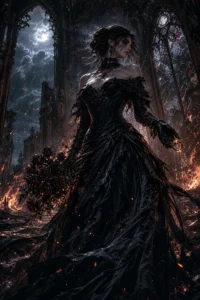
Elena stood at the edge of the ruin with a shawl drawn tight around her shoulders, though the cold had settled deeper than wool could reach.
Her hands still smelled of smoke.
No amount of scrubbing had removed it. Beneath her nails, in the creases of her palms, clinging to the cuffs of her mourning-black dress—smoke, ash, and the faint sourness of fear. Last night, she had crawled through broken glass and heat to salvage the metal box from beneath the tiled bench. Inside had been Helena Blackwood’s hidden correspondence, brittle papers tied with a blue ribbon, half of them eaten by fire before Elena could shield them beneath her body.
Helena’s words had survived in fragments.
It was not my husband.
If I vanish, look not to Adrian, but to the one who smiles beside him.
The chapel ledger proves blood was taken before the wedding.
And then, the final line—scorched through the middle, the ink blistered and brown.
The girl will remember when she hears—
The rest was gone.
Elena had read those words until dawn paled the windows of her chamber and the letters blurred with exhaustion. The girl. Not a girl. The girl.
Her.
She knew it with an instinct that tightened under her ribs like a fist.
Behind her, the sea battered the cliffs in a slow, brutal rhythm. Blackwater Hall loomed above the ruin, its stone face slick with rain, its windows dark and watching. The house did not look damaged by the fire. If anything, it looked relieved, as if some infected limb had been cauterized in the night.
“You should not be out here.”
Adrian’s voice moved through the mist before he did.
Elena did not turn.
“I have heard that before.”
His boots crushed the wet gravel behind her. He came to stand at her side, close enough that the heat of him touched her sleeve, though he did not reach for her. He wore no hat despite the rain. Damp had darkened his black hair and caught on the edges of his lashes. In the morning light, the bruise along his jaw from the night before looked almost elegant, a blue shadow beneath the sharp line of bone.
“The structure is unstable,” he said.
“It has already fallen.”
“Not all things collapse at once.”
At that, she looked at him.
His gaze was on the ruin, but she knew him well enough now to see when he was avoiding her. The stillness of his face was too complete. His hands were gloved, black leather buttoned at the wrist, one thumb rubbing once across the seam before going still.
He knew what she had found.
Perhaps he had known before she did.
“Helena was afraid of someone,” Elena said.
His jaw tightened.
“Yes.”
The simplicity of it sliced through her. No denial. No question.
“She said it was not you.”
Adrian turned then. The wind moved between them, dragging salt and ash through the space where softer words might have lived.
“Did that comfort you?”
Elena hated that her throat constricted. “Should it?”
His eyes, dark as the wet stones below the cliff, held hers with that terrible restraint she had come to fear more than anger. Adrian Blackwood did not plead. He did not explain unless cornered. He stood before disaster as if it were a servant he had paid to wait.
“No,” he said. “Not enough.”
She gave a small, bitter laugh. “At least you are honest when it is least useful.”
“I am honest when it will not get you killed.”
“And who decides that?”
“I do.”
The words should have enraged her. They did. But beneath the anger, some treacherous pulse answered the shape of him in the rain—his control fraying at the edges, his eyes not cold now but hunted. He had pulled her from the fire last night with blood on his hands from broken glass, his arms locked around her so fiercely she could still feel the bruises where his fingers had pressed into her waist.
Possession and protection wore the same face on him.
Elena stepped back.
“Helena wrote about a chapel ledger,” she said. “Blood taken before the wedding.”
Adrian’s expression changed so subtly that a stranger might have missed it. Elena did not. The faint loss of color around his mouth. The quieting of his breath.
“Come inside,” he said.
“No.”
“Elena.”
Her name was not command this time. It was warning.
“Tell me what the chapel ledger is.”
Rain slid from his hair down the side of his face like a tear he would rather drown than shed. “Not here.”
“Then where? In your study, with the doors locked? In our bed, where you mistake silence for tenderness?”
His eyes flashed.
She should not have said it. Or perhaps she should have said it sooner.
The ruin smoked between them. A gull cried somewhere below the cliff, thin and cruel.
Before Adrian could answer, the sound of wheels rose from the drive.
Not the heavy groan of a supply cart or the brisk rattle of the magistrate’s carriage. This was lighter, faster, reckless over the wet stones. A horse snorted. Iron rims struck a rut with a crack sharp as a pistol shot.
Adrian went very still.
Elena turned toward the front approach. Through the veil of rain and sea mist, a carriage came into view beyond the yew-lined curve of the drive—a glossy black phaeton drawn by two gray horses lathered at the neck. No Blackwood crest gleamed on the door. Instead, a silver fox had been painted there, its red mouth open in a laughing snarl.
The driver hauled the horses to a stop before the main steps with theatrical violence. One reared, hooves cutting the air. A groom ran forward from the stables, white-faced, but the carriage door had already opened.
A man stepped down.
For an instant, Elena thought she was looking at Adrian as he might have been in another life—one where nothing had been denied him, nothing buried, nothing locked behind iron discipline.
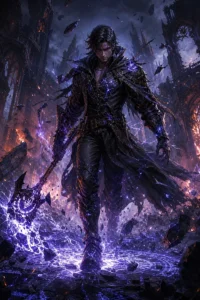
The stranger had the Blackwood height and the Blackwood bones, but everything that Adrian held rigid, he wore with careless grace. His dark hair was longer, curling damply at his collar. His mouth was too beautiful and too amused. His coat, traveling-stained at the hem, was cut from expensive green wool the color of deep moss, and he wore no gloves, as if the cold were beneath his notice. A thin scar touched the corner of his left eyebrow, lending his smile the permanent suggestion of a knife.
He lifted his gaze to the house, then to the burned conservatory, then, finally, to Adrian.
His smile widened.
“Still burning things you cannot control, brother?”
Elena felt the air alter.
Not with shock. With recognition. The household had gone silent in a way no household should. Servants appeared in doorways and vanished again. A footman carrying a coal scuttle froze near the side entrance, then lowered his eyes as if he had seen a ghost—or worse, someone who had the right to return from death and demand his place at table.
Adrian did not move.
“Lucian.”
The name fell like a blade into water.
Lucian Blackwood swept a look over him and sighed. “No embrace? No tears? No fatted calf dragged into the courtyard and slaughtered in my honor? Exile has ruined your manners.”
“Exile was meant to ruin yours.”
“And yet.” Lucian spread his arms, rain jeweled along his cuffs. “I remain delightful.”
His eyes shifted to Elena.
She had been assessed before. Men in drawing rooms had weighed her beauty against her family’s decline, creditors had measured her as collateral, and Adrian had once looked at her as if she were both danger and inevitability. Lucian’s gaze was different. It moved over her face, paused at her mouth, dipped to the ash staining her sleeve, then returned to her eyes with a flicker of interest too sharp to be mere flirtation.
He bowed.
“And this must be the new Mrs. Blackwood.”
Adrian stepped half a pace forward.
Lucian noticed. His smile turned brighter.
“Careful. If you loom any harder, the cliffs will feel inadequate.”
Elena refused to retreat behind Adrian’s shoulder. “And you must be the brother no one mentions unless they have first crossed themselves.”
A laugh broke from Lucian, warm and startled. It made him seem younger, though Elena suspected youth had never protected anyone from him.
“Oh, I like her.” He looked at Adrian. “Does she know?”
The question was tossed lightly, but it struck with force. Adrian’s hand flexed once at his side.
“You are not welcome here.”
Lucian clicked his tongue. “No, I am necessary here. There is a difference. Father understood it, even when he pretended otherwise.”
“Father is dead.”
“So I heard. Belatedly. The letter must have taken the scenic route through hell.” Lucian glanced toward the house again. “Or perhaps our dear aunt burned it with the others.”
Elena’s skin prickled.
“What others?” she asked.
Adrian said, “Inside. Now.”
Lucian’s brows rose. “Still giving orders to women who ask the proper questions. How nostalgic.”
Adrian crossed the distance between them so quickly the nearest groom flinched. He stopped inches from Lucian. The resemblance between them sharpened, terrible and intimate: the same dark eyes, the same proud mouth, the same inherited violence worn in different languages.
“Leave before I forget the promise I made our father.”
Lucian’s amusement did not falter, but something cold passed beneath it.
“You mean the promise not to kill me?” He leaned closer. “Did you keep it because you loved him, or because you were afraid he would rise from the crypt and tell the truth?”
The rain sounded suddenly louder.
Elena saw the moment Adrian nearly struck him. It moved through his body like lightning trapped under skin. But he did not lift his hand. That restraint frightened her more than the blow would have.
The front doors opened.
Mrs. Harrow stood at the threshold in her black gown, her keys hanging from her waist, her face carved from old wax. Behind her, two maids huddled pale and silent.
“Mr. Lucian,” the housekeeper said.
Lucian turned and placed a hand over his heart. “Mrs. Harrow. You have not aged a day. Still terrifying children and curdling cream?”
“Some milk curdles from sourness already present.”
He laughed again. “God, I missed this house.”
“The east rooms are closed,” she said.
“Then open the west.”
“No rooms have been prepared.”
“I have slept in worse places than an unprepared Blackwood bed. Ask Adrian. He sent me to most of them.”
Elena looked at Adrian.
His face had become unreadable.
“You will not stay,” he said.
Lucian began up the steps, unhurried, forcing Adrian either to stop him physically or yield the ground. “My dear brother, if you wanted the prodigal son to remain gone, you should have ensured there was nothing left to bring him back.”
At the top step, he paused beside Mrs. Harrow and lowered his voice just enough that Elena had to strain to hear.
“Where is Aunt Beatrice?”
Mrs. Harrow’s fingers tightened around her keys. “In the chapel.”
“Of course she is.” Lucian’s smile thinned. “Praying over bones she helped bury.”
Then he vanished into Blackwater Hall as if the house had opened its mouth and swallowed him whole.
For a moment, no one moved.
The horses stamped. The sea thundered. Somewhere high in the house, a shutter banged once, then again, like a fist demanding entry.
Elena turned to Adrian. “Your half brother.”
“Yes.”
“Exiled.”
“Yes.”
“For what?”
His eyes cut to the open doors through which Lucian had disappeared. “For surviving.”
It was not an answer. It was worse.
Elena’s frustration rose hot through the cold. “Do not do this. Do not give me pieces and expect me to thank you for not cutting my hands on the rest.”
Adrian looked back at her, and for the first time since Lucian stepped from the carriage, something like desperation cracked the surface.
“Stay away from him.”
She laughed once, incredulous. “You cannot possibly believe that will satisfy me.”
“I believe he will use anything you give him.”
“Unlike you?”
The words struck. She saw it. For a heartbeat, he looked younger, almost wounded, and that made her angrier because she did not want to feel pity for him. Not when Helena’s ashes were still damp behind her. Not when he stood between her and the truth like another locked door.
“Elena,” he said quietly, “Lucian does not lie the way other men lie. He tells truths in the order most likely to destroy you.”
“Then perhaps he will be the first Blackwood to tell me any truths at all.”
Adrian’s mouth hardened. “You think truth is a lantern. It is not. Not here. Here it is a match in a house soaked with oil.”
“Then perhaps someone should have stopped pouring oil.”
She turned and walked toward the steps.
He caught her wrist.
Not roughly. Never roughly, not since the night she had told him she would not be handled like a debt passed across a desk. His fingers closed around her with careful force, warm even through the wet fabric of her sleeve.
She looked down at his hand.
“Let go.”
He did.
Immediately.
The loss of contact felt obscene.
“He came for something,” Adrian said behind her.
Elena paused but did not turn.
“So did I.”
Inside, Blackwater Hall smelled of rain, beeswax, and smoke carried in on their clothes. The entrance hall was dim despite the hour, the carved banisters climbing into shadow, portraits glaring from gilt frames. Lucian stood beneath the portrait of old Elias Blackwood, Adrian’s grandfather, holding a glass of brandy he had apparently acquired within moments of entering a house where no one had welcomed him.
He looked up at the portrait and raised the glass.
“To family,” he said. “The most elegant form of predation.”
Mrs. Harrow hovered near the corridor, stiff with disapproval. “Mr. Adrian has not given leave for refreshments.”
“Mrs. Harrow, if I waited for Adrian’s leave, I would still be a boy locked in the north tower with no supper.”
Elena heard a maid gasp softly from the stairs.
Lucian turned his head. “Oh, did no one tell the new bride about that either?”
“Enough,” Adrian said from the doorway.
The word did not echo, but it seemed to occupy the hall completely.
Lucian sipped his brandy. “There he is. Lord of the house, jailer of memory, husband by arrangement and—what was the phrase in the papers?—savior of the Vale family’s reputation.”
Elena’s spine went rigid.
“You read the society notices in exile?” she asked.
“I read everything in exile. One develops hobbies when banned from all decent company.” His eyes flicked toward Adrian. “And indecent company begins to repeat itself.”
“Why have you returned?” Adrian asked.
Lucian’s smile faded by a fraction. “Because Helena is still dead.”
The hall chilled.
Even the servants seemed to stop breathing.
Adrian took one step forward. “Do not say her name for sport.”
“I rarely sport with corpses. That was always more Aunt Beatrice’s area of devotion.”
A distant door opened and closed somewhere in the east wing.
Elena felt the name Helena move through the house like a hand brushing old curtains. The first wife. The drowned wife. The mad wife. The wife who had written, It was not my husband.
Lucian set down his glass on a marble-topped table with a delicate click. “I came because someone set fire to the conservatory last night.”
Adrian’s eyes narrowed. “No messenger left this house.”
“Not all messengers use roads.”
“Who told you?”
Lucian smiled again, but there was no warmth in it now. “The dead are noisy if one knows where to listen.”
Elena stepped forward. “You knew Helena.”
His gaze moved to her. The mockery softened into something she did not trust.
“Yes.”
“Well?”
“Better than most. Not as well as I should have.”
Adrian’s face became stone.
The air between the brothers sharpened to a point.
Elena noticed it then—not jealousy, not precisely. Something older. Guilt perhaps. Or betrayal. It lived in the narrow space between them, fed by words neither had spoken.
“She was trying to expose someone,” Elena said.
Lucian did not look surprised.
“Helena was always trying to expose someone. She had the inconvenient habit of believing rot ought to be cut out, even when it supported the walls.”
“Who was it?”
Adrian said, “Elena.”
Lucian’s eyes brightened. “Ah. She has found something.”
“Enough.”
“No, no, don’t deprive me of this. I have been imagining the moment your bride stopped mistaking your cage for shelter.”
Elena’s pulse kicked. “What does that mean?”
Adrian moved closer to her. “It means he wants your attention.”
Lucian shrugged. “Everyone wants her attention. That is rather the point, is it not?”
Silence followed.
Not empty silence. Loaded silence. The kind that had weight, shape, teeth.
Elena looked from Lucian to Adrian. “What point?”
Lucian’s gaze did not leave hers. “You truly do not know.”
It was not a question.
Her fingers curled into her skirts. “Know what?”
Adrian’s voice dropped. “Lucian, if you value your life—”
“Oh, I value it immensely. It is the only thing in this family that remains indisputably mine.” He came down the final step from the portrait dais, moving toward Elena with languid confidence. Adrian shifted, blocking his path.
Lucian stopped inches from him and sighed. “Still keeping women behind your back. Does it ever work?”
“With men like you, yes.”
“Men like me tell them where the doors are.”
“Men like you lead them to cliffs and call it freedom.”
Their voices were quiet now. That made it worse.
Elena stepped around Adrian before either could stop her. “I am here. Speak to me, not over me.”
Lucian looked pleased. Adrian looked murderous.
“Very well,” Lucian said. “A question, Mrs. Blackwood. Before your marriage, did you ever come to this house?”
“No.”
“To the town?”
“Once or twice as a child, perhaps. My father traded here.”
“Perhaps.” He tilted his head. “Do you remember the chapel bells?”
She frowned. “Everyone in town remembers chapel bells.”
“Not these. Not the old burial bell beneath the cliff chapel. It has a crack down the side. When struck, it does not ring. It sings.”
Something brushed the back of Elena’s mind.
A sound. Low and trembling. Metal warped by sorrow. A child’s hands clamped over her ears. Salt on her lips. Someone whispering, Do not let her hear the third note.
She blinked, and the hall returned—the portraits, the rain-dark windows, Adrian’s hand half-lifted as if he meant to catch her if she fell.
Lucian watched her too closely.
“There,” he murmured.
Adrian turned on him. “Stop.”
Elena’s voice came thin. “What was that?”
“Memory,” Lucian said.
Adrian’s expression was terrible. “A trick.”
Lucian’s laugh was soft. “You wish.”
Elena pressed a hand to her temple. The sensation had gone, leaving only a faint ache and the taste of salt. “I do not remember a bell.”
“No,” Lucian said. “You were made not to.”
The words passed through her like cold water.
Adrian closed his eyes briefly.
That was all the confirmation she needed.
“Made not to,” she repeated.
Lucian took up his glass again though he did not drink. “Blackwater Hall is excellent at removing inconvenient things. Evidence. Wives. Brothers. Childhoods.”
Elena turned to Adrian. “What did he mean?”
“Not here,” Adrian said.
She almost laughed. The phrase was becoming a chain.
“No. Here. Now.”
“You are exhausted.”
“I am awake.”
“You were in a fire last night.”
“And someone lit it to keep me from reading what Helena left behind.” She stepped closer. “Was it you?”
His face flinched—not much, but enough.
“No.”
“Was it your aunt?”
He did not answer quickly enough.
Lucian made a small sound of appreciation. “Careful, brother. Silence is a confession when worn so often.”
Adrian did not look away from Elena. “Beatrice would burn the world if she believed God had asked politely.”
“And did He?” Elena asked.
“No. But someone else may have.”
Lucian’s amusement vanished.
For the first time since arriving, he looked at Adrian without mockery. “You think she has help.”
“I know she does.”
“From within the house?”
0 Comments