Chapter 29: A Cage Made of Protection
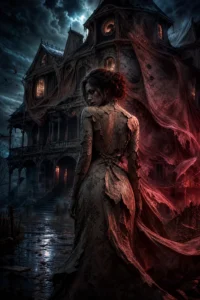
by inkadminThe door to the west wing had not been locked since Elena first entered Blackwater Hall as a bride in mourning lace.
It was locked now.
Not merely shut, not politely latched, but bolted from the outside with old iron that scraped like a blade across bone when she tried it. She yanked once, then again, palm stinging around the brass handle. The corridor beyond remained silent except for rain worrying the tall windows and the far, hollow mutter of the sea striking the cliffs below.
For one breath, Elena stood perfectly still.
Then she laughed.
It was not a pretty sound. It came from somewhere low and raw in her chest, cracked by smoke and disbelief. Her reflection in the dark window beside the door laughed with her: pale face, loosened hair, a bruise blooming at the edge of her jaw where the attacker’s ring had caught her, one sleeve torn from wrist to elbow. She looked like a woman dragged out of a grave before the earth had finished settling.
Adrian Blackwood had carried her through the rain less than an hour ago.
Not guided. Not supported.
Carried.
Through the servants’ entrance, past Mrs. Thorne’s bloodless face, past Bennett’s quick hand going to the pistol beneath his coat, past the old portraits whose painted eyes seemed to follow the muddy hem of her dress. Adrian had held her against him with an arm like iron beneath her knees and another across her back, his coat wrapped around her shoulders. His shirt had been dark with rain and something that might have been blood. Not hers. Not all of it.
She remembered the stink of wet wool and seaweed. The rasp of his breath near her temple. The way his hand had tightened when she tried to speak.
Do not move.
As if she were a relic. As if she were glass.
As if she belonged to him.
Now she was sealed inside the west wing, which had been cleared with ruthless efficiency. Two maids had delivered hot water, linen, a fresh nightdress, and a tray of broth she had not touched. One footman had replaced the cracked pane in the sitting room window without meeting her eyes. Another had carried away the bloodied basin after Adrian washed the cut at her temple, though the man’s hands trembled so badly that red water sloshed over the porcelain rim.
Then Adrian had left.
And locked her in.
Elena struck the door with the heel of her hand.
“Open it.”
No answer.
She leaned closer, breath fogging the dark grain of the wood. “I know someone is there.”
Silence.
But not emptiness.
Blackwater Hall had a way of holding silence too carefully, as though every corridor were a throat refusing to swallow. Elena heard the small betrayal of a boot shifting beyond the door.
Her fury sharpened into something clean.
“If you have orders not to speak to me, scrape your foot once.”
A pause.
Then, faintly, the drag of leather over stone.
She closed her eyes.
“Bennett?”
Nothing.
“Not Bennett, then. Thomas?”
Another pause. No scrape.
“One of my husband’s nameless shadows.” She opened her eyes again and stared at the lock. “How comforting.”
The guard did not respond.
Elena turned away before she gave him the satisfaction of hearing her breathe harder.
The west wing had once housed favored guests, back when Blackwater Hall entertained governors, bishops, and men who owned ships full of cargo they preferred not to describe aloud. The suite Adrian had chosen for her confinement was large enough to insult her. A bedchamber with a carved four-poster bed whose curtains smelled faintly of cedar. A dressing room. A bathing room with claw-footed tub and tarnished mirrors. A sitting room facing the sea. A narrow library full of moldy romances, prayer books, and shipping maps old enough to show coves by names no one used anymore.
It was not a prison cell.
That was the cruelty of it.
A fire burned in the sitting room hearth. Candles had been lit in silver sconces. The broth steamed beside a glass of wine. Someone had laid one of her shawls over the arm of the sofa. Her own shawl, pale blue cashmere, brought from her father’s house in one of the trunks she had packed under the eyes of creditors.
Everything soft. Everything warm.
A cage lined in velvet.
She walked to the sitting room window and shoved aside the heavy curtain. The glass looked west over the rain-slashed gardens and the black drop beyond. The storm had risen with evening, as if the coast itself had objected to her survival. Wind threw rain in glittering sheets against the pane. Far below, the sea was not water but a living bruise, dark and swollen, tearing itself white against the rocks.
Somewhere beyond the cliff path, in the ruined chapel where she had gone to check the mark in the ledger against the symbol carved into her mother’s rosary box, someone had been waiting.
Not a cutthroat from the docks.
Not a desperate man sent to frighten a woman into silence.
He had known her name.
He had stepped from behind the broken altar with a narrow blade and a voice like old ash.
Your mother should have stayed dead.
Elena’s fingers tightened in the curtain.
She had gone there because the ledger demanded it. Because ink had led to symbol, symbol to memory, memory to the ruins where the Blackwoods buried more than their wives. She had told no one. Not Mrs. Thorne. Not Lucy. Not even Adrian, whose eyes could strip secrets to bone.
And still the man had known.
Her stomach turned, though she refused to call it fear.
Fear was what men like Adrian expected from women behind locked doors. Fear made sense to them. Fear could be fed broth and watched by guards. Fury, however, was less convenient. Fury slipped through cracks.
Elena let the curtain fall.
On the small writing desk by the fire lay the object Adrian had not yet realized she possessed: a torn scrap from the attacker’s coat, ripped free when she struck him with a fallen candlestick. Dark wool, coarse and salt-stiff, folded beneath her handkerchief. Sewn into the inner seam was a thread of crimson silk.
Not decorative. Not accidental.
The same shade as the marks in the ledger.
She crossed to the desk, lifted the handkerchief, and touched the thread with one fingertip.
The door to the outer chamber opened.
Elena snatched the handkerchief back over the scrap and turned as Adrian entered.
He did not look like a man returning to apologize.
He wore no coat. His shirtsleeves were rolled to the forearm, exposing pale skin smeared with rainwater and blood. A fresh cut bisected one cheekbone. His dark hair was wet, pushed back from his face, and the candlelight made a severe thing of his beauty—hard lines, hollow shadows, mouth held too still.
Behind him, the guard closed the door.
The scrape of the bolt falling into place came almost gently.
Elena did not move.
Adrian’s gaze went to her hands, the desk, the untouched tray, the bruise on her jaw. It lingered there. Something violent passed behind his eyes and vanished before it could become expression.
“You should be in bed.”
“How fortunate that you have provided one.”
His jaw tightened. “Elena.”
She smiled. It hurt the bruise. “Do you prefer Mrs. Blackwood when issuing commands?”
He took one step into the room, then stopped as if the space between them had teeth. “I prefer you alive.”
“And I prefer doors that open.”
“Those preferences are currently incompatible.”
Her laugh was quieter this time, colder. “You locked me in.”
“Yes.”
No denial. No softening. Just the word laid down like stone.
It struck her more deeply than an excuse would have.
“You do not even pretend to be ashamed.”
“Shame is an indulgence for people who can afford to lose.”
“And can you not?”
Adrian’s eyes lifted to hers. The storm flared white beyond the windows, carving him briefly in lightning. “Not you.”
The words crossed the room and found the foolish place beneath her ribs that had not yet learned to defend itself from him. Elena hated that place. Hated its warmth, its ache, its traitorous leaning toward the sound of his voice when he spoke as if she were not property but catastrophe.
She turned away first.
“Do not make this sound like devotion.”
“It is not devotion.” His voice roughened. “Devotion kneels. This is war.”
“War against whom?” She faced him again. “The man who attacked me? The family symbol in your ledger? The dead woman whose mark was carved into my mother’s belongings? Or is this war against me because I am inconveniently curious?”
Adrian’s stare sharpened.
There. A strike landed.
“What did you find?” he asked.
Elena folded her arms to hide the pulse jumping in her wrist. “You first.”
“This is not a parlor game.”
“No. In parlor games the players know the rules.”
He came closer, slow enough not to startle her, which only infuriated her more. He stopped at the edge of the carpet, a tall black shape against firelight. “The men who want you dead are not smugglers frightened of exposure. They are not debtors, not dockside knives hired by my uncle, not priests drunk on superstition. They have waited years to move openly.”
“Who are they?”
A muscle worked in his cheek.
Elena gave a short nod. “Still too dangerous for my delicate ears. Of course.”
“You heard what he said in the chapel.”
Her fingers chilled. “I heard.”
“Then you know this is tied to your mother.”
“I have known that since before you admitted she was ever in this house.”
His expression changed. Barely. But Elena knew him now. Knew the fractional stillness that meant pain had touched some hidden nerve.
“Your mother came to Blackwater Hall the winter before you were born,” Adrian said.
The room seemed to shrink around the sentence.
Rain rattled the glass. The fire hissed as sap split in a log.
Elena’s anger faltered, not gone but displaced by a colder hunger. “Why?”
“I do not know all of it.”
“Then tell me what you do know.”
“Not tonight.”
She stared at him. “You cannot hand me a bone and command me not to dig.”
“I can command whatever I must if digging puts you in a grave.”
“There it is.” She stepped toward him now, her bare feet sinking into the carpet. “The great Blackwood creed. If you love a thing, chain it. If you fear losing it, hide it. If it asks questions, lock the door.”
His face went white in the places not shadowed by fire. “Do not call this love.”
The room went painfully still.
Elena had not meant to say the word. Perhaps neither had he. Yet there it stood between them, breathing.
She felt suddenly the ghost of his hands from an hour ago: one pressed to her bleeding temple, one closing around hers as he stitched the cut himself because he did not trust the doctor to arrive unseen. She remembered the tremor he had tried to hide when she flinched. The way he had whispered her name once, so softly she might have imagined it, while rain hammered the windows and Mrs. Thorne hovered with a rosary clenched between her teeth.
Then she remembered the bolt on the door.
“No,” she said. “You are right. Love asks. It does not imprison.”
“Love also buries fools,” he snapped.
Her chin lifted.
Regret crossed his face instantly, a dark flicker. Too late.
“Get out,” she said.
He exhaled through his nose. “Elena—”
“You have made yourself very clear. I am alive because you allow it, fed because you permit it, safe because men with pistols stand outside my door. How grateful I must be.”
“That is not what this is.”
“Then unlock the door.”
He said nothing.
She spread her hands. “No? Then it is exactly what this is.”
The fire cracked behind her. Adrian looked at the untouched tray again, at the broth gone lukewarm. “Eat.”
“Go to hell.”
For the first time that night, something like tiredness broke through him. It made him look younger and older at once, a boy raised by wolves and ghosts until he became the most dangerous thing in the house.
“I have been there,” he said. “It has your name written on the gate.”
He turned before she could answer.
At the door, his hand paused on the latch.
“There will be guards at the corridor and beneath the windows. The garden gate is chained. The cliff path has been watched since dusk. If you attempt to leave, you will be stopped.”
“How reassuring.”
He looked back once. “If anyone approaches claiming to be sent by me, demand the vow.”
Elena stilled despite herself. “What vow?”
His eyes held hers.
“Beneath black water, no breath borrowed.”
The phrase entered the room like a draft from a crypt.
“What does that mean?”
“It means if they cannot answer, you run.”
“To where, Adrian? The locked door?”
His hand flexed once around the latch. He had no answer for that. Or too many.
“Eat,” he said again, and left.
The bolt slid home behind him.
Elena stood in the center of the sitting room until the sound faded down the corridor.
Then she picked up the bowl of broth and hurled it into the fireplace.
Porcelain shattered. Pale liquid hissed across coals. Steam rose in a furious ghost.
In the silence after, her breath came hard.
A prison, then.
Good.
Prisons could be studied.
Elena had spent her girlhood in rooms where creditors sat on the good chairs and spoke over her mother’s piano as if beauty were something to be inventoried. She had learned early that locked drawers could be opened with hairpins, that men underestimated women who lowered their eyes, that servants knew more of a household’s true machinery than any master. Blackwater Hall was larger, older, crueler—but it was still a house.
And houses had bones.
She began with the windows.
The sitting room casements were tall, leaded, and newly checked. Adrian’s men had done their work well. The latch screws were fresh. The drop below did not lead to a balcony but to a narrow strip of sloped roof slick with rain, then a two-story fall into thorn hedges and stone urns. Beneath that, if one survived broken ankles and roses, the west garden wall. Beyond it, the cliff path.
She moved to the bedchamber. Same height. Same drop. A guard below, half-visible beneath the hood of an oilskin cloak, stood beside the yew arch with a rifle angled down.
Elena let the curtain fall before he glanced up.
The dressing room had no outer window, only a narrow ventilation slit too small for a child. The bathing room overlooked an interior lightwell that plunged into darkness. Rain fell through it in silver lines. Somewhere far below water dripped steadily into a cistern or drain.
She held a candle near the sill and examined the stone.
Old mortar. Scraped in places. Black mold in one corner. No bars.
But the opening was barely wider than her shoulders, and the drop offered no visible foothold.
For now.
She went to the library last.
The smell met her like a damp hand: leather, dust, salt, candle smoke, rot hidden under polish. Shelves climbed to the ceiling. A rolling ladder sat on brass rails. The books had been neglected for decades, spines cracked, gilt dulled. She pulled at volumes at random, searching less for wisdom than irregularity.
A house this old had servant passages.
Adrian had moved her to the west wing because he believed it secure. Which meant either he had sealed every passage, or he thought she did not know to look.
She preferred the latter.
Her fingers passed over sermons, tide tables, a French atlas, three identical copies of a devotional text with pages swollen from damp. She tugged each. Nothing shifted. She crouched to inspect the baseboards and found old scuff marks near the north shelf. Not recent, but repeated. A ladder? A chair? A door?
A soft knock came from the outer door.
Elena froze.
The knock came again. Not Adrian’s hard rhythm. Not a guard’s impatient rap.
Three taps. Pause. Two taps.
Lucy’s signal.
Elena crossed the suite quickly, every nerve alight. “Who is it?”
“Only me, miss.” Lucy’s voice slipped through the wood, thin with nerves. “Mrs. Thorne sent tea.”
A second voice muttered outside. Male. The guard.
Lucy said more loudly, “Mr. Blackwood said she was to drink something warm.”
The lock turned.
Elena stepped back as the door opened just wide enough for Lucy to enter carrying a tray. The young maid’s cap sat crooked over copper hair gone frizzy from rain. Her eyes darted once around the room, taking in the shattered bowl in the hearth, then landed on Elena’s face with a flash of alarm.
“Oh, miss.”
The door shut behind her. The bolt fell.
Elena put a finger to her lips.
Lucy swallowed and set the tray down with exaggerated care. Teapot, cup, honey, a folded napkin, a small plate of bread and butter. Her hands moved like a maid’s hands. Quick, practiced, harmless.
Then she slipped a hairpin from beneath her cuff and palmed it to Elena.
Elena’s fingers closed over the metal.
“You are an angel,” she whispered.
Lucy’s eyes filled unexpectedly. “No, miss. Don’t say that in this house.”
Elena looked at her more closely. “What has happened?”
Lucy glanced toward the door. “They’re searching the lower rooms. Mr. Adrian brought men from the harbor, not the house staff. Mr. Malcolm’s furious. I heard shouting in the east gallery.”
“Malcolm is here?”
“Arrived half an hour ago. With Father Callum.”
A chill went through Elena.
Father Callum, with his damp black cassock and his eyes that clung too long to women’s throats. Father Callum, who had blessed her marriage with a voice like a grave closing. Father Callum, who knew old Blackwood prayers no church would print.
“Why?”
Lucy shook her head. “They said the attempt proves the house is cursed. Mr. Malcolm said you brought the curse with you.”
Elena almost smiled. “Efficient of me.”
“Miss, please.” Lucy leaned closer, voice dropping until the rain nearly swallowed it. “I heard something else. Mrs. Thorne told Bennett to burn the chapel clothes. The man who attacked you—he weren’t found.”
Elena’s grip tightened on the hairpin. “What?”
“Mr. Adrian went back himself with four men. Blood on the stones, footprints to the old well, then nothing. Like the earth opened.”
The ruined chapel had an old well behind it, choked with ivy and superstition. Elena remembered stumbling past it in the rain, Adrian’s arm around her waist, his pistol aimed at the dark.
Your mother should have stayed dead.



0 Comments