Chapter 35: What He Did for Love
by inkadminThe storm had followed Elena home.
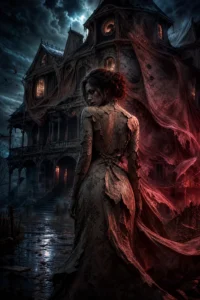
It pressed its wet hands against the tall windows of Blackwater Hall, rattled the panes in their leaded frames, dragged fingernails of rain down the glass. Far below, the sea hurled itself at the cliffs with a sound like cannon fire muffled beneath earth. The whole house seemed to breathe with it—old beams sighing, chimneys groaning, walls taking in the damp and giving back the scent of salt, ash, beeswax, and roses dying in silver bowls.
Elena stood in the vestibule with the hem of her traveling dress darkened by mud and seawater, her gloved fingers still curled around the handle of the valise Adrian had given her to escape. It was heavier now, though she had taken nothing new. Proof. Money. A pistol wrapped in linen she had not asked for. Her father’s ledgers. A key with no label. The weight of every chance she had been given to run.
And at the top of the marble steps, Adrian Blackwood watched her as if she had walked out of a grave.
He had not changed clothes since she had left. His black coat was open at the throat, rain spotting one shoulder where he must have stood outside before the storm drove him in, or perhaps before someone dragged him in. His dark hair was disordered in a way that should have made him look younger. It did not. It sharpened the hollows beneath his cheekbones, made the pale austerity of his face almost feverish.
His hand gripped the carved newel post. Not casually. Not elegantly.
As though it was all that kept him standing still.
No servant moved. No footman came forward for her coat. Somewhere deeper in the house, a door closed with the soft, careful click of someone retreating from the edge of a precipice. Even Mrs. Greene was absent, though Elena felt the old woman’s vigilance in the warm lamps, the fresh fire, the cup of tea waiting on the little console table beside the umbrella stand. Blackwater Hall had prepared for her return before anyone could have known she would make it.
Unless someone had known.
Unless Adrian always knew where she was.
Elena lifted her chin. “You look surprised.”
Adrian descended one step. The lamps threw amber across one side of his face and left the other cut in shadow. “I am not.”
“No?”
“Surprise is for men who have not already imagined every possible cruelty the world might commit.” His eyes moved over her—her wet hair, her pale fingers, the valise, the smear of mud near her ankle—as if cataloguing injuries. “But I had imagined the road taking you farther before it brought you back.”
“The road did not bring me.”
His mouth tightened.
“I chose,” she said.
At that, something moved across his face too swiftly to name. Relief, perhaps. Pain. Hunger. It was gone before it could be accused of softness.
“Yes,” he said. “You did.”
Elena set the valise down. Its brass clasps struck the marble with a small, definitive sound. “I told you why.”
His gaze stayed on the valise. “You said you would rather face the monster you know than the wolves pretending to be saints.”
“It was not forgiveness.”
“I did not mistake it for that.”
“Good.” She pulled off one glove finger by finger, because if she did not do something with her hands she might reach for him, or slap him, and she was not yet certain which would be more unforgivable. “Then perhaps we can begin with the truth.”
Adrian looked up.
The rain struck harder. For one violent second, water sheeted over the windows and turned the world beyond them black.
“The truth,” he repeated.
“Not the version of it you sharpen and hand me when it suits your plans. Not some piece of a dead woman’s letter. Not another locked door with my name carved into it.” Elena stepped away from the valise. The cold had entered her bones during the ride back; now heat rose behind her ribs, dangerous and bright. “You told me Lucian is hunting me. You told me my blood matters to whatever crime your family buried. You told me enough to make me afraid, but never enough to understand why I was here.”
Adrian’s fingers flexed against the newel.
“I came back,” she said, “so you could stop treating me like a thing you stole and start treating me like the woman who has to live with the consequences.”
For a moment he said nothing.
The house answered for him: a groan from the staircase, a hiss from the fire, the far-off thud of the sea beating itself senseless against the rocks.
Then Adrian moved.
Not toward her. Past her.
He crossed the vestibule and opened the door to the east corridor. “Come.”
Elena did not move. “No.”
He turned.
She hated how quickly his stillness could take command of a room. Hated that the silence around him did not feel empty, but armed.
“If you want to speak to me,” she said, “you will do it here.”
His eyes flicked once to the balcony above. To the shadows pooled between portraits. To the servants’ passages built into the bones of the house.
“Walls listen,” he said.
“Then let them learn something useful.”
A muscle jumped in his jaw. “Elena.”
Her name in his mouth was not a plea. Not quite. But it was close enough that she felt it beneath her skin.
“Do not use that voice with me,” she said quietly. “Not tonight.”
His expression closed. “Very well.”
He shut the corridor door and walked to the parlor off the vestibule—the smaller one, with green damask walls and a black marble hearth veined like old bruises. He did not ask her again. He simply opened the double doors and stood aside.
Elena waited long enough to make clear she entered because she wished to, not because he had commanded it.
The room smelled of smoke and rain-soaked wool. A fire burned low, throwing restless light across the pianoforte tucked beneath the front windows. Someone had placed a stack of music upon it. Her music. The pages she had left scattered on the drawing room floor two nights ago when she had discovered the hidden compartment behind the portrait of Adrian’s mother.
He had gathered them.
Of course he had.
The thought was so tender it made her angrier.
Adrian closed the doors.
Elena crossed to the hearth and held her hands toward the warmth. The flames painted her palms gold. Her wedding ring shone like a small shackle.
“Begin,” she said.
He stood near the doors, as if keeping distance was an act of penance. “Lucian sent word to my uncle six weeks before your father’s debts were called.”
Elena’s fingers curled.
She had expected many openings. Not that.
“What word?”
“That he had found the Vale girl.”
The parlor seemed to shrink around her.
“The Vale girl,” she repeated.
“His words.”
“And you knew what that meant?”
“Not fully.” Adrian’s gaze fixed on the fire, but Elena had the sense he was watching something else burn. “Enough.”
“How?”
His mouth hardened. “Because my father spent twenty years ensuring I would know the shape of every threat to this house. He believed ignorance was a sentimental disease. He cured me early.”
There it was again: the old wound beneath the iron. Elena had seen Lord Blackwood only once since her marriage, a ruined relic in the west wing with a mind that wandered between malice and terror. Yet his shadow lived in Adrian’s posture, in the careful economy of his movements, in the way affection seemed to cost him blood.
She did not soften.
“What did Lucian intend?”
Adrian looked at her then. “To take you before winter court.”
“Take me where?”
“To Saint Orla’s.”
The name chilled the room more effectively than the storm.
Elena knew the place by reputation, as everyone in Blackwater knew it. A white stone convent on the northern promontory, abandoned officially after the fever year, though candles still burned in its upper windows on certain nights and fishermen crossed themselves when passing beneath its cliff. Her nurse had once told her wicked girls were sent there to have sin scraped from their bones.
“Lucian is not a priest,” she said.
“No.”
“Then why—”
“Because the people who meet there prefer old walls and locked gates.”
Rain lashed the windows. Elena heard, beneath it, the phantom echo of hymns sung by voices with no mercy in them.
“Who?” she asked.
Adrian’s silence answered first.
She turned fully toward him. “Who, Adrian?”
“The magistrate. Two harbor masters. My uncle’s physician. At least one priest. Men who owed my family, then decided Lucian’s star was rising faster than mine.” His smile was brief and without humor. “Respectable men. Men who kiss their wives in church and order boys whipped for stealing bread.”
“And they wanted me.”
“Yes.”
“Because of my mother?”
The question slipped out before she could armor it. Her mother had become a keyhole in every mystery: a woman dead too long to defend herself, yet alive in every whispered conspiracy. Isabel Vale, with her gentle hands and unsent letters. Isabel, who had played lullabies in a house that apparently listened for blood.
Adrian took one step forward. Then stopped himself. “Because your mother witnessed what was done to Margot Blackwood.”
The first wife’s name passed between them like a candle carried into a crypt.
Elena’s pulse kicked.
Margot Blackwood—Adrian’s first wife, the ghost the town had given teeth. The woman said to have drowned herself from the north cliffs. The woman whose room had remained sealed. The woman whose letters suggested she had been murdered for knowing too much.
“My mother knew Margot?”
“Yes.”
“How?”
“They were both at Saint Orla’s during the last winter gatherings. Your mother was not a penitent. She played for them. Music for prayers, music for dinners, music while men performed their little rituals and called them law.” Disgust roughened his voice. “Margot found something. Your mother saw enough to understand she would not live if she spoke. She ran.”
Elena’s memories fractured and rearranged: her mother at the pianoforte, stopping abruptly whenever carriage wheels sounded outside; her father burning letters in the kitchen stove; the way they had left one rented house in the middle of the night when Elena was ten, though no one explained why.
“Why did she not tell me?”
“Because she wanted you to live.”
A laugh escaped Elena, brittle as ice. “That excuse seems beloved by everyone who lies to me.”
Adrian flinched.
Good, she thought savagely. Bleed a little.
“Lucian believed your mother left proof,” he continued. “A confession. A relic. Something that could expose not only Margot’s death, but the arrangement behind it.”
“Arrangement?”
“The Blackwood covenant with the harbor.”
Elena stared. “Speak plainly.”
“Ships vanish here, Elena. Men vanish. Cargo changes hands in fog. Judges look away, priests bless graves without bodies, and the town survives on money it pretends not to smell.” His eyes were merciless now, not toward her but toward the inheritance coiled around him. “My family did not build an empire from timber and shipping contracts. We built it by deciding who drowned.”
The fire cracked sharply.
Elena’s stomach turned. She had known the Blackwoods were criminals in the polished way aristocrats could be criminals: debts bought, magistrates bribed, rivals ruined. She had begun to suspect worse. But there was a difference between suspicion and hearing the sea itself named as an accomplice.
“And Margot?” she whispered.
“Margot discovered that my father and his council sank the Mercy Bell.”
Elena knew that name, too. Everyone did. A passenger vessel lost fourteen years ago with fifty-three souls aboard, most of them families traveling south before the worst of winter. Blackwater still held a bell service each year for the dead.
“No,” she said, though she did not know whom she meant to deny.
“Yes.”
“Why?”
“Insurance. Cargo hidden beneath the passenger decks. A rival’s documents. My father gave three reasons depending on how much he’d had to drink.” Adrian’s face looked carved from cold stone. “Margot found the original orders. She brought them to my mother. My mother brought them to your mother. By morning, Margot was dead, my mother was confined, and Isabel Vale had disappeared.”
Elena turned away from him, one hand at her throat. The parlor tilted. The green walls, the black hearth, the rain-smudged windows—everything seemed too vivid, too close. She could smell smoke. Salt. Wax. Her own damp wool. She could hear her mother humming a lullaby with trembling breath.
“And Lucian thought my mother left proof with me.”
“Yes.”
“Did she?”
Adrian did not answer quickly enough.
Elena faced him again. “Did she?”
“I don’t know.”
“That is not all.”
His gaze dropped to her mouth, not with desire but with a kind of anguish, as if truth had teeth and he had to force himself between them. “No.”
The fire sank lower. Shadows climbed the walls.
Elena’s heartbeat slowed, each beat heavy and separate. “Tell me.”
Adrian looked toward the pianoforte. Her music waited there, pages gently lifting at the corners when drafts found them. He crossed to it at last, but did not touch the keys. Instead he braced both hands against the polished wood and bowed his head.
It was the closest she had ever seen him come to kneeling.
“When I received Lucian’s message, I sent men to watch your father’s house.”
Elena went still.
“Do not make me ask every question,” she said.
His knuckles whitened. “Lucian had already approached your father.”
“About his debts?”
“About you.”
Her blood cooled so swiftly she felt almost light. “What did my father say?”
Adrian’s silence was a blade being drawn.
Elena remembered her father’s shaking hands on the morning the Blackwood notice arrived. The smell of stale brandy in the study. His inability to meet her eyes. She had thought it shame. Cowardice. Panic.
She had not thought sale.
“What did he say?” Her voice barely carried.
Adrian turned his head enough that she saw his profile, beautiful and brutal in the firelight. “He asked how much.”
For a moment, the sound of the storm vanished.
No rain. No sea. No house breathing around her.
Only those four words, clean and bright and murderous.
He asked how much.
Elena sat down because her knees had ceased belonging to her. The chair beside the hearth caught her with a soft creak of old velvet. Her hands lay in her lap. Bare, pale, composed. They did not tremble, which seemed monstrous.
“No,” she said.
Adrian’s head lifted.
“No,” she repeated, but the word had already begun to die.
Her father had loved music when her mother was alive. He had laughed loudly, dressed carefully, carried Elena on his shoulders along the promenade while gulls screamed overhead. He had also borrowed more than he could repay, lied to creditors, pawned her mother’s brooches, and wept when he thought no one could hear. Elena had spent years stitching dignity over his failures until the fabric looked almost whole.
How much?
Something in her chest tore without sound.
Adrian started toward her.
“Stop.”
He stopped at once.
She pressed her fingers against her sternum, not dramatically, simply to hold herself together. “And then?”
“Then I bought the debts.”
The words entered the room softly.
Elena looked up.
Adrian stood three paces away, too close and not close enough, his face stripped of every defense except the worst one: honesty.
“You bought them.”
“Yes.”
“All of them.”
“Every note. Every private marker. Every forged promise with your father’s signature on it.”
Her lips parted. No sound came.
He continued, because he had begun the killing and would not look away from the body. “I called them in through my solicitors. I made certain there was no extension, no friendly creditor, no discreet arrangement that might let him bargain elsewhere.”
Elena rose so quickly the chair struck the hearth rug behind her.
“You.”
He did not deny it.
“You ruined us.”
“You were already ruined.”
The words cracked across the space between them.
Elena slapped him.
The sound was sharp, intimate, obscene.
Adrian’s head turned with the force of it. For one suspended heartbeat, the room held its breath. Then a red mark bloomed across his cheek, vivid against his pale skin.
He did not lift a hand to it.
Elena’s palm burned. “Do not dare use precision as absolution.”
His eyes came back to hers slowly.
There was no anger in them. That made it worse.
“I am not asking to be absolved.”
“No,” she said. “You are confessing like a man who thinks suffering prettily will make him noble.”
Something dangerous flickered. “There was nothing pretty about it.”
“Was there not?” She laughed again, and this time it came out ragged. “You arranged the notices. You cornered my father. You let me believe your family had merely seized an opportunity when in truth you built the trap yourself.”
“Yes.”
“You sent the marriage offer.”
“Yes.”
“You forced me into this house.”
“Yes.”
“Into your bed.”
His face changed then.
The red handprint on his cheek seemed to darken. “No.”
“No?”
His voice dropped, harsh and low. “I forced the marriage. I forced the name. I forced the world to place you under my roof because the only fortress on this coast that Lucian could not breach without declaring war was mine. But I did not force your body.”
Elena hated that truth, because it stood there with all the others and would not let her simplify him into a single monster.
He had terrified her. Manipulated her. Surrounded her.
He had also waited.
He had touched her like a man holding fire he expected to be punished for wanting. He had accepted her refusals with a silence that cost him. He had given her escape and meant it.
And before all of that, he had taken away every other road.
“You think that distinction saves you?” she whispered.
“No.”
“Then why make it?”
“Because if you are going to hate me, I would have you hate me for what I did. Not for what I did not.”
Her throat tightened with fury so hot it nearly became grief. “How generous.”
Adrian absorbed the cruelty as if he deserved worse and had budgeted for it. Perhaps he had.
Elena turned away, pacing to the windows. The glass reflected her back in fragments: dark hair unpinned by the rain, eyes too bright, mouth bloodless. Behind her, Adrian’s reflection stood motionless near the fire, a black figure with a marked cheek and haunted eyes.
“When?” she asked.
“When what?”
“When did you decide I belonged to you?”
His reflection did not move. “That is not what happened.”
She faced him. “Do not lie now. You have come this far. Finish it.”



0 Comments