Chapter 34: The Choice to Stay
by inkadminThe rain came down like thrown gravel, hard enough to bruise.
It battered the carriage roof, hissed along the glass, and turned the narrow road from Saint Orlan’s parish into a black ribbon of mud. Beyond the window, the town of Marrowick hunched beneath the storm with its chimneys smoking and its chapel spire spearing the low clouds like an accusation. Lanterns trembled in their brackets outside shuttered shops. The harbor bells were ringing out of time, each iron note swallowed and thrown back by the sea.
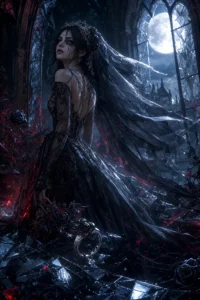
Elena Vale sat alone in the carriage, a pistol hidden beneath the folds of her mourning-blue cloak and a leather satchel pressed against her ribs.
Inside the satchel lay enough money to save what remained of her family. Bank drafts folded between oilcloth. A roll of sovereigns heavy as a confession. A packet of letters tied in black ribbon, the wax seals broken, the words inside damning enough to send half of Blackwater Hall’s household to the gallows if the magistrates had belonged to God instead of the Blackwoods.
And beneath those, wrapped in a scrap of yellowed muslin, lay the ledger page.
The page that proved her father had not simply gambled away the Vale fortune.
The page that proved Lucian Blackwood had engineered the debts, purchased them through three false companies, and timed their collapse precisely one month after Elena’s mother took ill. Her father’s ruin had not been weakness. It had been a hand tightening around a throat.
Elena had read the names by candlelight in the back room of Mrs. Gower’s apothecary while rain muttered against the roof and the old woman kept watch with a bone-handled knife on her knee. She had read the lines once as a daughter, once as a wife, and once as something colder than either.
Now the words lived under her skin.
The carriage lurched violently. Elena caught herself against the seat and felt the pistol knock against her thigh.
“Easy,” called the driver through the storm, though whether he spoke to the horses or to himself she could not tell.
She pushed the damp curtain aside with two fingers.
The road split ahead.
One way wound east along the coast, down toward the fishermen’s cottages and the smugglers’ inlets where a small boat waited beneath a ruined limehouse. Mrs. Gower had arranged it. A cousin of a cousin, she had said, a man with no love for Blackwood coin and a fondness for women who paid in advance. From there Elena could cross the black channel to the mainland by dawn. In two days, she could reach her aunt in Northwyck. In a week, if she did not spend unwisely, she could disappear.
The other road climbed.
Up through pine woods and iron gates. Up to the cliff where Blackwater Hall crouched over the sea with all its windows lit like watchful eyes.
The horses slowed as if they knew.
Elena’s gloved hand tightened over the satchel until the leather creaked.
She thought of her father’s face the last time she had seen him, ashen with humiliation, his eyes wet not from drink but from the effort of remaining upright beneath shame. She thought of her younger brother Tomas asleep in the narrow bed, one arm flung over his head, lashes damp from fever. She thought of all the whispered bargains that had been made over her body, her name, her future.
She thought of Adrian Blackwood standing at the head of the dining table the night before, one hand resting on the carved back of her chair like a claim and a threat both.
Men had been speaking around her as if she were a chess piece in ivory. Lucian with his silver beard and priestly smile. Magistrate Pell with his red-veined nose sunk in wine. Captain Merek of the harbor guard chewing at the inside of his cheek while pretending not to listen. They had discussed debts, bloodlines, inheritance, obedience.
Elena had listened until the heat in her chest turned clean and white.
Then she had risen.
The scrape of her chair had silenced the room more thoroughly than a gunshot.
“If the gentlemen are finished measuring the length of my leash,” she had said, “perhaps one of you might have the courtesy to ask whether I intend to wear it.”
Lucian’s smile had thinned. Pell had choked on his port. Someone’s wife had gasped into her lace.
And Adrian—Adrian had looked at her as if she had placed a blade against his throat and he was deciding whether to bleed or kiss the steel.
“Careful, Mrs. Blackwood,” Lucian had murmured, his voice velvet over rot. “Defiance is an expensive habit.”
“Then it is fortunate,” Elena had replied, “that your family taught me the value of debt.”
The room had gone still enough for the candles to sound loud.
Adrian’s mouth had curved.
Not in amusement. Not entirely.
There had been hunger in it, and warning, and something that looked too much like pride.
Afterward, chaos had rippled through the hall in glances and tightened fists. Lucian had left the table early, gathering men to him with a look. Adrian had not stopped him. He had only watched Elena across the gleaming ruin of the dinner plates, his eyes black with stormlight, as if she had become at last exactly what he had feared and wanted.
And before midnight, Mrs. Gower’s note had come slipped beneath Elena’s chamber door.
If you want the truth and the means to survive it, come before the third bell. Tell no one. Not even your husband.
Not even Adrian.
Especially not Adrian.
Elena lowered the curtain.
“Madam?” the driver called. Rain ran in silver lines down the front pane. “Which way?”
The horses stamped, restless at the fork.
For a moment, Elena heard only the rain and the wild, distant roar of the sea. Then, beneath it, memory: Adrian’s voice in the dark three nights ago, low and rough against her temple.
“If they come for you, do not bargain. Do not plead. Run.”
She had asked then, “And you?”
He had laughed without humor. “I was made for staying behind with monsters.”
Elena looked east.
Freedom lay there, or something wearing freedom’s dress. A boat. A new name. A little money. Proof enough to destroy Lucian if she ever found a court beyond his reach. She could save her father, perhaps. She could send for Tomas. She could play piano again in sunlit rooms where no one whispered prayers in the walls.
She looked up the road.
Blackwater Hall waited there with its secrets, its bloodstained chapel, its locked east wing, its servants who lied with terrified eyes, its master who could ruin her with a signature and touch her like she was the last warm thing in a dead world.
Her throat tightened.
There was no safety in either direction.
But only one path led toward the people who had decided she was prey.
Elena leaned forward, rapped once on the roof with the handle of her umbrella, and said, “Blackwater Hall.”
The driver twisted around, his hood dripping. “Madam?”
“Take me home.”
His expression flickered in the lamplight—surprise, fear, then the flat obedience of a man who knew better than to question a Blackwood bride. He clicked his tongue. The horses turned toward the hill.
Elena sat back.
The word home lingered like poison on her tongue.
Or like a vow.
The climb to Blackwater was steep and cruel. The trees thickened, their black trunks rising like bars on either side of the road. Wind tore at the carriage, carrying salt and pine sap and the faint mineral stink of the cliffs. Above, lightning flared behind the clouds, not striking, only showing the world in brief white negatives: branches clawing the sky, stone markers half-buried in bracken, the old watchtower leaning toward the sea.
At the first iron gate, two men stepped from the shadows with rifles beneath their coats.
The driver halted. One lifted a lantern.
Elena did not hide her face.
The guard stared, rain dripping from the brim of his hat. “Mrs. Blackwood.”
“Open the gate.”
He hesitated only a heartbeat too long.
Elena leaned toward the window, letting the lantern light catch the line of her cheek and the cold steadiness of her eyes. “If you are waiting for my husband’s permission, I suggest you run ahead and fetch it. In this rain. On foot.”
The second guard coughed into his fist.
The first reddened and stepped back. “Open it.”
Iron groaned. The gates parted.
As the carriage rolled through, Elena saw something pale tied to one of the spikes.
A strip of linen.
No—lace.
Wind snapped it against the iron. For one sick second she thought of a woman’s sleeve, torn away in flight.
Then the carriage turned, and it vanished behind rain.
By the time Blackwater Hall appeared, Elena’s hands had gone numb inside her gloves.
The house rose out of the cliff like something dredged from the bottom of the sea. Granite walls blackened by centuries of salt spray. Narrow windows burning gold. Chimneys coughing smoke into the storm. The southern wing remained dark, its glass blind, while the central tower wore a crown of lightning rods that sang whenever the sky flashed.
The sea below was invisible but never absent. It thundered against the rocks with the sound of doors being beaten open.
The carriage stopped at the front steps.
No footman came at once.
That alone told Elena everything.
Blackwater Hall was never truly asleep. It breathed through servants’ corridors and hidden stairwells, through lamps lit before dusk and fires banked before dawn. If no one came, it was because someone had ordered them not to.
Elena opened the carriage door herself.
The wind seized it and nearly ripped it from her hand. Rain struck her face, cold enough to sting. She stepped down into a puddle that swallowed the hem of her gown. The driver reached for her satchel.
“No.”
He withdrew as if burned.
Elena held the satchel close and climbed the steps.
The great doors opened before she touched them.
Mrs. Finch stood within, rigid in black wool, her silver hair braided tight enough to pull the skin at her temples. Behind her, the entrance hall stretched away in marble and shadow, all its candles lit, all its mirrors veiled in dark gauze since the supposed mourning for Adrian’s first wife had never truly ended in this house.
“Mrs. Blackwood,” the housekeeper said.
“Mrs. Finch.”
The older woman’s gaze dropped to the mud on Elena’s hem, then to the satchel. Her mouth pressed thin.
“You were not expected until morning.”
“By whom?”
A pause. Rain blew in behind Elena, speckling the marble.
Mrs. Finch stepped aside. “Allow me to take your cloak.”
“No.”
Something sharpened in the woman’s face. “You are soaked through.”
“Then the house may endure the inconvenience.”
Elena crossed the threshold.
The doors closed behind her with a boom that traveled up through her bones.
Warmth lapped over her skin—fire, wax, old wood, the faint sweetness of lilies decaying in vases. Somewhere deep in the house, a door shut. Somewhere above, a floorboard creaked under careful weight.
Everyone knew she had returned.
No one wished to be first to greet her.
“Where is my husband?” Elena asked.
Mrs. Finch’s eyes flickered toward the west corridor. “In the library.”
“Alone?”
“Mr. Blackwood does not account for his company to me.”
“No,” Elena said softly. “I imagine he only accounts for his sins.”
Mrs. Finch’s expression did not change, but a vein pulsed once in her throat.
Elena moved past her.
“Madam,” Mrs. Finch said.
Elena stopped without turning.
“If you have brought trouble into this house—”
A laugh escaped Elena. It was small and brittle and not amused. She turned then, rainwater sliding from her lashes. “Into this house?”
The entrance hall seemed to lean toward them. The portraits along the stairs watched with oil-dark eyes.
Mrs. Finch lowered her voice. “There are matters best left undisturbed.”
“Yes,” Elena said. “That appears to be the family motto.”
She left the housekeeper standing beneath the chandelier and walked toward the library.
With every step, Blackwater Hall spoke around her.
The sigh of pipes in the walls. The mutter of wind beneath doors. The tick of the longcase clock by the music room, its pendulum moving like a blade. Her wet skirts dragged against her ankles. The pistol’s weight pressed against her leg. The satchel seemed heavier now, as if the papers inside had absorbed the house’s malice and swollen with it.
At the bend in the corridor, she passed the portrait of Adrian’s mother.
Seraphine Blackwood had been painted in white, one pale hand resting on a sleeping hound’s head. Beautiful. Remote. Her dark hair coiled with pearls. But the artist had done something strange with her eyes; wherever Elena stood, Seraphine seemed to look just over her shoulder, as if watching someone behind her lift a knife.
Elena had not noticed before that the hound was not sleeping.
Its throat had been cut.
A sound came from the library.
Glass breaking.
Elena quickened her pace.
The library doors stood slightly ajar, golden light spilling through the gap. Voices moved inside, one low and furious, the other polished as a coffin lid.
Lucian.
Elena’s fingers tightened around the satchel strap.
“You think sentiment will save you?” Lucian was saying. “You have mistaken obsession for strength, Adrian. That has always been your disease.”
“Careful,” Adrian replied.
His voice was quiet.
Too quiet.
Elena stopped just outside the door.
“You mistake my patience for illness,” Adrian continued. “A common error among men who have benefited from it.”
Lucian gave a soft laugh. “Your patience? You nearly put a fork through Pell’s hand at dinner because your wife discovered she had a tongue.”
“Pell should not have looked at her mouth while discussing obedience.”
“Do you hear yourself?” Lucian snapped. For the first time, the velvet tore. “She is turning you into a spectacle. A boy panting after a flame. The men saw it. They smelled weakness.”
“Then let them come closer.”
“They will.”
The silence after that was a living thing.
Elena’s wet sleeve clung to her arm. A drop of rain slid from her hair and down her neck.
Lucian spoke again, softer. “She has fled. Or she will. The Gower woman was seen near the east road. Do you think your bride went to purchase laudanum?”
Adrian said nothing.
“Let her go,” Lucian murmured. “A runaway wife is inconvenient, but not fatal. We can say she was unstable. We can say she took after the first. The town enjoys a mad bride. It gives them something to whisper about between sermons.”
Elena felt the words like fingers around her throat.
“Say her name,” Adrian said.
Lucian paused. “Whose?”
“Celia’s.”
The air seemed to contract.
Lucian laughed once, very softly. “Still guarding ghosts?”
Something struck wood with a heavy thud. Elena flinched despite herself.
“Say her name,” Adrian repeated, and now his voice was not quiet at all. It was the sea on rocks. “If you intend to use her death, have the courage to put your teeth around it.”
“Celia,” Lucian said, with delicate disdain. “Poor, inconvenient Celia. Poor, drowned Celia. Poor Celia who knew when to stop fighting, unlike this one.”
Elena pushed the door open.
Both men turned.
The library was in disarray. A decanter lay shattered near the hearth, brandy spreading over the carpet like fresh amber blood. Books had been dragged from one shelf, a drawer hung open from Adrian’s desk, and the fire burned high enough to paint the room in violent orange.
Lucian stood near the globe, immaculate in charcoal despite the hour, one hand tucked behind his back. Adrian was by the desk, his shirtsleeves rolled to the forearms, waistcoat unbuttoned, hair disordered as if he had run his hands through it until restraint became impossible.
His face changed when he saw her.
Not softened. Adrian Blackwood did not soften in any way a sensible woman would trust.
But the ferocity in him shifted direction.
It moved from the room to her, not as violence but as gravity. His eyes swept over her wet hair, her mud-streaked hem, the satchel clutched to her body. He saw too much. He always did.
Lucian recovered first.
“Elena.” His smile appeared like a candle lit in a crypt. “How fortunate. We were just discussing you.”
“I heard.”
“Then you must forgive the indelicacy. Family conversations so often lose their polish.”
She stepped into the room. Water dripped from her cloak onto the carpet. “I am learning that Blackwood polish is mostly varnish over bone.”
Adrian’s gaze flicked to her mouth.
A dangerous spark lit there and vanished.
Lucian’s eyes narrowed a fraction. “You have been out late.”
“Have I?”
“A wife owes her husband some account of her movements.”
“Then let my husband ask.”
Adrian did not move. “Where were you?”
The words were simple. The room heard what lived beneath them.
Elena met his eyes. “Finding out who purchased my father’s debts.”
Lucian’s smile did not falter, but something dead showed behind it.
Adrian went still.
“And?” he asked.
Elena walked to the desk and set the satchel upon it. The leather hit the wood with a soft, decisive thump. She did not open it.
“And I found names.”
Lucian clicked his tongue. “My dear, desperate people are so easily deceived. Papers can be forged. Ledgers altered. Apothecaries bribed.”
“Yes,” Elena said. “So can magistrates.”
For the first time, Lucian’s eyes flashed.
Adrian saw it. So did she.
“Leave,” Adrian said.
Lucian looked at him, amused again. “You cannot dismiss me from my own family’s house.”
“I can dismiss you from my library before I decide to feed your tongue to the dogs.”
“There are no dogs left at Blackwater.”
Adrian smiled.
It was a terrible thing.
“Then I will acquire one.”
Lucian regarded him for a long moment, then turned his attention back to Elena. The storm flashed white beyond the windows, carving his face into planes of age and elegance and hunger.
“You had a chance tonight,” he said. “I hope you understand that.”
Elena’s pulse beat hard in her wrists.
“A chance?”
“To leave with whatever little prize you think you found. To slip away before this house closes around you completely.” His gaze dropped to the satchel. “Now you have brought it back into the lion’s mouth.”
“Perhaps I wanted to see which lion panicked.”
Lucian’s smile returned, but it no longer reached his eyes. “Clever girl.”
“Woman,” Adrian said.
Lucian glanced at him.
Adrian’s face was unreadable. “She is not a girl.”
The correction should have meant nothing. It struck the room like a match.
Lucian looked between them, and in that small movement Elena saw calculation rearranging itself. Whatever he had thought of her before—pawn, inconvenience, debt paid in flesh—he was reconsidering. Not because he respected her. Because he had recognized that Adrian’s attachment was not ornamental.
It was structural.
Something load-bearing.
Something that, if shattered, might bring down walls.
“How touching,” Lucian said. “Very well. I will leave husband and wife to their reunion.” He moved toward the door, pausing beside Elena. Up close, his cologne smelled of cedar and church incense. “A warning, Mrs. Blackwood. When wolves fight, lambs are trampled first.”
Elena turned her head slowly. “Then perhaps you should stop mistaking me for livestock.”

0 Comments