Chapter 3: The Groom Who Did Not Smile
by inkadminThe Ravenscroft carriage did not have a crest on its doors.
It did not need one.
The horses were black, the lacquered body blacker, the windows so darkly smoked that the city lamps slid across them like drowning moons. Men on the pavement looked away as it passed. Women drew children close beneath their umbrellas. Even the rain seemed to alter its course around the carriage, striking the cobbles with a hiss and then sheeting down the gutters toward the sea.
Seraphina Vale sat inside with her spine stiff and her gloved hands folded in her lap, because if she let them curl, she feared they would shake.
Across from her, Mrs. Hawthorne watched her with eyes pale as candle wax.
The Ravenscroft solicitor had introduced the woman as a chaperone, though she looked less like one than a warden. She wore a high-collared gown of severe gray, a mourning brooch at her throat, and gloves that fit so tightly over her long fingers they seemed stitched into her skin. She had not spoken since Seraphina was escorted from the courthouse steps, through the screaming rain and the louder silence of Blackwater’s spectators, into this velvet-lined coffin on wheels.
Seraphina had not spoken either.
Words were dangerous. She had learned that young, at her father’s elbow in the cathedral nave, when a careless comment could send a patron into a fit and cost them weeks of commission. She had learned it again when her father was carried home in a raincoat he had not been wearing when he left, face gray, knuckles split, mouth sealed forever around whatever truth had killed him.
And she had learned it today, standing beneath the courthouse clock, when Magnus Ravenscroft’s solicitor had unrolled a contract thick as scripture and offered her sister’s life as the ink.
Marry Lucian Ravenscroft, and Elowen would remain untouched.
Refuse, and the debt would be collected.
There had been a crowd. Of course there had been. In Blackwater, ruin drew witnesses the way blood drew gulls.
Seraphina had signed.
Not trembling. Not begging. Not asking why her dead father’s name appeared in a Ravenscroft ledger hidden behind the ruined face of Saint Cecily. She had signed because Elowen was seventeen and gentle and still kept pressed flowers inside medical textbooks as if tenderness could survive anatomy. She had signed because Blackwater devoured soft things first.
Now the carriage rolled uphill through the old district, where the streets narrowed and the houses rose higher, their windows narrow and lit like watchful eyes. Rain blurred the world beyond the glass into streaks of gold and iron. A cathedral spire stabbed through the fog somewhere to the west. The harbor bells tolled midnight in uneven peals, their sound dragged thin by the wind.
Mrs. Hawthorne finally stirred.
“You will meet him in the chapel.”
Seraphina looked up. “How theatrical.”
The woman’s expression did not change. “Mr. Ravenscroft dislikes theatrics.”
“Then he should have chosen a less ridiculous family.”
A faint flicker passed over Mrs. Hawthorne’s face. It might have been disapproval. It might have been amusement dragged out into the light and strangled.
“You are not expected to be charming, Miss Vale.”
“Good. I’m exhausted.”
“But you are expected to be obedient.”
Seraphina turned her head and watched the city climb past in black stone tiers. “Then he should have chosen someone else.”
Mrs. Hawthorne’s silence sharpened.
The carriage passed beneath a wrought-iron archway crowned with ravens. The birds had been fashioned with open beaks and spread wings, as if caught in the instant before they descended. Beyond the gate, Ravenscroft House rose from the hill like a judgment.
It was less a house than a fortress that had acquired manners. Black granite walls, narrow lancet windows, towers capped in wet slate, terraces that spilled down toward gardens smothered by fog. The sea churned far below, invisible except for the white slash of waves against cliffs. Lightning revealed gargoyles hunched along the roofline, their stone mouths slick with rain.
Seraphina had restored cathedrals, crypts, private chapels, mausoleums built by families who believed marble might soften death. She knew architecture as other people knew faces. Ravenscroft House had been designed to intimidate. Every arch drew the eye upward. Every window narrowed at the top like a blade. There was no welcome in it. No warmth. Only endurance.
The carriage did not stop at the main entrance.
It rolled along the curving drive, past the broad steps where two stone ravens flanked doors tall enough for saints, and continued toward the eastern wing. There the house sank into older masonry, where ivy clung in black ropes and broken saints peered from niches half-dissolved by salt air. A smaller structure crouched beyond a courtyard—a chapel, abandoned or pretending to be.
Its stained-glass windows were dark.
No, Seraphina realized as the carriage drew nearer. Not dark. Storm-dark. The glass held color too deep to show without lightning: bruised violet, wine red, tarnished gold. Saints and martyrs stood in elongated panels, their faces pale ovals beneath halos cracked by age. The central rose window had been shattered and repaired with clear panes that caught the rain like tears.
The carriage stopped.
Mrs. Hawthorne opened the door before the footman could reach it. Cold air poured in, raw with sea salt, wet stone, and something older—beeswax, dust, extinguished incense.
“Your veil,” the woman said.
Seraphina looked at the bundle beside her.
It had been placed in the carriage without ceremony: a wedding veil of black lace, folded like a dead moth. She had refused to touch it during the ride. Now Mrs. Hawthorne lifted it with both hands.
“No.”
For the first time, the older woman’s mouth tightened. “It is tradition.”
“Then tradition can walk in alone.”
“Miss Vale—”
“My father is not here to give me away,” Seraphina said. “My sister is not here to stand beside me. I have been threatened, transported, and dressed in the only black gown I own because your employers could not be troubled to murder me before midnight. I will not wear a veil like a corpse on display.”
Rain struck the carriage roof in a hard, furious drumming.
Mrs. Hawthorne studied her. “You mistake defiance for power.”
Seraphina leaned forward. “And you mistake obedience for virtue.”
The woman’s pale eyes lowered to the veil. For a moment, Seraphina thought she would insist. Instead Mrs. Hawthorne folded it once, twice, and set it back on the seat with unsettling care.
“Very well.”
That frightened Seraphina more than argument would have.
She stepped down into the rain.
Her boots sank slightly in the gravel. The black gown clung to her legs, the hem already damp, the sleeves too tight from where she had altered them herself by candlelight three winters ago. Her hair, braided severely and pinned beneath a small hat, loosened at once in the wet wind. A strand stuck to her cheek. She did not brush it away.
The chapel doors stood open.
Light burned within.
Not the warm spill of sanctuary candles, but a low, wavering glow that made the doorway resemble an open wound. Two men in Ravenscroft livery waited beneath the arch. They did not look at Seraphina. Their eyes fixed somewhere over her head, as if acknowledging her existence might bind them to it.
Mrs. Hawthorne walked first.
Seraphina followed.
The threshold was worn hollow by centuries of knees and footsteps. As she crossed it, the air changed. The storm dulled behind her, not silenced, never that, but muffled by thick stone walls. Cold moved over her skin in layers. Candles burned along the nave in iron stands, their flames bending whenever wind slipped through hidden cracks. The pews were old oak, carved with ravens and lilies. Dust lay in the grooves. Above, the vaulted ceiling disappeared into shadow.
The chapel was larger than it had seemed from outside, built in the old Blackwater style: narrow, vertical, hungry for heaven. The floor was black and white marble, the pattern warped by age. At the far end, beneath the storm-dark windows, stood the altar.
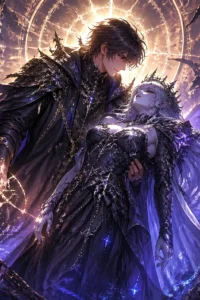
And before it stood Lucian Ravenscroft.
Seraphina stopped breathing.
Rumor had not prepared her.
Rumor had made him older. A gaunt tyrant with silver at his temples. A monster with a gentleman’s gloves and his father’s cruelty carved into his bones. Rumor had given him scars, a limp, a mouth twisted by contempt. Rumor had called him the man who never smiled, the heir who could ruin a magistrate with a letter and have a dockmaster dragged from his bed before dawn. Rumor had made him into something safely grotesque.
Lucian Ravenscroft was twenty-eight at most.
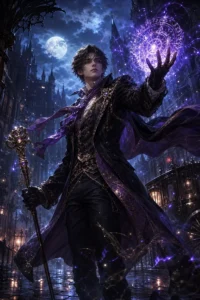
He wore black evening dress without ornament, the cut severe enough to seem clerical. No flower at his lapel. No wedding favor. His dark hair was swept back from a face so precisely made it felt almost violent: high cheekbones, straight nose, mouth firm and unsmiling, jaw shadowed by a day’s restraint. His skin held the pale cast of old families and candlelight. But his eyes—his eyes were the storm made human.
Not gray. Not blue. Something colder between, like the sea under winter cloud.
They fixed on Seraphina as she entered, and every candle in the chapel seemed to lean toward him.
He did not look surprised by her bare face.
He did not look pleased.
He looked as though he had been waiting for a blade to be delivered and was assessing its edge.
A priest stood near him, thin and nervous, his white collar too stark against his sweating throat. Two legal witnesses waited in the shadows. Magnus Ravenscroft was absent. Of course he was. Men like Magnus did not attend the machinery of ruin. They merely set it in motion.
Mrs. Hawthorne halted at the first pew and inclined her head.
“Mr. Ravenscroft.”
Lucian’s gaze remained on Seraphina. “Leave us.”
The words were quiet.
No one mistook them for a request.
The priest blinked. “Sir, the ceremony—”
“Will wait.”
The two witnesses moved at once, relief plain in the hurried scrape of their shoes. Mrs. Hawthorne paused only long enough to glance at Seraphina with something unreadable in her eyes, then withdrew. The priest followed last, clutching his small book as if it might save him.
The chapel doors closed.
The sound rolled through the nave like the sealing of a tomb.
Seraphina and Lucian stood alone beneath the watching saints.
Rain stroked the stained glass in silver threads. Somewhere high above, water dripped steadily into a basin or a crack in stone. One drop, then another, then another. The rhythm found Seraphina’s pulse and matched it with cruel precision.
Lucian spoke first.
“You refused the veil.”
His voice was deeper than she expected, low enough to move through the cold without needing volume. It carried no softness. No heat either. A blade laid flat on the tongue.
“I did.”
“Why?”
“I prefer to see where I’m being led.”
A candle guttered between them. His expression did not change, but something shifted in his eyes, a minute attention sharpening.
“You believe you are being led?”
“Dragged, then.”
“You walked in.”
“Into a trap, yes. One should maintain posture.”
He studied her in silence.
Seraphina forced herself not to fidget beneath it. She had endured patrons who inspected her work as if searching for proof of fraud. Bishops who mistook youth for incompetence. Wealthy widows who wept over saints’ chipped fingers and refused to pay invoices. But Lucian’s attention was different. It did not slide over her face, her gown, the damp curls escaping at her temples. It entered. Measured. Catalogued.
It made her skin feel too thin.
“Seraphina Vale,” he said.
Her name sounded dangerous in his mouth.
“Lucian Ravenscroft.” She tilted her chin. “You’re younger than I was promised.”
“Promised?”
“Threatened with.”
Still no smile. Not even the shadow of one. “You expected a decrepit monster.”
“I didn’t rule it out.”
“And now?”
“Now I’m considering that monsters are more varied than cathedral grotesques suggest.”
A gust slammed rain against the windows. Red glass flared behind him as lightning tore open the sky, and for an instant a martyr’s painted blood ran down his shoulder.
“You speak freely for someone in your position,” Lucian said.
“I was sold at a discount. Consider the insolence a defect disclosed after purchase.”
“You were not sold.”
Seraphina laughed once, sharp and humorless. The sound seemed profane in the chapel. “No? Shall we fetch the contract? I’m sure its language was delicate. Debt settlement. Familial collateral. Transfer of obligation. Aristocrats do love perfume over rot.”
His jaw tightened. So slight a motion that anyone else might have missed it. Seraphina had spent years noticing hairline fractures in plaster saints. She missed very little when she was afraid.
“Your father owed my family a debt,” Lucian said.
“My father restored churches.”
“He did more than that.”
The words struck somewhere beneath her ribs.
For a moment, she saw her father at their kitchen table, sleeves rolled, hands dusted in gold leaf, smiling tiredly as Elowen fell asleep over a book. She saw him in the cathedral triforium, humming old hymns through his teeth while Seraphina mixed pigment. She saw the coffin closed too quickly because the undertaker said there had been damage.
She hated Lucian for standing in candlelight and making a shadow move over those memories.
“You don’t get to speak of him,” she said.
Lucian’s eyes did not soften. “I get to speak of whatever truth keeps you alive.”
“Ah. So this is benevolence.”
“No.”
“Good. I’d hate to confuse it with extortion.”
He took one step toward her.
It was not dramatic. His shoes made almost no sound on the marble. Yet the distance between them altered. The chapel seemed to narrow around his movement. Seraphina had the absurd impulse to step back. She refused it with every bone in her body.
Lucian stopped close enough that she could see the fine rain caught on his coat shoulders, the faint blue vein at his temple, the scar—not rumor’s grotesque slash, but a thin white line—cutting through the skin near his left thumb where his hand rested at his side.
“Listen carefully,” he said. “After tonight, you will live at Ravenscroft House. You will not leave the grounds without my permission. You will not write letters that are not inspected. You will not receive visitors. You will not enter the north wing, the lower archive, or any room whose door is marked in black wax. You will not ask servants about family business. You will not involve your sister in any attempt to free yourself from this arrangement.”
Seraphina felt the words land like locks closing.
“And if I do?”
“Then people will suffer.”
“People,” she repeated. “How tasteful. Does the vagueness help you sleep?”
“Specificity would not comfort you.”
Her fingers curled in her skirts. “You threaten my sister again and I will put a chisel through your hand.”
His gaze dropped briefly to her fingers. “Do you carry one?”
“Not tonight.”
“Unwise.”
She stared at him.
Something like anger moved behind his eyes—not at her threat, she realized with a strange lurch, but at the absence of the weapon. As if her arriving unarmed offended him. As if the world had proved itself worse than expected.
“You find this amusing?” she asked.
“No.”
“Do you find anything amusing?”
“Rarely twice.”
It was almost a joke. Almost. Delivered with the solemnity of a burial rite.
Seraphina hated that she noticed.
She hated, too, the way the candlelight caught the edge of his cheekbone and the stern line of his mouth. Beauty should not have been allowed in men who made cages. It confused the instincts. It made brutality seem intentional rather than crude. A wolf did not become less dangerous because frost silvered its fur.
“I want to see Elowen,” she said.
“No.”
“I want proof she’s safe.”
“You will have it.”
“When?”
“After the vows.”
“Before.”
“After.”
Seraphina stepped closer now, closing what little remained between them. She had to tilt her face up to hold his gaze. Rain, stone, beeswax, and the faint scent of him—cedar, cold air, something like smoke—filled her lungs.
“If she has been hurt,” she said softly, “if there is so much as a bruise on her wrist from one of your men, I will become the most inconvenient wife Blackwater has ever seen.”
His eyes moved over her face then. Not like a man admiring. Like a man trying to remember something he had forbidden himself.
“You already are.”
The answer slipped between them, quiet and immediate.
Seraphina’s breath caught before she could stop it.
Lucian noticed. Of course he noticed. His lashes lowered, hiding whatever had sharpened there.
“Do not mistake this marriage for a negotiation,” he said.
“I would never. Negotiations require both parties to have something resembling honor.”
“Honor is a word men use when they want corpses to look noble.”
“And what do you use?”
“Leverage.”
“How lonely.”
That struck. Not visibly at first. Then the silence after it lengthened, and Lucian’s face became colder, not because he felt nothing, but because something had moved too close to the surface and been forced under ice.
“Be careful, Miss Vale.”
“Why? Will you break me?”
“No.” His voice dropped. “I don’t break what I intend to keep.”
The chapel seemed to inhale.
Heat rose beneath Seraphina’s collar, sudden and infuriating. The words were not tender. They were possession shaped into restraint. They should have repulsed her entirely.
They did repulse her.
Mostly.
“How flattering,” she said. “Shall I thank you for your restraint now or during the vows?”
“During would be memorable.”
“You’re very sure of yourself for a man being married in a chapel with mold in the transept.”
His gaze flicked, involuntarily, toward the left wall.

0 Comments