Chapter 6: Rules for a Captive Bride
by inkadminBy morning, the rain had turned Ravenscroft House into an island.
It sheeted down the tall black windows in shimmering veils, blurring the gardens into smears of cypress and ironwork. Beyond the glass, the sea threw itself against the cliffs with a violence Seraphina could feel in the soles of her feet. The entire house seemed to breathe with it—stone ribs expanding, old pipes groaning, chimneys sighing smoke into a sky the color of tarnished silver.
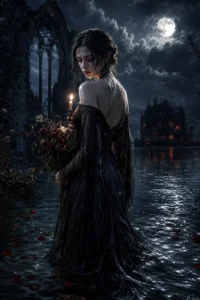
Seraphina stood barefoot in the center of her assigned bedroom, still wearing the ivory slip she had slept in, and stared at the door.
Not because it was unusual.
Because, sometime before dawn, Lucian Ravenscroft had been standing on the other side of it.
She had not imagined him. She knew the difference between dream and terror. Dreams blurred at the edges. Terror came with details sharp enough to cut: the faint gleam of his cufflink in the hallway gloom, the exact angle of his hand curled near his side, the rainwater darkening the shoulders of his black coat though he had supposedly been inside all night. His face had been pale, unslept, beautiful in the cruel way marble angels were beautiful before they toppled from cathedral roofs.
He had looked at her as if he had been waiting for something.
Or guarding against it.
Then the woman had cried again from somewhere beyond the forbidden corridor, a thin, strangled sound that crawled under Seraphina’s skin and nested there.
Lucian’s eyes had changed.
“Go back inside,” he had said.
Not please. Not Seraphina. Not wife.
An order, delivered softly enough to make disobedience feel dangerous.
Now morning had come, and with it the domestic machinery of captivity.
A maid arrived without knocking precisely at eight, balancing a silver breakfast tray and a gown over one arm. She was young, perhaps nineteen, with dark hair pinned so tightly it pulled her temples, and freckles scattered across her nose like flecks of cinnamon. She kept her eyes lowered as she entered, as if Seraphina were some holy relic best approached with caution—or a corpse.
“Good morning, Mrs. Ravenscroft.”
Seraphina flinched.
The name still felt like a hand closing around her throat.
“Don’t call me that.”
The maid froze so completely that the teapot on the tray gave a delicate chime against its saucer.
Seraphina exhaled through her nose. “I’m sorry. That came out sharper than I intended.”
“No apology needed, ma’am.” The girl crossed to the small table by the hearth. “Breakfast. And your clothes.”
“My clothes are in my trunk.”
“Mr. Ravenscroft had them taken for cleaning.”
Seraphina looked at the gown draped over the maid’s arm. A deep green wool dress with a high collar and buttons of black jet. Severe. Expensive. Mourning made fashionable.
“How thoughtful,” she said.
The maid’s mouth twitched, then flattened with panic at having almost smiled.
Seraphina noticed. She noticed everything. The faint reddening around the girl’s wrists where cuffs had rubbed. The way she positioned herself with her back never fully to the room. The tiny silver cross tucked beneath her collar, hidden but not hidden enough.
“What’s your name?” Seraphina asked.
“Mara, ma’am.”
“Mara. Did you hear crying last night?”
The tray rattled.
Not loudly. But enough.
“The wind is strange on the cliffs.”
“That wasn’t the wind.”
“Ravenscroft House has old pipes.”
“Pipes don’t weep.”
Mara poured tea with hands that had become very careful. “You should eat while it’s hot.”
Seraphina moved closer, the floorboards cold beneath her feet. “Who is in the west wing?”
At that, Mara’s gaze snapped up. Fear lived in her eyes like a trapped animal.
“You mustn’t ask that.”
“Mustn’t?”
“Please.” The word came out raw enough to strip away the performance of servitude. “Please, Mrs.—Miss Vale. Don’t.”
Seraphina’s irritation dimmed, not extinguished but redirected. “Why?”
Before Mara could answer, the door opened.
Lucian Ravenscroft stood on the threshold as if he had been summoned by the very shape of his name unsaid.
He wore black again. Of course he did. Black suit, black waistcoat, white shirt so crisp it made every shadow near him look deliberate. His hair, damp at the temples, had been combed back with the kind of control that suggested violence had simply been taught manners. A signet ring gleamed on his left hand—raven wings folded around a blood-red stone.
Mara immediately dipped her head and stepped away from Seraphina as if caught too close to a flame.
Lucian’s gaze moved over the room. The untouched bed, the breakfast tray, Seraphina’s bare feet, the dress still in Mara’s arms. It lingered nowhere long enough to be indecent and everywhere long enough to be possessive.
“Leave us.”
Mara fled with visible relief, abandoning the dress across the back of a chair. The door closed behind her with a click that sounded obscenely final.
Seraphina folded her arms over her chest. The slip was thin, but she refused to reach for a robe. Modesty would not become another weapon handed to him.
“Do you make a habit of entering women’s bedrooms without permission?”
“Only my wife’s.”
The word struck differently in his mouth. Not affectionate. Not tender. A legal fact sharpened into a blade.
“Convenient. I don’t recall granting you any rights beyond the ones forced on me at an altar.”
His eyes flickered. “You were not forced.”
Seraphina laughed once. “No? My sister’s safety was placed on one side of the scale and my life on the other. What a romantic proposal.”
“Your sister is alive.”
“Because I married a man who keeps locked corridors and terrifies his servants.”
“Because you listened when it mattered.”
“Don’t mistake survival for obedience.”
For a moment, the rain filled the space between them. Lucian did not move, but the room seemed to shrink around him anyway. He had the presence of a storm seen from inside a chapel: contained by glass and stone, yet capable of bringing the whole thing down.
“Dress,” he said.
“I don’t take orders before breakfast.”
His gaze dropped to the tray. “Then eat.”
“I don’t take orders during breakfast either.”
Something like amusement ghosted across his mouth and vanished before it could become human.
“You have ten minutes.”
“For what?”
“For me to explain the rules.”
“Ah.” Seraphina tilted her head. “The captivity comes with a handbook.”
His jaw tightened. “This house is older than both of us, Seraphina. It has habits. So do the people in it. If you insist on treating every locked door as an invitation, you will bleed on thresholds that were thirsty long before you arrived.”
Her name in his voice unsettled her more than the warning did. It had no warmth, yet it was not indifferent. He said it as if he knew where every syllable had been wounded.
“How poetic,” she said. “Do all Ravenscrofts threaten their brides before tea, or am I special?”
“You are many things.”
The answer came too quickly.
Seraphina’s pulse gave an inconvenient stutter. “Name one.”
Lucian looked at her then, truly looked, and for an instant the coldness in him thinned enough to show something beneath it. Not softness. Nothing so simple. Hunger, perhaps. Grief in a black coat. Recognition where none should exist.
“Reckless,” he said.
“Disappointing. I was hoping for clever.”
“Clever women live longer when they know when to appear foolish.”
“And foolish men think rules will stop a clever woman.”
This time, his almost-smile showed a hint of teeth.
“Get dressed.”
He turned toward the window, granting her his back with infuriating confidence.
Seraphina stared at the immaculate line of his shoulders. “You’re not leaving?”
“No.”
“Then I’m not dressing.”
He glanced back. His eyes moved over her face, not her body, which somehow made her feel more exposed. “Modesty from the woman who stood in a chapel at midnight and vowed herself to a monster?”
“I vowed nothing of the kind.”
“You said the words.”
“Under duress.”
“God heard them anyway.”
“If God was in that chapel, He was hiding.”
The rain slammed harder against the glass. Somewhere in the walls, a pipe knocked once, like a knuckle against a coffin lid.
Lucian’s expression went very still.
“Five minutes,” he said, and stepped outside.
The door shut.
Seraphina stood motionless for several seconds, breathing through the strange pressure in her chest. Then she snatched the green dress from the chair and dressed with furious efficiency, fingers fumbling only once on the small buttons at her throat. The fabric fit perfectly. Of course it did. The sleeves ended precisely at her wrists; the waist shaped itself to her body as if measured by hands she had never allowed near her.
That disturbed her more than the color.
She twisted her hair into a knot, stabbed it through with two pins from the vanity, and found her reflection in the mirror above it.
Someone had covered the glass during the night with a length of gray silk.
Seraphina froze.
She had noticed the servants avoiding mirrors yesterday. She had noticed every looking glass in the halls either veiled, turned toward the wall, or cracked in spiderweb patterns. But this mirror had been bare when she arrived. She remembered because she had stood before it after the wedding, white dress stained with candle smoke, and barely recognized herself.
Now it was covered.
By whom?
Lucian knocked once—not a request, a warning—and entered before she could answer.
His gaze passed to the covered mirror. Something unreadable crossed his face.
“Was that you?” she asked.
“No.”
“Mara?”
“Possibly.”
“Why?”
“Because she values her position.”
“And mirrors endanger it?”
Lucian did not answer. He opened the door wider. “Come.”
Seraphina considered refusing for the satisfaction of it, then followed because knowledge had always been her hungriest sin.
The hallway outside her room smelled of beeswax, old smoke, and roses left too long in water. Ravenscroft House in daylight was no less grim than at night, only more detailed in its menace. Portraits lined the walls in gilt frames, generations of pale aristocrats watching from painted gloom with identical dark eyes and mouths made for secrets. Velvet runners swallowed footsteps. Chandeliers hung overhead like crystal skeletons.
At the far end of the corridor, the west wing waited behind a set of double doors.
They were black oak, carved with ravens tangled in thorn branches, and bolted with iron. No light showed beneath them. Yet as Seraphina passed, the skin between her shoulders prickled, and she had the absurd certainty that someone on the other side had leaned close to listen.
Lucian stopped before a narrow table beneath a portrait of a woman in blue.
The woman was young. Younger than Seraphina, perhaps. She had hair the color of winter wheat and eyes painted so pale they seemed almost silver. A ribbon circled her throat. One hand rested over her heart; the other held a white rose whose petals had been painted with exquisite care.
But the face—
The face had been slashed.
Not by age. Not by accident.
Three deep cuts crossed the canvas from brow to jaw, exposing raw threads beneath the paint. Someone had tried to erase her beauty and failed. The wounds made her more impossible to ignore.
Seraphina felt Lucian watching her reaction.
“Who is she?”
His voice cooled by several degrees. “That is one of the rules.”
“The portrait?”
“The girl in it.”
Seraphina turned from the damaged face to him. “You brought me here to tell me not to ask a question after placing me directly in front of the answer?”
“I brought you here so you would understand I am not speaking in metaphor.”
“How refreshing. Literal threats.”
Lucian’s hand closed around the head of his cane. She had not noticed it before; black wood, silver raven skull handle. He did not lean on it. It was not an aid. It was an accessory with the soul of a weapon.
“There are three rules you will obey while you live in this house.”
“While I’m imprisoned, you mean.”
“While you are protected.”
“From whom?”
“First,” he said, ignoring her, “you do not enter the west wing. Not for any sound. Not for any servant. Not for me.”
Seraphina glanced toward the black doors. “Especially not for you, I imagine.”
“If you hear my voice from beyond those doors, you will go in the opposite direction.”
That stole the next retort from her tongue.
“What does that mean?”
“It means what I said.”
Rain whispered against the windows. A draft moved through the corridor, carrying with it the faintest scent of salt and something medicinal—camphor, perhaps, or old bandages.
Lucian continued. “Second: you will not speak to my uncle alone.”
“Which uncle?”
“I have only one still breathing.”
“A shame for the family tree.”
“Cassian Ravenscroft will flatter you. He will appear kind. He will tell you I am cruel.”
“So far, he’d be accurate.”
“He will tell the truth only when it makes the lie easier to swallow.”
There was something in Lucian’s voice then—not fear, never fear, but a blade drawn in darkness.
Seraphina studied him. “What did he do?”
“He survived.”
“That’s not a crime.”
“In this family, it often is.”
The answer lodged under her ribs.
“And the third rule?” she asked, though she already knew.
Lucian’s eyes shifted to the slashed portrait.
“Do not ask about the girl in the portrait.”
Seraphina looked at her again. The ruined face, the pale eyes, the white rose. A dead girl, obviously. Or a missing one. A fiancée, perhaps. A sister. A victim. In Ravenscroft House the possibilities were not endless, but all of them wore blood well.
“Does she have a name?”
“That is a question.”
“I’m aware.”
“Then be aware of the consequence.”
He stepped closer.
The corridor narrowed to the space between them. Seraphina refused to retreat, though instinct suggested it would be wise. Up close, Lucian smelled faintly of rain, cedar, and smoke. There was a small cut across one knuckle, fresh and red against his skin.
“Every rule in this house,” he said quietly, “was written after someone died breaking it.”
Her mouth went dry.
“Is that supposed to frighten me?”
“Yes.”
Honesty, sharp and unadorned.
Seraphina hated that it made something inside her lean closer.
“You’ll have to do better than ghost stories.”
“I know.”
The softness of that answer slipped beneath her guard.
Before she could respond, footsteps sounded from the staircase below—unhurried, elegant, accompanied by the tap of a cane far lighter than Lucian’s. Lucian’s expression changed so quickly it was like watching shutters slam over lit windows.
A man appeared at the end of the hall.
He was perhaps in his late fifties, tall and slender, with silver hair combed back from a face that had aged beautifully rather than kindly. His suit was dove gray, his cravat wine red, his smile warm enough to make a naïve woman think of libraries and good whiskey. But his eyes were Ravenscroft eyes: dark, amused, and full of locked rooms.
“There she is,” he said. “The bride our city has been whispering about.”
Lucian moved half a step in front of Seraphina.
The man noticed. His smile deepened.
“Nephew. How territorial.”
“Cassian.”
So this was the uncle.
Cassian Ravenscroft descended upon them with the gentle inevitability of poison poured into tea. He took Seraphina’s hand before Lucian could prevent it and bowed over her knuckles without kissing them.
“Seraphina Vale,” he murmured. “Your father spoke of your talent often.”
Her fingers chilled in his grasp.
“You knew my father?”
Lucian’s voice cut in. “Rule two.”
Seraphina did not look at him. “I’m not alone.”
Cassian chuckled. “Ah, he’s begun already. Lucian always did enjoy making commandments. One would think he fancied himself God.”
“Only because you played devil so poorly,” Lucian said.
Cassian released Seraphina’s hand. His thumb brushed once across the inside of her wrist as he did, light as a moth wing. Revulsion flashed through her so fast she nearly stepped back.
“Welcome to the family, my dear,” he said. “If you require anything—a book, a carriage, an honest answer—you have only to ask.”
Lucian’s fingers tightened around his cane.
Seraphina caught the movement. So did Cassian.
“How generous,” she said. “I’ve already been given rules. Honesty would be a novelty.”
Cassian’s gaze sharpened with appreciation. “Oh, I like her.”
“You will stay away from her,” Lucian said.
“Or what?” Cassian tilted his head. “You’ll lock another door?”
The air changed.
Not dramatically. No thunder cracked. No portrait fell.
But Lucian went still in a way Seraphina had only seen in dangerous men and damaged animals. Cassian’s smile remained. The slashed girl in the portrait watched with her ruined eyes.
“Careful,” Lucian said.
“Always.” Cassian turned back to Seraphina. “Do enjoy the house. It has such fascinating corners. Though I suppose my nephew has told you which ones to avoid.”
“Several.”
“Then he must be nervous.”
Lucian stepped forward.
Cassian lifted both hands in theatrical surrender. “Breakfast awaits. Don’t let him starve you, Mrs. Ravenscroft. Our family has buried enough hungry women.”
He walked away before the silence could close around the shape of that sentence.
Seraphina waited until his footsteps faded.
“Buried enough hungry women?”
“Do not repeat his words as if they contain truth.”
“They contain something.”
Lucian turned on her. “They contain bait.”
“And you think me too stupid not to bite?”
“I think you have spent your life prying beauty out of rot and calling the rot history.”
The accuracy of it stung.
Seraphina lifted her chin. “And I think you are terrified I’ll find something you missed.”
A muscle worked in his jaw.
“You will eat in the morning room,” he said. “Mara will attend you. I have business in the city.”
“Leaving so soon? But we were just beginning to enjoy our marriage.”
His gaze flicked to her mouth. It happened so quickly she might have imagined it, except her body reacted before pride could stop it—a small, traitorous tightening low in her stomach.
Lucian saw that too.
Of course he did.
His expression darkened, not with triumph, but with something closer to pain.
“Do not test the rules today,” he said.
“Why? Is there a more convenient day for rebellion?”
He leaned close enough that his voice brushed her skin.
“Because today I will not be here to save you.”
Then he left her standing beneath the slashed girl’s gaze.
Seraphina told herself she would behave for exactly one hour.
It seemed reasonable. Sensible, even. Enough time to observe, to memorize the rhythms of the house, to let Lucian’s departure settle the servants into carelessness. She ate breakfast in the morning room beneath a ceiling painted with ravens circling a red sun. Mara poured coffee. Another maid dusted shelves that had already been dusted. A footman stood near the door pretending not to watch her.
Everything tasted of butter, salt, and suspicion.
“Does Mr. Ravenscroft always leave so early?” Seraphina asked, cutting into an egg with more force than necessary.
Mara kept her eyes on the coffeepot. “His schedule varies.”
“Does he tell anyone where he goes?”
“No, ma’am.”
“Does anyone ask?”
Mara’s silence was answer enough.
After breakfast, Seraphina requested a tour of the house.
The housekeeper, Mrs. Damaris, arrived to conduct it. She was a severe woman in black bombazine with iron-gray hair and a ring of keys at her waist. Her face looked carved from old soapstone, and her left eye was clouded white, giving the impression she saw half this world and half another.
“The public rooms,” Mrs. Damaris said. “Mr. Ravenscroft gave instructions.”
“How generous of him.”
“The library, the conservatory, the east gallery, the music room, the chapel passage. Not the cellars. Not the upper attics. Not the west wing.”
“So many nots. How does anyone breathe?”
Mrs. Damaris looked at her with the first hint of personality Seraphina had seen. “Carefully.”
The tour began.
Ravenscroft House unfolded like a family Bible with pages glued together. The library smelled of leather, dust, and extinguished fires; its shelves climbed two stories, accessible by a wrought-iron gallery. The conservatory overflowed with pale orchids and carnivorous plants gleaming wetly in the damp heat. The music room held a grand piano covered in a black cloth, though dust did not dare settle on it. Every room contained wealth. Every room contained absence.
In the east gallery, portraits gave way to photographs.
Black-and-white images of ships, courtrooms, ribbon cuttings, masked balls. Ravenscrofts standing beside mayors, judges, bishops. Ravenscrofts at docks where men in flat caps lowered their eyes. Ravenscrofts at charity galas, their smiles polished to a shine.
There was Lucian at sixteen, tall and unsmiling beside an older man who must have been his father. Lucian at twenty, accepting some award from a judge who looked frightened of him. Lucian at perhaps twenty-four, standing at the edge of a ballroom with a champagne flute untouched in his hand, his gaze fixed outside the frame.
Seraphina paused.
“He never smiles.”
Mrs. Damaris did not need to ask who. “No.”
“Did he ever?”
The housekeeper’s keys whispered against her skirt. “Once.”
Seraphina turned.
But Mrs. Damaris had already moved on.
By the time the tour ended, Seraphina had learned several useful things. The servants used a narrow back staircase near the laundry. The west wing could be accessed not only through the carved black doors near her room, but through an older service passage behind the tapestry in the north hall. Mrs. Damaris’s clouded eye had a blind side. Mara bit her lower lip whenever she lied. The footman stationed near the morning room had a limp that would make him slow in a chase.
And Cassian Ravenscroft occupied rooms on the south side of the house, far from the west wing but close to the main staircase.

0 Comments