Chapter 5: The Locked Wing
by inkadminThe carriage that took Seraphina from the black chapel had no crest on its door.
That frightened her more than if it had borne a raven in silver, wings spread and claws hooked over the world.
Blackwater slid past the rain-streaked window in panes of distorted light: gas lamps trembling in puddles, cathedral spires spearing the low clouds, dock cranes standing like gallows along the harbor. The city did not sleep. It watched. Behind curtains and shuttered balconies, behind the fogged glass of gentlemen’s clubs and the iron grates of debtors’ doors, Blackwater watched Seraphina Vale ride away as a bride with blood still drying in the crease of her palm.
The ring Lucian Ravenscroft had forced over her finger was too cold to belong to any living thing.
It sat there now, heavy and ancient, a band of blackened silver carved with ravens so small and detailed she could feel the feathers when she turned it. Her cut palm throbbed beneath the strip of linen a servant had tied around it in the chapel vestry. The white cloth had already bloomed red in the center, like a rose opening.
Lucian sat across from her.
Not beside. Across.
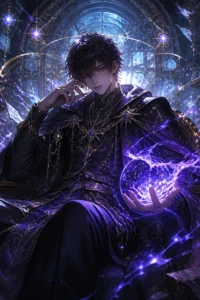
Even in the swaying dark, even with his profile cut by rain and reflected lamplight, he looked composed enough to have been carved into the carriage itself. Black coat. Black gloves. Black hair damp from the storm and brushed back from a face beautiful in the way cathedral angels were beautiful before time and smoke had made them terrible.
He had not spoken since the chapel.
Seraphina had spent the first mile telling herself she would not speak either.
She lasted until the carriage turned away from the river and began climbing the hill toward Ravenscroft House.
“Did my sister return home safely?”
Lucian’s eyes moved from the window to her face. In the dim, they were not gray or blue or black, but something colder and stranger, like moonlight on slate.
“Yes.”
One word. No softness. No explanation.
Seraphina curled her injured hand into her lap. Pain answered sharply, bright enough to clear her head. “You could have told me sooner.”
“You didn’t ask sooner.”
“You dragged me from my own wedding like a criminal being transported to the gallows.”
“It was not your own wedding.”
Her spine stiffened. “No?”
“It was ours.”
The word should have sounded intimate. From him, it sounded like a verdict stamped into wax.
Outside, the city thinned. Houses grew taller and farther apart, withdrawing behind walls crusted with ivy. Iron gates rose from the fog. The hill belonged to old money and older sins. Above them, barely visible through the rain, Ravenscroft House appeared piece by piece: first a line of chimneys like black fingers, then steep roofs slick with water, then a façade of pale stone and narrow windows glowing dimly as if lit from underwater.
Seraphina had seen drawings of the house in preservation archives. Ravenscroft House, built in the early eighteenth century on the ruins of a plague monastery, revised after the harbor fire, expanded after the famine riots. A place restored too many times by too many hands, all of them afraid to remove the old bones beneath the new skin.
In person, it looked less like a house than a sentence waiting to be carried out.
The carriage rolled through gates that opened before any hand touched them.
Seraphina leaned toward the window despite herself. The ironwork twisted into ravens and thorn vines, but among the decorative curls she saw smaller shapes: keys, eyes, and little crowned skulls hidden where a casual visitor would never notice. Rain ran over them like tears.
“Your family has subtle taste,” she said.
Lucian did not look away from her. “My family has never cared for subtlety.”
“Then the skulls are meant to be noticed?”
“By those who know where to look.”
Seraphina hated the small, unwilling spark of interest that lit in her chest. Secrets in stone. Messages in ornament. Threats disguised as craftsmanship. She had spent half her life reading walls, finding histories under soot and limewash. Ravenscroft House seemed to know that, and had already begun whispering.
The carriage stopped beneath a portico held up by four columns blackened from age or fire. Footmen appeared at once, their coats dark, their faces pale and careful. One opened the door on Lucian’s side first, then hers only after Lucian had stepped down.
Of course.
Seraphina gathered the torn hem of her wedding dress and descended into the rain.
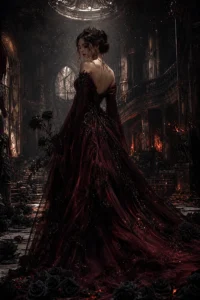
The dress had been chosen by the Ravenscrofts, or perhaps by their enemies. Ivory silk, high neck, long sleeves, delicate as an old burial shroud. The chapel dust had stained the train. Blood spotted one cuff. Her veil was gone, abandoned somewhere between altar and carriage floor. She hoped some rat made a nest of it.
Lucian offered his arm.
She looked at it.
“I can walk.”
“I know.”
His arm remained there, immovable.
Rain struck her lashes. Behind him, the servants waited with the tense patience of people watching a lit candle tilt toward gunpowder.
Seraphina placed her fingers on his sleeve.
His muscles tightened beneath the wool—not visibly, not enough for anyone else to notice, but she felt it. As if her touch had startled him. As if, after binding her to him with blood and law and threat, he had not expected the simple fact of her hand.
Then the great doors opened.
Warmth spilled out, threaded with beeswax, wet wool, woodsmoke, and beneath it all the faint metallic scent of old water trapped in stone. The entrance hall rose three stories high, its ceiling lost in painted shadows. A chandelier hung above them, not crystal but black glass, each drop shaped like a tear. Portraits lined the walls: Ravenscrofts in lace collars and military coats, in mourning veils and riding leathers, each painted with the same watchful arrogance.
But what Seraphina noticed first were the mirrors.
Or rather, the places where mirrors should have been.
Along the hall, gilt frames hung empty. Tall rectangles of dark backing remained inside them, their reflective glass removed. Over the mantel, a broad oval mirror had been shrouded in black cloth and pinned tight as a corpse’s face. Even the polished silver tray carried by a waiting maid had been dulled with a layer of wax so it reflected nothing but a smeared gray blur.
Seraphina’s gaze moved over the servants.
They avoided the empty frames the way people avoided graves.
A woman stood at the foot of the stairs. She was tall and narrow, with iron-gray hair coiled at the nape of her neck and a black dress so severely cut it seemed more uniform than clothing. Her hands were folded at her waist. Her face revealed nothing at all.
“Mrs. Finch,” Lucian said. “My wife.”
My wife.
Seraphina felt the words settle over the hall. Several servants lowered their eyes.
Mrs. Finch dipped into a curtsy shallow enough to be technically respectful and cool enough to draw blood. “Welcome to Ravenscroft House, Mrs. Ravenscroft.”
The name struck harder than it should have.
Seraphina Vale had climbed scaffolds with cracked ribs. Seraphina Vale had scraped soot from saints’ faces and slept beside hospital beds and bargained with pawnbrokers while smiling as if she still owned a soul. Seraphina Vale had been her father’s daughter and her sister’s shield.
Mrs. Ravenscroft sounded like a woman buried alive beneath another family’s stone.
“Vale,” she said.
Lucian’s head turned slightly.
Mrs. Finch’s eyebrows did not move, but the air around her sharpened. “Pardon?”
“Mrs. Vale will do.” Seraphina smiled with all her teeth. “For tonight.”
Somewhere to the left, a footman inhaled too quickly.
Lucian’s fingers brushed the inside of Seraphina’s wrist, where her pulse betrayed her. A warning. Or a restraint.
Mrs. Finch looked to him.
He said nothing for three long seconds.
Then, “You will address her as she asks.”
Mrs. Finch lowered her chin. “Of course, sir.”
Seraphina did not look at Lucian. She refused to give him the satisfaction of seeing her surprise.
“Her rooms?” he asked.
“Prepared in the east suite.”
“Not the bridal chamber?”
The question came from the shadow near the staircase.
Seraphina had not seen the man standing there until he moved. He was perhaps thirty, slim and handsome in a ruined sort of way, with fair hair too long at his collar and a mouth designed for either poetry or lies. He leaned against the banister with a glass in hand, though the hour was long past polite drinking and long before desperate drinking. His smile lifted when Seraphina looked at him.
“How disappointing,” he said. “I had wagered our Lucian would observe tradition at least once before death.”
Lucian’s expression did not change. “Adrian.”
So this was the cousin.
Adrian Ravenscroft. She remembered the name from whispers at the chapel. A man whose debts were forgiven too often, whose scandals became other men’s imprisonments, whose charm had the gleam of a knife used for dinner.
Adrian descended two steps and bowed extravagantly. “Cousin’s wife. Bride of the blood ring. Survivor of the most romantic execution I’ve ever attended.”
“You attend many executions?” Seraphina asked.
“Only the fashionable ones.”
“Then I’m honored.”
His smile brightened. “Oh, she bites.”
Lucian’s voice cut across the hall like a blade through silk. “Go to bed.”
Adrian tipped his glass toward him. “Alone?”
The footmen turned to stone.
Seraphina felt Lucian’s arm beneath her hand become something inhumanly still.
Adrian seemed delighted by it. “Forgive me. Wedding nights make me sentimental.” His gaze slid to Seraphina’s bandaged palm. “And nostalgic.”
“Adrian,” Mrs. Finch said quietly.
Not a reprimand. A plea.
Adrian’s amusement flickered, just once, then returned. “Very well. I leave the bride to her tower.” He climbed the stairs backward for two steps, eyes still on Seraphina. “Avoid the west corridor, Mrs. Vale. It dislikes pretty things.”
Then he vanished into the dark above.
Seraphina turned to Lucian. “Does everyone in this house speak in riddles, or is that a family defect?”
“Both.”
“Comforting.”
“You were warned not to trust anyone.”
“Including you.”
He looked at her then, and the noise of the rain seemed to thin around them. “Especially me.”
Mrs. Finch began up the staircase, and Seraphina had no choice but to follow. Lucian walked at her side, though he kept just enough distance that their sleeves did not touch. Servants moved around them with soundless efficiency, carrying trunks she had not packed and did not recognize. Her entire life had been reduced to what the Ravenscrofts permitted through their doors.
The staircase was wide enough for four people to climb abreast. Its banister was carved with ravens feeding on vines of roses. No, not roses. On closer inspection, they were hearts split open, arteries curling into leaves.
“Who carved this?” she asked before she could stop herself.
Mrs. Finch glanced back. “A Flemish craftsman, in 1713.”
“He hated someone.”
Lucian’s mouth almost moved. Not a smile. Something ghosting near it, then gone. “My great-great-grandmother, according to family letters.”
“Did she deserve it?”
“Undoubtedly.”
They reached the landing. The corridor stretched left and right, lit by wall sconces shaped like black lilies. Paintings lined one side; tall windows the other. Rain rattled against the glass, silvering the darkness beyond.
Seraphina slowed.
At the far end of the right-hand corridor stood a pair of double doors.
Unlike the others, these were made of dark oak banded with iron. A chain threaded through both handles and fastened with a lock the size of a fist. Above them, the arch was carved with words in Latin, but soot and age had eaten half the inscription. The sconces nearest those doors were unlit.
No servant approached that end.
Even Mrs. Finch, rigid and unflappable, kept her gaze carefully away.
Seraphina’s fingers itched.
Lucian noticed.
“No.”
She blinked. “I didn’t ask.”
“You were about to.”
“Perhaps I simply admire doors.”
“Admire another one.”
“What’s behind it?”
Mrs. Finch stopped walking.
The silence that followed was not natural. It had weight. It pressed against the walls, thick with all the answers no one wanted spoken.
Lucian looked at the locked doors, and for the first time since the chapel, something moved through his face too quickly to name. Not fear. Not grief. Something older than both.
“The west wing is closed,” he said.
“Closed wings usually contain dust, old furniture, family shame.” Seraphina tilted her head. “Which is it?”
“Yes.”
She laughed once, despite herself. It came out sharper than humor. “That isn’t an answer.”
“It is the only one you’ll get tonight.”
“And tomorrow?”
His gaze returned to her. “Tomorrow I’ll tell you the same thing in daylight.”
“How efficient.”
Mrs. Finch resumed walking, quicker now.
Seraphina followed, but the locked doors remained in the corner of her vision. The chain caught what little light reached it, dull and wet-looking, though no rain could touch it. As she passed the corridor leading to it, a draft slid across her ankles. Cold. Not the ordinary cold of old houses, but cellar cold. Crypt cold.
For an instant, beneath the smell of beeswax and rain and woodsmoke, she caught another scent.
Rotting lilies.
Then Lucian stepped between her and the corridor, blocking it from sight.
“Come,” he said.
It was not a request.
Her suite was at the far end of the east corridor. Mrs. Finch opened the door to a chamber warmed by a low fire and dressed in muted colors: gray silk walls, dark green velvet curtains, a carved bed large enough to make any occupant look like an offering. Fresh candles burned on the mantel. A copper tub steamed near the hearth. Someone had placed a vase of white roses on the dressing table.
Every mirror had been removed.
Seraphina stood just inside the threshold, feeling the room gather itself around her.
There should have been a cheval glass beside the wardrobe. Its shadow remained on the wallpaper, a tall pale shape where the silk had not faded. Above the washstand, two hooks protruded uselessly. The dressing table had an oval space where a mirror had clearly once stood, but now held only the roses. Their petals were too white, their scent too sweet.
“Is vanity forbidden here?” she asked.
Mrs. Finch’s mouth tightened. “Mirrors are not kept in the occupied rooms.”
“How do you dress?”
“Carefully.”
Seraphina looked at Lucian. “Is there a reason?”
“Yes.”
“You have a gift for making conversation feel like pulling nails.”
“And you have a gift for finding nails.”
Mrs. Finch gestured toward the tub. “Hot water, clean linens. Your trunks have been placed in the dressing room. If you need assistance undressing—”
“I don’t.”
The older woman’s gaze flicked over the blood on Seraphina’s sleeve, the torn train, the bandage wrapped around her palm. “As you wish.”
She curtsied again and left, taking the waiting maid with her. The door closed softly.
Seraphina and Lucian remained alone.
The fire cracked.
Rain whispered against the windows.
Somewhere deep in the house, a door shut, the sound traveling through stone and timber like a heartbeat under floorboards.
Seraphina reached for the buttons at her wrist and found her injured hand clumsy. “If you’ve come to claim some barbaric husbandly right, I suggest you consider how many sharp objects a restorer carries under her skirts.”
Lucian’s gaze dropped—not to her body, but to the hand she had pressed against the seam of her gown. “Do you?”
“Wouldn’t you like to know.”
“I would.”
The quiet way he said it sent a disloyal warmth through her, gone as quickly as it came. She hated that his voice could do that. Hated more that he seemed aware.
He crossed the room.
She stepped back at once.
He stopped.
For one strange moment, something like irritation flashed in his eyes—not at her, but at himself.
“Your hand,” he said.
“Still attached.”
“Let me see it.”
“No.”
His jaw worked. “Seraphina.”
Her name in his mouth was a different thing than Mrs. Ravenscroft. More dangerous. Less easily resisted.
“Don’t.”
“Don’t what?”
“Say my name as if you have any right to it.”
He went still again, that terrible stillness that made the whole room seem to hold its breath. Then he removed his gloves finger by finger and set them on the mantel. His hands were long, pale, elegant. Not soft. There were old scars across his knuckles, thin silver lines near the bones.
“I have every legal right.”
“Law and right are not the same thing.”
His eyes lifted. “No. They are not.”
That answer stole whatever retort she had prepared.
He moved more slowly this time, giving her space to refuse. When he reached her, he did not touch her wrist. He held out his hand, palm up.
Seraphina stared at it.
Everything in her wanted to spit defiance until he left. Everything wiser knew infection cared little for pride. The cut still burned. The ring had sliced deep when it broke, and he had pressed her bleeding hand to his own before the altar while the silent chapel watched.
She placed her hand in his.
The contact struck her harder than it should have. His skin was warm. Not corpse-cold, not marble, not the chill myth the city wrapped around him. Warm, and careful. He unwound the bandage with a concentration that made her throat tighten for reasons she refused to examine.
The wound opened across her palm, angry and dark.
Lucian frowned.
“It’s nothing,” she said.
“It is not nothing.”
“I’ve had worse.”
“I know.”
Her eyes snapped to his face. “How?”
He did not answer.
Of course he did not.
He reached into his coat and withdrew a small silver case. Inside were gauze, a vial of amber liquid, and a curved needle threaded with black silk.
Seraphina stared. “Do you always carry a surgeon’s kit to weddings?”
“Only family weddings.”
“That was nearly a joke.”
“Don’t encourage it.”
Despite herself, she watched his mouth again for that almost-smile. It did not come.
The liquid stung like fire. Seraphina hissed between her teeth but did not pull away. Lucian’s thumb pressed lightly against the heel of her hand, steadying her. His head bent over her palm. A lock of black hair fell forward, breaking the severe line of him.
He stitched with practiced precision.
“Who taught you that?” she asked.
“Necessity.”
“Necessity has a name.”
“Many.”
She studied him while he worked. The strong bridge of his nose. The dark lashes. The faint mark near his temple, half-hidden by hair, as if something had once split the skin there. He looked too young to carry the weight he did and too old to ever be relieved of it.
“Did you kill my father?” she asked.
The needle paused.
The fire snapped once, loud as a pistol shot.
Lucian looked up.
Close like this, his eyes were not colorless after all. They were gray, yes, but flecked with blue so dark it seemed bruised.
“No.”
“Did you order it?”
“No.”
“Do you know who did?”
The room changed.
Nothing moved. No sound announced it. Yet the shadows along the ceiling seemed to lean closer, and the locked west wing might as well have been standing between them.
Lucian pulled the stitch through her skin. “Ask me again when you decide whether you want revenge or truth.”
0 Comments