Chapter 2: The Ash Prince
by inkadminRain stitched silver wounds down the windows of the Blackthorne car.
Seraphina sat with her spine straight, her wedding dress spilling like a dead swan across the black leather seat, and tried not to look at the man beside her.
Cassian Blackthorne had not touched her since the chapel.
Not when the priest’s trembling hands bound the ribbon around their wrists. Not when her father kissed her cheek with lips cold as marble. Not when the old families lifted their crystal glasses and drank to peace with blood still wet beneath their fingernails. Not even when Cassian had leaned close enough for the heat of his breath to graze her ear and whispered, I know what they buried in you.
Those words had followed her into the car like a living thing.
She could still feel them moving beneath her skin.
The city slid past in fractured reflections: gothic towers, gold-lit hotels, rain-glossed avenues, the black ribs of elevated train lines cutting through fog. St. Orison never slept. It only watched from behind velvet curtains and iron gates, its old-money families feeding on rot and ritual while pretending their hands were clean. Tonight every street seemed to know she had been given away. Every lit window became an eye. Every church bell in the distance sounded like a warning.
Cassian’s profile was carved from shadow and rainlight. He wore his wedding suit like armor, the black fabric immaculate despite the violence of the storm. A thin line of blood marked one knuckle where his ring had bitten too deep during the ceremony. The signet on his hand caught the passing city lights—a blackthorn branch curled around a crown of ash.
The Ash Prince.
Children of the underfamilies whispered the name like a curse. Men who had killed for money lowered their voices when speaking of him. Heir to Blackthorne House, executioner of debts, favorite son of a dynasty built on burned churches and vanished enemies.
Her husband.
The word sat inside Seraphina like poison.
Across from them, behind the privacy divider, the driver said nothing. The engine purred, nearly soundless. The tires cut through puddles with a soft hiss. She could smell leather, rain, Cassian’s cologne—smoke, bitter orange, something darkly resinous that reminded her of the chapel incense used at funerals.
She folded her gloved hands in her lap to hide how tightly her fingers trembled.
“If you stare any harder,” Cassian said without turning his head, “you’ll start a fire.”
His voice was low and smooth, almost bored.
Seraphina looked away at once, furious with herself for flinching. “I was wondering how long you could sit in silence before needing to hear yourself threaten someone.”
The corner of his mouth moved. Not quite a smile. Something colder.
“That wasn’t a threat.”
“No?”
“No.” He finally turned, and the full weight of his gaze struck her. Grey eyes, pale as stormwater, framed by lashes too dark for softness. “If I threaten you, Seraphina, you’ll know.”
Her name in his mouth sounded stolen.
She held his gaze because looking away felt too much like kneeling. “How comforting.”
“Comfort isn’t one of the vows.”
“Neither is cruelty.”
His eyes dropped, briefly, to the ribbon still tied around her wrist—the wedding binding, crimson silk damp where the rain had touched it as they left the chapel. The other end had been cut from his wrist after the ceremony with a ceremonial blade, as custom demanded. Blood alliance severed and sealed. A pretty tradition for families that preferred symbolism over honesty.
“Cruelty is usually implied,” Cassian said.
Seraphina’s nails bit through the satin of her gloves. “My father said you wanted this marriage.”
“Your father says many things.”
“Did you?”
For a moment, the car seemed to grow quieter. Rain drummed harder overhead. Cassian leaned back against the seat, studying her as if she were a ledger with missing entries.
“Want is a childish word.”
“Then choose an adult one.”
His gaze sharpened. She saw the instant he reassessed her—not as the painted doll delivered to him in bridal white, but as something inconvenient beneath the lace. Her father had made sure her obedience was immaculate in public. Chin lowered. Hands folded. Voice soft. A Vale daughter did not interrupt. Did not question. Did not bare her teeth unless instructed.
But her father was no longer in the car.
Cassian’s attention lingered like a blade against her throat.
“I accepted,” he said.
Seraphina laughed once, quietly, because the alternative was screaming. “How romantic.”
“Romance is expensive theater.”
“And what am I?”
“Collateral.”
The word landed cleanly. No hesitation. No apology.
Something hollow opened beneath her ribs.
She had known. Of course she had known. Her entire life had been a series of locked rooms preparing her for this exact moment: etiquette lessons, language tutors, dance instructors, lessons in which poisons paired best with which wines, lectures about the precise angle of a wife’s smile when men discussed murder over dinner. She had been polished, appraised, and hidden until her father could spend her.
Still, hearing Cassian say it hurt in a way she refused to show.
She smoothed an imaginary wrinkle from her skirt. “Collateral can depreciate.”
“Not if properly kept.”
Her eyes snapped back to him. “Kept?”
“You’re very quick for someone raised in a cage.”
There it was again—the sense that he knew too much. Not gossip. Not the obvious facts any family spy could gather. Something more intimate, more invasive.
She tilted her head. “And you’re very arrogant for a man who bleeds the same color as everyone else.”
A slow silence followed.
Then Cassian laughed.
It was not warm. It was not kind. But it transformed his face for half a heartbeat, cracking the marble to reveal something alive beneath. Dangerous, yes. Beautiful in the way lightning was beautiful before it split a tree down the middle.
“Careful,” he said.
“That one sounded like a threat.”
“No.” His smile faded. “That was advice.”
The car left the commercial heart of the city and climbed toward the old northern district, where the streets narrowed and the mansions hunched behind iron fences like beasts guarding ancestral sins. Gaslamps burned along the sidewalks despite the modern grid, their flames shivering in glass throats. Dead leaves clogged gutters. Stone angels watched from rooftops, their faces eaten by weather.
Blackthorne House appeared through the rain like a ruin refusing to die.
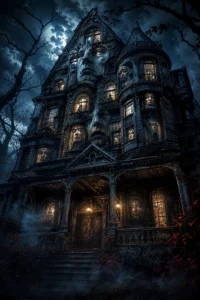
It crowned the hill above the river, a sprawling gothic mansion of black stone and steep roofs, its turrets piercing the storm clouds. Ivy strangled the walls in thick, glossy ropes. Gargoyles crouched beneath the eaves with mouths open to drink the rain. Dozens of windows stared out, most dark, a few lit amber from within. The place looked less built than unearthed, as though the city had tried to bury it and failed.
The gates opened without a sound.
Seraphina’s pulse beat once, hard.
Beyond the ironwork, the drive curved through overgrown gardens. Statues lined the path—saints with broken hands, veiled women, hounds with ruby eyes set into their stone skulls. The headlights swept across a fountain choked with black leaves. At its center stood a woman carved from pale marble, her arms lifted not in welcome but surrender. Rain ran down her face like endless tears.
Seraphina stared until the car rolled past.
Something flickered.
Not memory, exactly.
A smell: smoke and wet earth.
A child crying behind a wall.
A woman’s voice, hoarse and urgent—
Don’t say your name. No matter what they ask you, little star, don’t say your name.
Seraphina inhaled sharply.
Cassian’s head turned.
She forced the vision down, shoving it into the locked place where so many strange fragments lived. Memories that did not belong to the childhood her father described. Rooms she had never seen. Hands that had held her differently. Songs no Vale nursemaid had ever sung.
“Problem?” Cassian asked.
“Your house is hideous.”
“It grows on people.”
“Like mold?”
“Like grief.”
The answer slipped out too quickly, too honestly.
For the first time, Seraphina saw something pass through his expression that was not calculation. It was gone before she could name it, swallowed by the dark.
The car stopped beneath a porte cochère held up by pillars carved into thorned trunks. A pair of servants waited at the top of the steps, black umbrellas angled against the rain. No smiles. No welcome garlands. No household rushing out to greet the new bride. Only watchful faces, pale in the lamplight.
The driver opened Cassian’s door first.
Of course.
Cassian stepped out into the rain and buttoned his jacket with one hand. The servants lowered their heads.
“Mr. Blackthorne.”
Not sir. Not my lord, though the old houses loved their antique vanities. His name itself seemed title enough.
Then Cassian turned back and offered Seraphina his hand.
She looked at it.
Long fingers. Scar across the thumb. A ring that could buy a judge, bury a witness, or seal a death warrant.
“I can walk,” she said.
“I didn’t ask if you could.”
The rain hammered the car roof. Her dress was too wide, too delicate, too perfectly made for a room full of witnesses and utterly useless for escaping a vehicle with dignity. Cassian knew it. His hand remained extended, patient as a trap.
She placed her gloved fingers in his.
His skin was warm.
That annoyed her most.
He helped her from the car without pulling, without gripping too hard, without giving her any small cruelty to cling to. She hated him for that restraint. It left her anger with nowhere to go.
The moment her satin shoes touched the wet stone, a gust of wind shoved rain beneath the portico. Her veil snapped back. She stumbled on the hem of her dress.
Cassian caught her at the waist.
For one suspended second, she was pressed against him, her hands braced on his chest, his fingers spread over the narrowest part of her. Beneath his jacket, his body was unyielding, all controlled strength and heat. She smelled smoke again—not cologne this time, but something embedded deeper, as if fire had marked him and never fully left.
His gaze dropped to her mouth.
Seraphina’s breath stopped.
Then his fingers tightened once, not possessive, not gentle—warning—and he set her away from him.
“Careful, Mrs. Blackthorne.”
Her new name cut colder than rain.
“Don’t call me that.”
The servants heard. She saw it in the almost invisible shift of their eyes.
Cassian’s expression did not change. “You prefer collateral?”
Heat climbed her throat.
He turned and climbed the steps.
Seraphina followed because there was nowhere else to go.
The doors of Blackthorne House opened before Cassian touched them. Inside, the foyer rose three stories high, swallowed in shadow and candlelight. A chandelier hung overhead, not crystal but iron and bone-white glass, each flame trembling inside a cage. The floor was black marble veined with grey. Portraits crowded the walls—severe men, unsmiling women, children painted too pale, all framed in tarnished gold. Their eyes followed her in the way old portraits always seemed to, but here the effect felt less like artistry and more like surveillance.
The air smelled of beeswax, rain-damp stone, old books, and underneath it all, ash.
A line of servants stood along the left side of the foyer.
Not many. Fewer than a house this size required. A house like this should have been alive with footmen, maids, security, cooks, groundskeepers. Instead, perhaps twelve people watched her enter as though she were a lit match carried into a room full of oil.
At their head stood a woman in her sixties, tall and spare, her iron-grey hair twisted into a knot so severe it seemed capable of drawing blood. She wore a black dress fastened to the throat with a silver brooch shaped like a thorn. Her eyes were dark and deeply set, the eyes of someone who had seen too many bodies carried through halls and had learned not to ask which stains would come out.
“Mrs. Blackthorne,” she said.
Seraphina’s fingers curled.
Cassian noticed. Of course he did.
“This is Mrs. Hawthorne,” he said. “She runs the house.”
Not welcomes you. Not will help you settle. Runs the house. A warning disguised as an introduction.
Mrs. Hawthorne inclined her head. “Your rooms have been prepared.”
“My rooms,” Seraphina repeated.
The housekeeper’s expression remained perfectly still. “Yes, madam.”
Cassian removed his gloves finger by finger. “Everything you require will be provided. Everything you do not require will be denied.”
Seraphina turned toward him. “Is that the Blackthorne version of hospitality?”
“It’s the honest version.”
“How refreshing. I’ll be sure to embroider it on a pillow.”
One of the younger maids made a strangled sound and immediately lowered her gaze.
Cassian’s eyes moved to the girl. The foyer temperature seemed to drop.
Seraphina stepped forward before she thought better of it. “If you punish her for having ears, I’ll consider it poor manners.”
The maid went white.
Mrs. Hawthorne’s mouth tightened.
Cassian looked back at Seraphina, and there—again—that flicker of reassessment.
“You collect strays?” he asked.
“Only when men make themselves easy to dislike.”
The silence that followed was sharp enough to break glass.
Then Cassian handed his gloves to Mrs. Hawthorne. “Show her the east wing.”
“Yes, Mr. Blackthorne.”
“And the rules.”
Seraphina hated the way the word slid through the foyer, invisible chains clinking behind it.
She lifted her chin. “I prefer hearing rules from the person arrogant enough to invent them.”
Cassian looked toward the staircase, then back at her. “Very well.”
Mrs. Hawthorne’s eyes flashed—not surprise exactly. Concern.
Cassian moved past Seraphina, close enough that his sleeve brushed hers. “Come.”
The command settled over the servants like dust.
Seraphina stayed where she was.
Cassian paused at the foot of the staircase.
Slowly, he looked back.
Every servant in the foyer seemed to stop breathing.
Seraphina felt the old training rise in her like a hand around her throat. Obey in public. Never invite correction where others can witness it. A daughter’s defiance is a father’s weakness. A wife’s defiance is a husband’s shame.
She thought of her father’s fingers gripping her arm before the ceremony hard enough to bruise. Thought of his smile as he gave her away. Thought of Cassian’s whisper.
I know what they buried in you.
She gathered the skirt of her wedding dress in both hands and climbed the stairs without bowing her head.
The east wing smelled colder than the foyer. The corridor stretched long and narrow, lined with dark paneling and mirrors clouded by age. Wall sconces cast amber pools of light that failed to reach the ceiling. Closed doors passed one after another, most locked, some with brass plates polished by years of hands. A library. A music room. A conservatory whose glass doors had been chained shut from the outside. A portrait gallery draped in white sheets, as though the dead had become too exhausting to look at.
Seraphina noted every turn.
Left at the stag’s head. Right past the cracked blue vase. Twelve steps between the portrait of the woman in green and the door with the missing handle.
Cassian walked beside her, not ahead, not behind. A jailer who understood that cages were more elegant when the prisoner entered voluntarily.
“You’re counting,” he said.
Seraphina kept her gaze forward. “Am I?”
“Exits. Doors. Distance.”
“Perhaps I admire architecture.”
“You don’t.”
“You don’t know what I admire.”
“I know you hate this house.”
“Everyone with eyes hates this house.”
“And yet your pulse quickened at the fountain.”
She nearly missed a step.
His hand moved as if to steady her, then stopped before touching her.
She looked at him. “Were you watching my pulse?”
“I watch everything.”
“That sounds exhausting.”
“It keeps people alive.”
“And does it make them happy?”
“Happiness gets people killed.”
The answer was too immediate. Too old.
They reached a set of double doors at the end of the corridor. Mrs. Hawthorne, who had followed at a discreet distance, stepped forward with a ring of keys. The sound of them scraping together made Seraphina’s stomach tighten.
The housekeeper unlocked the door.
The room beyond had clearly been prepared for a bride.
That made it worse.
A fire burned low in a carved stone hearth. Candles glowed on the mantel and beside the bed. The bed itself was enormous, framed in black wood with posts carved into twisting thorns, draped in gauze curtains the color of smoke. White roses filled crystal vases on every surface, their petals too perfect, their scent thick and cloying. A vanity waited near tall windows overlooking the storm-drowned gardens. Wardrobes stood open to reveal rows of dresses—black, ivory, deep wine, forest green—none of them hers.
Her trunks from Vale House sat at the foot of the bed.
Already searched.
She knew because the brass clasps had been closed wrong.
A small, cold smile touched her mouth.
Cassian saw that too.
“Something amusing?”
“Whoever went through my things was careless.”
Mrs. Hawthorne’s face did not change, but one of her hands tightened around the keys.
Cassian stepped into the room. “What makes you think anyone did?”
Seraphina walked to the nearest trunk and touched the clasp. “The left latch sticks unless you lift it while pressing down on the lid. Whoever closed it forced it. There’s a scratch.” She looked up. “Also, the lavender sachet was placed on top. I keep it beneath the nightgowns because my maid overfills it and the scent gives me headaches.”
A pause.
“Your maid is loyal,” Cassian said.
“You say that as if it’s a flaw.”
“It’s a vulnerability.”
“Only to people who mistake affection for weakness.”
His gaze held hers.
Something passed between them then, too quick to name. Not softness. Never that. Recognition, perhaps. The unpleasant realization that they were not speaking only about a maid.
Cassian turned to Mrs. Hawthorne. “Leave us.”
The housekeeper hesitated.
It was almost nothing. A breath. A fraction.
But Cassian’s eyes cut to her.
“Now.”
Mrs. Hawthorne bowed her head. “Yes, Mr. Blackthorne.”
The door closed behind her with a soft, final click.
Seraphina and Cassian were alone.
The room seemed to shrink around them.
Rain scratched at the windows. Firelight climbed the walls in orange tongues. The roses perfumed the air until breathing felt intimate, unwilling. Seraphina stood near her violated trunk in a wedding dress chosen by her father and paid for by men who had toasted her sale.
Cassian moved to the mantel and poured amber liquor from a crystal decanter into a glass. He did not offer her any.
“The rules,” he said.
“At last. I was afraid the romance would overwhelm me.”
He drank. His throat moved with the swallow. “You will not leave Blackthorne House without my permission.”
“No.”
His glass paused halfway to the mantel.
Seraphina’s heart battered her ribs, but her voice remained even. “I thought we were listing rules. That was mine.”
He turned slowly.
“You misunderstand your position.”
“I understand it perfectly. My father gave you a wife to purchase peace. But if I’m valuable enough to end a war, I’m valuable enough to negotiate terms.”
Cassian’s expression went still in a way that frightened her more than anger would have.
“Negotiate,” he repeated.
“Yes.”
“With me.”
“Unless there is someone more reasonable in this house.”
“There isn’t.”
“Then you’ll have to do.”
He set the glass down very carefully.
Seraphina felt the instinctive warning of an animal sensing a predator shift from watchful to interested.
Cassian crossed the room toward her. He did not hurry. Each step was measured, quiet against the carpet. Her body wanted to retreat; pride nailed her feet to the floor.
He stopped close enough that the hem of her dress brushed his polished shoes.
“What terms would you like, wife?”
The last word was deliberate.
She refused to let it wound her again. “My maid brought from Vale House.”
“Denied.”
“Correspondence with my sister.”
“You don’t have a sister.”
Her mouth went dry.
“Cousin,” she corrected too quickly. “Livia.”
Cassian’s gaze narrowed.
She cursed herself silently. There were gaps in her when fear moved too fast. Places where false family trees tangled with instinct. Livia Vale was her cousin. Not sister. Never sister. Her father had made that clear enough.
Hadn’t he?
Cassian leaned slightly closer. “Interesting mistake.”
“It’s been a long night.”
“It has.”
“Correspondence,” she pressed. “Supervised if your paranoia requires it.”
“My paranoia has kept this family alive for three generations.”
“And yet here you are, marrying into mine.”
His eyes cooled. “You will not write to anyone unless I approve the words before they leave this house.”
“How generous.”
“You will not enter the west wing.”
“Why?”
“Because I said not to.”
“A compelling argument. Did you learn it at tyrant school?”
“You will not question the staff about Blackthorne affairs.”
“Do Blackthorne affairs include the number of locked doors? Because I may lose count.”
“You will not receive visitors.”
“Will I be fed, or is starvation also implied in the vows?”
“You will not provoke me in front of my household again.”


0 Comments