Chapter 1: The Bride in Black
by inkadminOn the morning of Seraphina Vale’s wedding, her father handed her a black veil and told her not to scream when her husband kissed her.
The veil lay across his gloved palms like a strip of midnight cut from the throat of the sky. Rain dragged silver claws down the tall windows behind him, blurring the city into wet smears of cathedral spires, iron balconies, and distant black towers crowned with red warning lights. Below, the Vale estate crouched above the river like a mausoleum pretending to be a mansion, its stone angels weeping water from their blind eyes.
Seraphina stared at the veil.
It was not lace. Lace was delicate. Lace was something mothers chose with trembling smiles and sisters held up to the light. This was netted silk so fine it looked like smoke, embroidered along the edges with tiny black beads that swallowed the morning’s dimness and gave nothing back.
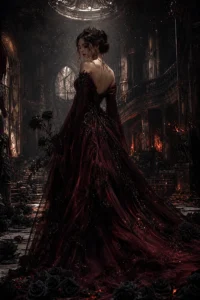
Her wedding dress matched it.
Black satin. High throat. Long sleeves. A narrow waist pulled so tight the bones of her corset had already begun carving their demands into her ribs. The gown spilled around her like oil, pooling at her feet in glossy waves. There were no pearls. No white roses. No golden combs for her hair. Only onyx pins, a velvet ribbon at her throat, and the small antique dagger her father had insisted be sewn into a hidden pocket beneath her skirt.
Not for protection. Seraphina knew better than that.
In House Vale, weapons were ornaments until someone powerful gave permission for blood.
Her father’s study smelled of cigar ash, old paper, and the blue lilies wilting in the marble vase beside his desk. The lilies were for her mother. They had been replaced every morning since Lucienne Vale’s death twelve years ago, always fresh, always pale, always arranged by servants who lowered their eyes as if grief could hear them.
Or as if Lucienne could.
“Midnight,” her father said.
Seraphina lifted her gaze from the veil to his face.
Valerius Vale stood as he always did, perfectly erect, his silver hair combed back, his black suit immaculate, the crest of their family—a thorned crown encircling a sleeping serpent—glinting at his cuff. Age had not softened him. If anything, it had refined him down to the cruel essentials: thin mouth, cold eyes, hands that could bless or break with equal elegance.
“You said after All Saints’ Day,” Seraphina said.
Her voice came out steady. She was proud of that. She had learned steadiness before she had learned cursive, before piano, before Latin prayers, before the names of the men who smiled at dinner and ordered executions before dessert.
“Circumstances have changed.”
“Circumstances,” she repeated.
His eyes sharpened. “Do not make the mistake of thinking repetition is wit.”
Seraphina folded her hands in front of her. Her nails had been painted the color of dried wine. “Then don’t make the mistake of thinking obedience is stupidity.”
The rain thickened against the glass.
For one breath, one dangerous little breath, something like anger moved through the room. The guards at the door did not shift, but Seraphina felt their attention tighten around her throat. Men with guns always listened better when women stopped sounding afraid.
Valerius smiled.
It would have been more comforting if he had struck her.
“I have indulged your education,” he said softly. “Your books. Your languages. Your little talent for mathematics and accounts. Your habit of reading people’s faces as if they were ledgers waiting to be balanced. Do not confuse indulgence with freedom.”
“I wasn’t confused.”
“Good.” He stepped closer and held the veil higher. “Then you understand what happens tonight.”
Seraphina understood too much and not enough.
For months, whispers had gathered in the walls of the estate. Blackthorne shipments burned on the southern docks. Vale couriers vanished from rain-slick alleys and reappeared in pieces. Men with old names and new guns bled into gutters beneath saints’ statues. The city of Veyr had always been ruled by bloodlines and debt, but lately every invitation, every funeral bell, every glass raised at the private clubs had carried the same metallic taste.
War.
And now peace, apparently, required a bride.
“Cassian Blackthorne is not a man,” her cousin Marta had whispered three nights ago while pinning Seraphina’s hem. Marta’s fingers had trembled so badly she pricked her twice. “He’s what happens when a grave learns to walk.”
The Ash Prince, they called him.
The Blackthorne heir with smoke-gray eyes and hands that had strangled a traitor in the nave of Saint Orison’s while choirboys sang vespers. The boy whose mother had died screaming in a fire that three families still denied starting. The man who never raised his voice because everyone else lowered theirs for him.
Seraphina had never met him.
She had seen him once through the rain-spotted window of a moving car. A tall figure in a black coat beneath the awning of the Obsidian Club, cigarette ember glowing briefly between his fingers. Men had circled him like wolves pretending not to be dogs. He had looked up as her car passed, and for a second she had felt—absurdly, impossibly—as if he had seen through tinted glass, through silk and bone and all the locked doors of her life.
That memory had returned often in the nights since.
Not because of his face. She barely remembered his face.
Because of the way her own pulse had recognized danger before her mind had named it.
“You will be respectful,” Valerius said. “You will be quiet. You will not provoke him.”
“And if he provokes me?”
“You are clever enough to survive a moment of discomfort.”
“Is that what we’re calling marriage now?”
His hand moved so fast she only saw the blur after the sting.
Seraphina’s head turned with the force of the slap. Heat bloomed across her cheek, bright and humiliating. The guards looked at the floor. The lilies shivered in their vase.
She did not lift a hand to her face.
Her father’s breathing remained even, but a faint flush had risen under his skin. “You will not shame me today.”
There it was. Not you will not suffer. Not you will not be hurt. Shame was the sin. Pain was merely weather.
Seraphina looked back at him and smiled with the side of her mouth that didn’t ache.
“Of course, Father.”
Something flickered in his eyes. Suspicion, perhaps. Or the memory of another woman who had smiled that way before she disappeared into a coffin no one had been allowed to open.
He draped the veil over her head.
The world darkened.
Through the black gauze, her father became a pale, sharpened shape. The study blurred at the edges. Seraphina’s own breath warmed the fabric near her lips.
“There are worse things than fear,” he said.
She tasted blood where her teeth had cut the inside of her cheek. “I know.”
“No,” Valerius said, leaning close enough that she caught the mint and smoke on his breath. “You don’t. But Cassian Blackthorne does.”
A knock fell against the door.
Not a servant’s knock. Not the light double tap of a maid or the careful pause of a footman. Three measured blows, slow as a funeral drum.
One of the guards opened it.
Octavian Vale entered without waiting to be announced. Seraphina’s eldest brother looked as though he had been assembled from their father’s spare parts and polished to a more fashionable cruelty. Dark hair, wolfish beauty, a scar slicing through one eyebrow. His suit was midnight blue, his tie black, his smile careless.
“The Blackthornes have arrived,” he said.
The temperature in the room seemed to drop.
Valerius checked his watch. “Early.”
“They brought a priest, twelve witnesses, and enough armed men to invade a province.” Octavian’s gaze flicked to Seraphina beneath the veil. “Our bride looks appropriately doomed.”
“How thoughtful of you to notice,” Seraphina said.
Octavian grinned. “Careful, little saint. Husbands rarely appreciate teeth.”
“Then perhaps mine should avoid putting his fingers in my mouth.”
One of the guards coughed into his fist.
Valerius’s stare cut across the room, and silence snapped back into place.
Octavian laughed softly. “I almost pity him.”
“You pity no one,” Seraphina said.
“True.” He walked to the sideboard and poured himself a drink though it was not yet noon. “But I am entertained by unusual risks.”
“Enough,” Valerius said. “Where is Cassian?”
Octavian’s smile thinned. “In the west hall. Speaking with Uncle Severin.”
A muscle moved in their father’s jaw. “About what?”
“He asked to see the chapel.”
Valerius went very still.
Seraphina noticed because she had been trained to notice stillness. Stillness was where men hid knives. Stillness was where rooms decided who would leave alive.
“The chapel is prepared,” her father said.
“He asked to see it alone.”
“No Blackthorne walks alone in my house.”
“He does not seem overly concerned with what we permit.” Octavian lifted his glass in a mock toast. “He has that in common with our bride.”
Valerius turned to Seraphina. “Remain here.”
It was an order. All of them were orders, even when shaped like ordinary words.
He left with Octavian and two guards, the door shutting behind them with a soft click.
Seraphina stood alone in the study, veiled and bruised, listening to the rain and the distant murmur of men negotiating her body as if it were a bridge between territories.
The dagger beneath her skirt pressed cold against her thigh.
She should not have moved.
She moved immediately.
The study had three doors. One led to the hall, one to her father’s private archive, and one—hidden behind a bookcase of false theological histories—to the servant passage that ran like a vein through the old bones of the estate. Seraphina knew because when she was nine, she had spent six months mapping the house in charcoal behind loose nursery wallpaper. She had been a lonely child. Lonely children either invented friends or escape routes.
Seraphina had never trusted imaginary things to save her.
She crossed to the bookcase, pressed the bronze serpent’s eye on the family crest carved into the shelf, and slipped through the gap that opened with a sigh of dust.
The passage swallowed her in narrow darkness. Her skirts brushed stone. Somewhere overhead, pipes groaned. The house breathed around her, full of secrets and rot.
She moved by memory, one hand on the wall, veil dragging shadows across her sight.
Voices floated through vents and cracks.
“—Blackthorne wants the northern routes signed before vows—”
“—tell him the girl is guarantee enough—”
“—no woman is guarantee enough for blood—”
“—she’s Valerius’s blood—”
Seraphina stopped.
A headache tightened behind her eyes, sudden and sharp. The darkness shifted.
For a heartbeat, she was not in the passage.
She was beneath a table.
Small hands pressed over her ears. Smoke clawed at the floor. A woman was singing somewhere, a broken lullaby in a language Seraphina did not know and somehow did.
Hush now, little ember. Don’t let them see you burn.
Red light licked across marble. A child sobbed. Someone shouted a name.
Not Seraphina.
Another name.
It struck the inside of her skull and shattered before she could catch it.
She gasped and found herself back in the passage, one palm pressed to damp stone, her heart beating so violently it hurt.
Not now.
The memories had been coming more often. Fragments. Smells. Words in languages she had never studied. A nursery with black curtains instead of blue. A woman’s hand wearing a ring of twisted ash wood. Firelight. Screaming. Always the sense that her mind was a locked room and someone on the other side had begun to scrape at the door.
Her father called them fancies.
Her physician called them nervous episodes.
Seraphina called them evidence.
Evidence of what, she did not yet know.
She forced herself forward.
The west hall lay above the oldest part of the estate, where the original Vale chapel had been built into the cliffside two centuries earlier. Not the grand public chapel, with its marble altar and stained-glass saints, but the private one beneath it. The blood chapel. Where alliances were sworn, debts inherited, and family members buried when official graves proved inconvenient.
The wedding would be there.
Of course it would.
Peace made in daylight was for governments. Families like hers trusted only stone, witness, and the memory of bones.
Seraphina reached a narrow grate behind a carved screen overlooking the chapel’s side aisle. She crouched, careful with her skirts, and peered through.
Candles had been lit in iron stands along the walls, hundreds of them trembling in the draft. The chapel’s ceiling disappeared into shadow. Black stone pillars rose like tree trunks from a forest that had never seen the sun. At the altar, white roses had been arranged in tall silver urns.
White roses.
They looked obscene against all that darkness.
Men stood in clusters below, their voices low, their coats damp from rain. Vale soldiers to the left, Blackthorne men to the right. Two packs of wolves separated by an aisle and centuries of reasons to kill each other.
Then Seraphina saw him.
Cassian Blackthorne stood before the altar with his back half-turned to her, speaking to no one.
He wore black, but not like mourning. On him, black looked like a decision the world had failed to argue with. His suit fit close across broad shoulders, his dark hair brushed back from a face too severe to be beautiful and too beautiful to be kind. Candlelight caught the edge of his cheekbone, the straight line of his nose, the faint scar cutting from beneath his left ear down into his collar.
He was younger than she expected.
Not young. No one who carried himself like that could be young. But he was not the monster from whispers, not some ancient butcher with jeweled hands. He looked perhaps thirty, perhaps less, with the stillness of a man who had learned early that movement invited bullets.
His eyes lifted.
Straight to the grate.
Seraphina froze.
It was impossible. The screen hid her. The chapel was dim, and she was veiled, tucked behind carved wood and shadow. Yet Cassian’s gaze found hers as if there had never been anything between them but air.
Smoke-gray, Marta had said.
No. Smoke was too soft. His eyes were the color of ash after fire had eaten everything worth saving.
He did not smile.
Neither did she.
For a long moment, the chapel, the rain, the armed men, the entire city seemed to hold its breath around that locked glance.
Then Cassian’s mouth moved.
Not enough for anyone below to notice. Just enough for Seraphina to read the shape of the words.
Run, little bride.
Her fingers tightened on the grate.
A hand seized her shoulder from behind.
Seraphina whipped around, but the passage was too narrow for escape. Marta’s pale face hovered in the gloom, eyes wide, finger pressed to her lips.
“Saints preserve me,” Marta whispered. “Are you trying to get us both killed?”
Seraphina exhaled shakily. “Not both.”
“That is not comforting.” Marta grabbed her wrist. “Your father is looking for you.”
“Already?”
“You’ve been gone twenty minutes.”
Seraphina looked back at the grate.
Cassian was gone.
The place where he had stood seemed colder without him.
Marta tugged her down the passage. “Do you have any idea what happens if they find you spying?”
“They’ll assume I’m intelligent?”
“They’ll assume you’re disobedient. In this house, that’s worse.”
Seraphina let herself be pulled, partly because Marta’s fear was real and partly because her knees had remembered to tremble. “He saw me.”
Marta glanced back. “Who?”
“Cassian.”
The name felt strange in her mouth. Too intimate for a stranger. Too dangerous for a husband.
Marta crossed herself. “Don’t say it like that.”
“Like what?”
“Like you’re curious.”
Seraphina almost laughed. It came out thin and breathless. “Should I be bored?”
“You should be terrified.”
“I am.”
But it was not the clean fear she had expected. It was tangled with anger, with questions, with the ghost of his silent warning burning behind her eyes.
Run, little bride.
Had it been mockery? Threat? Mercy?
Men like Cassian Blackthorne did not offer mercy. They offered terms.
Marta shoved open the hidden panel into Seraphina’s dressing chamber. The room erupted in noise the moment they entered. Maids gasped. Aunt Isolde cursed. A seamstress dropped a box of pins that scattered like tiny silver insects across the rug.
“Where were you?” Aunt Isolde demanded.
She was Valerius’s sister and wore widowhood as if it were a rank awarded for brutality. Her black dress was edged in jet. Her mouth was painted red enough to look wounded.
“Praying,” Seraphina said.
Isolde’s eyes narrowed. “For what?”
“A sudden plague.”
Marta made a strangled sound.
Aunt Isolde slapped the back of Seraphina’s head—not hard enough to bruise, just enough to remind her age meant nothing when power entered the room. “You have your mother’s tongue.”
“I thought we weren’t allowed to speak of my mother.”
The room went quiet.
Aunt Isolde’s face changed. Not much. A twitch near the left eye. A tightening at the corners of her mouth.
“Then perhaps you should stop inviting comparisons.”
Before Seraphina could answer, the door opened.
Valerius filled the threshold.
No one breathed.
His gaze swept the room and landed on Seraphina’s veil, slightly crooked from her adventure. He walked to her and adjusted it with careful hands. The tenderness of the gesture made her skin crawl more than his anger had.
“I told you to remain in my study.”
“I needed air.”
“There is air in my study.”
“Not much.”
His fingers paused at her temple. Beneath the veil, his face was pale and close.
“Listen to me, Seraphina.” His voice lowered until it was nearly kind. That was when he was most frightening. “By midnight, you will belong to a man who has every reason to hate your name. You will survive him by being useful. You will survive this marriage by remembering that pride is a luxury for people who can afford graves.”
She held his gaze through the black silk. “Why does he hate our name so much?”
Something cold passed behind his eyes.
“Because Blackthornes are sentimental about their dead.”
“And Vales aren’t?”
He leaned in. “Vales are practical.”
That, more than anything, told her he would never answer.
The day moved around Seraphina like a ritual performed on a corpse.
Women came and went. Her hair was pinned, unpinned, pinned again. Powder touched the mark on her cheek until the slap became another family secret hidden beneath careful artistry. Someone fastened obsidian drops to her ears. Someone tightened her corset another impossible inch. Contracts were brought in on ivory paper for her signature, witnessed by lawyers whose hands smelled faintly of ink and fear.
She signed where instructed.
Seraphina Vale.


0 Comments