Chapter 6: The Girl in the Photograph
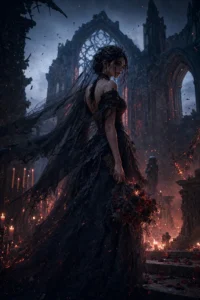
by inkadminThe west wing had been locked since Seraphina arrived at Blackthorne House.
Not merely closed. Not politely discouraged. Locked—its double doors of black oak fitted with a brass plate worn smooth by fingers that no longer touched it, its keyhole dark as a pupil watching from beneath the curve of the staircase. Every morning, the maids passed it with lowered eyes. Every night, the footmen avoided its corridor as if a draft from beneath those doors might carry plague.
Seraphina had noticed.
She noticed everything in houses where silence was a language.
On her fifth night as Cassian Blackthorne’s wife, rain stitched silver threads down the tall windows of her bedroom, blurring the city beyond into smears of wet light. The house breathed around her, old pipes groaning in the walls, floorboards settling with the tired sighs of a creature too ancient to sleep peacefully. Somewhere below, a clock counted the hours in slow, mournful strokes.
Two.
Three.
She sat at the vanity with her hair unpinned around her shoulders, a storm-dark spill against the pale silk of her dressing gown. The bruise on her wrist, left by Isolde’s grip at the cathedral steps before Cassian had intervened with such icy violence, had faded from purple to yellow at the edges. Seraphina pressed her thumb into it until pain sharpened, clean and immediate.
Cassian had not come to her room.
Not since the mass. Not since he had dragged Isolde close by the throat and whispered something that drained the blood from her elegant face. Not since his hand had hovered at Seraphina’s back afterward, never touching, yet burning through every inch of air between them.
Possession without tenderness. Protection without explanation.
He had deposited her in the car, sat beside her in silence while rain battered the roof, and when she asked, “What did she mean by the old sin always finds its daughter?” he had turned his head just enough for the passing streetlights to stripe his face into darkness and gold.
“Forget her.”
“I don’t forget insults.”
“Then learn.”
He had not looked at her again.
But Seraphina had been raised in a house where men expected obedience to sound like gratitude. Her father’s rules had been wrapped in velvet, but they had always tightened like wire. Do not ask about your mother’s family. Do not open the green nursery cabinet. Do not enter the east cellar during meetings. Do not read sealed letters. Do not remember things that make no sense.
Especially that last one.
Do not remember.
Memory had never obeyed.
It came in shards. A woman’s voice humming beneath a storm. The smell of smoke and orange peel. A silver comb shaped like a crescent moon. Small hands—not hers, yet hers—pressed against cold glass while someone screamed on the other side of a door.
And lately, ever since entering Blackthorne House, the shards had begun to cut deeper.
Seraphina rose.
The floor was cold beneath her bare feet. She crossed to the wardrobe and took the black cashmere robe one of the maids had hung for her, though no one had asked her preference. In this house, even comfort arrived like an order. She tied it loosely, then opened the jewelry drawer and lifted the thin silver hairpin she had once used to pick the lock on her father’s study.
It had been her small rebellion at sixteen. A ridiculous one, because she had found nothing but ledgers and cigars and a photograph of herself at six years old that she did not remember being taken. Yet the technique had stayed in her fingers.
Useful skills, she was discovering, were often born from punishments.
The hallway outside her room waited in a hush. Lamps burned low in sconces shaped like lilies, their stained-glass petals bleeding amber across the wallpaper. Portraits watched from gilt frames: Blackthorne men with wolf-pale eyes, women with gloved hands folded over pearls, children dressed like ghosts.
Seraphina moved past them without a sound.
Blackthorne House had once been a bishop’s residence before the family purchased it and turned sanctity into fortress. Its corridors twisted around courtyards and chapels, its ceilings arched too high, its shadows too deep. It smelled of beeswax, rain-damp stone, old roses dying in vases, and beneath that—faint but persistent—ash.
She had told herself the scent came from the dozens of fireplaces.
She had never believed it.
At the head of the western corridor, the forbidden doors waited.
Up close, she saw scratches around the keyhole. Not fresh. Old enough for dust to soften their edges. Someone had tried to force it open once, perhaps many times. The brass plate bore no name, but a faint outline showed where letters had been removed.
Seraphina knelt, slid the hairpin into the lock, and listened.
Her breath slowed. Her fingers remembered.
There were three pins. Stubborn ones. Expensive lock. Old mechanism.
The first gave with a tiny click.
From somewhere below came the murmur of men’s voices. Guards changing shifts, perhaps. Cassian’s household never truly slept. Guns lived beneath suit jackets. Knives flashed in sleeves. Loyalty moved on polished shoes.
The second pin lifted.
Her pulse beat in her throat.
The third resisted, then yielded with the softest sigh.
The lock opened.
For a moment, Seraphina stayed crouched there, stunned by her own success, one hand against the door as if the house might feel her trespass and wake.
Nothing happened.
So she stood and stepped inside.
The air changed at once.
It was colder in the west wing, not with the clean chill of winter but with the sealed damp of rooms abandoned to memory. Dust lay thick over the runner carpet. White sheets covered furniture along the corridor, transforming chairs and side tables into hunched figures waiting beneath shrouds. Her footsteps disturbed the silence, raising the stale scent of linen and cedar, something floral gone sour with age.
The lamps here were unlit. Only the storm gave light, flashing now and then through tall windows, silvering the walls in brief violent strokes. In those flashes she saw paintings turned to face the wallpaper. A cracked mirror draped with black gauze. A vase of dried hydrangeas collapsed into brittle brown fists.
At the far end of the corridor, a door stood ajar.
Seraphina should have turned back.
She knew that. Every nerve in her body knew it. Cassian had not forbidden many things aloud, but the west wing existed as a warning all its own. He was a man who kept fury leashed so tightly it had become part of his elegance. She had seen him kill with a sentence. She had watched hardened men go silent when he entered rooms.
And still, her feet carried her forward.
The open door sighed inward beneath her touch.
A sitting room lay beyond.
Not a grand salon for guests, but a private room, feminine in its decay. Pale blue wallpaper, faded nearly gray. A marble fireplace blackened at the mouth. A piano beneath a sheet, its shape unmistakable, like a coffin with legs. Bookshelves lined one wall, their spines dulled by dust. On the mantel stood a row of silver frames turned facedown.
Seraphina’s mouth went dry.
The scent was stronger here.
Not ash.
Orange peel.
Her hand went to her throat.
The flash came without mercy.
Small fingers sticky with sugar. Laughter bright as bells. A woman kneeling, dark hair coiled low, eyes the color of storm clouds. “Again, little star?” she asked, holding out a curl of candied orange peel.
Seraphina staggered, catching the back of a chair beneath its dust cover. The vision vanished, leaving her with the sting of sugar on her tongue and a heartbeat too fast for the empty room.
She had never been here.
She couldn’t have been here.
Her childhood had unfolded in Vale House, across the river, beneath her father’s rules and tutors and locked gardens. She had been told her mother died when she was a baby, though no portraits of the woman hung in the house, no grave was visited, no stories shared. Just absence, polished until it gleamed.
Seraphina straightened slowly.
On the mantel, the silver frames waited.
She crossed the room as if underwater, each step heavy, the air pressing against her ears. Her reflection drifted in the dark window to her left—pale face, black robe, hair loose, eyes too wide. Behind her reflection, lightning exposed the city’s jagged roofs and cathedral spires, all of it drowning in rain.
She reached for the first frame.
Her fingers left clean marks in the dust.
The photograph inside showed a young Cassian, perhaps twelve, standing stiffly beside a woman seated in a garden chair. His hair was shorter, his face thinner, but the eyes were the same—frost-gray, already guarded. The woman beside him was beautiful in a way that hurt to look at. Not soft, not ornamental. Striking. Dark hair pinned at the nape, cheekbones sharp, mouth curved with secrets. One hand rested on Cassian’s shoulder.
Not a mother’s absent gesture.
A claim.
On the bottom edge of the photograph, someone had written in faded ink:
Marcelline and Cassian, midsummer.
Marcelline Blackthorne.
Cassian’s mother.
Dead, according to everyone. Mentioned only in the brittle pauses of servants and the sudden tightening of Cassian’s jaw when her name almost entered a conversation and then did not.
Seraphina set the frame down carefully and turned over the next.
Marcelline at the piano, head bowed, long fingers hovering over keys. Marcelline in a fur coat on the front steps, snow caught in her lashes. Marcelline holding a glass of champagne at some long-ago party, a man cropped from the edge of the frame so only his hand on her elbow remained.
Each image tightened something inside Seraphina.
The fourth frame was heavier than the others.
Its silver backing had tarnished black at the corners. Dust clung to the carved roses around the glass. When Seraphina turned it over, the world narrowed to the size of the photograph.
A little girl stood beside Marcelline Blackthorne in the garden.
She could not have been more than five.
Dark curls tumbled around her face, tied back with a ribbon that had slipped loose on one side. Her chin was lifted in defiance or delight. One hand clutched Marcelline’s skirt. The other held a wooden toy horse painted white.
Her eyes were Seraphina’s eyes.
Not similar.
Not the resemblance of cousins or coincidence.
Hers.
The same slight tilt. The same dark ring around the iris. The same small beauty mark beneath the left eye, pale now under foundation but visible in childhood photographs her father had kept locked away. Even the stubborn set of the mouth was painfully familiar.
Seraphina stopped breathing.
Lightning tore open the sky. The room flared white.
In that instant, the photograph seemed to move.
Marcelline’s hand rested on the little girl’s head with devastating tenderness.
A mother’s hand.
Seraphina’s knees weakened.
No.
The word did not leave her mouth. It formed somewhere deeper, somewhere older.
She lifted the frame closer, searching the background, the edges, any clue that might make the impossible less impossible. The garden wall behind them was unmistakably Blackthorne House—ivy climbing black stone, a fountain shaped like a weeping angel, the west terrace windows reflecting sun.
On the lower border, handwriting scratched across the white margin.
M. with S., before the fire.
S.
Seraphina’s fingers went numb.
Before the fire.
Her mind unlatched a door she had spent years leaning against.
Smoke in a hallway. Heat licking up her arms. A woman’s voice, hoarse with terror, whispering, Don’t make a sound, Seraphina. Whatever happens, don’t make a sound. The taste of blood where she had bitten her own hand. Arms carrying her through rain. A man saying, She’s dead. The girl is dead too. Make it true on paper.
Seraphina gasped and nearly dropped the frame.
A sound behind her cut through the room.
One soft click.
The door closing.
She turned.
Cassian stood in the threshold.
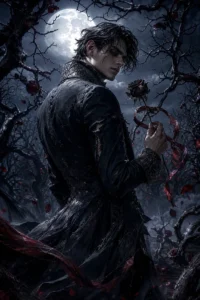
He wore black trousers and a white shirt open at the throat, sleeves rolled to the forearms. No jacket. No tie. His hair was damp, as if he had come in from the rain or dragged wet hands through it. In the dimness, his face might have been carved from the same cold stone as the house, except for his eyes.
They were not cold now.
They were ruin.
His gaze fell to the frame in her hands.
The air between them became a blade.
“Put it down,” he said.
His voice was quiet.
That made it worse.
Seraphina’s fingers tightened around the tarnished silver. “Who is she?”
Cassian did not move. “Put it down, Seraphina.”
“Who is the girl?”
“You are in a room you had no right to enter.”
“And this is a photograph I had no right to find?” Her voice shook, but she held the frame higher. “She looks like me.”
His mouth hardened. “Enough.”
“No.” The word cracked like a match. Fear burned into something brighter, more dangerous. “No, not enough. Not from you. Not after your former lover spits riddles at me in front of half the city, not after my father sells me into this house like livestock, not after I start remembering things I was told never happened.”
A muscle flickered in his jaw.
Seraphina took a step toward him, clutching the photograph as if it were a weapon. “Who is she, Cassian?”
He crossed the room so fast she barely had time to retreat.
One moment he was at the door; the next he was before her, tall and furious, the scent of rain and tobacco and iron clinging to him. His hand closed over the frame. Not her skin. Never her skin. He gripped the silver edge and pulled.
Seraphina held on.
For a heartbeat they stood locked together, the photograph between them, their breaths colliding.
“Let go,” he said.
“Tell me.”
His eyes dropped to her mouth, not with desire but with the terrible awareness of how close they were. When he looked back up, something in him had splintered.
“You want the truth?”
“Yes.”
“Liar.”
The word struck harder than she expected.
“You don’t want truth,” he said, voice low and ragged at the edges. “You want a story that makes the floor solid again. You want one clean answer. There isn’t one.”
“Then give me the ugly answer.”
His laugh was soft and empty. “You have no idea what ugly is.”
“I married you, didn’t I?”
Silence slammed into the room.
His expression changed so subtly another person might have missed it, but Seraphina saw the wound open beneath the insult. Not pain exactly. Confirmation.
Then his hand shot out.
This time he did touch her.
His fingers closed around her wrist, just above the fading bruise Isolde had left, firm enough to stop her but not enough to hurt. Heat seared through her skin. Seraphina’s breath caught. Cassian felt it; his grip loosened at once, but he did not release her.
“Do not,” he said, each word measured as if dragged over glass, “use me as a blade because you are bleeding.”
Her throat tightened.
“Then stop cutting first.”
Something dark moved across his face.
He pried the frame from her numb fingers and set it on the mantel faceup. His care with it was worse than any violence would have been. Reverent. Protective.
Seraphina stared at the little girl in the photograph. At herself. At a ghost wearing her face.
“Is it me?” she asked.
Cassian turned away.
“Cassian.”
He braced both hands on the mantel, head bowed. His shoulders rose and fell once. Twice. The lamplight from the corridor cut along his profile and revealed a man holding himself together by force.
“My mother kept secrets,” he said.
Seraphina did not move.
“She collected them the way other women collected jewels. Men loved her for it. Feared her for it. Killed for her. Died because of her.” His fingers curled against the marble. “She believed knowledge was the only inheritance a woman could keep after men decided what she was worth.”
The room seemed to lean closer.
“She hid ledgers. Names. Bloodlines. Confessions. Debts.” His voice thinned. “Children.”
Seraphina’s skin went cold.
“What does that mean?”
He turned then, and the look in his eyes stopped her.
“It means my mother knew where the bodies were buried before they were bodies.”
“And the girl?”

0 Comments