Chapter 4: The Husband With Blood on His Cuffs
by inkadminRain had a way of making Blackthorn House sound alive.
It whispered along the leaded windows in silver veins. It tapped at the slate roof with fingernails. It crawled through the stone gargoyles and poured from their mouths as though the mansion itself were bleeding water into the dark. Far below, the harbor groaned beneath the storm, iron ships rocking in their berths, foghorns low and mournful as beasts trapped under the waves.
Seraphina Vale had not slept.
She sat curled in the window seat of the room that had been assigned to her—not offered, not chosen, but assigned—with a wool blanket around her shoulders and a silver letter opener in her hand. The blade was small, decorative, and almost certainly useless against whatever lived inside Blackthorn House, but its weight steadied her fingers.
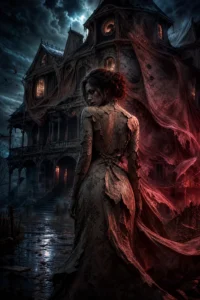
Across the room, the fire had collapsed into a red, watchful glow. Shadows gathered in the corners like eavesdroppers. Her wedding dress hung from the wardrobe door, pale and accusatory, its lace ruined where rain had kissed the hem during her arrival. It looked less like a gown now and more like a shed skin.
On the writing desk beside her lay a sheet of stationery embossed with the Blackthorn crest: a thorned branch coiled around a key. She had turned the page over and over in her hands until the edges softened, as if the paper might confess something if she worried it enough.
It had not.
The desk in the library had.
E.V.
The initials had been carved beneath the antique wood in jagged, hurried strokes. Evelyn Vale. Her mother’s hand—or someone pretending to know it. Seraphina had traced those letters until a splinter bit beneath her nail and drawn blood, a tiny bead of red bright against the dust. It had felt absurdly ceremonial, as if the house had asked for proof of kinship and she had given it.
Her mother had been here.
Not rumored. Not imagined. Here, inside these walls, beneath these chandeliers, behind these locked doors and family portraits with their painted eyes.
And Lucian Marrow had known.
Seraphina looked toward the bedroom door.
He had left shortly after the staff served a dinner neither of them ate. There had been no explanation, only the soft scrape of his chair, the black line of his coat as he moved toward the hall, and that unreadable glance at her from beneath lowered lashes.
“Do not leave your wing tonight,” he had said.
“How romantic,” she had replied, lifting her wineglass with a hand that did not shake. “Shall I embroider that on our anniversary pillows?”
His mouth had not smiled. His eyes had gone to the wine in her glass, then to her throat when she swallowed. “I mean it.”
“You often do. It’s one of your less charming qualities.”
He had stepped closer then, too close for a man she had sworn to hate. Lucian Marrow carried cold with him, but not emptiness. His presence had heat beneath the ice, banked and dangerous. The scar that ran from the corner of his mouth toward his jaw had looked almost silver in the candlelight.
“There are parts of this house that would not forgive curiosity.”
“Houses don’t forgive or condemn, Mr. Marrow.” She had set down the glass. “People do.”
Something had flickered in his face so quickly she might have missed it if she had not been searching for cracks. Pain, perhaps. Or memory. Then the mask returned.
“Lucian,” he said.
“Pardon?”
“You married me this morning. You may as well use the name.”
“I married your bank accounts, your threats, and my father’s poor decisions. I’m still considering whether you came as part of the bargain.”
This time, his mouth had almost moved.
Almost.
Then he had turned and left her with the rain, the fire, and the initials carved into the underside of a dead woman’s desk.
Now, hours later, the house held its breath.
Seraphina knew the sound of sleeping mansions. She had grown up in one before debt and disgrace stripped the Vale estate down to echoing rooms and covered furniture. Old houses settled; pipes knocked; servants moved in muffled rhythms; wind pried at frames. But Blackthorn House had gone still in a manner that felt deliberate. Even the fire seemed afraid to crackle.
Somewhere below, a clock struck two.
On the last chime, a sound sliced through the rain.
Engines.
Not one. Several.
Seraphina sat upright, the blanket sliding from her shoulders. Through the warped glass, she saw pale headlights sweep the black curve of the drive, briefly illuminating hedges trimmed into thorny shapes and the wet flanks of stone lions guarding the front steps. A procession of cars slid out of the storm: three black vehicles, low and expensive, their windows dark as sealed coffins.
Her pulse changed.
She rose, the letter opener clutched at her side, and crossed to the door. She expected it to be locked. It was not. That made her more uneasy.
The corridor outside was dim, lit by sconces shaped like iron lilies. Their flames trembled as she passed. The house smelled of rain-damp stone, beeswax, and the faint medicinal bitterness of old herbs. Somewhere far below, a door opened. Male voices murmured. A sharp command cut through them.
Lucian’s voice.
Lower than the others. Colder. Ragged at the edges.
Seraphina paused at the top of the staircase, one hand on the carved banister. Below, the entrance hall yawned vast and shadowed, its checkerboard marble reflecting the storm-light from the open doors. Men moved through it like pieces on a black-and-white board.
There were four of them.
One she recognized as Mr. Hawthorne, Lucian’s silver-haired steward, whose composure seemed sewn into his skin. Another was the driver who had brought her from the church, his cap gone, his knuckles split. The third was a broad man with a shaved head and a bloodied cloth pressed to his temple.
The fourth was Lucian.
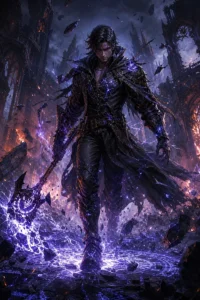
He stepped into the hall without his overcoat. Rain had soaked his black shirt until it clung to his body, revealing the hard line of muscle beneath. His dark hair was plastered to his brow. Blood marked his face in a thin streak from cheekbone to jaw—not his, perhaps, until she saw the way his left arm hung close to his side.
His cuff was dark.
Not with rain.
Blood had soaked the white fabric at his wrist and spread upward under his sleeve in a blooming stain.
Seraphina’s fingers tightened around the banister.
“The east gate?” Lucian asked.
“Secured,” the driver said. “No one followed past the lower bridge.”
“You’re certain?”
“Yes.”
Lucian’s gaze cut to the man with the cloth at his head. “Tell Mikhail if he sends boys to do butcher’s work again, I’ll send them back in jars.”
The injured man gave a grim, humorless smile. “Don’t think they were expecting you to come yourself.”
“They should have.”
Mr. Hawthorne moved toward him. “My lord, the physician—”
“No physician.”
“The wound—”
“Is mine.”
“Unfortunately, sir, so is the blood on my floor.”
Under any other circumstance, Seraphina might have admired the steward’s courage. Lucian’s eyes shifted, and the hall seemed to drop several degrees.
“Clean it.”
“After someone closes you.”
“I said no physician.”
“And I heard you. I have worked in this house for forty-one years, sir. I have survived three Marrow patriarchs, two police raids, one poisoning, and your grandmother before breakfast. Your tone does not frighten me.”
A strange silence followed.
Then Lucian exhaled through his nose, the smallest surrender. “The kit. Study.”
Hawthorne turned, and that was when his eyes lifted to the staircase.
Seraphina did not move quickly enough.
The steward saw her. Then Lucian saw her.
Everything in him went still.
For one charged moment, the storm, the men, the blood—everything narrowed to his gaze on her bare feet, her night robe, the letter opener glinting in her hand.
“Go back upstairs,” he said.
Seraphina descended one step.
The driver glanced between them and wisely looked at the floor. The shaved-headed man muttered something under his breath that earned him a sharp elbow from Hawthorne.
“Is that your preferred greeting for all wives,” Seraphina asked, “or am I receiving special treatment?”
Lucian’s jaw flexed. “This does not concern you.”
She took another step. “You returned to our marital home at two in the morning covered in blood. I’m afraid concern has entered the room whether invited or not.”
“Seraphina.”
Her name sounded different in his mouth like this. Not an instruction. Not a warning. A fracture.
She looked at his sleeve again. Blood gathered at the edge of his cuff and fell in a slow, heavy drop onto the marble.
“You’re bleeding on the floor Mr. Hawthorne intends to outlive you upon,” she said.
The steward’s mouth twitched.
Lucian’s expression did not. “Upstairs.”
“No.”
The word landed harder than she expected. Perhaps because no one in that hall seemed accustomed to hearing it directed at Lucian Marrow.
His eyes darkened.
She came down the remaining steps, each one colder beneath her feet. As she reached the hall, the scale of him became impossible to ignore. He was taller than she remembered from the day’s rituals, broader in the shadows, and violence clung to him—not theatrical, not drunken, but precise, like the edge of a knife cleaned after use.
He smelled of rain, smoke, metal, and blood.
Seraphina stopped an arm’s length away. “What happened?”
“A business disagreement.”
“Do all your business disagreements end with arterial spray?”
The shaved-headed man coughed, perhaps to hide a laugh. Lucian did not look away from her.
“Only the dull ones.”
There. A sliver of him. Dry as ash, gone almost before it appeared.
Seraphina looked to Hawthorne. “Where is the medical kit?”
Lucian said, “No.”
She ignored him.
Hawthorne lifted one silver brow. “In the study, madam.”
“Then bring it.”
“Hawthorne,” Lucian warned.
“Yes, sir,” the steward said pleasantly, and went to fetch it.
Lucian’s stare could have shattered glass. “You do not give orders in my house.”
“I believe the vows said something about sharing worldly goods.” Seraphina glanced around at the oppressive grandeur of the entrance hall. “Unfortunately for you, that includes bandages.”
“You think this is clever.”
“I think you’re losing blood and being tiresome about it.”
His mouth tightened. “You should not see this.”
The quiet beneath the words caught her more effectively than anger would have. She studied him, the rigid line of his shoulders, the hand pressed too casually against his side. Rainwater dripped from his hair to his collar. Beneath the brutality, beneath the command, he looked exhausted.
Not weak. Never that.
But worn down to something raw.
“I have seen worse than blood,” she said softly.
His eyes moved over her face, and something like regret passed behind them.
“I know.”
The words were almost too quiet to hear.
Seraphina’s breath hitched before she could stop it.
I know.
Not I imagine. Not I’m sure. I know.
Before she could ask, Hawthorne returned carrying a black leather case. “The study is prepared.”
“I can do it myself,” Lucian said.
Seraphina took the case from Hawthorne. “Can you remove a bullet from your own arm one-handed?”
No one spoke.
Her stomach turned cold.
“Bullet,” she repeated.
Lucian’s eyes narrowed faintly at Hawthorne, who gazed back with saintly innocence.
“A graze,” Lucian said.
The driver made an unwise sound.
Lucian turned his head. “Leave.”
The men left.
Quickly.
Hawthorne lingered just long enough to meet Seraphina’s gaze. In his expression she saw calculation, worry, and something she disliked more than both: pity.
“Pull the bell if you require assistance, madam.”
“Thank you.”
“She will not require assistance,” Lucian said.
Hawthorne looked at the blood dripping onto the marble. “Of course not, sir. You are always very reasonable when injured.”
Then he vanished down the corridor.
Lucian stared after him with murder in his eyes.
Seraphina turned toward the study. “Walk before you fall.”
“I do not fall.”
“How reassuring. Bleed dramatically, then.”
For a moment she thought he would refuse out of pure stubbornness. Then he moved past her, and she saw the brief hitch in his stride.
Fear touched her before she could name it.
It was unreasonable. This man had bought her like collateral. This man lived behind locked doors and secrets. This man might know what happened to her mother. If he collapsed on the marble, she should have felt justice, perhaps satisfaction.
Instead, she followed him with the medical case pressed to her chest and a pulse that would not obey.
The study waited at the end of a corridor lined with portraits of dead Marrows. Candlelight licked across their painted faces: pale women with cruel mouths, men with eyes like wolves, children dressed as miniature tyrants. Seraphina had passed them earlier and felt watched. Now she noticed that several frames hung slightly crooked, as if the house itself had flinched at Lucian’s return.
The study door stood open.
Inside, the room breathed dark wood and smoke. Floor-to-ceiling shelves crowded with books rose toward a coffered ceiling. A fire burned low in the hearth, its glow catching on glass decanters and the brass fittings of a locked cabinet. One wall held a map of the city, marked with pins of black, red, and white. Seraphina’s eyes caught on the harbor district, where red pins clustered like a rash.
Lucian noticed her noticing.
“Sit,” she said before he could speak.
His brow lifted. “You grow bolder by the hour.”
“You grow paler by the minute.”
That made him obey, though she suspected spite played a role. He lowered himself into the leather chair near the desk with controlled precision. Only the tightening around his eyes betrayed pain.
Seraphina set the case on the desk and opened it.
The contents gleamed with chilling organization: gauze, antiseptic, sutures, forceps, scissors, vials, a small curved needle, rolls of bandage, and instruments she did not want to name. Not a household kit, then. A battlefield disguised in leather.
“How often,” she asked, “does your staff prepare for bullet wounds?”
“Less often than my enemies prefer.”
“That is not an answer.”
“It is the only one you’re getting.”
Seraphina removed the scissors. “Shirt.”
His gaze sharpened. “Pardon?”
“Either take it off or I cut it off.”
A beat passed.
Rain battered the windows.
Lucian leaned back slightly, a dangerous amusement threading through his pain. “Most brides wait until the second night to threaten a man out of his clothes.”
Heat rose uninvited to her face. She hated him for noticing. Hated herself more for noticing the deep rasp in his voice, the shadow of his throat, the way rain clung to the hollow beneath his jaw.
She held up the scissors. “Most husbands don’t come home perforated.”
His gaze dropped to the blade, then returned to her. “Careful, Seraphina.”
“Are you afraid I’ll slip?”
“No.” His eyes stayed on hers. “I’m afraid you won’t.”
Something passed between them then—dark, electric, unwelcome. The fire cracked in the hearth, and she realized she was standing close enough to see that the blood on his face had dried at the edge of his scar.
She looked away first.
“Take off the shirt.”
For once, he did not argue. He unfastened the buttons with his right hand, each movement slow, precise, maddening. When the fabric stuck to his left sleeve, his breath changed. Not a gasp. Lucian Marrow would sooner bite through his tongue than gasp. But his inhale caught, and Seraphina’s annoyance dissolved into focus.
“Stop.” She stepped between his knees before thinking better of it. “Let me.”
His body went still beneath her hands.
She felt it. The way every muscle locked, as if touch were a blade laid against his throat.
“I’m not going to hurt you,” she said.
A bitter curve touched his mouth. “That makes one of us.”
She glanced at him.
He looked away.
Seraphina cut the sleeve carefully from wrist to shoulder. Blood had glued the fabric to his skin. As she peeled it back, the wound revealed itself: a torn line along the outer upper arm, deeper than a graze, the flesh angry and slick. No bullet remained, thank God, but the bleeding had not stopped.
Her stomach lurched.
She forced it down.
Her mother used to say fear was allowed at the table, but never permitted to hold the knife.
“It went through?” she asked.
“Yes.”
“You’re sure?”
“I was there.”

0 Comments