Chapter 5: Rules for a Captive Bride
by inkadminRain worried at the windows until dawn forgot to come.
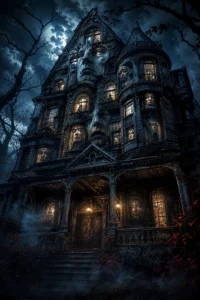
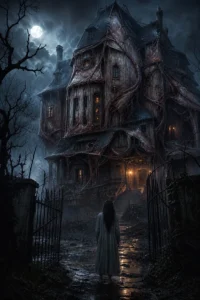
It slid down the black glass in trembling veins, turning the world beyond Seraphina’s bedroom into a watercolor of cliffs, iron gates, and restless sea. Somewhere below, waves threw themselves against the rocks beneath Blackthorn House with a rage that sounded almost human. The old mansion answered in groans: pipes sighing in the walls, ancient wood contracting under the wet cold, the distant tick of clocks hidden in rooms she had not yet seen.
Seraphina had not slept.
The bed was too large, too soft, too perfumed with lavender and cedar. The ceiling above it was painted with a faded fresco of storm clouds parting around some saint’s pale, accusing face. Every time she closed her eyes, she saw Lucian Marrow in the dressing room mirror: shirt half-open, blood dark on his ribs, jaw clenched as if pain were a language he refused to speak.
She saw her own hands on him.
Her fingers had pressed gauze to the cut beneath his ribs while his breath shuddered once—only once—against her knuckles. The memory warmed and sickened her in equal measure. He had sat there like a carved thing made briefly mortal, black hair damp from rain, scars silvering his skin, eyes fixed on her with an intensity that had felt less like being watched and more like being measured for ruin.
Then, when she had tied off the bandage, he had caught her wrist.
Not hard. Not cruelly.
That was the trouble.
“You should be afraid of me,” he had said.
And Seraphina, because exhaustion made liars of sensible women, had answered, “I am. It simply isn’t stopping me.”
He had released her as if burned.
Now, hours later, the ghost of his touch still circled her pulse.
She threw the covers aside.
The floorboards were cold beneath her bare feet. A low fire burned in the marble hearth, fed sometime in the night by a servant she had never heard enter. Blackthorn House had a way of moving around her while pretending to be still. Doors opened silently. Meals appeared on silver trays. Footsteps faded the instant she turned her head.
A prison, she had decided, was not defined by bars. It was defined by how politely one was denied the key.
Her wedding gown hung in the armoire like a murdered ghost, ivory satin bruised by shadow. Beside it, her own clothes had been unpacked with surgical precision. She chose dark trousers, a cream blouse, and a thick gray cardigan that smelled faintly of starch and sea air. Practical. Quiet. Not the sort of outfit a bride wore the morning after her wedding.
Then again, Seraphina Vale had not been purchased for softness.
She crossed to the vanity. Her reflection stared back from a mirror framed in tarnished silver vines: pale face, sleepless eyes, hair loose over one shoulder like spilled ink. The Vale necklace was gone from her throat, locked somewhere by creditors or lawyers or her father’s trembling hands before the ceremony. She touched the hollow where it had rested since childhood and felt, absurdly, naked.
On the vanity lay an envelope.
It had not been there when she came to bed.
Heavy cream paper. Her married name written across it in black ink.
Mrs. Marrow.
Her stomach tightened.
She slid a finger beneath the seal and opened it.
Breakfast will be served at seven in the east dining room.
Do not mistake this house for a hotel.
—L
Seraphina read it twice, then laughed once under her breath.
It was not a pleasant sound.
“Good morning to you too, husband.”
The word scraped.
Husband.
A legal noose tied in silk. A debt repaid in flesh and name. Lucian Marrow owned half the docks, all the rumors, and now, on paper, her. Her father’s signature had sold what his shame could not pay.
But Seraphina had signed too.
Not because she was meek. Not because she was cornered, though she had been. Not because Lucian’s dark beauty had rattled something foolish and hungry inside her, though God help her, it had.
She had signed because her mother had vanished after coming to Blackthorn House.
And somewhere in this mansion of locked wings and dead ancestors, there was a truth with Evelyn Vale’s fingerprints on it.
A soft knock sounded at the door.
Seraphina slipped the note into her cardigan pocket. “Come in.”
The woman who entered carried a tray with coffee, toast, berries, and two white pills in a dish. She was perhaps fifty, with iron-gray hair braided tight at the nape of her neck and a face handsome in the way of old statues. Her black dress was severe enough for mourning.
“Mrs. Marrow,” she said, dipping her head.
Seraphina hated the little jolt the name sent through her. “You must be Mrs. Finch.”
The housekeeper’s eyes flicked up, sharp as pins. “I am.”
“Lucian mentioned you last night.”
“Did he?”
“No. But everyone seems too terrified to enter a room without permission, and you walked in like the house owes you rent.”
For half a breath, the older woman’s mouth almost curved.
Almost.
“I have served Blackthorn House for thirty-two years,” Mrs. Finch said, setting the tray on a small table by the window. “It owes me considerably more than rent.”
Seraphina liked her immediately, which meant she was probably dangerous.
“Coffee?”
“Strong.” Mrs. Finch poured without asking how she took it. Black, no sugar. Correct. Seraphina accepted the cup and tried not to wonder who had told her.
“The pills?” Seraphina asked.
“For sleep. Mr. Marrow thought you might not have rested.”
“Mr. Marrow thought correctly, but I prefer my unconsciousness unassisted.”
“Very wise.” Mrs. Finch removed the dish and tucked it back onto the tray. “Medication in this house is rarely only medication.”
Seraphina’s fingers tightened around the cup.
Mrs. Finch looked toward the rain-streaked window, expression blank.
“Was that a warning?” Seraphina asked.
“That was an observation.”
“Do you make many of those?”
“Fewer than I used to.”
There it was. The first crack in the house’s polished silence.
Seraphina set down her coffee. “Did you know my mother?”
The room changed.
Nothing moved. The rain continued its delicate assault. The fire shifted with a sigh. But Mrs. Finch went very still, and in a house full of watching portraits and locked doors, stillness felt louder than speech.
“I knew of her,” she said.
“That isn’t what I asked.”
“No, Mrs. Marrow. It isn’t.”
Seraphina stepped closer. “Evelyn Vale came here fifteen years ago. She was writing an article about old family charities. Blackthorn funds. Missing donations. Girls from the harbor district who disappeared after accepting scholarships from Marrow foundations.”
Mrs. Finch’s hand tightened on the tray handle.
“She came to this house,” Seraphina continued, voice dropping, “and three days later she was gone. Her car was found near the south bridge with her coat inside and blood on the steering wheel. Not enough to prove death. Enough to make everyone stop looking.”
“Everyone?”
“Everyone except me.”
The housekeeper’s gaze finally met hers. Behind the severity lay something old and tired and afraid.
“You should eat your toast before it goes cold.”
“I’m not hungry.”
“In this house, hunger is not always about appetite.” Mrs. Finch moved toward the door. At the threshold, she paused. “Breakfast at seven. The east dining room is down the main stairs, across the gallery, second door past the conservatory.”
“And if I get lost?”
Mrs. Finch did not turn around.
“Then pray you do so in the correct direction.”
The door closed softly behind her.
Seraphina stood in the silence she left behind, pulse steady and too loud.
Pray you do so in the correct direction.
She crossed the room and opened the door.
The corridor beyond was dim, paneled in dark wood that swallowed the gray morning. Gas-style sconces glowed along the walls though the house was thoroughly modern beneath its gothic affectations. Ancestors stared from oil paintings in gilded frames, their faces long and pale, their eyes following with generational disapproval.
At the far end of the hall, a man in a black suit stood with hands folded before him.
Not a servant.
A guard.
Broad shoulders. Earpiece. Eyes like a locked door.
He inclined his head. “Mrs. Marrow.”
“Good morning,” Seraphina said. “Are you ornamental or functional?”
His jaw flexed. “Functional, ma’am.”
“Shame. I was hoping to rearrange the corridor.”
No smile. Lucian’s men had clearly been trained to withstand charm, insult, and possibly torture.
She started down the hallway.
He fell into step behind her.
Seraphina stopped.
He stopped.
She took three more steps.
So did he.
“Do you plan to follow me into the bath as well?” she asked without turning.
“No, ma’am.”
“How reassuring.”
At the staircase landing, another guard waited beneath a portrait of a woman in a black veil. This one was younger, with a scar splitting one eyebrow and a mouth that suggested he might have once laughed before employment at Blackthorn House cured him.
The mansion unfurled below in shadows and polished stone. The grand staircase descended into an entrance hall floored with black-and-white marble, where a chandelier hung like a captured constellation. Beyond arched doorways, Seraphina glimpsed rooms arranged with suffocating beauty: velvet chairs, silver-framed mirrors, cabinets of porcelain, bookshelves climbing into gloom.
And everywhere, closed doors.
She reached the lower hall at one minute before seven.
Lucian was waiting.
He stood beside a long table in the east dining room, dressed in a black suit that fit him with cruel precision. He should have looked weakened after the wound she had treated only hours ago. He did not. His posture was immaculate, his expression unreadable, his dark hair still damp from a recent shower. Only the faint pallor beneath his skin betrayed him, and the careful way he kept his left arm from moving too quickly.
Sunless morning gathered behind him in tall windows overlooking the east gardens. Rain shivered over the glass, blurring the hedges into dark green smears.
The room smelled of coffee, beeswax, and oranges.
Seraphina halted in the doorway.
Lucian’s gaze moved over her once. Not lazily. Not with the vulgar confidence of men who believed looking was a form of possession. He looked as if cataloging injuries, weapons, exits.
Then his eyes snagged on the cardigan pocket where his note hid.
“You came,” he said.
“Your invitation was so warm.”
“It wasn’t an invitation.”
“Yes, I noticed the distinct lack of please.”
A servant pulled out a chair at the opposite end of the table. Seraphina did not sit.
Lucian lifted one hand. The servants withdrew. The guards remained outside the doors, shadows beyond the frame.
“Sit down, Seraphina.”
“Good morning, Lucian. How is your stab wound?”
Something moved across his face too quickly to name. “A cut.”
“A cut is what one gets from paper. You were bleeding through your shirt.”
“Are you always this dramatic before breakfast?”
“Only when my husband returns home at midnight leaking crime onto the carpet.”
His mouth tightened. Not quite amusement. Not quite pain.
“Sit.”
The word slid through the room in velvet over steel.
Seraphina held his stare a moment longer, then sat. Not because he ordered her. Because standing had begun to feel like acknowledging the game, and she refused to be obvious.
Lucian took the seat at the head of the table. He poured coffee himself, ignoring the bell rope near his hand. His fingers were long, scarred across the knuckles, steady despite the wound beneath his clothes.
“You have questions,” he said.
“A charming number of them.”
“You’ll ask three.”
Her brows rose. “Is this marriage or a parlor game?”
“Everything in this house has rules.”
“How convenient for the person making them.”
He pushed a plate toward her. Eggs, toast, grilled tomatoes, figs cut open like small purple hearts. “Eat.”
“You do enjoy verbs with no decoration.”
“And you enjoy bleeding sarcasm instead of answering simple requests.”
“Requests wear manners. Orders wear you.”
For the first time, his eyes warmed with something dangerous enough to be mistaken for humor.
“Three questions,” he repeated.
Seraphina picked up her fork. “Fine. First: why are there guards outside my bedroom?”
“To keep you safe.”
“From whom?”
“Everyone.”
“That is not an answer.”
“It’s the only one you’re getting for free.”
She cut into a fig with more force than necessary. “Second: are the guards keeping me safe from everyone, or keeping everyone safe from me?”
“Both, potentially.”
“Careful. I might be flattered.”
Lucian drank his coffee. “You shouldn’t be. You have a talent for walking toward danger with your chin raised, as if death can be shamed into better manners.”
“That sounded almost like concern.”
“It was assessment.”
“Assessment wears you too.”
The rain thickened against the windows. Somewhere distant, thunder rolled like furniture dragged across the sky.
Seraphina set down her fork. “Third: did my mother come to Blackthorn House before she disappeared?”
The silence that followed was clean and sudden.
Lucian’s cup stopped halfway to the saucer.
For one fractured instant, the room seemed to reveal itself beneath its polish: table as altar, windows as confessionals, Lucian as the dark priest of a family that had buried too much and called it inheritance.
Then he set the cup down.
“Yes.”
Seraphina’s lungs forgot themselves.
So many people had lied with softness. No, darling, she was never there. Your mother was unwell. Grief invents patterns. Let the dead rest.
Lucian’s truth struck harder than any denial.
“When?” she asked.
“That was your third question.”
Her chair scraped back. “Do not do that.”
“Do what?”
“Give me one bone and expect me to wag my tail.”
His eyes sharpened. “Careful.”
“No. You don’t get to say her name’s shadow and then hide behind rules.”
“I didn’t say her name.”
“You didn’t have to.”
He rose slowly. Even with the table between them, the room seemed to shrink around him. “Your mother asked questions that put her in danger.”
“From your family?”
“From people who use family names as masks.”
“That is a poet’s answer, not a husband’s.”
His jaw hardened at the word. “Do not romanticize what we are.”
“Believe me, Lucian, romance is not the first word that comes to mind.”
He came around the table. Seraphina forced herself not to step back. He stopped a pace away, close enough that she could see the faint shadow beneath his eyes, the tiny cut at the corner of his mouth from whatever violence had found him the night before. Close enough to smell soap, rain, and something darker—smoke, perhaps, or the leather interior of expensive cars used for terrible errands.
“Then understand this,” he said. “You are not at Vale House. You are not protected by a father’s name or a dead mother’s reputation. You are inside Blackthorn now, and Blackthorn does not forgive curiosity.”
“Houses don’t forgive. People do.”
“Not the people who live here.”
She tilted her head. “Do you include yourself?”
His gaze dropped to her mouth for the briefest, most unforgivable second.
“Especially me.”
The words should have chilled her. They did. But beneath the chill came another sensation, slower and more treacherous. A pull. As if the part of her trained by grief to recognize danger had confused it with gravity.
Lucian stepped away first.
“There are three rules,” he said.
“Only three? You’re losing your touch.”
He ignored that. “First: you do not enter the west wing. Ever.”
Every nerve in her body lifted its head.
“What’s in the west wing?”
“Nothing for you.”
“How ominous. Did you practice that in a mirror?”
“Second: you do not leave the estate without guards.”
“Because everyone wants to kill me?”
“Because someone might try.”
That landed differently. Not possessive. Not theatrical. Flat, factual, and edged with a memory he did not offer.
Seraphina folded her arms. “And the third?”
Lucian looked at her then, really looked, all the cold machinery of him going still.
“Never lie to me.”
Something in his voice made the room feel suddenly airless.
She smiled because it was easier than shivering. “But you may lie to me?”
“I will withhold what keeps you alive.”
“That’s a pretty dress for a lie.”
“I don’t dress my sins prettily.”
“No,” she said softly. “You put them in black suits and give them earpieces.”
He almost smiled again. Almost.
Then his expression closed.
“You think this is a cage,” he said.
“Is it not?”
“It is a fortress.”
“Fortresses and cages differ mainly in who holds the key.”


0 Comments