Chapter 1: The Contract in the Coffin
by inkadminOn the morning of her father’s funeral, Elara Voss found her wedding contract nailed inside his coffin.
At first, she thought the paper was a funerary notice.
The chapel at Blackthorn Hall was too dim for certainty, its narrow windows filmed with salt and rain, its candles guttering in the drafts that slipped between ancient stones. The dawn outside had not truly broken. It had merely thinned the darkness into a miserable pewter wash, the kind that made the world look drowned before the day had even begun.
Her father lay beneath the ribs of the family chapel, arranged in oak and brass like a man of consequence. Which was absurd. Edmund Voss had died with a debt ledger thicker than his Bible, a ruined name, and prison ink still staining the records of three counties. The Blackthorns had paid for the coffin, the flowers, the priest, the grave. They had even sent a car to the station to collect Elara from the night train, though no one had been waiting when she arrived at the rain-slick platform with her suitcase in one hand and her anger in the other.
Now, alone with the dead, she stood beside the coffin and looked down at the pale face of the man who had taught her how to clean soot from saints.
Death had made him smaller.
In life, Edmund Voss had been all restless hands and ink-stained cuffs, a cathedral restorer who could coax whole centuries out of smoke-darkened stone. He had smelled of turpentine, lime dust, black tea, and the peppermint lozenges he’d chewed whenever he lied. He had laughed with his head thrown back. He had prayed only when cornered. He had vanished into Blackthorn Hall eighteen months ago to take a commission he would not discuss, then emerged in handcuffs, accused of fraud, theft, and desecration.
And now he smelled faintly of lilies and wax.
Elara rested one gloved hand against the coffin’s edge. The oak was cold beneath her palm. Someone had polished it until the candle flames trembled on its surface.
“You always hated being made presentable,” she whispered.
The chapel answered with rain.
It battered the stained glass in fitful bursts, rattling the lead seams around saints whose faces had been scratched almost completely away. That was the first thing Elara had noticed when she stepped inside Blackthorn Chapel as a child—the vandalized saints. Every face scored through with a knife or nail. Not smashed. Not removed. Scratched out, deliberately, as though the eyes themselves had offended someone.
She had been nine then, trailing after her father while he assessed damp damage in the east wall. He had caught her staring.
Never ask a Blackthorn why something has no face, Ellie.
He had smiled when he said it, but his hand had tightened around hers until her knuckles hurt.
Now the faceless saints watched her in silence.
Elara drew a breath through her nose, tasted dust and rainwater and extinguished smoke, and forced herself to look properly at her father. His white hair had been combed back from his forehead. His hands were folded over his chest, skin waxen, nails trimmed. Too neat. Too quiet. Someone had placed a sprig of blackthorn blossom between his fingers, though the trees had no business flowering in November.
That was when she saw the corner of parchment beneath his right wrist.
Not a card. Not a prayer. Parchment.
Her grief stalled.
Elara leaned closer. The edge of the paper was thick, cream-colored, and marked with a dark red flourish that peeked between her father’s folded hands. For several seconds she only stared, her mind refusing to form the obvious question.
Then she lifted one of his hands.
His fingers were stiff.
The shock of touching him nearly undid her. Not the cold. She had expected the cold. It was the weightlessness of him, the awful ease with which his hand yielded to hers once she overcame the stiffness, as if her father had become an object pretending badly at humanity.
“Sorry,” she breathed, ridiculous and broken. “I’m sorry.”
The parchment did not slide free.
Elara frowned and pulled again. It held fast.
Only then did she see the nail.
A small iron nail had been driven through the upper left corner of the document and into the satin lining beneath her father’s ribs. The head was black, old-fashioned, squared by hand. A tremor passed through her fingers. For one wild instant she imagined it had been driven through him as well, pinning the paper to bone.
Her stomach turned.
She looked over her shoulder.
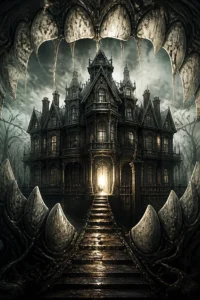
The chapel doors stood closed at the far end of the aisle, dark oak beneath a carved lintel of thorns. Beyond them, Blackthorn Hall waited, a house too old and too proud to creak. No footsteps sounded. No servants whispered. No priest murmured prayers. The entire estate seemed to be holding its breath.
Elara seized the nail with her fingertips and pulled.
It did not move.
“Of course,” she muttered. “Because grief needed hardware.”
Her voice came out steadier than she felt. That had always been one of her talents: sounding unafraid while fear put roots through her lungs.
She searched the coffin’s edge, the floor, the nearest pew. Nothing useful. Her black funeral dress clung damply to her knees from the walk across the courtyard. Her coat lay over the back of a pew, dripping onto flagstones already mottled with centuries of damp. In her pocket she had a train ticket, a cracked phone, thirty-seven pounds, and the small folding scalpel she used for delicate restoration work because old habits were more reliable than prayers.
She took out the scalpel.
The blade clicked open, bright as a sliver of moon.
“If you’re haunting this place,” she told her father, “now would be an excellent time to look away.”
She slid the blade under the nail head and worked it slowly, careful not to tear the parchment. The iron squealed against steel. The sound was too loud in the chapel, a thin animal cry that lifted the hairs on her arms. Rain struck the windows harder, as if trying to get in.
At last the nail gave.
Elara caught it before it fell into the coffin. The parchment loosened. She withdrew it from beneath her father’s hands and stepped back into the aisle, where the candlelight could reach it.
The seal at the bottom had been broken.
Black wax, stamped with a thorn-wrapped letter B, cracked through the center.
The ink was not black.
It was red. Deep, brownish red, dried darker at the edges of each letter as though the words had clotted into the fibers. Elara had restored medieval manuscripts, Victorian wills, parish registers speckled with mold and mouse droppings. She knew iron gall, vermilion, cochineal, sealing pigments ground from cinnabar and beetle shell.
This ink looked too much like blood.
Her eyes moved to the first line.
CONTRACT OF MATRIMONIAL COVENANT
Her breath shortened.
She read faster.
Between the House of Blackthorn, represented by Adrian Malachi Blackthorn, lawful heir of Blackthorn Hall, and Elara Magdalene Voss, daughter of Edmund Alaric Voss, witness to debts incurred and obligations unpaid.
The chapel tilted.
Elara gripped the back of the nearest pew until the carved wood bit into her palm.
No.
Her name looked wrong on the page. Too formal. Too exposed. As if someone had undressed her while she slept and written down the shape of her bones.
She kept reading because ignorance had never saved anyone in her family.
The named parties shall be joined in lawful marriage before the hour of midnight on the day of Edmund Alaric Voss’s burial. Upon completion, all claims held against Samuel Thomas Voss shall be suspended under the protection and surety of the House of Blackthorn.
Sam.
The name struck harder than any threat could have. Her little brother with his ridiculous trainers, his copper curls, his tendency to hum when nervous. Twenty years old and still pretending he didn’t flinch when the phone rang after midnight. Samuel Thomas Voss, who had spent the last year answering questions from police officers, creditors, and men in dark coats who smelled of expensive rain.
Elara’s hand tightened around the parchment.
The red ink continued in elegant, merciless script.
Should Elara Magdalene Voss refuse, flee, conceal herself, contest the validity of this covenant, or fail to appear at the appointed hour, all protections shall be withdrawn. The evidence held in trust shall be delivered to the appropriate authorities, and Samuel Thomas Voss shall answer in full for crimes committed under the Voss name.
Her pulse roared in her ears.
Crimes committed under the Voss name.
That phrase had followed her father into court. Into prison. Into headlines. Into death.
Voss Restorer Accused in Historic Relic Fraud.
Cathedral Funds Laundered Through Conservation Scheme.
Disgraced Expert Dies Awaiting Appeal.
Elara had read every article until the words no longer meant anything. She had sat in the back of courtrooms while barristers reduced her father’s life to invoices, signatures, missing relics, and forged certificates. Edmund had looked at her only once from behind the glass.
Keep Sam out of it.
Those had been the last words he had managed before the guards led him away.
Now his corpse had become the hiding place for a contract that used her brother as a noose.
Elara turned the parchment over. On the reverse, two signatures slashed across the bottom.
One she recognized with a pain that made her vision blur.
Edmund A. Voss.
Her father’s hand. Unmistakable. The long upper loop on the E. The sharp downward stab of the V, as if he had always been angry at his own name.
The other signature was darker, controlled, almost violently precise.
Adrian M. Blackthorn.
Elara had never met him.
Not properly.
She had seen him once, twelve years ago, from the back of a cathedral nave where her father had been restoring a cracked alabaster angel. Adrian Blackthorn had stood beside his mother beneath the great west window, a boy carved out of shadow in an immaculate black coat. He had been sixteen then, perhaps seventeen, tall and still as a blade. Other boys fidgeted. Adrian had watched.
Years later, the world had watched him back.
Adrian Blackthorn, heir to one of the oldest estates on the northern coast, suspected in the death of his first wife.
No charges. No trial. Only whispers, photographs through rain-spattered car windows, a young woman in a white dress smiling beside him three months before she fell from the east tower of Blackthorn Hall. The official verdict had been misadventure. The village had called it murder with an old name.
Now that name waited for Elara at the bottom of a marriage contract.
She folded the parchment once, then again, with hands that did not shake because she would not allow them to. The iron nail lay in her palm like a tooth.
Somewhere beyond the chapel doors, a clock began to strike.
Seven slow notes rolled through the walls of Blackthorn Hall.
Seven in the morning.
Midnight was seventeen hours away.
Elara turned back to her father. His face remained smooth, indifferent. A terrible anger rose inside her, sudden and hot enough to burn through grief.
“What did you do?” she whispered.
The corpse gave no answer.
A sound came from the other side of the chapel doors.
Not footsteps.
A scrape.
Elara went still.
The old instinct returned before thought did. Years of entering abandoned churches, unsafe crypts, locked restoration sites where rotten floors waited beneath dust. Listen first. Move second. Survive always.
She slipped the contract into the inner pocket of her coat, closed the scalpel, and tucked it into her sleeve.
The door opened.
A woman in a charcoal dress stood in the threshold, silver hair twisted into a severe knot. Her posture belonged in a portrait gallery. Her eyes belonged in an interrogation room.
“Miss Voss.”
The voice was dry, polished, and free of surprise.
Elara recognized her from the night before: Mrs. Vale, the housekeeper who had met her at Blackthorn Hall’s main doors with a lantern and the expression of someone receiving a parcel of questionable origin.
“Mrs. Vale,” Elara said.
The housekeeper’s gaze moved once to the coffin, once to Elara’s coat pocket, and back to Elara’s face.
“The mourners will begin arriving within the hour.”
“Will they?” Elara asked. “How touching. I didn’t realize my father had so many friends among the people who destroyed him.”
No flicker. Not even offense.
“Blackthorn Hall observes its obligations.”
“Does it? I’ve just had an education in Blackthorn obligations.”
Mrs. Vale’s hands folded at her waist. “Then you would be wise not to mistake them for invitations.”
The words landed softly. The threat beneath them did not.
Elara walked toward her, each step echoing on stone. She stopped close enough to smell lavender starch and old paper.
“Who put that document in my father’s coffin?”
“I am not in a position to discuss family arrangements.”
“I’m not family.”
“Not yet.”
Elara’s palm twitched toward the scalpel hidden at her wrist.
Mrs. Vale noticed. Her gaze sharpened by a fraction.
“I would advise against making a scene before the service.”
“And I would advise against nailing threats to corpses, but apparently we’re all disappointing each other today.”
For the first time, something like approval ghosted across the older woman’s face. It was gone so quickly Elara might have imagined it.
“Your room remains available should you wish to compose yourself.”
“I wish to leave.”
“The bridge road is flooded.”
“Then I’ll walk.”
“In those shoes?”
Elara looked down at her black heels, mud-stained from the courtyard. “I’ve climbed scaffolding in worse.”
“The north path has collapsed into the sea.”
“Convenient.”
“Predictable,” Mrs. Vale corrected. “The cliffs have been unstable for years.”
“And the phones?”
“Storm damage.”
Elara laughed once. It sounded ugly in the chapel. “Of course. Roads flooded, paths collapsed, phones dead. Does the Hall also swallow letters if they contain pleas for help?”
Mrs. Vale’s expression did not change.
“Sometimes.”
The answer chilled her more than a denial would have.
From somewhere far above them came a low groan of timbers under wind. Blackthorn Hall was waking. Pipes clanked in the walls. Rain hissed down gutters shaped like beasts. The old mansion breathed around them, vast and damp and watchful.
Elara moved past Mrs. Vale into the corridor.
“Tell whoever sent you that if Adrian Blackthorn wants to discuss his little corpse contract, he can do it to my face.”
Mrs. Vale followed without hurry. “Mr. Blackthorn is not presently in residence.”
“Then he can enjoy being disappointed at a distance.”
“Miss Voss.”
Elara stopped.
“You should understand something before you make a decision born of temper.”
She turned slowly.
The corridor outside the chapel ran beneath a vaulted ceiling painted with flaking stars. Portraits lined the walls—generations of Blackthorns in black coats and pearl chokers, pale hands resting on hounds, swords, books, skulls. Some faces had been turned to the wall. Others had been slashed so deeply that canvas hung in ribbons where eyes and mouths should have been.
Mrs. Vale stood among them like she had been there for centuries.
“Temper is what people call courage when it inconveniences them,” Elara said.
“Courage has buried many Vosses.”
The name struck like a slap.
“What do you know about my family?”
“Enough to suggest that your brother is safer while you remain under this roof.”
Elara crossed the space between them so quickly the housekeeper took one small step back. Not fear. Calculation.
“If anything happens to Sam—”
“It already has.”
Silence opened.
“What did you say?”
Mrs. Vale’s mouth thinned. “You should speak with Mr. Blackthorn.”
Elara did not remember moving. One moment she was in the corridor; the next she was half running through Blackthorn Hall with wet skirts snapping around her legs and her heart trying to break through her ribs.
The house rose around her in dark paneling and stone arches, impossibly larger than it had seemed from outside. Corridors branched into corridors. Staircases climbed into gloom. Doors stood locked with keyholes black as blind eyes. Everywhere, the smell of sea damp seeped beneath polish and old smoke.
She passed a long gallery where dust sheets covered furniture like shrouded bodies. Passed a conservatory where dead vines pressed skeletal fingers to cracked glass. Passed a suit of armor missing its helmet, its hollow neck stuffed with dried blackthorn branches.
Her boots slipped on marble as she reached the entrance hall.
The front doors were barred.
Not simply closed. Barred from within by a black iron beam as thick as her arm.
Elara grabbed it and pulled. It did not shift.
“Damn you.”
She set her shoulder against it. The iron remained unmoved, cold and smug beneath her hands. Outside, rain blurred the narrow windows beside the door. Beyond the glass lay the drive, the moors, the road to the village, the train station, the world where contracts were paper and coffins were for the dead.
Her phone had no signal.
She tried anyway.
Sam’s number. Call.
The screen showed nothing for a long second, then failed.
Again.
Failed.
Again.
Failed.
“Come on,” she whispered. “Pick up, pick up, pick up.”
The phone beeped and died in her hand.
Elara stared at the black screen.
A memory surfaced, unwanted: Sam at eight years old, hiding beneath the kitchen table while debt collectors pounded on the door of their flat in York. He had clutched her wrist with sticky fingers and whispered, Don’t let them take Dad.
She had promised.
She had been seventeen and stupid enough to think promises had weight in the real world.
Behind her, a voice said, “The front doors swell in this weather.”
Elara turned.
The man standing at the foot of the grand staircase was not Adrian Blackthorn.
Too old, for one. Late fifties, perhaps, with a ruddy face, thinning hair, and a clerical collar slightly askew beneath his black coat. He held a prayer book in one hand and an umbrella in the other, dripping steadily onto the marble.
“Father Harrow,” he introduced himself, attempting a smile that died before it reached his eyes. “I’m very sorry for your loss, Miss Voss.”
Elara looked from his collar to the barred doors. “Are you?”
His fingers tightened on the prayer book. “Your father was a complicated man.”
“That’s what cowards call people after helping ruin them.”
Color crept up the priest’s neck. “I did not come here to quarrel.”
“Why did you come?”
He hesitated.
There it was. That tiny pause. The same pause accountants had made before saying they had no record of payment. The same pause solicitors had made before explaining that certain files had gone missing. The pause of a man deciding how much truth he could afford.
“To conduct the burial.”
“And the wedding?”
Father Harrow flinched.
The rain filled the space between them.
Elara laughed softly. “So you knew.”
“Miss Voss—”
“Did you bless the nail too, Father? Or was that more of a house tradition?”
He glanced toward the upper landing. Fear crossed his face so plainly that Elara followed his gaze.
The landing was empty.
Only a row of portraits stared down, their painted eyes dark under varnish.
“Leave,” the priest said under his breath.
Elara stilled.
Father Harrow stepped closer, voice barely audible beneath the rain. “If you can leave, leave before he returns.”
“Who? Adrian?”
His eyes flicked again to the landing. “There are things in this house that do not loosen once they close around you.”
“Then open the door.”
“I can’t.”
“Can’t or won’t?”
His mouth trembled.
Before he could answer, the house changed.
It was subtle at first. A vibration beneath the floorboards. A shift in the air, as if the walls had drawn in a collective breath. Then came the sound of an engine beyond the doors—low, powerful, approaching through rain.
Father Harrow went very pale.
The car stopped outside.
Elara’s pulse slowed, each beat distinct.
Boots struck stone beyond the entrance.
Once. Twice.
A key turned in the lock.
Elara looked at the iron bar. It should have made the door impossible to open.
Instead, the bar lifted by itself.



0 Comments