Chapter 5: The Brother in the Dark
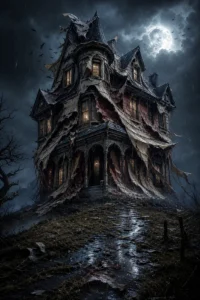
by inkadminThe rain had been tapping at the windows since dawn, soft at first, then insistent, then intimate—as if the sky had leaned close to Blackthorn Hall and begun whispering secrets against the glass.
Elara woke to it with her hand still curled around the iron key she had stolen from the portrait gallery.
For one stunned moment she did not know where she was. The ceiling above her was too high, too ornate, its plaster roses browned with damp and shadow. Her room smelled of old lavender sachets, cold ashes, and the sea. The carved bedposts rose like dark sentries at the corners of the mattress, and the curtains had been left half-open, allowing the morning to seep in gray and bruised.
Then memory returned.
The locked corridor. The torn scrap of lace caught on the splintered edge of a doorframe. The servant girl with red-rimmed eyes pressing a shaking finger to her mouth.
Stop asking, miss. Please. Before the house chooses another.
Elara sat up too quickly. Pain needled at the base of her skull, and the key bit into her palm hard enough to leave a crescent. She stared at it—small, blackened, older than the lock of any modern door. It had been tucked behind the frame of Cecilia Blackthorn’s portrait, hidden where only someone with a restorer’s hands would think to look.
Adrian’s dead wife had watched her from beneath slashed canvas and layers of dust, her painted eyes somehow more alive than any portrait had a right to be.
Elara closed her fist around the key again.
A knock sounded.
Not the polite, gloved tap of Mrs. Vale. Not the brisk rap of a maid with breakfast. This was a single knock, low and uncertain, followed by the hush of something being pushed beneath her door.
Elara froze.
The room seemed to draw in around her. Rain. Breath. The faint groan of old pipes inside the walls.
She slipped from the bed without putting on her shoes, the boards cold beneath her bare feet. A cream envelope lay on the rug just inside the threshold, heavy and damp at one corner, as if it had been carried through the rain. There was no name written across the front. No seal. No scent of perfume or wax.
Her pulse changed its rhythm.
She crossed to the door and wrenched it open.
The corridor beyond was empty.
Gas sconces flickered along the wallpapered passage, although it was nearly morning, their flames bending in a draft Elara could not feel. At the far end, where the corridor turned toward the servants’ stair, a shadow shifted and vanished. It might have been a person. It might have been the house breathing.
“Hello?” she called.
No answer came. Only the rain, and beneath it the sea striking the cliffs with the dull, relentless force of a body against stone.
Elara closed the door and turned the lock.
She did not sit to open the envelope. She stood in the middle of the rug in her nightdress, the cold rising through her bones, and slid one finger beneath the flap.
Three photographs fell into her hand.
For a heartbeat, her mind refused to assemble what she was seeing.
The first was of a school gate in York, rain-speckled, its green paint familiar enough to make her throat close. A boy stood near the curb with his hood up and his backpack hanging from one shoulder. His hair had curled at the edges from the damp. He was looking down at his phone, the little furrow between his brows so like their father’s that grief struck her cleanly, without warning.
Noah.
The second photograph showed him outside the flat they had once shared above the bakery. He was carrying a paper bag tucked against his chest and smiling at someone just out of frame. His smile was quick, lopsided, trusting. Too young. Too open.
The third photograph had been taken at night.
Elara’s fingers went numb.
Noah was visible through a window—his bedroom window—in the wash of a desk lamp. He sat hunched over a book, one foot tucked beneath him, unaware of the lens fixed on him from outside. The photograph was grainy, shot from across the narrow lane or perhaps from the roof opposite. Close enough to see the chipped blue mug by his elbow. Close enough to see that he had not closed his curtains properly.
A folded slip of paper remained inside the envelope.
Elara pulled it free.
He looks like your father when he is afraid.
Ask your husband what Silas Voss took.
Ask before we take the boy instead.
The words did not blur. They sharpened. Every letter seemed cut into the paper rather than printed upon it.
For several seconds, Elara could not move. Her heart hammered so violently that the sound filled her ears. The room tilted around her—wardrobe, windows, the basin on its stand, the dead roses in the vase Mrs. Vale had not replaced. Her brother’s face stared up from her hand, unsuspecting and alive.
Alive for now.
The fear that rose in her was not clean. It was black, choking, full of teeth. It dragged her backward through years she had spent trying not to remember: Noah at six with jam on his sleeve; Noah at ten clutching her hand outside their father’s court hearing; Noah at fifteen pretending he did not cry after the prison visits, though his pillow had been damp every time she changed the sheets.
She had promised him. Over and over, in every drafty flat and every cheap cafe where they had counted coins for bus fare. She had promised their father. She had promised herself.
I will keep him safe.
Elara snatched her robe from the chair, thrust her arms into it, and shoved the photographs and note into the pocket. She did not bother with slippers. She did not brush her hair. She left the key hidden beneath her pillow because some sharp and feral instinct told her not to carry every secret into the open at once.
Blackthorn Hall was waking reluctantly.
The mansion did not greet morning so much as submit to it. Dust motes hovered in shafts of pallid light. Somewhere below, a door opened and shut; somewhere deeper, a pipe shrieked. The carpets swallowed Elara’s footsteps until she reached the west landing, where the long windows faced the cliffs and the wind rattled their warped frames.
A maid carrying a tray nearly collided with her at the turn.
“Mrs. Blackthorn—” The girl’s eyes widened at Elara’s bare feet and unpinned hair. “Are you unwell?”
“Where is he?” Elara asked.
The maid’s hands tightened around the tray. Porcelain trembled.
“Mr. Blackthorn?”
“Yes.”
“I—I think he’s in the east study. He told us not to disturb—”
Elara was already moving.
The maid made a small sound behind her, something like warning, but Elara did not turn back. She descended the staircase with one hand sliding along the banister polished by generations of Blackthorn palms. Portraits watched her from the walls: stern men in black coats, pale women with pearls at their throats, children painted with solemn faces and dead birds in their hands. Their eyes followed her as if they knew exactly what it meant to be trapped by blood.
At the foot of the stairs, Mrs. Vale stepped from the shadow of the hall.
“Madam.”
The housekeeper looked carved rather than born, her gray hair bound in a faultless knot, her black dress buttoned to the throat. Only her eyes moved, flicking over Elara’s face, her robe, her clenched hands.
“Not now,” Elara said.
Mrs. Vale did not move aside. “Mr. Blackthorn is engaged.”
“Then he can disengage.”
“There are matters in this house which are better approached with—”
“If you say patience,” Elara said, her voice low enough that it startled even herself, “I will make you regret the word.”
A minute change passed over Mrs. Vale’s face. Not fear. Recognition, perhaps. As if she had suddenly glimpsed someone else in Elara’s anger.
Then she stepped aside.
“The east study,” she said softly. “But be careful what you demand from him before breakfast.”
Elara did not ask what that meant.
The east study lay at the end of a corridor paneled in dark oak. She had not been inside before. The door was closed, but voices bled through the wood—Adrian’s, calm and cold; another man’s, older, clipped with irritation.
“—cannot keep delaying the board,” the older voice said. “You have a wife now. The appearance of stability is useful, but only if you use it.”
“I don’t recall asking you for lessons in appearances.” Adrian’s tone was quiet enough to be dangerous.
“You asked for funds.”
“No. I demanded the release of funds already mine.”
“Your grandfather’s trusts are not—”
Elara opened the door.
The room beyond smelled of leather, smoke, and rain-soaked earth. Books lined three walls from floor to ceiling, their spines cracked and gold-lettered. A fire burned low in the grate despite the season. Tall windows looked out over the estate, where the gardens shivered beneath sheets of rain.
Adrian stood behind a massive desk strewn with papers, dressed in a black shirt with the sleeves rolled to his forearms. He looked as though he had not slept. Shadows bracketed his mouth; a faint mark darkened one knuckle. Yet even unguarded by waistcoat or tie, he possessed that awful composure, that aristocratic stillness which made other people seem poorly assembled.
Across from him stood a thin man in a charcoal suit with silver hair and a hawk’s nose. He turned at Elara’s entrance with open annoyance.
Adrian’s eyes found her. The room changed.
Not visibly. The fire did not leap, the rain did not falter, the older man did not vanish. But something in Adrian’s face tightened with instant awareness. His gaze went to her bare feet, her unbound hair, the robe clutched closed at her throat.
“Leave us,” Elara said.
The silver-haired man’s brows rose. “I beg your pardon?”
She did not look at him. “Now.”
A flicker crossed Adrian’s mouth. Not amusement. Something darker.
“Mr. Graves,” he said, “you heard my wife.”
Graves’s annoyance hardened into insulted dignity. “This is highly irregular.”
“So was your last attempt to move money through a Swiss shell account, yet here we are.” Adrian picked up a silver letter opener from the desk and turned it once between his fingers. “Go.”
The man’s face went white around the mouth. He gathered his papers with sharp, offended movements and strode toward the door. As he passed Elara, his cologne struck her—dry citrus over stale tobacco.
He paused just long enough to murmur, “A little advice, Mrs. Blackthorn. Men like your husband do not keep wives. They keep hostages.”
Elara looked at him then.
“And men like you?” she asked.
His eyes narrowed.
“What do they keep?”
For an instant, something ugly surfaced beneath his polished skin. Then he smiled without warmth. “Receipts.”
He left. The door clicked shut behind him with the finality of a lock.
Silence pressed into the room.
Adrian set the letter opener down. “What happened?”
The question was too controlled. Too immediate. It angered her more.
“You tell me.”
“Elara.”
Her name in his mouth had been many things since the wedding—an order, a warning, once nearly a confession in the dark when his hand had hovered at her waist and then retreated as if from flame. This morning it was something else. A hand reaching for a blade by the wrong end.
She crossed to his desk and threw the photographs down.
They scattered across the polished wood.
Adrian did not touch them.
His gaze dropped. Whatever she expected to see—surprise, guilt, calculation—what appeared instead was worse.
Recognition.
His face became very still.
Elara’s breath caught. “You knew.”
“I knew they might move.”
“Move?” The word came out raw. “That is my brother.”
“I know who he is.”
“They photographed him in his bedroom.”
Adrian’s eyes lifted to hers. “Where is the envelope?”
“Do not.” She slapped her palm against the desk hard enough to sting. “Do not make this about evidence while my brother is being hunted.”
A muscle flexed in his jaw. “Everything is about evidence when enemies want you emotional enough to make mistakes.”
“I am not one of your staff. I am not a piece on whatever board your family has been bleeding over for the past hundred years.”
“No,” he said, voice dropping. “You are my wife.”
Heat flashed through her, violent and unwelcome. “Because you gave me a choice between a wedding and a prison cell.”
“Because I kept the Wardens from taking Noah that night.”
The words hit her like a thrown stone.
She stared at him. “What?”
Adrian moved at last. He picked up the third photograph—the one taken through Noah’s window—and studied it with an expression that made the room feel colder.
“The people who sent this are not trying to scare you,” he said. “They are trying to make you run to him. If you leave the grounds without precautions, they’ll have both of you before you reach the station.”
“Who are they?”
He did not answer.
Elara laughed once, disbelieving and sharp. “Of course. Another locked door. Another family secret. Shall I guess? A rival estate? Some decaying branch of aristocrats with too many knives and not enough land?”
“This is not a game.”
“Then stop playing it.”
Adrian’s eyes darkened. “You think I enjoy this?”
“I think you enjoy control.”
“Control is the only reason your brother woke up alive this morning.”
The sentence emptied the air from her lungs.
She gripped the edge of the desk. Its wood was smooth beneath her fingers, worn by other hands, other confrontations. “Do not say things like that to me unless you mean to explain them.”
Adrian looked toward the rain-lashed windows. For a moment, the storm reflected across his face, turning his eyes to black glass.
“There are families in the north,” he said slowly, “who never stopped being feudal. They put on suits. They sit on hospital boards and museum committees. They donate to cathedral restorations and prison reform charities. But underneath it, they still count debts in blood.”
Elara felt the old unease stir at the mention of cathedrals, of prisons. “The Wardens.”
His gaze cut back to her. “You’ve heard the name?”
“My father said it once.” She swallowed. The memory had the texture of cigarette smoke and visiting-room plastic. “During one of the visits. He thought Noah was asleep on my shoulder. He told me if anyone with a rook pin came to the door, I was to take Noah and get somewhere crowded.”
Adrian’s expression closed. “Did anyone come?”
“No.”
“Lucky.”
“No,” she said. “Poor. We moved too often for monsters with cufflinks to keep track.”
Something passed through his eyes, a brief shadow of something like admiration, quickly smothered.
She hated that she noticed.
“What do they want with Noah?” she demanded.
“Leverage.”
“Against whom? Me?”
“Against me.”
“Then why mention my father?”
Adrian’s fingers tightened around the photograph. The paper curved but did not crumple.
“Because Silas Voss stole something from the Blackthorn family the night he died.”
The study seemed to lurch.
Elara had braced herself for lies, evasions, perhaps some cruel revelation about money or forged documents. She had not braced for this—her father’s name spoken like an accusation, attached to the verb that had destroyed him once already.
“Take that back,” she said.
Adrian’s face did not soften. “I can’t.”
“My father was many things. Stubborn. Secretive. Too proud to ask for help even when the walls were falling in.” Her voice shook, and she hated it. “But he was not a thief.”
“He was convicted of theft.”
“Because your world needed someone disposable to blame.”
“Yes.”
The admission landed between them, quiet and brutal.
Elara went still.
Adrian set the photograph down with deliberate care. “Your father was framed for the first theft. Not the second.”
For a heartbeat, she could only hear rain.
“What second theft?”
He looked at her as if measuring how much truth a person could survive before they mistook it for cruelty.
“The night he died, Silas came to Blackthorn Hall.”
“No.”
“He entered through the old chapel crypt just after midnight.”
“No,” she said again, but weaker, because the word was no longer denial. It was prayer.
Adrian opened a drawer and removed a flat black folder. He placed it on the desk but did not open it. “The camera over the north gate caught his car. The chapel sensor logged an entry at twelve seventeen. By one o’clock, the reliquary vault had been opened.”
Elara stared at the folder. It seemed alive somehow, pulsing with the possibility of ruin.
“My father died on the A171,” she said. “The police said he lost control in the rain.”
“He did.”
“After leaving here?”
Adrian said nothing.
Her hands curled into fists. “You let me stand at his grave. You watched me marry you. You watched me walk through this house grieving him, and you knew he had been here the night he died?”
“I suspected.”
“Do not split words with me.”
“I confirmed it yesterday.”
Yesterday. While she had been finding torn lace and scraped portraits, he had been holding another piece of her father’s death behind his teeth.
“Why didn’t you tell me?”
“Because you would have done exactly what you’re doing now.”
“Wanting the truth?”
“Running at it with both hands bleeding.”
She stepped around the desk before she knew she meant to. Adrian did not retreat. He stood very still as she came close enough to strike him, close enough to see the faint stubble along his jaw, the sleeplessness beneath his eyes, the scar cutting pale through one eyebrow.
“My father died alone in the rain,” she said. “If you know why, you will tell me.”
His gaze dropped, briefly, to her mouth. The moment was there and gone so fast she might have imagined it, except her body betrayed her with a treacherous shiver.
His voice lowered. “Silas took the Ashen Vow.”
The words meant nothing. They meant everything. She felt them settle against her skin like soot.
“What is that?”
Adrian turned away first. He walked to the fire and braced one hand on the mantel. Above it hung a landscape of Blackthorn Hall before its decay, the stone pale beneath a clean blue sky, the gardens disciplined and bright. It looked less like the same house than a dream the current one had murdered.
“A document,” he said. “Older than the family trust. Older than most of the land laws that pretend to govern estates like this.”
“A deed?”
“A vow.”
“That is not an answer.”
“It is a contract signed by the first Blackthorn and five other houses after the chapel burned in 1819. It bound them to secrecy over what was buried beneath this estate.”
Elara’s stomach tightened. “Buried?”
“Records. Bodies. Names.” He looked back at her. “Proof of crimes that could topple families still powerful enough to decide who is prosecuted and who disappears.”
The note in her pocket seemed to grow heavier.
Ask your husband what Silas Voss took.
“Why would my father steal it?”
“I don’t know.”
“Lie better.”
“If I knew, I would have already used it.”
There was enough cold honesty in that to stop her.
Elara looked down at the folder. “Open it.”
“No.”
“Adrian.”
His name came out before she could shape it into anger. It was bare, unguarded, and for the first time since she had entered the room, pain flickered across his face.
“If I show you what is in that folder,” he said, “you will not sleep.”
“You overestimate how well I’ve been sleeping.”
“Elara.”
“Open it.”
For a long moment, neither moved.
Then Adrian came back to the desk and lifted the folder’s cover.
Inside were photographs, grainy security stills printed on matte paper. Elara recognized her father in the first image despite the hood of his coat, despite the angle and the rain. Silas Voss had been broad-shouldered and stooped by worry long before prison; in the photograph, he looked ghost-thin, a man carved down to intention.
He stood at an iron gate beneath an arch of stone. The time stamp read 00:09.
The second image showed him in the chapel ruins.
Elara’s breath caught despite herself.
She had seen the old chapel from the outside only—a black-boned structure attached to the north wing, its stained-glass windows boarded, its roofline broken. In the photograph, candlelight blurred around her father’s face. He was looking over his shoulder as if someone had called his name.
The third image made her grip the chair beside her.
Silas stood beside a vault door carved with thorns. It hung open. In his arms was a long metal casket, narrow as a child’s coffin, chased with blackened silver and symbols Elara could not decipher.
Her father’s expression was not that of a thief.
It was terror.
“That isn’t theft,” she whispered. “That is escape.”
Adrian said nothing.
“Who was he running from?”
He touched one of the photographs and slid it free from beneath the others.



0 Comments