Chapter 4: Rooms That Remember Screams
by inkadminBy morning, the rain had become part of the house.
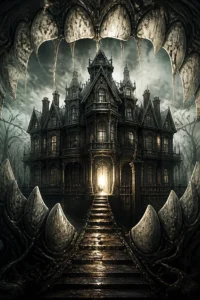
It slid down the tall windows in trembling veins, tapped through cracks in the gutters, whispered in chimneys that had not known fire in years. Blackthorn Hall did not wake so much as deepen, its corridors loosening from darkness by degrees, like a corpse reluctantly surrendering to the undertaker’s lamp.
Elara stood before the bedroom mirror in Adrian’s locked wing with a silver-backed brush clenched in one hand and her hair still damp against her throat. The woman looking back at her seemed composed enough to be a stranger. Pale face. Sleepless eyes. Mouth pressed into a line that had learned stubbornness from hunger and grief. Around her neck, the thin chain of her mother’s locket glinted beneath the collar of a borrowed black dress.
Borrowed, because nothing she owned had been brought from her father’s rooms in the village inn. Borrowed, because everything in Blackthorn Hall seemed to come with an invisible hand at the back of her neck.
On the small writing table near the window, a tray waited untouched. Coffee cooling in a porcelain pot. Toast arranged with military severity. A soft-boiled egg nestled in silver. There was also a note, folded once, her name written in black ink with the clean, ruthless precision she was beginning to associate with Adrian Blackthorn.
Mrs. Blackthorn,
You may walk the east and south wings. The north wing remains locked. Do not enter the old chapel without me. Do not question the staff about matters predating your arrival.
A.B.
Elara read it twice, then set the paper down as if it had burned her fingertips.
Mrs. Blackthorn.
The name sat on the page like a shackle polished until it gleamed.
She had signed the contract. She had stood beneath the eyes of dead men while a magistrate with trembling hands declared her bound to a man the county whispered had murdered his first wife. She had done it because Tomas’s life had been weighed against her freedom, and freedom had lost.
Now the house watched to see what she would do with the little that remained.
Elara pinned her hair back with two black combs from the vanity drawer. They were old, tortoiseshell, too fine for the room’s dust-veiled decay. For a moment, she wondered if they had belonged to the first Mrs. Blackthorn.
Vivienne.
No one had spoken the name aloud since Elara’s arrival, but the air bent around it. Servants glanced away. Adrian’s expression closed like iron gates. Even the portraits seemed to know. Last night, when she had noticed the fresh red marks beneath Adrian’s cuffs, she had almost asked who had put them there.
Almost.
There were questions one asked men like Adrian Blackthorn and questions one survived long enough to ask later.
Elara crossed to the door and tried the handle.
It opened.
The relief that moved through her was sharp and shameful. She disliked how quickly captivity taught the body gratitude for a loosened bolt.
Outside, the corridor stretched in two directions, panelled in dark oak that had swollen with damp until the carved vines writhed out from the walls. Gas sconces, electrified badly sometime in the last century, gave off a weak amber glow. Under the smell of beeswax and old timber lay something else—brine, cold stone, faint mildew, and the metallic ghost of extinguished candles.
At the far end of the corridor, a maid in a gray dress paused with a stack of folded linen in her arms.
She was young, perhaps nineteen, with a pointed chin and light brown hair scraped into a bun so tight it drew her brows upward. When she saw Elara, she dipped at once.
“Good morning, ma’am.”
“Good morning.” Elara stepped toward her. “Your name?”
The girl’s fingers tightened on the linen. “Martha, ma’am.”
“Martha.” Elara softened her voice. “Do you know where Mr. Blackthorn is?”
“Gone down to the shore road with Mr. Vale. There was trouble with the boundary wall.”
Mr. Vale. The solicitor. The man with the blood-red contract and dry eyes.
“And Mrs. Harker?” Elara asked.
“In the kitchens, ma’am.”
“Good. Then perhaps you can help me.”
Martha’s face flickered as if a shutter had blown open and slammed closed again. “I’ve linens to put away, ma’am.”
“It won’t take long. I’m looking for the house records. Architectural plans, restoration accounts, old inventories. My work requires knowing what was changed, and when.”
“The master keeps papers in his study.”
“Which is locked.”
“Most things are.” The girl said it too quickly, then flushed. “Beg pardon.”
Elara studied her. Fear had a thousand dialects. Martha spoke in lowered eyes and whitened knuckles.
“I won’t get you in trouble,” Elara said.
A laugh almost escaped the girl. It died before becoming sound. “That’s not something anyone can promise in this house.”
The words hung between them with the damp.
Before Elara could press, footsteps sounded on the servants’ stair. Martha startled so hard one sheet slipped from the pile. Elara caught it before it fell.
“Thank you, ma’am.” Martha snatched it back. Her gaze darted past Elara, down the corridor toward a door with a brass plate so tarnished it looked black.
“What’s there?” Elara asked.
“Nothing.”
“Nothing rarely needs a lock.”
Martha’s face lost color. “Please, ma’am.”
The footsteps below faded. No one appeared.
Elara turned toward the door.
It sat recessed between two carved pilasters, less grand than Adrian’s rooms, but better maintained. The keyhole had been polished by recent use. On the brass plate, beneath the corrosion, faint letters emerged when she rubbed them with her thumb.
Morning Room.
“Did she use this room?” Elara asked quietly.
Martha did not answer.
“Vivienne.”
The stack of linen trembled.
There it was. The house did not creak. The rain did not hush. Yet the name altered the corridor, drawing the cold closer.
Martha whispered, “Don’t.”
“Did she die in there?”
“No.”
Too fast.
Elara turned fully. “Then where?”
Martha’s eyes lifted at last. They were gray, rimmed red, and frightened beyond youth. “Mrs. Blackthorn, if you’ve sense, you’ll eat your breakfast, write your letters, and keep to the rooms he gives you.”
“I had sense yesterday. It signed itself away by midnight.”
Something like pity crossed Martha’s face.
“I know what people say about your husband,” the girl breathed. “I know what they said after the first one. But people outside these walls don’t know the half of it. They think the danger here has a man’s face because that’s easier than believing the house has teeth.”
Elara’s pulse gave a slow, hard knock.
“Houses don’t choose victims, Martha.”
The girl looked past her again, at the sealed door.
“This one does.”
She fled before Elara could stop her, linen clutched to her chest like a shield.
For a long moment, Elara listened to her footsteps vanish down the servant stair. Then she faced the Morning Room door.
The sensible thing would have been to walk away.
Elara had built a career on ignoring what crumbling buildings wished to conceal. She knew how to read the seam of a blocked arch beneath plaster, the age of mortar by its smell, the lie in a wall when stones had been replaced by hands too hurried to match them properly. Cathedrals remembered fire, flood, plague, and war. They hid bones beneath chapels and coins inside saints. They were honest in their decay, if one knew how to look.
Blackthorn Hall was not honest.
It performed ruin while guarding something very carefully.
Elara reached into her hair and drew out one of the tortoiseshell combs. The pins were narrow, flexible, and old enough to be real tortoiseshell instead of imitation. She snapped one tine free with a wince at the sacrilege, bent it slightly, and crouched before the lock.
Her father had taught her to pick simple locks when she was thirteen, not for theft, he had insisted, but for old buildings whose keys had been lost by drunk wardens, dead vicars, and governments with poor filing systems. She could still hear Edmund Voss’s voice, warm with amusement.
A locked door is an opinion, Ellie. Sometimes a foolish one.
The lock resisted, stiff with disuse but not complicated. Her hand steadied. Rain tapped against distant glass. Somewhere below, a door closed.
The mechanism clicked.
Elara froze, listening.
No shout. No footsteps.
She slipped inside.
The Morning Room was not dead.
That was the first thought, absurd and immediate. Most unused rooms settled into a soft, stale emptiness, furniture crouched beneath sheets, air thick with dust. This room seemed held in a breath. Curtains of faded blue silk were drawn against the rain, but a thin gray light seeped around their edges. A fire had not been lit, yet the grate held fresh ash. On a small table near the window, a vase of white lilies sagged in brown water, petals bruised at the edges.
Someone had been here recently.
The room smelled of damp flowers, cold ash, and beneath both, a perfume so faint it might have been memory—violet and bitter orange.
Elara closed the door softly behind her.
The furnishings were delicate, French, and feminine in a way Blackthorn Hall otherwise refused: gilt-legged chairs, a pale escritoire, a harp with three broken strings, watercolors of coastal flowers on the walls. A woman’s room. A cage made comfortable enough that its bars could be mistaken for decoration.
Above the mantel hung a portrait.
Vivienne Blackthorn had been painted standing beside the west cliffs at sunset, one gloved hand resting on the neck of a black greyhound. She was beautiful in the costly, exhausted way of women raised to be admired and never believed. Golden hair arranged beneath a feathered hat. Eyes the pale blue of skimmed milk. A mouth that might have smiled if the painter had allowed it.
Someone had scratched her face.
Not destroyed it entirely. That would have been mercy. Four deep gouges ran from brow to chin, as if claws had tried to erase her expression while leaving her body untouched. The paint curled at the edges of each wound.
Elara stepped closer. The scratches were old, but not as old as the portrait. The exposed canvas had darkened with grime. Whoever had done it had wanted the violence to remain visible.
Below the painting, on the mantel, stood a row of porcelain birds. Swallows, each one painted mid-flight. One lay broken, its head missing.
Elara moved through the room carefully, resisting the urge to touch everything at once. The restorer in her took over where fear might have slowed her. She noted disturbed dust on the escritoire. Recent fingerprints on the lid of a silver box. A fresh candle stub in a holder beside the hearth. The lilies, not more than three days old.
Adrian had forbidden questions about the past. He had not forbidden rooms from answering.
The escritoire was unlocked.
Inside lay stationery embossed with a faded crest, dried ink, a pen with a cracked mother-of-pearl handle. The pigeonholes held old receipts, visiting cards, pressed flowers gone brown and brittle. Elara sifted with growing impatience until she found the hidden catch.
There was always a hidden catch in furniture made for women with secrets.
The back panel slid loose under her thumb.
A narrow compartment opened.
Within it lay three things: a small brass key tied with blue thread, a folded handkerchief stained rust-brown, and a diary bound in green leather.
Elara’s breath caught.
The diary’s clasp had been broken. The first pages were mundane—weather, callers, headaches, complaints about the cook’s heavy hand with salt. Vivienne’s handwriting began careful and ornamental, the sort taught by governesses. Then, weeks later, it sharpened. Ink blotted. Lines slanted.
Elara turned pages until a passage snagged her eye.
March 3rd. A.B. did not come to dinner. Mrs. H says he has taken to the old chapel again. I hear him walking after midnight, though his room is below mine and the steps are above. When I asked, he looked at me as if I had placed a knife against my own throat.
Elara swallowed and read on.
March 7th. I found mud in the nursery corridor. No child has lived here since Adrian was small. Mrs. Harker scrubbed it before breakfast and told me I must have imagined it. Mud does not imagine itself.
The nursery corridor. The north wing?
Her fingers tightened around the diary.
March 9th. They lie. All of them. Even A., especially A. He holds silence like a blade and thinks because he bleeds from it too, I should be grateful.
Elara thought of the scars beneath Adrian’s cuffs, red and fresh against controlled hands.
March 12th. I am not mad. I am not. I heard a woman crying behind the chapel wall. When I pressed my ear to the stone, she stopped. Then she laughed in my voice.
The room seemed to contract.
Elara glanced toward the door, suddenly aware of the silence beyond it. No footsteps. No servants. Only rain, softer now, as if the house listened with its roof.
She turned another page.
March 15th. If anything happens to me, it will not be by the sea.
The words struck like cold water.
Vivienne Blackthorn, according to county whispers, had thrown herself from the cliffs during a storm. Some said Adrian pushed her. Others said she ran from him and the dark took her before he could drag her back. Her body had been found among rocks below Blackthorn Point, broken by tide and stone.
Elara read the line again.
If anything happens to me, it will not be by the sea.
Beneath it, another line had been scratched so violently the nib had torn the paper.
He promised me the sea would be the story.
He.
Adrian?
Elara felt the question open like a pit beneath her. She wanted him to be monstrous in a simple way. A cruel husband. A murderer with beautiful hands and controlled eyes. Then she could hate him cleanly. But nothing in Blackthorn Hall offered clean edges.
She flipped ahead. Several pages had been cut out with a blade.
Near the end, Vivienne’s handwriting had changed completely. Large, uneven, frantic.
The room remembers screams. Not mine first. Not mine last. There is a door behind the Virgin’s broken hand. A.B. knows. He stands guard not to keep us in but to keep it—
The sentence ended in an ink smear.
Elara leaned closer, heart beating against her ribs.
The Virgin’s broken hand.
The old chapel.
Do not enter the old chapel without me.
A sound came from the wall.
Not the corridor. Not outside. The wall behind the portrait.
A faint scrape.
Elara went still.
It came again. Slow, deliberate, like fingernails dragged along the other side of wood.
Every instinct screamed for her to run. Instead, she set the diary down, crossed to the mantel, and stood beneath Vivienne’s mutilated face. The scratching stopped.
Elara held her breath and pressed her palm to the wall paneling.
Cold.
Too cold. The oak felt like stone chilled underground.
She ran her fingertips along the carved border. There. A seam barely wider than a hair, hidden in the vines. She pushed. Nothing. She pressed higher, lower, searching for a latch. Her thumb brushed one of the carved leaves.
It gave.
The portrait swung forward on silent hinges.
Behind it was darkness.
Elara’s throat closed. The opening was narrow, perhaps two feet wide, revealing a passage descending between walls. Damp air breathed out, smelling of salt, lime dust, and something organic gone sour with age.
A servants’ passage? A priest hole? A smuggler’s route? Northern estates collected secret ways the way churches collected relics.
On the inner wall just beyond the opening, a line had been carved into the plaster.
Elara took the candle from the mantel, struck a match from the silver box, and coaxed flame to the wick. The light trembled over the inscription.
V.B. — I WAS NOT ALONE
Below it, smaller, scratched with a weaker hand:
Tell Adrian I forgive him.
The candle flame bent sharply though no wind touched it.



0 Comments