Chapter 3: The Cathedral Without Saints
by inkadminThe cathedral had no saints.
Lenore noticed it the moment the iron doors groaned open and the damp breath of the place rolled over her skin. There were niches where saints should have stood—arched hollows climbing the walls in solemn rows, each pedestal carved with old names worn smooth by centuries of rain and prayer—but every one of them was empty.
No Virgin with chipped blue robes. No martyr holding a palm. No carved bishop with a hand raised in blessing.
Only shadows.
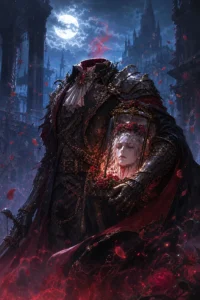
The private cathedral crouched behind Blackthorne House like something the estate had swallowed and failed to digest. Its spire pierced the predawn sky, black against the bruised violet clouds, and rain threaded down its stained-glass windows in silver veins. Somewhere beyond the cliff road, the sea hurled itself at the rocks with the same dull fury that had battered Saint Orison for generations.
Lenore stood at the threshold in a wedding dress that did not belong to her, with her father’s debt hanging around her throat heavier than the pearls sewn into her collar.
“Walk,” murmured the woman at her left.
Madame Vey was not family, though she had been sent to dress Lenore as if she were kin. She had appeared in Lenore’s borrowed bedroom three hours before dawn with a black lacquered case, two silent maids, and the expression of a physician preparing a body for burial.
Now her gloved fingers pressed between Lenore’s shoulder blades. Not hard. Not kindly.
A reminder.
Lenore stepped into the nave.
The cathedral smelled of cold stone, candle smoke, rainwater, and lilies left too long in a locked room. Hundreds of tapers burned in iron stands along the aisle, their flames trembling whenever the doors admitted another gust of sea wind. The light gilded the faces gathered in the pews, turning them momentarily sacred before revealing what they truly were.
Enemies.
Saint Orison had sent its finest monsters to pray.
The Voss family occupied the first pew to the left, all winter-pale hair and fox-sly smiles. Old Elias Voss leaned on a cane capped with a silver serpent, his eyes cloudy but awake with malice. Beside him, his granddaughter Seraphine wore white feathers at her throat and watched Lenore as if deciding which piece of her to pluck first.
The Marrow brothers sat across the aisle, broad and red-knuckled in black suits that strained over their shoulders. One of them had a fresh split in his lip. Another kept rubbing his thumb over the scar where his right ear should have been.
Behind them, the Thornes, the Larkes, the Sable women with their gloved hands folded over rosaries they had likely used to strangle men.
All the bloodlines of Saint Orison’s polite underworld had arrived before dawn to witness the transaction.
Not a wedding.
A transfer of ownership.
Lenore lifted her chin.
Her veil was antique lace, so fine it felt like spider silk over her face. It blurred the world at the edges, softening the knives. The dress had been chosen to make her look innocent, which was either cruelty or comedy. Long sleeves buttoned tight at her wrists. A high collar embroidered with seed pearls hid the hollow at her throat. The bodice fit as if made for her, which disturbed her more than if it had been too large.
Madame Vey had tightened the laces while Lenore stared at her reflection in a black-framed mirror.
“Who wore this before me?” Lenore had asked.
The old woman’s hands paused for half a heartbeat.
“No one who needs it now.”
That had been the end of the conversation.
At the far end of the aisle, beneath a cross carved not with Christ but with a spray of blackthorn branches, Cassian Blackthorne waited.
Lenore hated that the sight of him steadied the room.
He stood in a coat so dark it seemed cut from the hour before sunrise, his posture straight, his hands bare and still at his sides. Candlelight caught on the sharp planes of his face, the austere line of his mouth, the slash of his cheekbones. He looked less like a groom than a sentence being carried out.
Beautiful men were supposed to be easy to despise. Beauty made them vain, and vanity made cracks.
Cassian had no cracks.
At least none visible.
His gaze found her through the veil and did not move away.
Lenore felt it settle on her like a hand at the back of her neck.
Her father was not walking her down the aisle.
That was another kindness the Blackthornes had denied him or another punishment they had inflicted on her. Lenore had not asked. Thaddeus Vale had been confined somewhere inside the estate since the previous night, after Cassian had placed the old contract on the desk between them and spoken the words that had turned Lenore’s blood to ice.
Your mother did not die because she was ill, Miss Vale. She died because she remembered something she was not permitted to remember.
The proof had been worse than the statement.
A photograph, water-stained at the edges, showing her mother in Blackthorne House twenty-two years ago, one hand pressed protectively to her swollen belly. Beside her stood a young man with the Blackthorne eyes and a priest’s collar. On the back, in her mother’s handwriting, three words:
If Lenore asks.
Lenore had asked nothing after that.
Not because there were no questions.
Because every question had teeth.
The aisle seemed longer than the nave itself. Her shoes whispered over stone worn smooth by generations of criminals kneeling where saints should have watched. Rain ticked steadily against the glass above. Thunder moved somewhere offshore, low and patient.
Halfway down, someone laughed softly.
Lenore turned her head just enough to catch Seraphine Voss leaning toward the man beside her. “She is prettier than expected,” Seraphine whispered, not bothering to lower her voice. “Shame. Pretty things rot so visibly.”
Lenore stopped walking.
Madame Vey’s hand stiffened against her back.
The cathedral seemed to inhale.
Lenore looked directly at Seraphine through the veil and smiled.
“How kind of you to warn me,” she said. Her voice carried cleanly in the vaulted hush. “I would hate to compete with your experience.”
A Marrow brother choked on a laugh.
Seraphine’s smile sharpened to the point of drawing blood. Old Elias Voss tapped his cane once against the floor.
At the altar, Cassian did not smile.
But something moved in his eyes.
Something quick. Dark. Almost alive.
Lenore walked on.
The priest waiting beneath the blackthorn cross wore vestments of deep gray rather than white. His hair was silver, his face narrow, and his hands folded around a book bound in cracked black leather. Lenore recognized him from the photograph, though the years had pulled his skin taut over bone and hollowed his cheeks.
The young man with the priest’s collar.
Older now. Not dead. Not vanished.
Standing at the altar of her forced marriage as if he had expected her all along.
Her steps faltered.
Cassian’s gaze flicked to the priest, then back to her.
A warning?
An apology?
Lenore despised that she was already learning to read the silences of a man she had sworn to hate.
She reached the altar alone.
Madame Vey withdrew into the shadows with a rustle of black silk. Lenore stood beside Cassian but did not look at him. Up close, he carried the cold scent of rain, cedar, and something metallic beneath it, like old coins warmed in a fist.
“Miss Vale,” the priest said.
His voice struck some buried nerve. Not memory. Not exactly. More like the ache of a bruise pressed before she knew where it lay.
“Father.” Lenore let the word hang between them. “Have we met?”
His fingers tightened on the book.
“Not in any way that matters today.”
“That sounds like a yes wearing a cassock.”
Cassian’s hand brushed hers.
It was no more than a whisper of skin. A restraint so slight no one else could have noticed, and yet Lenore felt the command in it.
Not here.
She turned her head, finally looking at him.
His face remained composed, the edges of him carved in candlelight. But his eyes were fixed on her with such intensity that the cathedral and its watching vultures seemed to recede.
“If you touch me to silence me again,” she said softly, “I will make this ceremony memorable.”
“It already is.”
His voice was low enough for her alone, velvet laid over steel.
“Because you bought a bride before breakfast?”
“Because you are standing.”
She hated the way that struck her. Not flattery. Not tenderness. A fact offered with the quiet weight of respect.
Lenore looked away first.
The priest opened the book.
“We gather under witness of blood, bond, and covenant,” he began.
No mention of God. No blessing. No saints to intercede. Only blood, bond, covenant.
The words fell through the nave like stones dropped into a well.
“Two houses enter accord. Two names are bound before those who keep the laws beneath the laws. Let any who hold grievance against this union speak now and place their claim before the altar.”
A murmur threaded through the pews.
Lenore felt rather than saw Cassian shift beside her. It was barely movement, a settling of his weight, but the effect traveled through the cathedral. Men who carried knives for a living lowered their eyes. Women with poison rings folded their hands more tightly.
For one absurd second, Lenore thought no one would speak.
Then old Elias Voss rose.
His bones cracked audibly. Seraphine offered her arm; he ignored it. His silver serpent cane struck the stone once, twice, three times.
“House Voss objects.”
The words sliced through the candle smoke.
The priest did not look surprised. Cassian did not move.
Lenore’s heart gave a hard, traitorous kick.
“On what claim?” asked the priest.
Elias smiled with yellowed teeth. “Blood-debt cannot be redeemed with spoiled collateral.”
A rustle passed through the congregation, silk and wool and hungry interest.
Lenore’s face went cold.
Spoiled.
She knew without being told what shape the insult carried. A woman offered in settlement had to be clean of other claims, untouched by other contracts, free of promises, pregnancies, scandals, illnesses, madness. Saint Orison’s old families had rules for everything, even the purchase of daughters.
“Explain,” the priest said.
Elias lifted one trembling hand toward Lenore. “Vale blood carries ruin. Her father is a drunk, her mother died raving, and the girl herself earns coin scraping paint from dead men’s portraits. Hardly a bride fit to secure Blackthorne inheritance.”
Lenore laughed.
She could not help it. The sound escaped before fear could cage it.
Every face turned toward her.
She lifted her veil with one hand, just enough to see the old man clearly. “Forgive me. I expected an objection with substance.”
Elias’s milky eyes narrowed.
Lenore smiled at him the way she smiled at rotten varnish before stripping it from a masterpiece. “My father is a drunk, yes. My mother died raving, yes. I restore art because dead men pay more reliably than living ones. If those are your revelations, Mr. Voss, then Saint Orison’s intelligence network has become tragically underfunded.”
One of the Sable women hid her mouth behind her glove.
Seraphine’s eyes gleamed.
Elias leaned harder on his cane. “Impudent little—”
“Careful,” Cassian said.
One word.
The cathedral froze around it.
Cassian had not raised his voice. He did not need to. The word carried down the nave colder than the rain on the windows.
Elias looked at him.
For a moment, the old man’s smile faltered.
Cassian turned slightly, placing himself half a step in front of Lenore. Not enough to shield her completely. Enough to make the statement visible.
“You may object to the contract,” he said. “You may object to the terms. You may even object to me, if age has made you sentimental for suicide.”
A terrible quiet spread.
“But you will not insult my bride.”
My bride.
The words slid under Lenore’s skin with a heat she did not want. She told herself it was anger. Told herself her pulse leapt because she was trapped, dressed in dead lace, surrounded by people waiting to see whether she would flinch.
Elias bowed his head an inch. “No insult was intended to House Blackthorne.”
“And yet one was delivered.”
Seraphine touched her grandfather’s sleeve. Her smile had vanished.
Cassian waited.
The silence sharpened.
At last, Elias said, “House Voss withdraws its objection.”
“No,” Cassian said. “House Voss apologizes.”
A whisper of shock moved through the pews.
Lenore stared at Cassian’s profile. The arrogance of him should have been unbearable. It was unbearable. It was also, in that moment, aimed like a blade away from her.
Elias’s face mottled purple. His cane hand shook. “To whom?”
Cassian’s eyes were merciless. “To my wife.”
“She is not your wife yet.”
“Then be grateful I am still patient.”
The priest’s expression did not change, but Lenore saw the muscle jump in his jaw.
Rain hissed against the glass.
Everyone waited to see whether Elias Voss would choose pride or survival.
The old man turned his gaze on Lenore. Hatred lived there, ancient and practiced. But beneath it was something stranger.
Recognition.
Not of her face, perhaps. Of something behind it.
His lips peeled back. “House Voss apologizes to Miss Vale.”
Lenore inclined her head. “How generous. I will treasure it always.”
A Marrow brother coughed into his fist. It sounded suspiciously like a laugh.
Elias sat, each movement stiff with humiliation. Seraphine leaned close to him, whispering something that made his knuckles whiten on the serpent cane.
The priest waited until the murmurs died.
“Are there further claims?”
No one rose.
Lenore almost wished someone would. Anything to delay the moment when refusal ceased to be performance and became consequence. But the old families had measured Cassian’s mood and decided there were easier ways to die.
The priest turned a page.
“Then let the covenant proceed.”
A boy emerged from the shadows near the altar carrying a shallow silver bowl. He could not have been more than twelve, pale and solemn, with Blackthorne-dark hair falling into his eyes. In the bowl lay two rings and a small dagger with a handle carved from bone.
Lenore stared at the blade.
“No,” she said.
The priest paused.
Cassian turned toward her fully. “Lenore.”
It was the first time he had spoken her name since the library.
Not Miss Vale. Not bride. Lenore.
It landed between them with dangerous softness.
“You did not mention blood,” she said.
“It is ceremonial.”
“So are funerals.”
His mouth tightened. “A cut across the palm. Nothing more.”
“I have had quite enough of men deciding how much of me is nothing.”
Something flickered over his face. Regret, perhaps. It was gone before she could be certain.
“If you refuse the blood rite,” the priest said quietly, “the covenant may be challenged within three days by any house present.”
Lenore looked at him. “And if I accept?”
“Then any challenge against you becomes a challenge against House Blackthorne.”
There it was. The trap with its teeth painted gold.
Without the rite, she remained vulnerable—collateral in a room filled with collectors. With it, she became Blackthorne property, protected because damage to her would be insult to Cassian’s name.
A cage was still a cage, even if the bars were locked from the inside.
Lenore reached for the dagger.
Cassian caught her wrist.
The contact jolted through her. His fingers were cool, firm, careful not to bruise. She looked down at his hand encircling hers, then up at him.
“I warned you about touching me.”
“I heard you.”
“And yet.”
“And yet,” he said, “do not cut too deep.”
For one instant, the mask slipped—not enough for the congregation, not enough for anyone who did not stand close enough to see the faint tension at the corner of his mouth.
But Lenore saw.
He was afraid.
Not of her disobedience. Not of scandal.
Of her bleeding.
The realization was so unexpected she forgot to breathe.
Then his hand released her, and the cold returned to his face as if it had never left.
Lenore took the dagger.
The blade was sharper than it looked. She drew it across her palm before she could think better of it. Pain flashed white and clean. Blood welled immediately, bright against her skin.
Her stomach turned.
Not from the cut.
From the sudden scent of iron.
For a heartbeat, the cathedral vanished.



0 Comments