Chapter 5: The Husband Who Sleeps Armed
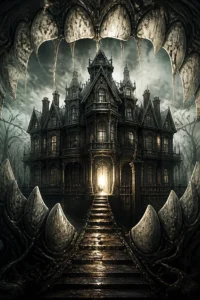
by inkadminThe rain had learned the shape of Blackthorne House.
It slid down the windows in long, trembling fingers, gathered in the carved mouths of stone saints, and whispered through gutters black with age. It tapped against Lenore’s bedroom glass like nails on a coffin lid, soft at first, then impatient, then soft again, as if the house itself were trying to remember a song.
She had not slept.
The bed was too large, the sheets too cold, and the canopy above her hung like mourning cloth. Every time she closed her eyes, she saw the portraits from the western gallery—faces of Blackthorne men and women arranged in bloodline order, all with their painted eyes gouged out to reveal raw canvas beneath. She had stood before them at dusk with her fingers clasped behind her back, pretending not to feel watched by the mutilated dead.
Never enter the east wing after midnight.
Cassian’s voice had followed her into the room assigned to her. It had settled beneath the door, wound itself around the bedposts, and lay beside her like a blade.
Lenore turned onto her side and glared at the dark.
“A rule,” she whispered, because the silence irritated her. “One rule, and naturally it’s the one meant to be broken.”
No answer came, unless the old house’s groan counted as judgment.
Her bedroom had been prepared with grotesque thoughtfulness. A fire had burned low in the marble hearth, banked with enough care to last the night. Someone had placed a pitcher of water beside the bed, cut lemons floating in it like pale little moons. Her travel-worn dress had been taken away and replaced with a nightgown of ivory silk so fine it seemed woven from breath. The wardrobe held clothes in her size. Not close to her size. Her exact size. Gowns, stockings, gloves, shoes wrapped in tissue. A woman could live here for months and never need to ask for anything.
That realization had made her skin crawl more than any empty portrait ever could.
Blackthorne House anticipated needs the way predators anticipated movement.
Lenore sat up. The silk nightgown slid cold along her thighs, and she shoved the blanket aside. The room smelled faintly of smoke, rain, and some dark flower pressed too long between Bible pages. She crossed the rug barefoot, wincing at the chill beyond its edge, and reached for the candlestick on the nightstand.
The candle had burned down to a crooked stump. She lit it from the hearth with more defiance than necessity. Its little flame trembled as though aware it had no business pushing against such old darkness.
She could have rung for a servant. She had seen the bellpull beside the door, black velvet rope ending in a brass tassel shaped like a thorn. But the servants here moved like an army under a vow of silence, and Lenore had no intention of summoning any witness to her insomnia.
Besides, she wanted to know if the east wing was truly forbidden or merely theatrically forbidden.
There was a difference. Men like Cassian Blackthorne used both.
She put on the dressing robe left folded across the foot of the bed. Heavy black velvet, lined in dove-gray satin. It belonged to a richer, more obedient woman. Lenore tied it badly and opened her door.
The corridor beyond lay drowned in blue-black shadow. Gas lamps along the walls burned low behind frosted glass, their light smeared by damp. Blackthorne House did not sleep; it held its breath.
Lenore stepped out.
At once, the air changed. Her bedroom had been cold, but the corridor felt refrigerated by stone memory. The floorboards did not creak beneath her feet. They seemed to swallow sound. On either side of her, tall doors stood closed, each carved with thorn branches and tiny, watching birds. The birds had garnet eyes.
She chose the direction she remembered from earlier: left at the saints’ niche, down the long gallery with the water-stained ceiling, then toward the main staircase. The east wing would be beyond the chapel passage. She had seen it before dinner—or what passed for dinner in Blackthorne House: a meal served by silent staff beneath a chandelier of black crystals, while Cassian sat at the opposite end of a table built for thirty and spoke only once.
Do you always refuse wine, Mrs. Blackthorne?
She had corrected him sharply. “Miss Vale will do.”
His mouth had curved then. Not a smile. A recognition of an amusing injury.
Not here, it won’t.
Lenore’s fingers tightened around the candlestick.
The main staircase appeared ahead, descending into the atrium like a spill of polished bone. Above it, the vast arched window showed only rain and the city lights far below, blurred gold beneath the storm. Somewhere in Saint Orison, her father was either drunk, praying, or congratulating himself on still being alive.
The thought came with such sudden force she stopped on the landing.
Her father had sold her.
No. Not sold. That sounded simple, clean, transactional. He had offered her as collateral against a debt measured in blood and ledgers. He had watched Blackthorne men take her from the only home she had ever known, and he had said, with that ruined dignity of his, You’ll be safer there than anywhere else.
Safer.
Lenore almost laughed.
A sound answered.
Not laughter.
A scrape.
She froze, candle lifted.
The noise had come from below. No—beside the atrium, through the arch that led to the old music room. She remembered passing it earlier: a chamber of sheet-draped furniture and a grand piano with its lid shut like a sealed coffin.
Another sound.
A breath, hard and restrained.
Lenore should have turned back. Even her worst instincts admitted that wandering through a criminal dynasty’s mansion in the dark because she was angry was perhaps not the brightest evidence of survival.
Instead, she moved toward the sound.
The hallway narrowed near the music room, paneled in walnut so dark it drank the candlelight. Her bare feet found patches of cold where the rugs had worn thin. She passed an alcove containing a statue of Saint Orison himself, throat cut open in martyrdom, stone hands lifted in blessing or surrender.
The music room door stood ajar.
A thin line of firelight trembled across the threshold.
Lenore stopped outside and listened.
There it was again: a wet, controlled exhale. Then the unmistakable metallic click of something being checked, handled, readied.
She pushed the door open.
Cassian Blackthorne sat in the dark with a gun in his hand.
For one suspended heartbeat, the room held him like a portrait painted for damnation. He occupied the armchair nearest the dead hearth, though a single lamp burned low on the table beside him. The flame threw gold across one side of his face and abandoned the other to shadow. His white shirt hung open at the collar, sleeves rolled to the forearms. Blood darkened the fabric at his ribs and had run down his side to stain the waist of his trousers.
The pistol rested against his thigh, loose in his hand, angled toward the floor.
Not loose enough.
His eyes lifted to hers.
Lenore discovered, with inconvenient clarity, that fear could be silent and enormous.
He did not start. Did not curse. Did not fumble to hide the weapon or the wound. He only watched her from the chair, pale and beautiful and bleeding, as though she were the intruder in a scene that had existed long before she opened the door.
“You are very bad at obeying instructions,” he said.
His voice was quiet. Too quiet. The kind of quiet that came from pain being held between the teeth.
Lenore looked from the gun to the blood, then back to his face. “And you are very bad at dying discreetly.”
Something flickered at the corner of his mouth.
“I’m not dying.”
“I’m sure death asks your permission first.”
“Usually.”
She stepped into the room before she could reconsider. The door sighed behind her, remaining half-open, an escape route or a witness. The music room smelled of dust, old varnish, coal smoke, and blood. The grand piano sat in the corner beneath a gray sheet, its curved body monstrous in the dimness. Rain dragged fingernails down the tall windows.
Cassian’s gaze dropped to her bare feet.
“You came downstairs like that?”
“I’m touched that modesty concerns you while you’re leaking onto the carpet.”
“That carpet survived my grandfather. It can survive me.”
“Your grandfather had taste for ugly things.”
“My grandfather had taste for permanent things.”
“How unfortunate for his enemies.”
“More unfortunate for his wives.”
The words landed between them with a strange gravity. Lenore glanced, despite herself, toward the wall above the mantel. A portrait hung there under a black veil. Only the gilded frame showed through: thorns carved around lilies, the Blackthorne crest at the top.
“Is that meant to comfort me?” she asked.
“No.”
“Good. You would have failed.”
His hand flexed around the gun.
Lenore did not miss it. “Are you expecting company?”
“I have company.”
“I mean company you intend to shoot.”
“That depends on whether you keep standing in the doorway looking like an accusation.”
“I’ve been told it’s one of my better looks.”
His breath hitched. Not much. Barely anything. But she saw the ripple of it travel across his abdomen, the brief hardening of his jaw. Beneath the blood, his skin had taken on a gray cast.
“You need a doctor,” she said.
“I have one.”
“Then he’s either imaginary or negligent.”
“He’s asleep.”
“Wake him.”
“No.”
“Because waking the doctor might reveal that someone stabbed or shot you in your own house? How embarrassing.”
“Because waking the doctor would wake the house.”
Lenore stared at him.
His eyes held hers, flat and unreadable.
Somewhere in the corridor, wood settled with a soft pop. She became intensely aware of the hour, the size of the estate, the locked wings, the silent servants, the rule about midnight. She had not checked the clock before leaving her room. The house around them felt suddenly full of unseen ears.
“And the house can’t know you’re hurt,” she said.
“The house knows everything. I prefer that it not have evidence.”
Lenore’s pulse moved into her throat. “Who did this?”
“You ask questions like you expect answers.”
“I ask questions like someone with a working brain.”
“A dangerous habit here.”
“So I’ve noticed.”
She set the candlestick on the nearest table and crossed the room, ignoring the faint warning tilt of his head. Up close, the blood looked worse. Not a flood, but enough. It had soaked the right side of his shirt and dried at the edges, black-red against white linen. A cut rather than a bullet wound, unless the bullet had been polite enough not to tear. The sleeve near his left wrist bore another dark smear. His knuckles were split.
Cassian watched her approach as though she were the armed one.
“Stop,” he said.
Lenore stopped within two steps of his chair. “Or what?”
His gaze sharpened.
The pistol rose an inch.
Not toward her. Never fully toward her. But enough to remind her what he held.
“Don’t make a habit of testing me,” he said.
“Don’t make a habit of bleeding in rooms I enter.”
“This is my house.”
“And apparently your blood is very committed to redecorating it.”
His eyes stayed on her. Then, slowly, with a control that looked painful, he lowered the gun back to his thigh.
“There is brandy on the cabinet,” he said. “If you intend to be useless, pour some.”
“For you?”
“For both of us. You’re shaking.”
Lenore looked down. Her free hand, the one not curled into the robe, trembled faintly.
Annoyance flushed through her, bright and welcome. “I’m cold.”
“Of course.”
“And you’re pale.”
“I’m always pale.”
“This is different. This is corpse-adjacent.”
“An artist’s eye.”
“An undertaker’s would do.”
She turned to the cabinet before he could see that the trembling had worsened. Crystal decanters stood in a neat row, glowing amber in the lamp’s low light. Beside them lay a folded cloth, a shallow basin, a spool of black thread, and a curved needle.
Lenore went still.
“You planned to stitch yourself,” she said.
“I’ve done it before.”
“That does not improve the sentence.”
“It improves the odds.”
She picked up the cloth. Clean. Laid out in advance. The basin held water, tinted pink at the edges. He had already tried to clean the wound. Alone. Armed.
The anger that came next startled her.
Not pity. Not concern. Anger. Hot, precise, unreasonable anger that he would sit there like a statue splitting open, that he would refuse help as if pain were a private sacrament, that he could look so composed while his blood ruined the carpet.
She poured brandy into a glass and brought it to him.
He reached with his left hand. His right remained around the gun.
“Give me that,” she said.
His eyebrows lifted. “The brandy?”
“The gun.”
“No.”
“I’m not dressing a wound while you cradle a pistol like a beloved pet.”
“Then don’t dress it.”
“Fine.”
She set the glass on the side table hard enough that brandy sloshed over the rim. Then she turned toward the door.
“Lenore.”
Her name in his mouth stopped her more effectively than a shout would have.
He had said Mrs. Blackthorne at dinner, Miss Vale with cold correction after she snapped, but not this. Not simply her name. It came low and roughened by pain, the syllables touched with something she refused to examine.
She looked back.
He held out the gun by the barrel.
“Safety is on,” he said.
“How reassuring. My husband comes with instructions.”
“Your husband comes with enemies.”
Lenore crossed back and took the weapon. It was heavier than she expected, cold despite the warmth of his hand. The metal smelled faintly of oil and smoke. She placed it on the piano, far enough from him to make him glare.
“If something comes through that door,” he said, “you’ll regret that.”
“If something comes through that door, I’ll scream so loudly your dead ancestors will climb out of their frames.”
“They would only complain.”
“Then I’ll scream louder.”
For one absurd second, the corner of his mouth actually softened. Then he pressed a hand to his side and breathed through his nose.
Lenore returned to the cabinet and gathered the cloth, basin, and needle with more confidence than she felt. She had restored paintings damaged by fire, knives, neglect. She knew how to clean old blood from canvas without destroying pigment. Human skin was not canvas.
But flesh, like art, punished hesitation.
She dragged a footstool close and sat before him.
Cassian looked down at her with a faint frown. “You know what you’re doing?”
“I know how to sew.”
“That is not the same thing.”
“No? Shall I embroider flowers while I’m there?”
“Make them black.”
“Naturally.”
She reached for the buttons of his shirt.
His hand caught her wrist.
The contact shocked through her.
His fingers were cold. Strong. The grip was not cruel, not even painful, but absolute. For a moment, all Lenore knew was the precise circle of his hand around her wrist, the faint rasp of his thumb over her pulse, the scent of blood and brandy and rain-soaked wool. His eyes, when she lifted hers, were no longer flat.
They were dark enough to fall into.
“Ask,” he said.
Lenore swallowed. “What?”
“If you mean to touch me, ask.”
The words should have sounded arrogant. Another command from a man who had bought a wife and placed her in a room with clothes chosen before her arrival. But his voice did something strange on the final word. It thinned. Not with weakness.
With restraint.
Lenore looked at his hand around her wrist. Then at the wound beneath his bloodied shirt. Then back to his face.
“May I unbutton your shirt so you don’t bleed to death out of stubbornness?”
A pause.
“Yes.”
He released her.
The place his fingers had been felt colder afterward.
Lenore’s hands were steadier when she touched the buttons. She undid them one by one, careful where the cloth stuck to dried blood. He did not watch her hands. He watched her face, which was worse. Far worse.
She peeled the shirt open.
His body was all lean muscle and old violence. Not the polished softness of rich men who inherited power without lifting anything heavier than a glass. Scars crossed his skin in pale, disciplined lines: one along the collarbone, another beneath his ribs, a jagged mark near his shoulder that looked old and ugly. The fresh wound cut across his right side, shallow in some places, deeper near the ribs. A knife, she thought. Long and clean. Too deliberate to be an accident.
There was a bruise blooming near his hip, purple-black already.
“Saints,” she whispered.
“None here.”
“Who did this?”
“No one you need to worry about.”
“If people are stabbing my husband inside the house where I’m expected to sleep, I feel entitled to mild worry.”
“You are expected to sleep in your room.”
“And you are expected not to be stabbed. We’re both disappointing.”
He took the brandy from the table and drank. His throat moved. Lenore noticed the movement despite herself and hated him for it.
“It didn’t happen inside the house,” he said.
She glanced at the rain-slick windows. “You went out?”
“Yes.”
“After threatening me about the east wing?”
“I warned you. I don’t threaten unless I intend to follow through.”
“That sounds like something men say before doing something tedious.”
“You’ll know when I threaten you.”
The room seemed to contract.
Lenore pressed the damp cloth to his side. Cassian’s jaw tightened, but he did not make a sound. She cleaned away the blood in careful strokes, revealing the red mouth of the cut beneath. It was not as deep as she feared. It was still deep enough that she did not enjoy the relief.
“Tell me what happened,” she said.
“No.”
“That was not a request.”
“It was not a successful command.”
“You are infuriating.”
“You married me.”
She laughed once, sharp as broken glass. “I was collateral.”
His gaze flicked to hers.
“Is that what he told you?”
Lenore’s hand paused. “My father?”
“Did he use that word?”
“No. He used several worse ones wrapped in self-pity.”
“And you believed him.”
“I watched his debts walk through my door wearing Blackthorne rings. Belief was not required.”
Cassian set the glass down. “Your father has survived longer than cleverer men because he knows how to appear weaker than he is.”
“Don’t.”
“Don’t what?”
“Do not sit there bleeding on antique furniture and imply I don’t know my own father.”
“Do you?”
The question struck too close, too cleanly.
Lenore returned to the wound, perhaps with more pressure than necessary. Cassian’s fingers dug into the chair arm.
“You know nothing about my family,” she said.
“I know your mother died in the old infirmary on Bellweather Street. I know she refused a priest. I know she whispered my family name before she stopped breathing.”
The cloth stilled against his skin.
For a moment, the rain vanished. The room. The blood. The candle flame. Everything narrowed to the sound of her own heart doing violence beneath her ribs.



0 Comments