Chapter 4: Blackthorne House Welcomes No One
by inkadminThe carriage smelled of wet leather, candle smoke, and the lilies someone had thought appropriate to place at Lenore’s feet after the wedding—as if a bride delivered into a criminal dynasty required flowers rather than a priest willing to write her name in the book of the dead.
They were white lilies, bruised now from the turn of the wheels and the violence of the roads. Their petals had folded in on themselves like small, defeated hands.
Lenore sat with her gloved fingers knotted in her lap and watched Saint Orison dissolve beyond the rain-streaked glass. The city retreated in layers: first the cathedral spires, black and needle-thin against a sky the color of pewter; then the crooked roofs of the old merchant quarter; then the gas lamps haloed in fog, each light trembling as if afraid to be seen.
Beside her, Cassian Blackthorne did not move.
Not once.
He occupied the opposite bench with the stillness of a carved saint, long legs arranged with careless elegance, one gloved hand resting on the silver head of his cane. His wedding coat was still immaculate despite the rain. Black wool. Black waistcoat. Black cravat pinned with a thorn-shaped piece of jet. Only the thin line of his collar was white, stark against his throat, where a pulse beat slow and maddeningly calm.
Lenore had seen men like him in paintings. Not in life.
Men whose faces had been made beautiful by cruelty rather than softened by it. Men who looked as though they had stood too long in candlelit rooms where terrible bargains were made, and the shadows had finally learned the shape of them.
Her husband.
The word lodged somewhere beneath her ribs, sharp and foreign.
Cassian’s gaze was angled toward the window, but Lenore did not believe for a second that he had stopped watching her. He had watched her through the vows. Watched her father sign away the last of their family name with a trembling hand. Watched the priest wrap the black cord around their wrists and declare them bound before God, law, and whatever darker thing truly ruled Saint Orison.
And when Cassian had spoken his final vow, he had said, I will protect what is mine, in a voice cold enough to frost the altar.
Lenore had not flinched then.
She refused to flinch now.
“Do you ever speak in carriages?” she asked.
Cassian’s eyes shifted to her. Pale gray. Rainwater over stone.
“Only when something worth saying presents itself.”
“How fortunate for both of us that I asked.”
His mouth did not smile. It merely considered the possibility and rejected it.
“You dislike silence,” he said.
“I dislike being transported like evidence.”
“Evidence is usually treated with more delicacy.”
“And wives?”
His gaze dropped, slowly, to the black cord still looped around her left wrist. The priest had untied theirs after the ceremony, but a single strand remained knotted there—a tradition, he had said. A symbol of devotion. Lenore had wanted to ask whether devotion often resembled a noose in the circles he served.
“That depends on the wife,” Cassian said.
Lenore’s fingers tightened. The thin cord bit her skin.
Outside, the carriage wheels struck a flooded rut, and the whole cabin lurched. The lilies slid across the floorboards and struck Cassian’s polished boot. He looked down at them as if they had committed an offense.
“They’re dead,” Lenore said.
“Not yet.”
“They’re in a Blackthorne carriage. I assume the end is implied.”
This time, something did touch his mouth. Not warmth. Not amusement. Recognition, perhaps, of a blade drawn cleanly.
“Careful, Mrs. Blackthorne.”
The title hit harder than she expected. She turned back to the window before he could see it land.
“Do not call me that.”
“It is your name now.”
“Names can be stolen.”
“So can lives.”
The carriage rolled through an iron gate she had not seen until it was already upon them. Its bars rose out of the fog like the ribs of some buried leviathan, crowned with spearpoints and blackened roses. On either side, stone pillars leaned under the weight of ivy and rain. A wrought-iron crest sprawled above the arch: a thorned branch coiled around a sword, the Blackthorne sigil stamped in rust and old blood.
Lenore’s breath caught despite herself.
Beyond the gate, the city ended.
Not softened into countryside. Not faded into any gentle estate road. It stopped as if Saint Orison itself had no permission to continue past those bars.
The lane beyond was narrow and black, hemmed by cypress trees so tall their upper branches vanished into the rain. Their trunks crowded the road like witnesses, slick bark gleaming, roots splitting the ground in places where the earth had tried and failed to hold them down. The carriage lamps swung with every rut, throwing frantic gold over old stone markers sunk half-buried in moss. Some were statues. Some were graves.
Lenore leaned closer to the glass.
“Are those headstones?”
“Yes.”
“On your drive?”
“The dead were here first.”
“How hospitable.”
“Blackthorne House welcomes no one.”
He said it quietly. Not as a warning designed to impress her. As a fact long settled.
The trees thinned without mercy, and the estate appeared.
Lenore had seen Blackthorne House from a distance only once, as a girl, sketched in fog above the northern cliffs. In memory it had been a silhouette: towers, sharp roofs, windows like blind eyes. Up close, it was worse.
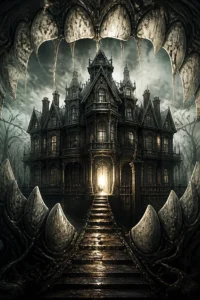
The house rose from the cliffside like a cathedral that had lost its faith. Black stone walls climbed in brutal tiers, buttressed and crenellated, their surfaces streaked silver by centuries of rain. Narrow windows burned with dim amber light, too few for a structure so vast. Gargoyles crouched along the roofline, mouths open to drink the storm. Three towers stabbed upward into the low clouds, each crowned with iron finials shaped like thorns.
Behind it, the sea battered the cliffs. Lenore could not see the water through the sheets of rain, but she felt it in the carriage floor—the distant concussion of waves striking rock, again and again, like fists against a locked door.
The carriage curved before a sweep of stairs slick with black rain. At the top stood the front doors: twin slabs of dark oak banded in iron, tall enough to admit giants or funeral carts. The door knockers were ravens clutching rings in their beaks.
And there, waiting beneath the portico, stood an army.
Not soldiers. Servants.
Rows of them.
Men and women dressed in severe black, hands folded, eyes lowered. Maids in high collars and white cuffs. Footmen with silver buttons gleaming like a line of teeth. Older men with keys at their belts. Younger girls hardly more than children, their hair scraped back so tightly their faces looked carved. There must have been fifty of them, all arranged in perfect stillness along the stairs and beneath the arch.
None held an umbrella.
Rain fell across the outer steps, dampening hems and shoulders, but not one servant shifted. Not one lifted a hand to wipe their face.
Lenore stared.
“Do they breathe?”
Cassian opened the carriage door before the footman outside could reach for it. Rain rushed in, cold and briny.
“When instructed.”
He stepped down first, then turned and offered her his hand.
Lenore looked at it.
Black glove. Long fingers. A wedding ring of dark metal on his left hand, so smooth it seemed less worn than grown there.
She could refuse. She knew that. She could gather her skirts and descend alone, slip on the wet step, crack her skull open before fifty silent servants and one husband who would likely send for a mop before a doctor.
Her pride was a precious thing. It was not, unfortunately, practical.
She placed her hand in his.
His grip closed around her, cool and firm.
The contact lasted three steps too long.
By the time her boots touched the stones, she had become aware of too many things: the strength in his hand, the faint scent of cedar and smoke clinging to his coat, the way his body angled against the rain so that the worst of it struck him instead of her.
That small consideration irritated her more than any insult could have.
“You needn’t pretend gallantry,” she murmured.
He did not release her immediately.
“You mistake strategy for kindness.”
“Strategy?”
“If you fall and break your neck on my front steps, I will have to marry again.”
“A fate too tedious to endure, I’m sure.”
“You have no idea.”
His fingers slipped from hers.
At the top of the stairs, the eldest servant stepped forward. He was a narrow man with silver hair combed flat to his skull and a face that had been starved of surprise decades earlier. His black suit fit like a coffin lining. A chain of keys hung from his belt, each one tagged with a sliver of bone.
He bowed to Cassian first.
“Master Blackthorne.”
Then, after a fraction too long, to Lenore.
“Madam.”
The word was correct. The tone was not. It carried no disrespect obvious enough to challenge, but Lenore had spent years restoring portraits for women who smiled while bleeding their rivals dry with tea spoons and compliments. She knew the delicate architecture of insult.
“Your name?” she asked.
The man’s eyes flickered.
Cassian’s gaze moved lazily toward her.
The rain sharpened.
“Silas Thorne,” the servant replied. “House steward.”
“How unfortunate.”
Silas blinked once.
“Madam?”
“To have a name so nearly belonging to the house. It must make escape difficult.”
A few servants shifted their eyes. No heads turned. No mouths moved.
Cassian’s silence beside her felt almost like attention.
Silas bowed again, shallower this time. “Blackthorne House has little use for escape.”
“So I’m beginning to gather.”
The great doors opened inward without a sound.
Lenore had expected darkness. She had not expected scale.
The entrance hall swallowed them.
It rose three stories beneath a vaulted ceiling webbed with carved beams and painted saints whose faces had gone black with age. A chandelier hung from the center, vast and iron, its candles burning with steady blue-edged flames. The floor was marble, black and white veined, polished until it reflected the servants as pale ghosts. Twin staircases curved up from opposite sides of the hall and met at a gallery lined with suits of armor, their visors lowered, their gauntlets clasping swords point-down.
The air smelled of wax, cold stone, and old roses left too long in water.
Lenore stepped over the threshold.
The moment she did, the doors closed behind her with a depth of sound that seemed to seal the weather outside—and her with it.
Servants flowed in around them soundlessly, each taking position with terrifying precision. Someone removed Cassian’s coat. Someone else appeared at Lenore’s side, reaching for her cloak.
Lenore caught the maid’s wrist before the girl could touch the clasp.
The girl froze.
She was young, perhaps sixteen, with freckled cheeks and brown eyes too large for her face. Fear flashed through them, quick as a match.
Lenore let go at once.
“I can manage.”
“Yes, madam.” The girl’s voice was barely a thread.
She took one step back and stared at the floor as if Lenore might strike her.
A cold little fury moved under Lenore’s skin.
Not at the girl. At the house. At the men who made children flinch for failing to predict the wishes of strangers.
Cassian saw it. Of course he did.
“Mara,” he said.
The maid’s head snapped up.
“You will attend Mrs. Blackthorne.”
Lenore’s jaw tightened at the name.
Mara paled. “Yes, sir.”
“If anyone corrects you for speaking to her when spoken to, send them to me.”
The hall seemed to inhale.
Silas Thorne’s expression did not change, but something behind his eyes shuttered.
Mara’s throat moved. “Yes, sir.”
Lenore looked at Cassian. “How generous. You permit my maid to answer questions.”
“No.” He removed his gloves finger by finger. “I permit her to survive the answers.”
The words slid beneath her irritation and found bone.
Before she could decide whether it was a threat, a confession, or another cruelty disguised as manners, he turned toward the staircase.
“Come.”
Lenore did not.
His foot paused on the first stair.
She untied her cloak with deliberate slowness and handed it to Mara. The girl received it as if taking a relic.
“If I am to be imprisoned,” Lenore said, “I would prefer a tour of the cell.”
Cassian looked back at her over his shoulder.
From that angle, with the chandelier flame licking blue across his cheekbones, he seemed almost unreal—some beautiful, bladed creature the house had invented to keep itself from being lonely.
“You are not imprisoned.”
“Can I leave?”
Silence.
Not long. Not dramatic.
Just enough.
Lenore smiled without softness. “How reassuring.”
Cassian descended the step again. “You may go anywhere in the house except the locked wings.”
“Plural.”
“Yes.”
“And the grounds?”
“Not beyond the lower garden without an escort.”
“For my safety, naturally.”
“For everyone’s.”
Her smile faltered despite her best effort.
He saw that too.
“Would you like the tour, Lenore?”
It was the first time he had used her name since the altar.
Not Miss Vale. Not wife. Not possession wrapped in law.
Lenore.
Her name sounded different in his mouth. Darker. More intimate than she had given him permission to make it.
“I would like many things,” she said. “At present, information will do.”
“Then ask carefully.”
He started across the hall, cane striking marble once every third step though he did not appear to need it. Lenore followed because the only alternative was standing in the entrance hall while fifty servants pretended not to watch her breathe.
Blackthorne House did not unfold; it multiplied.
Corridors led to corridors. Doors rose in endless ranks, many unmarked, some fitted with locks elaborate enough to belong on bank vaults. Narrow windows gave glimpses of rain-lashed courtyards, stone fountains, clipped yew hedges, a chapel roof, a conservatory green with steamed glass. The house seemed less built than accreted over centuries, each generation adding another wing, another secret, another place to hide a sin until the architecture itself grew monstrous with it.
Cassian named rooms as they passed them.
“Morning room. Unused. West library. You may enter. Music room. The piano is tuned, though no one plays it. Gallery. Smoking room. Not for your use unless you enjoy stale cigars and worse company.”
“Do you ever say anything about your home with affection?”
“No.”
“How sentimental.”
He opened a set of double doors into the gallery.
Lenore stopped on the threshold.
Portraits covered every inch of the long room.
They rose from wainscoting to cornice, stacked in gilded frames tarnished almost black. Men in old military coats. Women in pearl collars and mourning lace. Children stiff in velvet, their small hands resting on hounds, globes, skulls. Some paintings were centuries old, varnish darkened to amber gloom. Others were recent enough that Lenore recognized the flatter brushwork of modern academies.
All of them had their eyes scratched out.
Not painted over. Not faded.
Scratched.
Deep gouges tore through each face where the eyes had been, scoring canvas and panel alike. Some slashes were clean and narrow, made by a knife tip. Others were savage, ragged excavations that had shredded the linen beneath. The damage was old on some portraits, edges browned and curled. On others, the raw canvas was still pale.
Lenore’s stomach turned—not from horror exactly, but from the intimate violence of it.
She took one step forward without meaning to.
An art restorer’s grief moved through her hands before thought could catch up. Destruction always felt personal to her. A painting was not merely pigment and surface. It was witness. It was time made visible. To blind a portrait was to murder memory while leaving the corpse displayed.
“Who did this?” she asked.
Cassian had remained near the doors.
“Different people. Over many years.”
“Why?”
“Because the dead in this family have poor manners.”
She turned to him. “That is not an answer.”
“It is the only one you will get today.”
Lenore moved deeper into the gallery, drawn despite herself. A painted woman watched blindly from above the mantel, her face pale beneath a hood of black lace, lips curved in the faintest suggestion of scorn. The scratches through her eyes were furious, crossing over and over until the upper half of her face had become a wound.
The plaque beneath read: Seraphina Blackthorne, 1821–1847.
Lenore reached toward the frame but did not touch it. Her fingers hovered close enough to feel the cold rising from the gilding.
“This could be restored,” she said softly.
“No.”
His refusal came too quickly.
Lenore glanced back. “No?”
“You are not to restore any portrait in this house.”
“Afraid of what they might see?”
The air tightened.
Cassian crossed the room then, slow and silent despite the cane. He stopped beside her, close enough that she could see a single raindrop caught in his dark hair, refusing to fall.
“Afraid of what you might remember.”
Lenore went still.
The waves below the cliffs struck hard enough to tremble the window glass.
“What did you say?”
He looked at the portrait, not at her. “You have a talent. Hidden layers. Overpaint. Forged signatures. Lies under varnish. Your father made certain everyone knew.”
“My father made certain everyone knew when he needed money.”
“He needed money often.”
The bitterness rose before she could cage it. “And your family was generous enough to let him drown in debt before hauling me in like salvage.”
Cassian turned his head. “Do not confuse my family with me.”
“Why? Do you confuse mine with me?”
For the first time, his expression changed.
Only slightly. A tightening near the eyes, made more visible by their absence in every face around them.
“No,” he said.
One word. Too careful.
Lenore hated him more for making her wonder.
She turned back to Seraphina’s blinded face. “My mother restored paintings too.”
“I know.”
“Of course you do.” Her voice thinned. “Everyone knows what is useful.”
“Not everyone.”
“She died whispering your name.”
The words left her before caution could catch them.
Cassian’s hand flexed on the silver head of his cane.
For a heartbeat, the gallery seemed to tilt. The blind dead leaned from their frames, listening.
“Blackthorne,” Lenore clarified, though he had not asked. “Not Cassian. I was thirteen. She was fevered. The doctor had stopped pretending. She grabbed my wrist and said it like a prayer she was choking on. Blackthorne. Blackthorne. Blackthorne.”
His face closed.
“You should have told me this before the wedding.”
A laugh escaped her, small and sharp. “There were so many tender opportunities. Perhaps between my father signing me over and the priest binding my wrist?”
“Lenore.”
Again her name. Again that intolerable softness buried under command.
“Do not,” she said.
“Your mother—”
“Is dead. Which makes her one of the few people in Saint Orison beyond your reach.”
Something dark moved through his eyes.
“You would be surprised what my family reaches.”
The chill that followed did not come from the rain.
Lenore stepped away from him and nearly backed into a narrow side table. On it stood a single silver bowl filled with black water. Floating on the surface were rose petals so dark they appeared bruised purple. Their scent was cloying, almost rotten.
At the far end of the gallery, one portrait hung alone between two shuttered windows.
It was covered with a black cloth.
Unlike the others, it had been given privacy.
Lenore looked at it, and a pressure gathered behind her eyes so sudden she almost lifted a hand to her temple.
A flash came—not memory, not exactly. More like light under a door.
A girl’s laugh.
A ribbon the color of fresh blood.
Small fingers sticky with paint.
Then nothing.
“Who is that?” she asked.
Cassian followed her gaze.
Every trace of life vanished from his face.
“No one.”
“No one is usually not covered in mourning cloth.”
“We are done here.”
He did not wait to see whether she followed.
This time, Lenore remained where she was for three full seconds, staring at the covered portrait while the strange ache behind her eyes pulsed once, twice, then faded.
Mara waited in the corridor, hands folded so tightly her knuckles were white. Lenore wondered how much the servants heard. In a house this old, walls did not need ears. They only needed cracks.
Cassian led her onward.
Past a dining room where a table long enough to seat forty had been set for two. Past an inner courtyard where a fountain shaped like an angel spilled water from its broken mouth. Past a chapel with iron grates over the doors and candles burning before a veiled altar. Lenore slowed there, but Cassian did not.
“Do you worship behind bars?” she asked.
“We confess there.”
“To priests?”
“Sometimes.”
The answer crawled over her skin.
They passed more servants. None spoke unless Cassian spoke first. None stared outright at Lenore, but she felt their attention trail after her like cold fingers.
At last they reached the main staircase again and climbed.
The upper floors were quieter. Carpet swallowed their steps. Lamps burned low behind smoked glass. The walls here held no portraits, only faded tapestries depicting hunts: stags dragged down by hounds, boars speared through the throat, a white wolf standing over a crowned man in the snow.
Lenore touched the edge of one tapestry as she passed. The wool was damp.
“Does nothing in this house dry?”
“Some things are not meant to.”
“You have a gift for making mildew sound like a curse.”
“Everything is a curse if it lasts long enough.”
They stopped before a pair of doors at the end of the west corridor. Unlike most she had seen, these were not barred or chained. Their panels had been carved with thorn branches and small birds caught among them.



0 Comments