Chapter 4: Terms of Surrender
by inkadminThe room Lucien Draven chose for negotiations had once been a chapel.
Seraphina knew it the moment the door closed behind her and the air changed—cooler, older, thick with the stale perfume of extinguished incense. The Dravens had stripped the saints from their niches and replaced them with ledgers bound in black leather. They had torn the altar down and set a table of veined obsidian in its place. But no amount of wealth could scrub holiness from stone. It lingered in the vaulted ceiling and the rain-streaked lancet windows, in the thin ribs of shadow stretching across the floor like fingers folded in prayer.
Or perhaps that was only the house mocking her.
Outside, the sea hurled itself against the cliffs below Blackthorne Manor, a distant, relentless violence. Thunder rolled over the roof. Candles burned in iron sconces along the walls, each flame caught in a glass hood the color of old smoke. They threw Lucien’s reflection into every polished surface at once, multiplying him until Seraphina had the uncomfortable impression of being surrounded.
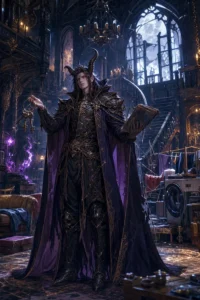
He stood at the far end of the table, unhurried, gloved hands resting on the back of a high-backed chair. He had removed his coat since dinner, leaving him in a dark waistcoat cut close to his frame and a white shirt that looked almost indecently clean in a house built on blood. His sleeves were fastened with silver cuff links shaped like ravens’ skulls. His black hair was still damp from the rain, one strand fallen across his brow, softening nothing.
Seraphina remained by the door.
She had survived seven years by understanding thresholds. Which ones promised shelter. Which ones became cages the instant they closed.
Lucien watched her notice the absence of a handle on her side.
“A little theatrical,” she said.
“My ancestors favored confession rooms.”
“And you favor prisons?”
His mouth curved. Not a smile. A blade remembering its edge. “Only when my guests mistake courtesy for weakness.”
Seraphina let her gaze drift around the room again, slower this time, pretending calm while her heart kept an ugly, practical rhythm. One door. No visible servants. Two windows too narrow for escape unless she intended to slice herself into ribbons on the stained glass. A fireplace to her left, burning low, its tools arranged neatly beside it. Poker. Tongs. Shovel. Potential weapons, all too far.
On the table waited a silver tray with a decanter of amber liquor, two glasses, a stack of cream-colored papers, and a fountain pen laid across them like a miniature dagger.
Marriage contract.
The words had a taste. Ink and iron. Lace tied around a noose.
“Sit,” Lucien said.
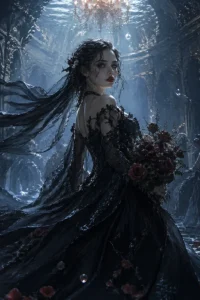
She moved at last, each step measured. The black silk gown his household had provided whispered around her legs, unfamiliar against her skin after years of plain tavern wool. They had taken her wet clothes, her apron, the little knife she kept sewn into the hem, and the second knife they had not been meant to find tucked into her boot. They had bathed her in rosewater until she smelled like a dead noblewoman laid out for burial.
Perhaps that was the point.
She drew the chair opposite him and sat without waiting for him to pull it out. “If this is where you tell me what an honor it is to be purchased by a Draven, I warn you, I’m too exhausted to laugh properly.”
Lucien took his own seat. “I don’t purchase what belongs to me by right.”
“And there it is.”
“There what is?”
“The disease rich men inherit along with their houses. Mistaking reach for ownership.”
He poured liquor into one glass, then the other. “Reach is ownership in Blackthorne. You know that better than most.”
He slid a glass toward her. She didn’t touch it.
Lucien lifted his instead, the candlelight turning the liquid to molten gold. “Not poisoned.”
“A generous reassurance from a man who invited me here under threat of exposure.”
“I didn’t invite you.” He drank. “I collected you.”
The words should have frightened her. They did, in some quiet animal corner of her body. But fear had long ago learned to wear Seraphina’s smile.
“Then you collected poorly,” she said. “I’m expensive, disobedient, and likely to bite.”
His eyes lowered briefly to her mouth.
It lasted less than a heartbeat. It should have meant nothing. Yet the air between them tightened with the soft, treacherous pull of a drawn thread.
“I know exactly what you are,” he said.
Seraphina’s fingers curled against her lap beneath the table. “Do you?”
He leaned back, studying her as if she were a cipher written in a language he had taught himself in secret. “Seraphina Aurelia Vale. Last living daughter of Lord Cassian Vale and Lady Mirelle Ardent-Vale. Presumed dead in the Ashwake fire seven years ago. Formerly hiding in the Lantern District under the name Sera Voss, age twenty-three by parish records, though that record was bought from a priest with a gambling debt and poor handwriting.”
Her lungs forgot themselves.
He continued, mercilessly calm. “Employed at the Gilded Heron for four years. Before that: scullery maid at the Salt Widow, dock clerk under Master Pell, and, briefly, graveyard assistant at Saint Orinth’s, which I admit showed creativity.”
“Graves are honest,” she said, because silence would have revealed too much. “They don’t ask questions if you sleep among them.”
Something flickered in his expression. Not pity. She would have despised him for pity. This was smaller, sharper. Recognition, perhaps. The kind that came from knowing something about cold stone and nights without witnesses.
It vanished.
“You have one surviving asset,” he said, tapping the papers. “Your bloodline. I require it.”
“How romantic.”
“Romance is what people invent when they cannot afford contracts.”
“And yet you need a bride.” She tilted her head. “I was under the impression men like you took what they wanted without ceremony.”
“The Obsidian Consortium was built before Blackthorne had gas lamps or police captains worth bribing. Its laws are old. Inconvenient. Occasionally sacred to men who have forgotten every god except power.”
“Poor Lucien. Forced to marry into nobility like a common social climber.”
His eyes warmed with dangerous amusement. “Careful. If you wound my vanity too deeply, I may seek comfort in my fiancée’s arms.”
The word struck like a match.
Fiancée.
Seraphina looked down at the papers before she could stop herself. The top sheet bore the Draven crest at the head: a raven clutching a key in one claw and a thorned crown in the other. Beneath it, in exquisite legal script, her true name had been written in full.
Seraphina Aurelia Vale.
For seven years, that name had belonged to a ghost.
Seeing it alive on paper hurt more than she had expected.
Do not flinch. Dead girls do not flinch when summoned.
She reached for the glass and drank.
The liquor burned down her throat, smoky and rich, nothing like the watered gin served at the Heron. It settled hot in her empty stomach. Lucien watched her swallow as though every tiny surrender had been catalogued.
“Let us be clear,” she said, placing the glass down. “I am not marrying you because I feel moved by your tragic inheritance troubles.”
“No.”
“I am not sharing your bed.”
“We’ll discuss appearances.”
“That wasn’t an opening for debate.”
His fingers stilled on the rim of his glass. “No one enters my bed unwilling.”
The flatness of his tone drew her gaze up.
There were things men said because they wished to seem honorable. There were things men said because they had rehearsed the proper shape of virtue. Lucien’s words had neither polish nor plea in them. They sat between them like a sealed law.
Seraphina hated that some taut, guarded part of her loosened by a fraction.
“How noble,” she said softly. “Do you keep that principle in the same drawer as your blackmail letters?”
“Blackmail requires a demand for silence. I’m offering survival.”
“You’re offering a cage with finer bars.”
“And you were free at the Gilded Heron?” His voice gentled, which made it worse. “Free to serve men who would have sold you for the price of their debts if they had known your name? Free to sleep with a blade under your pillow and one eye open? Free to duck every patrol on Ashwake anniversaries because some drunk might remember the shape of your mother’s mouth?”
Her hand struck the table before she realized she had moved. The sound cracked through the old chapel.
The candle flames shuddered.
Lucien did not.
“Don’t speak of my mother.”
“Then don’t mistake hiding for freedom.”
For a moment the rain filled the room. It slid down the windows in silver veins, blurring the black sea beyond. Seraphina saw her mother in the glass, not as she had died but as she had lived: fastening pearls at her throat, humming to herself; lifting Seraphina’s chin after a lesson in etiquette and saying, Spine straight, darling. The world bows only to those who refuse to bend first.
Her spine was straight now. It hurt.
“What do you want from me beyond a signature?” she asked.
Lucien pushed the contract toward her. “Three months of public courtship, accelerated under the excuse of prior acquaintance through your mother’s Ardent line. A private ceremony before the Consortium’s winter convocation. You will appear at my side in all formal gatherings. You will answer to Lady Seraphina Draven once vows are sealed.”
Her stomach turned. “I won’t surrender my name.”
“You surrendered it seven years ago.”
“To survive.”
“Then take it back to win.”
The words landed too close to the hunger she kept buried.
Win.
Not survive. Not endure. Not crawl another day beneath the notice of monsters who drank from crystal and called murder inheritance.
Win.
Lucien saw it. Of course he saw it. His eyes sharpened.
“There she is,” he murmured.
Seraphina’s lips curled. “Careful. If you admire me too openly, I may think you have a weakness.”
“I have several.”
“Name one.”
“No.”
“Coward.”
“Alive,” he corrected.
She almost smiled. That irritated her, so she reached for the contract instead.
The clauses were precise, brutal, and elegant. Lucien Draven would provide her with protection under Draven law, restoration of Vale holdings currently seized or dormant where legally viable, a monthly allowance obscene enough to purchase three taverns, private chambers, staff, clothing, transport, and access to select Draven archives “as mutually agreed.” In exchange, she would offer her name, lineage, social presence, and absolute discretion regarding Draven internal affairs.
Absolute discretion. How pretty the law made shackles.
She turned a page. “You’ve written that I cannot leave Blackthorne without your consent.”
“Correct.”
“Remove it.”
“No.”
“I’m not a dog to be kept inside your gates.”
“Dogs are loyal.”
“Men are not, yet society allows them passports.”
Lucien’s mouth twitched. “The clause stays.”
She leaned forward. “If you think I’ll sign away the right to walk out when I choose—”
“You may walk through any door in this house, attend any modiste, any charity function, any gala where I place you on the guest list. You may go to the opera, the cemetery, the Vale ruins if you enjoy reopening wounds in dramatic weather. But you will not leave the city.”
“Because you need your bride convenient?”
“Because the moment the wrong people learn Seraphina Vale breathes, every road out of Blackthorne becomes a hunting path.”
She studied him. He had said it without inflection, but the hand near his glass had tightened just enough to whiten the knuckles beneath his glove.
“The wrong people,” she repeated. “Such as?”
“We’re not there yet.”
“No, Lucien, that is precisely where we are.” She dropped the contract onto the table. “You know who killed my family.”
The chapel seemed to draw inward around them.
Lucien looked at her for a long time.
“I know enough to know you’re not ready for the answer.”
Seraphina laughed once, sharp and humorless. “That is the sort of thing cowards say when they want to be mistaken for guardians.”
“And that is the sort of thing grieving daughters say when they mistake vengeance for a map.”
She stood so quickly her chair scraped back. “Do not make me your tragic little cause.”
Lucien rose as well.
He did not do it quickly. He did not need to. Power moved differently in men who had never feared being ignored. He came to his feet like a tide coming in, inevitable, the room rearranging itself around the fact of him.
“If you were my cause,” he said, “I would have left you in the Lantern District where sentiment could rot harmlessly.”
“Then what am I?”
“A risk.”
The honesty struck harder than any insult.
Seraphina’s fingers curled at her sides. “To your inheritance?”
“To my plans.”
“And do those plans include the men who butchered children in their beds?”
A shadow crossed his face. There and gone, but she saw it. Felt it.
“Yes,” he said.
The single word opened something under her ribs.
She had imagined this moment for years—someone powerful enough to know, someone close enough to the rot. She had imagined forcing names from trembling lips, imagined blood on white marble, imagined satisfaction descending like grace.
But Lucien did not tremble. He stood in his converted chapel with rain sliding over the glass and looked at her as if he had been expecting her rage, perhaps even counting on it.
“Give me their names,” she said.
“Sign the contract.”
“Give me one.”
“No.”
“Then we have nothing.”
She turned toward the door.
“Your father kept a journal.”
Seraphina stopped.
The rain became suddenly loud. Too loud. It filled her skull, her throat, the hollow spaces behind her eyes.
She did not turn around. “You’re lying.”
“He kept several. Most burned. One did not.”
Her nails bit into her palms. “Where is it?”
“In a place you cannot reach without me.”
Slowly, she faced him.
Lucien stood beside the table, one hand resting on the contract, the other at his side. There was no triumph in his expression. Somehow, that was worse. Triumph she could fight. Cruelty she understood. This stillness felt like a locked door.
“If you had my father’s journal,” she said, each word pulled thin, “why not lead with that?”
“Because I wanted to know what you valued more. Freedom in theory, or answers in reach.”
“You manipulative bastard.”
“Yes.”
His easy admission robbed the insult of its bite. She wanted to cross the room and slap him. She wanted to seize his shirt and shake the names from his throat. She wanted, absurdly, to hear her father’s voice again so badly that her knees felt weak.
Lord Cassian Vale had smelled of cedar and ink. He had taught her chess with captured buttons when her mother declared proper ivory pieces too cold for a nursery. He had laughed with his whole chest. On the night of the fire, he had shoved Seraphina through the servants’ passage with blood running from his hairline and his signet ring pressed into her hand.
Do not look back, little star.
She had looked back.
She still saw what waited behind her.


0 Comments