Chapter 3: The Draven Heir
by inkadminThe carriage that took Seraphina Vale from the underbelly of Blackthorne City bore no crest.
It was black lacquer and ironwood, with windows smoked so dark the city beyond appeared as a drowned painting: lamps bleeding gold into rain, gutters foaming with gray water, silhouettes bent beneath umbrellas like mourners at an endless funeral. The wheels barely made a sound over the slick cobblestones. Draven craftsmanship, she thought. Even their carriages knew how to keep secrets.
Lucien sat across from her, one ankle resting over the opposite knee, gloved hands relaxed over the silver head of his cane. If he felt the motion of the carriage, he gave no indication. He looked carved from the same midnight as the vehicle carrying them—black coat, black waistcoat, black hair damp from the rain and brushed back from a face too composed to be human. Only his eyes betrayed life. Pale gray, watchful, and cold enough to make her bones ache.
Seraphina kept her hands folded in her lap because anything else would reveal how badly she wanted to claw his face open.
The false name she had worn for seven years—Mara Vey—lay dead between them.
He had killed it with a sealed packet of documents, a lock of childhood hair tied in blue ribbon, and one sentence whispered in the alley behind the Black Lantern.
I know what they buried in your coffin, Lady Vale. And I know it wasn’t you.
Even now, the memory crawled beneath her skin.
“You’re quiet,” Lucien said.
“I was told well-bred brides should be demure.”
His mouth softened, not quite a smile. “And here I feared you had no instincts for survival.”
“Don’t mistake silence for surrender.”
“I don’t mistake you for anything.”
The carriage turned sharply. Seraphina braced one hand against the seat before she could stop herself. Lucien did not move. Outside, the narrow tavern streets gave way to the wider avenues of the upper city. Blackthorne rose in tiers from the harbor like a throne built for a tyrant—dockside slums clinging to the sea wall, mercantile districts webbed with bridges, then the old aristocratic heights where mansions perched above the fog. Gas lamps burned behind frosted glass. Gargoyles hunched along rooflines. The rain made every surface gleam as though the city had been polished with oil and blood.
“Where are you taking me?” she asked.
“Home.”
The word did not fit him. It sounded too warm, too simple.
“Your home.”
“For now.”
Seraphina turned from the window. “If you think I’ll be kept in some velvet room while you decide what to do with me—”
“I have already decided what to do with you.”
His gaze moved over her in a manner so clinical it should not have made heat prickle at her throat. She was still in the black serving dress from the Lantern, rain dried stiff at the hem, sleeves smelling faintly of wine, smoke, and the copper tang of spilled blood from the man Lucien had left breathing in the alley only because killing him would have been inconvenient.
“We will present you to my family tonight,” Lucien said. “Tomorrow, the contract will be drafted. Within the week, it will be witnessed by the Veiled Court.”
“How efficient. Do I get to choose the flowers for my execution?”
“You may choose any flowers you like. I suggest white lilies. They look charming at funerals.”
Her nails bit into her palms. “You are enjoying this.”
“I rarely enjoy anything.”
“Then you’re remarkably practiced at pretending.”
For the first time since he had stepped into the tavern, something flickered behind his eyes. Not amusement. Not anger. A shadow passing behind frosted glass.
“Pretending is how people like us remain alive, Seraphina.”
Her name in his mouth struck like a match in a dark room.
Not Mara. Not girl. Not waitress. Seraphina.
The girl who had once worn sapphire ribbons and danced barefoot through the western gallery of Vale House. The girl who had hidden beneath a collapsed wine rack while men in silver masks dragged her mother by the hair across marble. The girl who had stopped breathing when her father’s body hit the floor above her with a sound like furniture breaking.
The girl who should have burned with the rest.
She forced her voice steady. “You don’t know anything about people like me.”
“I know more than you think.”
“Because you collected my bones?”
His gloved fingers tightened almost imperceptibly around the cane. “Because I was there the night Vale House burned.”
The carriage seemed to tilt.
Rain hissed against the glass. Wheels whispered over stone. Somewhere beyond the window, a bell tolled midnight from the cathedral on Saint Orlan’s Hill.
Seraphina felt the old darkness open beneath her feet.
“What did you say?”
Lucien held her gaze. “You heard me.”
Her blood roared so loudly she almost missed the next turn. “If this is another threat—”
“It is a warning.”
“About what?”
“About what you think you remember.”
She lunged before sense could stop her.
Lucien caught her wrist across the narrow space between them. Not roughly. That was somehow worse. His fingers closed around her pulse with precise, infuriating control, as though he had expected the movement before she made it. The carriage lantern cast gold over his face, sharpening the angles of cheekbone and jaw, gilding the scar that cut faintly through his right eyebrow.
“Let go of me,” she whispered.
“Will you try to stab me?”
“Not without a knife.”
“Then I admire your honesty.”
“Let. Go.”
His thumb rested against the frantic beat beneath her skin. For one suspended second, neither of them moved.
Then he released her.
Seraphina drew back as if burned, cradling her wrist against her chest. His touch remained there, a phantom pressure she hated more because her body remembered it with terrible clarity.
“You don’t get to speak about that night,” she said. “You don’t get to make it into one of your little weapons.”
“Everything in this city is a weapon.”
“Then choose carefully which one you point at me.”
The almost-smile returned, but this time there was no pleasure in it. “There she is.”
“Who?”
“The Draven bride.”
She wanted to spit at him. Instead, she looked back out the window, because rage was safer when it had somewhere to go.
The carriage climbed higher. The houses grew older, larger, more withdrawn from the road, their gates iron-laced and crowned with family sigils. Thornwood. Calder. Ashbourne. Their names were carved into Blackthorne’s bones as surely as the salt and rot. Founding families, the old bloodlines, the polite monsters who had built fortunes from smuggling routes, debt contracts, private prisons, and the quiet disappearances of those who asked the wrong questions.
She recognized none of the streets by sight, yet her body knew the ascent. Vale House had once stood on the southern ridge, overlooking the same black sea. Her father used to say the founding families had chosen the cliffs so they could watch both God and their enemies approaching.
God had never come.
Her enemies had.
The carriage passed beneath an arch of wrought iron shaped like ravens in flight. The gate opened without a sound.
Draven House rose from the cliff beyond it.
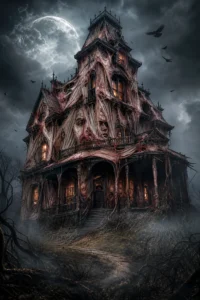
No—house was too small a word. The estate sprawled across the headland like a fortress pretending to be a mansion, built of black stone veined with silver and polished by centuries of sea wind. Towers speared into the cloud-thick sky. Tall windows glowed amber behind rain-streaked glass. A wall of thorn hedges surrounded the grounds, their branches so dark they seemed charred, each thorn long as a finger bone. Beyond the mansion, the sea hurled itself against the cliffs, white foam exploding in the dark.
Seraphina had seen Draven House only once before, from a distance, when she was eleven and her father’s carriage had passed along the ridge road. She had pressed her nose to the window, staring at the black towers until her governess slapped her hand and told her no decent girl looked too long at cursed places.
Now the cursed place had opened its gates for her.
The carriage stopped before a broad staircase slick with rain. Servants in dark livery waited beneath the portico, faces lowered, hands gloved in gray. Not one of them looked surprised to see a tavern waitress step down from the Draven heir’s carriage.
That frightened her more than if they had stared.
Lucien descended first. He did not offer his hand.
Good.
Seraphina lifted her skirts and stepped into the storm. The wind struck immediately, sharp with salt and cold enough to slice through wet wool. Far below, waves roared like beasts chained in the dark. Her boots touched black stone, and for the first time in seven years, she stood at the threshold of one of the great houses as herself.
A butler waited at the top of the steps. He was thin as a blade, with silver hair pulled back at the nape and a face so pale it might have been stored in a drawer between uses.
“Mr. Draven,” he said, bowing. “The family has gathered in the east drawing room.”
“Of course they have,” Lucien murmured.
The butler’s gaze slid to Seraphina. It did not widen. It did not flicker. “My lady.”
Seraphina’s heart gave one hard beat.
My lady.
The words wrapped around her throat like a garrote.
Lucien glanced at her. “This is Osric. He knows everything that happens in this house and lies about most of it.”
“Only when necessary, sir,” the butler said.
“It is always necessary.”
“Indeed.” Osric stepped aside. “Shall I have a room prepared for Lady Vale?”
Seraphina’s fingers curled.
Lucien’s expression did not change. “The blue suite.”
Osric paused for less than a breath. “Very good, sir.”
“What is the blue suite?” Seraphina asked as they crossed beneath the portico.
“A room.”
“Your talent for explanation is dazzling.”
“It belonged to my mother.”
That silenced her.
The doors opened before them, and Draven House swallowed her whole.
Warmth met her first, thick with beeswax, smoke, and old wood. The entrance hall soared three stories high, its ceiling lost in shadows painted with ravens and thorn branches. Black marble stretched beneath her boots, veined like lightning. On the walls hung portraits in gilded frames: Dravens through the centuries, pale-eyed and unsmiling, their hands resting on sword hilts, ledgers, pistols, the shoulders of unhappy spouses. A chandelier of black crystal hung overhead, each candle flame reflected a hundred times until the air seemed filled with small captive fires.
Seraphina forced herself not to stare like the gutter rat she had pretended to be.
She had been born to rooms like this. She had learned to walk on marble polished by servants, to curtsy beneath chandeliers, to hear threats hidden in compliments and compliments sharpened into threats.
But seven years belowstairs changed the body. Her shoulders expected blows. Her eyes found exits. Her hands sought trays, bottles, knives.
Lucien noticed. Of course he did.
“There are fourteen visible exits from this hall,” he said softly as Osric took his coat. “Six concealed. Three trapped. You have already counted nine.”
“Ten,” she said. “The panel behind the Saint Verena statue is too clean at the base.”
That earned her the first true smile she had seen from him.
It vanished quickly, but not before it changed his face into something dangerous for entirely different reasons.
“Try not to use it,” he said. “My grandmother dislikes drafts.”
“I’ll keep that in mind while fleeing for my life.”
“In this house, those are often the same thing.”
Osric returned with a dark velvet cloak and draped it around Seraphina’s shoulders before she could protest. It was warm from the fire, heavy and soft, smelling faintly of cedar. She hated that her chilled body leaned into it.
“The family awaits,” Osric said.
Lucien offered Seraphina his arm.
She looked at it as though it were a snake. “No.”
“They will expect it.”
“They can survive disappointment.”
“Undoubtedly. But can you survive their conclusions?”
The hall seemed to listen.
Seraphina lifted her eyes to his. She understood the game. The Dravens could smell weakness the way sharks smelled blood. If she entered as his captive, they would carve her open before she learned their names. If she entered as his chosen bride, they might only sharpen the knives where she could see them.
Slowly, she placed her hand on his arm.
Muscle shifted beneath fine wool. Lucien’s body was warm, solid, terribly present. He looked down at her hand for one heartbeat too long.
“Careful,” she murmured. “Someone might think you’re sentimental.”
“No one who knows me would be so foolish.”
“Then perhaps I’m fortunate not to know you.”
“You will.”
The promise moved through her like cold wine.
They crossed the hall and entered a corridor lined with tall windows overlooking the sea. Rain battered the glass. Beyond it, the ocean stretched black and endless, devouring what little moonlight escaped the clouds. Every few paces, niches held marble busts of dead Dravens, each one staring into eternity as if unimpressed.
The east drawing room doors were open.
Voices drifted out—low, polished, poisonous.
“I don’t care what Lucien thinks he has found,” a woman said. “An alley whore in a dead girl’s dress is still an alley whore.”
Seraphina felt Lucien’s arm harden beneath her hand.
“Careful, Aunt,” he called as they entered. “You’ll make our guest feel unwelcome.”
The room fell silent.
It was a beautiful room in the way a dagger could be beautiful. Dark green walls. A white marble fireplace large enough to roast a sinner whole. Velvet chairs arranged around a low table set with crystal decanters and untouched tea. Rain streaked the tall windows, blurring the sea beyond into a moving wall of night.
Five people waited within.
Seraphina knew them by reputation before Lucien spoke a name.
At the fireplace stood a woman in a high-necked gown of steel-gray silk, her hair silver-white and braided like a crown. Her face was narrow, aristocratic, and bloodless. A black cane rested beneath one hand, topped with a raven carved from obsidian.
Octavia Draven. Lucien’s grandmother. Matriarch in everything but title. It was said she had once poisoned a judge at breakfast and acquired his court by supper.
Beside the decanter table lounged a man in his late forties with Lucien’s pale eyes and none of his restraint. Cassian Draven, Lucien’s uncle, broad-shouldered and handsome in the decaying way of men who mistook cruelty for charm. His wineglass caught firelight as he turned it slowly between thick fingers.
The woman who had spoken sat near the hearth, one hand draped over the arm of her chair. Vespera Draven, Cassian’s wife. Her beauty was sharp and expensive—red mouth, dark hair pinned with pearls, eyes like polished jet. She looked Seraphina up and down and found the sight lacking.
A younger man stood in the window alcove, half hidden by shadow. He wore burgundy velvet and an expression of bored amusement. Dorian Draven, cousin to Lucien, rumored to have ruined three heiresses, two bankers, and one priest.
The last was a girl perhaps sixteen, sitting on a stool near Octavia’s chair with an embroidery hoop in her lap. She had a spill of black curls, large gray eyes, and a face too soft for the room. When she saw Lucien, relief flashed across it so quickly Seraphina almost missed it.
Lucien’s sister.
Isolde Draven.
“You’re late,” Octavia said.
“I found a bride,” Lucien replied. “These things take time.”
Cassian laughed. “In a tavern, did you? How efficient. I usually only find brandy and regret.”
Vespera’s smile thinned. “Lucien, darling, you cannot expect us to pretend this is anything but desperation.”
“I expect very little from you, Aunt Vespera. You continue to meet my expectations.”
Dorian coughed into his fist. Isolde bent over her embroidery, hiding a smile.
Octavia’s gaze never left Seraphina.
It was not contemptuous. Contempt had heat. This was assessment, cold and precise as a jeweler examining a stone for flaws.
“Come closer,” the matriarch said.
Seraphina did not move.
Lucien’s arm remained steady beneath her hand.
Octavia’s brows lifted. “Does it obey commands?”
Seraphina smiled before Lucien could answer. “Only from someone worth obeying.”
The room changed.
It was subtle—the stilling of Cassian’s glass, the flare in Vespera’s eyes, Dorian’s sudden interest. Isolde looked up, lips parted.
Octavia stared at her for a long moment. Then the corner of her mouth twitched.
“There may be teeth after all.”
“Several,” Seraphina said. “Would you like to count them?”
Lucien made a sound suspiciously close to a breath of laughter.
Octavia tapped her cane once against the floor. “Bring her into the light.”
Lucien leaned slightly toward Seraphina. “If you bite my grandmother, aim for the throat.”
“Noted.”
They crossed the room together. Every step felt like walking across thin ice over a lake of knives. Seraphina stopped before Octavia and lifted her chin.
The matriarch’s gaze traveled over her face, lingering on the line of her cheek, the shape of her mouth, the faint scar near her temple from the night she had crawled through broken glass to escape the burning servants’ passage.
“Elaine Vale’s mouth,” Octavia said quietly. “And Corvin’s eyes.”
Seraphina’s breath caught before she could trap it.
Vespera rose half out of her chair. “Surely you don’t believe—”
“Sit down, Vespera.”
The older woman did not raise her voice. Vespera sat.
Octavia extended one hand. Her fingers were thin, ringed in black diamonds. “Your wrist.”
Seraphina looked at Lucien.
He gave the smallest nod.
She hated herself for obeying it.
Octavia took her wrist and turned it palm up. Her grip was dry and cool. With her other hand, she pushed back the sleeve of Seraphina’s serving dress.
There, just below the inside of her elbow, lay the mark that had doomed her at birth and saved her in hiding only because no one had known to look for it: a small birthmark shaped vaguely like a crescent flame.
The Vale ember.
Octavia’s fingers tightened.
“Well,” Cassian said, all amusement gone. “That complicates things.”
“No,” Lucien said. “It simplifies them.”
Vespera’s face had gone still. “The Vales are extinct.”
Seraphina pulled her wrist free. “And yet I remain inconveniently animate.”
Dorian laughed softly. “Oh, I like her.”
“You like anything that bleeds when pressed,” Lucien said without looking at him.
“Not true. Some things bruise beautifully.”
“Speak to her again like that and I’ll remove your tongue.”
Dorian’s smile sharpened. “Protective already, cousin?”
“Practical. I dislike noise.”
Seraphina felt the warning hum beneath the words. Not romance. Not tenderness. Territory.
She should have despised it.
She did despise it.
And still, some traitorous part of her noticed that Lucien had stepped half a pace in front of her.
Octavia returned to her chair. “If she is who you claim, she has old blood. Founding blood.”
“She is who I claim,” Lucien said.
“That remains to be proven to the Court.”
“It will be.”
Cassian set down his glass with a soft click. “Convenient, isn’t it? Seven years after the Vale massacre, the lost daughter reappears just when your claim requires a bride.”
“I do try to be punctual.”
“You expect us to believe you stumbled upon her?”
Lucien’s gaze cooled. “No. I expect you to believe I found what everyone else failed to.”
Vespera looked at Seraphina as if she had found something unpleasant in her tea. “And what, precisely, does Lady Vale receive in this arrangement? Jewels? Protection? A chance to crawl back into polite society?”
Seraphina smiled. “A better wardrobe, I hope. This one smells of ale.”
Isolde’s embroidery needle slipped. She bit her lip.
Vespera’s eyes narrowed. “How charming. A tavern education.”
“Better than a drawing room one. In taverns, people are honest about wanting to rob you.”
Cassian laughed again, but this time there was calculation in it. “She’ll be eaten alive at the Veiled Court.”
“Many have tried,” Seraphina said. “Most found me indigestible.”
Lucien looked down at her, and for a moment the room seemed to fall away. There was something in his expression she could not name. Approval, perhaps. Or hunger wearing a respectable coat.
Octavia watched them both.
“You understand the requirement?” she asked Seraphina.
“Lucien explained very little. With great confidence.”
“Naturally.” Octavia folded both hands over the raven cane. “The Obsidian Consortium was founded by five bloodlines: Draven, Vale, Thornwood, Calder, and Ashbourne. Its charter predates the city government and, in practice, supersedes it. Our shipping lanes, vaults, courts, and enforcement houses are bound by blood succession.”
Seraphina felt the room tighten around the words.
She knew pieces of this. Every child born to the great houses learned the nursery version: five families, one city, vows made beneath the old cathedral while warships burned in the harbor. But the true laws were kept in locked rooms and whispered into heirs’ ears when they were old enough to understand that inheritance often required a body.
Octavia continued. “Lucien’s father is dead. His seat remains contested until Lucien fulfills the founding clause.”
“Which says?” Seraphina asked.
“That an unseated heir must bind his claim through marriage to a bloodline not his own, witnessed by the Court, sealed by vow, and consummated before the next black moon.”
The word struck like a slap.
Seraphina’s face did not change. She would have bitten through her own tongue before giving Vespera the satisfaction.
Lucien’s voice cut in, low and lethal. “The final clause is symbolic and has not been enforced in eighty years.”
Octavia looked at him. “Everything is symbolic until power requires otherwise.”
Vespera’s smile returned, slow as poison blooming in water. “How awkward for your bride.”
Seraphina turned her head. “I survived my family’s murder. I suspect I can survive awkward.”
Silence crashed down.
There it was.
The thing none of them had named.
The massacre.
The night of ash.
The dead Vales seated like ghosts around the room.
Cassian’s expression shuttered. Vespera looked away first. Dorian’s amusement dimmed. Isolde went pale. Octavia remained still, but her fingers tapped once against the head of her cane.
Lucien did not move at all.
Seraphina felt his stillness beside her, terrible and contained.
“Careful, Lady Vale,” Octavia said at last. “The dead have long memories in this house.”
“Then perhaps one of them can tell me who killed mine.”
The fire popped. Outside, thunder rolled over the sea.
Lucien’s hand closed around her elbow—not hard enough to bruise, but enough to warn.
Seraphina looked at his fingers. “Remove your hand.”
“Not here.”
“Especially here.”
His eyes met hers. A battle flared in the narrow space between them. He wanted obedience. She wanted blood. Neither of them was accustomed to losing.
Slowly, Lucien let go.
Octavia’s gaze sharpened with interest.
“You seek revenge,” the matriarch said.
“No,” Seraphina replied. “I seek names. Revenge comes after.”
“And you think marriage to my grandson will give them to you?”
“I think your grandson knows more than he says.”
Lucien’s expression turned unreadable.
Octavia looked between them. “Then this may be a more suitable match than I anticipated.”
“Mother would have objected,” Cassian said.
“Your mother objected to everything except winning,” Octavia replied.
Vespera rose fully now, silk whispering. “This is madness. The girl’s existence will destabilize every agreement made since the Vale estate was absorbed. Thornwood will contest it. Calder will demand inquiry. Ashbourne will send assassins before breakfast.”
“Let them,” Lucien said.


0 Comments