Chapter 2: A Proposal Made of Knives
by inkadminThe name struck the room harder than the thunder.
Seraphina.
Not Mara with the chipped black nail polish and the lowered eyes. Not the girl who laughed when men bought her cheap champagne and pretended not to notice when they stared at the hollow of her throat. Not the ghost she had built from stained aprons, forged papers, and seven years of swallowing her own rage until it tasted like copper.
Seraphina Vale.
The dead girl.
The last daughter of a house buried in fire.
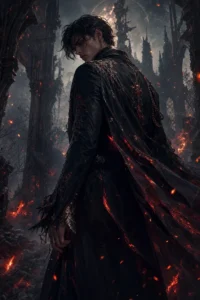
Lucien Draven stood at the edge of the private room as if he had always belonged there, framed by red velvet curtains and the smoky gold glow of the wall sconces. Rain slid in silver threads down the window behind him, turning Blackthorne City into a blurred cathedral of lamplight, slick rooftops, and black water. His coat was still wet at the shoulders. Drops clung to the ends of his dark hair like beads of oil.
He had not raised his voice. He had not needed to.
At the sound of her true name, every instinct Seraphina possessed became a knife.
Her hand tightened around the neck of the wine bottle she carried. The glass was slick with condensation. She measured the distance between them, the weight of the bottle, the angle of his jaw. If she shattered it against the table, she could drive the jagged edge into his throat before the guards outside heard. Perhaps.
His eyes moved to her hand.
“If you are considering killing me,” he said, “aim for the artery beneath the left side of my jaw. It will be faster.”
Her pulse slammed once against her ribs.
“I don’t know what you’re talking about,” she said.
The lie came easily. It always did. She had worn lies so long they fit better than skin.
Lucien’s mouth curved, but there was no amusement in it. He stepped farther into the room, and the shadows seemed to move around him with the obedience of trained hounds. Behind him, the door clicked shut. The sound was soft. Final.
“You know exactly what I’m talking about.”
Seraphina tilted her chin. “My name is Mara Voss.”
“No.” His voice was velvet over steel. “Mara Voss drowned at six years old in a flooding drain beneath Saint Orison’s Market. Her mother received twelve silver crescents from the city for the body. A generous sum, considering there was hardly enough left of the child to bury.”
The room narrowed.
Rain. Candle smoke. Wine. His voice.
Her fingers went numb around the bottle.
Lucien reached inside his coat and withdrew a folded paper sealed in black wax. He set it on the table between them with the care of a man placing a loaded pistol. The seal bore no family crest. Only a single vertical line cut through a circle: the mark of a private investigator from the old courts, the kind who could dig up bones with names still attached.
“Your forged registry,” he said. “Your employment papers. The baptism record you bought from Sister Calanthe before the convent mysteriously burned. The first coin you spent under that name. The room you rented in the Sable Quarter. The old woman who taught you how to dye your hair with walnut husk and ash. Shall I continue?”
Seraphina did not look at the paper.
To look would be to admit it mattered.
Instead, she uncorked the wine with one clean twist and poured into the nearest glass. Her hand did not tremble. She was proud of that, absurdly proud, even as terror crawled beneath her ribs and began to chew.
“That sounds like a great deal of effort for a serving girl.”
“You were never good at being a serving girl.”
Her eyes snapped to his.
Lucien’s gaze was a dangerous gray, pale enough to catch candlelight and cold enough to make it die there. Men in the club whispered that Dravens were born with winter in their blood. Looking at him, Seraphina almost believed it.
“You carry trays with your left hand because your right remembers a rapier,” he said. “You stand with your back to walls. You count exits before faces. When Lord Mavren grabbed your wrist last winter, you broke his smallest finger in three places and made him believe he had done it himself.”
“He was drunk.”
“He was lucky.”
A beat passed between them.
Something dangerous flickered in his expression. Not admiration. Not quite. Recognition, perhaps. One weapon noting the edge on another.
Seraphina placed the bottle on the table. “If you came to threaten me, Lord Draven, I recommend doing it plainly. I have other tables.”
“You have no other tables.”
Outside the room, the muffled hum of the club continued: laughter, music, crystal chiming, a woman’s bright false shriek. The Violet Hour never slept before dawn. Men came to drown secrets there. Women came to collect them. Beneath its velvet and perfume, the place was a gutter with chandeliers.
Seraphina had survived in gutters before.
She would survive this one.
“Did Silas sell me?” she asked.
Lucien moved to the chair opposite her and sat as though accepting a throne. “The owner of this establishment would sell his grandmother’s teeth if the price included a better vintage.”
“That isn’t an answer.”
“No. Silas does not know.”
Something cold loosened half an inch around her lungs. Not relief. Relief was for safer people.
“Then why are you here?”
Lucien unfolded the paper. She saw columns of handwriting, dates, names. Hers. Others. Too many others. The past laid out like organs on a butcher’s slab.
At the bottom sat a sketch in ink: a child’s face, solemn, with dark eyes and a pointed chin. Beside it, a more recent likeness drawn from memory or surveillance. The hair was different. The cheekbones sharper. But the mouth—Gods, the mouth was the same.
Her mother used to press two fingers to that mouth when Seraphina spoke too sharply at breakfast.
Little hawk, Elianora Vale would murmur. Do not show your talons to everyone. Some will cut them off and call it kindness.
A flash of flame swallowed the room.
Her father’s study door splintering inward. The smell of burning silk. Her brother screaming her name once, just once, before smoke filled the hall. A masked man with a silver serpent pinned to his lapel stepping over a body she could not look at. Blood dripping down the white marble stairs in thin red ribbons.
Seraphina blinked, and the private room returned.
Lucien was watching her too carefully.
She hated him for seeing the slip. Hated herself more for allowing it.
“You’ve been busy,” she said.
“You made yourself difficult to find.”
“I’ll take that as a compliment.”
“Take it as a failure. I found you.”
The words landed with brutal simplicity.
Seraphina smiled then, because a smile was often sharper than a scream. “And now? Do you drag me out by the hair? Cut my throat in the alley? Deliver me wrapped in ribbon to whichever of your friends still has nightmares about House Vale?”
“My friends do not have nightmares.”
“No?”
“They cause them.”
“How poetic.”
“How accurate.”
Her smile thinned. “Then why not hand me over?”
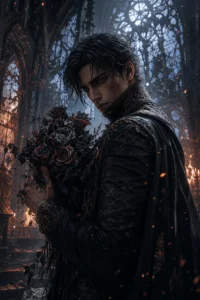
Lucien leaned back, and the candlelight slid along the hard line of his cheekbone. He wore black like it had been invented for him: black coat, black waistcoat, black gloves folded in one hand. Only the ring on his finger broke the darkness, silver set with a flat shard of obsidian. The Draven signet.
Children in Blackthorne learned the old warnings before prayers.
If a Thornwood smiles, count your coins.
If a Mavren offers wine, refuse the second cup.
If a Draven asks for your name, give him someone else’s.
She had.
It had not saved her.
“Because I have a use for you,” Lucien said.
There it was.
Not murder. Not mercy.
Use.
Seraphina laughed softly. “There’s the family resemblance.”
His eyes did not change, but the air did. “Careful.”
“Why? Will I offend your delicate criminal sensibilities?”
“No,” he said. “You will waste time pretending I came here to trade insults, and we have very little of it.”
“We?”
“Yes.”
That single word made her skin prickle.
Lucien took something else from his coat. Not another document this time. A small black envelope, thick as a wound dressing, sealed with red wax. He pushed it across the table.
“Open it.”
“I don’t obey commands from men who stalk me.”
“Then think of it as a suggestion from the only man in this building currently keeping you alive.”
Seraphina looked at the envelope.
The wax seal bore a crest she knew too well: three knives crossing a crown.
The Obsidian Consortium.
Not a family. Not exactly. The Consortium was older than the city’s police, older than most churches, older than the pretty laws politicians recited from marble balconies while accepting bribes below them. It was the hidden court of Blackthorne’s crime aristocracy, the place where smuggling routes, dock tariffs, assassinations, marriages, inheritances, and blood debts were weighed by candlelight.
House Vale had once held a seat there.
Until the night their manor burned and their seat was declared vacant before the ashes cooled.
Seraphina had dreamed of that seal for seven years. Sometimes she imagined grinding it beneath her heel. Sometimes she imagined pressing it into the chest of the men who had destroyed her family, hot from the flame, again and again until their screams tore open the sky.
She picked up the envelope.
The paper smelled faintly of smoke and cloves.
Inside lay a formal invitation embossed in black.
By decree of the Interim Council, the matter of succession to the Draven seat shall be heard at the winter convocation. All claims must be reinforced by covenant, bloodline, or sanctioned alliance. Failure to secure majority recognition shall result in forfeiture.
Below the text were seven signatures.
Seraphina recognized three family crests immediately: Mavren, Thornwood, Saint Cyr.
Three names from the list burned into the inside of her skull.
The men who had attended her father’s last supper.
The men who had smiled at her mother over crystal glasses while their hired killers waited outside in the rain.
Her thumb pressed into the invitation hard enough to bend the edge.
Lucien saw.
Of course he saw.
“My father is dying,” he said.
Seraphina looked up.
It should have meant nothing to her. Magnus Draven had been a monster in a city that bred them in cellars and taught them table manners. His name had moved ships, judges, widows, and bodies. If death had finally put a hand on his shoulder, Blackthorne should have sung.
But Lucien spoke the sentence without grief, and that made it worse.
“Congratulations,” she said.
A faint line appeared between his brows. “Do you ever tire of using your tongue as armor?”
“Do you ever tire of making people need it?”
For one second, his mouth almost softened.
Then it was gone.
“When he dies, the Draven seat goes before the Consortium,” Lucien said. “My claim should be uncontested. It is not.”
“How tragic for you.”
“My uncle has support among the old houses. They believe I am too young, too uncontrolled, too…” He paused, and the word he chose wore a blade under its coat. “Unsentimental.”
“Imagine that.”
“They also believe the Draven line has grown too far from its noble roots. Too much blood in the gutters. Not enough in old ledgers.” He tapped the invitation. “The Consortium is theater dressed as law. They like symbols. They like bloodlines. They like the appearance of legitimacy while they divide up the city by knife.”
Seraphina’s heartbeat slowed.
Not from calm.
From understanding.
She lowered the invitation to the table. “You need a bride.”
Lucien did not blink. “Yes.”
The word split something open inside her.
For a moment, she could only stare.
Then laughter rose in her throat, quiet at first, then bright enough to cut. It sounded wrong in the red room. Too alive. Too close to hysteria. She stopped it with her teeth.
“No.”
“You haven’t heard the offer.”
“I heard enough.”
“Seraphina—”
“Do not say my name like it belongs in your mouth.”
The words cracked through the room.
Lucien went still.
Outside, the music changed to a slower song, something mournful played on violin and piano. Rain battered the windows, frantic as fingers on coffin lids.
Seraphina stepped back from the table. Every nerve in her body screamed at her to run, though there was nowhere to run that his reach could not follow now. “You came here with papers and threats and a marriage proposal? How romantic. Did you bring flowers, or just blackmail?”
“I brought the truth.”
“Men like you always call it that when they hold the knife.”
“I am offering you a blade of your own.”
“You’re offering me a collar.”
“A crown can feel like that if it is made correctly.”
Her eyes narrowed.
There it was again—that flicker beneath his composure, that precise, infuriating calm. He was not trying to seduce her with softness. He was not pretending kindness. He laid cruelty on the table as if it were an honest coin and expected her to admire its weight.
Some foolish part of her did.
Not the cruelty. Never that.
The honesty of it.
In Blackthorne, a naked threat was almost a courtesy.
“If I refuse?” she asked.
Lucien’s gloved fingers rested on the table. Long fingers. Elegant. Hands that could sign a contract in the morning and order a drowning by noon.
“Then by dawn, Abel Mavren will know Seraphina Vale has been serving wine beneath his nose for thirteen months.”
The room lost all warmth.
Mavren.
The name crawled up from the ashes of her childhood on a serpent’s belly.
She saw him as he had been seven years ago: gold hair, pink cheeks, rings on every finger. Laughing over pear tart in her father’s dining room. Calling her “little duchess” while flicking sugar from his cuff. Later, in memory’s fractured dark, she saw that same ringed hand resting on the hilt of a knife at his belt while her father knelt bleeding on the marble.
Seraphina had been fourteen.
She had watched from behind the torn arras, one hand clamped over her own mouth so hard she tasted skin.
Abel Mavren had not struck the killing blow.
He had only smiled when it fell.
“You would give me to him,” she said.
Lucien’s face revealed nothing. “If you refuse.”
“And if I accept?”
“You become untouchable.”
She laughed once, without humor. “As your wife?”
“As Lady Draven. As the last Vale restored publicly to life under my protection. As a woman whose death would ignite a succession war no one can afford before the convocation.”
Protection. The word tasted poisoned.
“You really think your name is a sanctuary?”
“No. I think it is a locked room full of weapons. But while you are inside it, anyone who wants you dead must come through me.”
Seraphina searched his face for vanity, for greed, for the hunger men showed when they imagined possessing something rare.
She found ambition. Calculation. Exhaustion buried so deep it had become part of the bone.
And something else.
A secret with teeth.
“Why me?” she asked. “There are other old families. Other daughters bred for alliances and trained to smile while their husbands sharpen knives.”
“None with your bloodline.”
“House Vale is dust.”
“House Vale was one of the founding seven.”
“Was.”
“The Consortium respects ghosts more than living men. Your return would make them choke on their own rites.”
That image should not have pleased her.
It did.
Lucien leaned forward. “You want proximity to the men who destroyed your family. I can give it to you.”
Seraphina’s blood stopped moving.
“Careful,” she whispered.
“You want names.”
“I have names.”
“You have fragments. Childhood memories. Faces in smoke. Servants’ rumors. Half-rotten records stolen from court cellars.” His voice lowered. “You do not have the full ledger.”
The silence after that sentence was immense.
Seraphina felt it press against her eardrums.
“What ledger?”
Lucien’s gaze held hers. “The one your father kept.”
The room tilted.
Her father’s study had burned. She had seen the flames eating the shelves, the desk, the oil portrait of the first Vale admiral with his hand on the hilt of a ceremonial sword. Everything had burned. Everything except the memories that refused to die.
“You’re lying.”
“I am not.”
“My father’s records were destroyed.”
“Most of them.”
“Where is it?”
“Safe.”
“Where?”
“Not here.”
She moved before she decided to.
One heartbeat she stood at the table. The next, she had the wine bottle in her hand and its glass throat shattered against the edge. The sound was sharp enough to slice through the music outside. Red wine spilled like blood across the polished wood.
She lunged.
Lucien rose with impossible speed.
He caught her wrist before the broken bottle reached his throat. His grip was iron, but not crushing. Controlled. That enraged her more than pain would have. Seraphina twisted, driving her knee toward his thigh. He shifted. She used the movement, pivoted, brought her free hand up toward his eyes.
He caught that too.
Suddenly she was against the wall, the velvet curtain crushed behind her, both wrists pinned above her head in one of his hands.
The broken bottle fell.
It struck the carpet with a dull sound, wine soaking into crimson fibers until the spill vanished as though the room had swallowed it.
Seraphina breathed hard through her teeth. Lucien stood too close. Close enough that she could smell rain on wool, smoke, leather, and something colder beneath it, like winter air moving over stone tombs.
His body did not press against hers, but the restraint of it was somehow worse. He had left a precise inch between them, a line drawn by discipline rather than courtesy.
His gaze dropped briefly to her mouth.
She hated that she noticed.
Hated the answering spark of awareness that flared under her fury, shameful and bright.
“If you have finished trying to murder your only source of information,” he said softly, “we can continue.”
“Let go.”
“Will you try again?”
“Probably.”
That almost-smile returned, ghosting at one corner of his mouth. “Honest.”
“I learned from a monster.”
His eyes darkened.
For a moment, she thought he would answer sharply. Instead, his thumb shifted against the inside of her wrist, resting over her pulse. Her body betrayed her by letting him feel how violently her heart was beating.
“I did not burn your house,” he said.
“No? Did you merely warm your hands at the fire?”
His expression closed so completely it was like watching a door seal in stone.
“You know less than you think.”
“Then enlighten me.”
“Marry me.”
She laughed breathlessly. “That is your answer to everything?”
“No. It is the only answer that keeps you alive long enough to ask better questions.”
“And if I say yes, you hand me my father’s ledger?”
“No.”
0 Comments