Chapter 3: Blackthorne House Has Teeth
by inkadminThe rain followed them from the cathedral.
It clung to the black lacquered flanks of the car in silver veins, shivered across the windows, and turned the city beyond into a smeared watercolor of gaslit avenues and towering facades. Seraphina sat very straight in the rear seat, gloved hands folded in her lap, wedding ring cold as a shackle against her finger.
Beside her, Lucian Blackthorne said nothing.
Silence suited him too well. It settled around his broad shoulders like another tailored garment, sleek and expensive and impossible to remove. In the dim interior of the car, the hard line of his profile appeared carved from shadow: high cheekbones, a mouth made for commands rather than tenderness, dark lashes lowered over eyes that had watched her at the altar as if she were both prize and problem.
Her husband.
The word sat in her throat like a swallowed coin.
Outside, Veyr’s aristocratic district rose through the rain. Old money had built its bones from pale stone and pride, each mansion crouched behind ironwork gates sharpened into spears. Their windows glowed amber behind curtains of embroidered silk. Carriages and black motorcars lined the curbs before private clubs whose names never appeared in newspapers unless someone powerful needed a scandal buried.
Seraphina had grown up among those houses. She knew their polished foyers, their libraries smelling of leather and cognac, the way gentlemen laughed softly while destroying one another over cards. She knew which countess kept an opium parlor behind her conservatory and which earl had paid three girls to disappear before his son’s election. She knew the language of diamonds, debts, and locked doors.
Still, when the car turned off Kingsmourne Avenue and began to climb the hill toward Blackthorne House, she felt the city withdraw from her.
The street narrowed. The lamps became fewer. Mansions vanished behind walls knitted with ivy, and the rain seemed darker here, heavier, as though the clouds had opened above one house in particular.
Lucian did not look at her when he spoke.
“You are quiet.”
Seraphina’s mouth curved without warmth. “Would you prefer we sing hymns? We have just come from a church.”
His gaze shifted to her reflection in the window. “I prefer to know what my wife is planning.”
“Already suspicious? We have been married less than an hour.”
“You wore black to your wedding.”
“A woman should dress honestly for a funeral.”
A faint movement touched his mouth. Not a smile. Something more dangerous, because it suggested amusement restrained by habit. “Yours or mine?”
She turned her head then. The pearls at her ears brushed her jaw, cold from the cathedral air. “That depends entirely on how tiresome you become.”
For a moment, the rain and engine swallowed everything. Lucian’s eyes found hers in the gloom. They were not merely dark; they seemed to hold depth improperly, like wells in old forests where something had been dropped and never retrieved.
“Careful, Seraphina.”
Her name in his mouth was not soft. It was intimate in the manner of a blade pressed beneath the chin.
“Why?” she asked. “Do you break things that displease you?”
“No.” He looked away as the car crested the hill. “I keep them.”
The gates of Blackthorne House appeared through the rain.
They were taller than the gates of the cathedral, wrought iron twisted into thorns and ravens with outstretched wings. At their center, a crest had been worked in blackened metal: a crowned wolf gripping a key between its teeth. The car slowed before them. No guard stepped from the shadows. No servant hurried out with an umbrella. Yet the gates began to open, slow and silent, as if the house itself had recognized its master and bared its jaws.
Seraphina felt something in her chest tighten.
Beyond the gates, the drive curved through a park of ancient yews. Their branches leaned low over the gravel, knitting the sky into strips. Statues appeared between trunks: marble women with veiled faces, saints with missing hands, children holding dead birds. Rain ran over their stone cheeks like tears.
At the end of the drive, Blackthorne House waited.
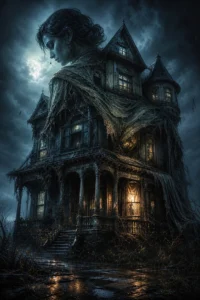
It was less a mansion than a verdict. Four stories of storm-dark stone rose against the night, crowned with chimneys and blade-thin spires. Narrow windows burned with candlelight in uneven patterns, making the facade look awake in patches, one eye lit, another blind. Ivy crawled over the walls in black ropes, strangling balconies and clinging to carved gargoyles whose mouths gaped above the entrance.
Seraphina had heard the whispers, of course. Everyone had. That the old duke had built hidden passages to move contraband beneath polite society’s nose. That Lucian’s grandfather had hosted masked dinners where men entered laughing and left ruined. That his mother had thrown herself from the east balcony, though no balcony faced east. That Blackthorne House did not let go of what it was given.
Whispers had always bored Seraphina. They were currency for women with trembling fans and men who feared facts.
But as the car stopped before the front steps, she understood at once that rumor had failed this house by being too small.
A footman opened her door. He was young, perhaps nineteen, with red-rimmed eyes and a face so pale he looked bloodless. Rain lashed at his shoulders, but he held the black umbrella over her with mechanical precision.
“Your Grace,” he murmured.
The title struck her like a hand on the back.
Seraphina stepped from the car. Her satin shoes met wet stone. The train of her black gown dragged behind her, gathering rain and grit from the drive, the same gown she had worn beneath vaulted ceilings while old enemies watched her be purchased in God’s name.
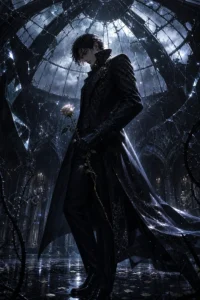
Lucian came around the car without waiting for assistance. Rain jeweled his black hair and darkened the shoulders of his coat. He offered her his arm.
Seraphina stared at it.
“Must we perform for the gargoyles?” she asked.
“For the servants.”
“They look terrified already.”
“Then reassure them.”
“With what? My natural warmth?”
This time his mouth did curve. Barely. It vanished before it could become human.
“With obedience.”
Seraphina placed her gloved hand on his sleeve because refusing would have made the footman’s grip on the umbrella tremble harder, and she had not survived her father’s house by wasting rebellion on audiences who could not afford to applaud. Lucian’s arm was warm beneath the wool. Solid. Too solid. The contact sent memory flickering through her—the pressure of his hand over hers at the altar, his thumb brushing her pulse as he spoke vows that had sounded like ownership.
She lifted her chin and climbed the steps beside him.
The doors opened before they reached them.
Two immense slabs of black oak swung inward without a creak, revealing a foyer that glowed with a hundred candles and no welcome. The air inside was warmer than the rain, but not kinder. It smelled of beeswax, old stone, roses left too long in vases, and beneath it all, something metallic and faint as a secret bitten open.
Servants lined both sides of the hall.
Not many, considering the size of the house. A butler stood at the front, tall and cadaverous, his silver hair slicked back from a narrow face. A housekeeper beside him clasped a ring of keys at her waist with both hands. Behind them were maids in black dresses and white aprons, footmen with lowered eyes, a cook with flour still dusting one sleeve. None of them looked directly at Seraphina.
Except one.
A maid near the end of the line raised her gaze for half a heartbeat. She was slight, brown-skinned, with dark curls scraped into a bun and freckles across the bridge of her nose. Fear widened her eyes before she dropped them again.
Lucian’s hand closed over Seraphina’s where it rested on his arm.
“Mrs. Whitcomb,” he said.
The housekeeper curtsied. “Your Grace.” Her voice was dry paper.
“This is the Duchess of Blackthorne.”
The word duchess moved down the line like a draft extinguishing flames. Heads bowed lower.
Seraphina wanted to laugh. She had been bankrupt that morning. Sold by evening. Now a duchess by nightfall. Society did love a costume change.
Mrs. Whitcomb turned to her. “Welcome to Blackthorne House, Your Grace.”
“How kind,” Seraphina said. “I was beginning to worry the house might swallow me before introductions.”
A footman flinched.
The butler did not. “Blackthorne House is old, Your Grace,” he said. “It has its peculiarities.”
“I have married into the family. I assumed as much.”
Lucian’s thumb pressed once against the inside of her wrist. Warning or approval, she could not tell. The distinction irritated her.
“This is Mr. Graves,” Lucian said. “He has served my family for thirty years. Mrs. Whitcomb oversees the domestic staff. Anything you require, you may ask of them.”
Mr. Graves inclined his head. His eyes remained fixed somewhere near her shoulder. “At your service, Your Grace.”
“How generous. Does that include answers?”
Silence thickened.
Seraphina felt Lucian turn his head slightly toward her.
Mrs. Whitcomb’s fingers tightened around her keys until they chimed against one another. “If it is within propriety.”
“Propriety has rarely been useful to me.”
“Then you will need to learn usefulness of a different sort,” Lucian said quietly.
She looked at him. “Is that husbandly advice?”
“It is mercy.”
There it was again—the cold thread beneath his words, the implication of rooms she had not seen and punishments not yet named. Seraphina’s smile sharpened. If he expected her to wilt before his servants, he had chosen poorly. If he expected gratitude for being purchased from ruin, he had chosen disastrously.
“How fortunate,” she said. “I have always wanted mercy from a man who buys wives to balance accounts.”
A maid inhaled audibly.
Lucian did not look away from Seraphina. “The accounts are not balanced.”
The foyer seemed to grow colder.
“No?” she asked.
“Not yet.”
His hand left hers. The absence should have relieved her. Instead, the place where his fingers had rested prickled as though marked.
“Mrs. Whitcomb will show you to your rooms,” he said. “Your trunks have already been brought up.”
“And you?”
His gaze lowered briefly to her mouth, so quickly she might have imagined it if her body had not betrayed her with a startled heat beneath the tight bodice of her gown.
“I have business.”
“On our wedding night?”
“Especially on our wedding night.”
A flush of anger rose to her cheeks before she could stop it—not because she wanted him, she told herself, but because he had found yet another way to make the marriage feel like a transaction concluded and set aside. An insult in white gloves.
Lucian leaned closer, close enough that the servants could not hear.
“Lock your door if it comforts you,” he murmured. “It will not keep me out.”
Her pulse kicked. “Do you threaten every bride like this?”
“I have only had one.”
“Then you are making a memorable start.”
“Good.” His eyes held hers. “Remember everything.”
Then he turned and walked away down the left corridor, coat sweeping behind him like a slice of night. The servants parted without sound. A door opened somewhere in the shadowed depths of the house, then closed.
The sound was not loud.
It still felt final.
Mrs. Whitcomb cleared her throat. “If Your Grace will follow me.”
Seraphina gathered the wet train of her gown in one hand and moved after the housekeeper up the grand staircase.
The staircase rose in a wide curve beneath a chandelier of black crystal. Candlelight shivered inside each prism, turning the walls to a shifting bruise of gold and violet. Portraits climbed with them, generations of Blackthornes staring from gilded frames. Men with hawk faces and hard mouths. Women pale as peeled fruit, their throats heavy with rubies. Children posed beside hounds with eyes more alive than their own.
Halfway up, Seraphina paused before a portrait larger than the rest.
A woman stood in a green gown embroidered with silver ivy, one hand resting on the back of a chair. She had Lucian’s eyes, but where his were winter-dark, hers seemed lit from within by some private catastrophe. Her mouth was soft. Too soft for this house.
“Who is she?” Seraphina asked.
Mrs. Whitcomb looked back. The keys at her waist gave the smallest chime.
“The late Duchess. Lady Evangeline.”
Lucian’s mother.
The woman in the painting wore no smile, but there was something in the angle of her head that looked like listening. Behind her, the painter had rendered a window half-open to a night garden. In the darkness beyond the painted glass, a single pale hand seemed to press against the pane.
Seraphina leaned closer.
Mrs. Whitcomb stepped sharply between her and the portrait. “The artist was fond of dramatic shadows.”
“How reassuring.”
“This way, Your Grace.”
They continued upward. On the second-floor landing, corridors unfurled in three directions. The west wing smelled faintly of lavender and linen. The north corridor was lined with busts draped in black cloth. The east wing lay behind a set of double doors banded in iron.
Both doors were locked.
Not simply closed. Locked with an iron bolt as thick as Seraphina’s wrist, a brass mechanism near the handle, and above that, three separate keyholes arranged in a triangle. Wax seals hung from the central latch, stamped with the Blackthorne crest. A crowned wolf. A key in its teeth.
Seraphina stopped.
“Subtle,” she said.
Mrs. Whitcomb did not smile. “The east wing is not in use.”
“It appears to be in use by several locksmiths.”
“It is unsafe.”
“Structurally?”
The housekeeper’s mouth tightened. “In every way that matters.”
Rain tapped at the tall windows behind them. Somewhere below, a clock began to strike the hour, each note deep and solemn.
“Does my husband keep all his unused rooms under seal?” Seraphina asked.
“His Grace has reasons for every door in this house.”
“That was almost an answer.”
Mrs. Whitcomb met her gaze then, and for the first time Seraphina saw not only fear in the older woman’s face, but exhaustion. The kind that gathered in the bones after years of obeying what conscience could not forgive.
“Forgive me, Your Grace,” she said. “I have served this house long enough to know that answers can be more dangerous than ignorance.”
“For whom?”
The housekeeper looked at the iron-banded doors. “For whoever asks.”
Before Seraphina could reply, a sound came from behind the locked doors.
Soft.
Brief.
A scrape, perhaps. Wood over stone. Or nails drawn once along the other side.
Every servant on the landing froze.
The young maid Seraphina had noticed in the foyer stood at the back of the group carrying a folded shawl. Her face drained of color so quickly the freckles seemed to darken.
Mrs. Whitcomb’s hand flew to the keys at her waist.
“Old pipes,” she said.
Seraphina looked at the doors. “Of course.”
The scrape came again.
This time, it ended in a faint thud.
Like something leaning its weight against the wood.
No one breathed.
Seraphina felt the childish impulse to step closer, press her ear to the door, demand to know what her husband had locked away on the very night he brought her into his home. She had spent too many years with men who hid their appetites behind mahogany doors and called the secrecy tradition. Her father’s study had been locked too. So had the blue sitting room after her mother died. Locked rooms were never empty. They were full of whatever powerful people believed they had the right to keep.
Mrs. Whitcomb moved abruptly. “Your rooms are this way.”
This way was west.
Away from the east wing.
Seraphina allowed herself to be led down a corridor paneled in dark walnut. Gas sconces hissed along the walls, their flames sheltered behind frosted glass. The carpet underfoot was Persian, wine-red, its pattern crowded with vines and tiny beasts devouring one another. Every few doors, a keyhole gleamed in the shadows.
She noticed because every door was locked.
The first had a silver knob shaped like a rose. Locked.
The second was painted blue and bore scratches near the lower hinge. Locked.
The third smelled faintly of tobacco and cedar through the crack beneath it. Locked.
At the fourth, Seraphina stopped and tried the handle before Mrs. Whitcomb could object.
It did not move.
The housekeeper’s lips compressed.
“Curiosity can be an expensive vice, Your Grace.”
“I was under the impression I married a wealthy man.”
“Money is not the only thing one spends in Blackthorne House.”
Seraphina released the handle slowly. “You all speak like undertakers.”
“We have reason.”
The words came not from Mrs. Whitcomb, but from the young maid holding the shawl.
Mrs. Whitcomb turned so sharply the keys snapped against her skirts. “Mara.”
The maid dropped her gaze. “Forgive me.”
Seraphina studied her. Mara’s hands shook against the folded wool. There was a small burn on her wrist, half-hidden by her cuff. Fresh, pink at the edges. The shape was odd: a crescent crossed by a line.
Not a kitchen burn.
“Mara,” Seraphina repeated. “A pretty name.”
The maid’s mouth trembled. “Thank you, Your Grace.”
Mrs. Whitcomb resumed walking with brisk purpose. “Mara has been assigned to assist you until a lady’s maid can be properly arranged.”
“Has she?”
“If that is acceptable.”
Seraphina glanced at Mara, whose terror was now mingled with something else—pleading, perhaps, or warning.
“I suppose that depends whether Mara intends to faint every time I ask a question.”
A spark passed through the girl’s fear. Not courage exactly, but the memory of it. “I do not faint, Your Grace.”
“Excellent. I despise cleaning up after other people’s dramatics.”
The corner of Mara’s mouth twitched before she remembered where she was.
Mrs. Whitcomb opened a door at the far end of the corridor, one of the few she did not need to unlock. “Your suite.”
Seraphina entered and found herself in a room too beautiful to trust.
The bedchamber was vast, its ceiling painted with a night sky where gold-leaf stars gleamed between drifting clouds. A fire burned in a marble hearth carved with thorn branches. Heavy velvet curtains framed windows overlooking the black gardens and the city below, distant lights trembling through rain. Her trunks had been arranged near a wardrobe large enough to hide a family of ghosts. On a table stood white roses in a crystal vase, each bloom perfect, each stem stripped of thorns.
That detail made her uneasy.
A sitting room adjoined the bedchamber through an arch, and beyond it, a bathing room tiled in black and white marble. Candles had been lit everywhere. Too many. Their flames made the mirrors glow.
There were seven mirrors in the bedchamber alone.
“Does His Grace expect me to admire myself from every angle?” Seraphina asked.
Mrs. Whitcomb’s expression did not shift. “The mirrors have always been here.”
“How comforting. Nothing says marital bliss like being watched by one’s own reflection.”
Mara entered quietly behind them and laid the shawl on a chair.
“Supper can be sent up,” Mrs. Whitcomb said. “Or, if Your Grace prefers, you may dine in the small breakfast room. His Grace is unlikely to join.”
“Naturally. He would not want marriage to interrupt his hobbies.”
“His Grace keeps irregular hours.”
“Do his irregular hours include explanations?”
“Rarely.”


0 Comments