Chapter 4: The Husband Who Does Not Sleep
by inkadminThe first night in Blackthorne House did not pass like a night.
It stretched.
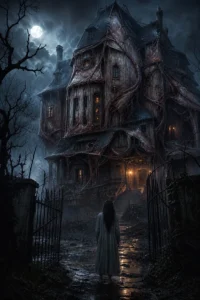
It lengthened itself over Seraphina Vale’s bones, over the cold sheets tucked too tightly around her body, over the ceiling where the shadows of rain trembled like drowned fingers. The room she had been given was beautiful in the merciless way expensive things were beautiful—ivory walls, black lacquered furniture, velvet curtains heavy enough to smother a scream. A fire burned low in the marble hearth, its coals breathing red in the dark.
And still, she was freezing.
Not from the temperature. Blackthorne House had heat humming behind the walls, a quiet mechanical pulse like a beast asleep beneath the floorboards. No, the cold came from elsewhere. From the locked door across the hall. From the portraits whose eyes followed her in the corridors. From the maid’s trembling mouth as she had whispered:
Never enter the east wing after midnight.
Seraphina rolled onto her side and stared at the clock on the mantel.
12:17.
She had been married for less than twelve hours.
There should have been some ritual to mark the horror of it. A storm breaking glass. A raven striking the window. A ghost stepping out of the wardrobe with pity in its eyes. Instead, there had been supper served on silver under the gaze of dead Blackthornes, Lucian sitting at the head of the table like a judge who had already decided the sentence.
He had not touched his food.
He had watched her instead.
Not hungrily. Hunger would have been simpler. Men had looked at Seraphina with hunger before; she understood how to weaponize it, how to tilt her chin and sharpen her smile and make them stumble over their own desire. Lucian Blackthorne’s gaze had been something far more unnerving.
Assessment.
Possession.
Warning.
As if he had purchased a blade and was deciding whether to sheathe it or press it to his own throat.
Seraphina closed her eyes.
Sleep did not come.
Instead came memory—her father’s hands trembling over legal papers, the smell of cigar smoke and brandy in the solicitor’s office, the way everyone had avoided saying the word sold. Her mother’s pearls in a velvet box, pawned three weeks earlier. The Vale townhouse sealed by creditors before dawn. Lucian Blackthorne standing in the rain outside St. Bartholomew’s with his black umbrella and colder eyes, offering marriage as if offering a noose lined in silk.
Your father’s debts are mine now.
And so are you.
She sat up sharply, breath tight in her throat.
The house was silent.
Not peaceful. Silent.
There was a difference, and Blackthorne House knew it. The silence here had weight. It pressed its palm over keyholes. It crouched beneath doors. It listened.
Seraphina pushed the covers aside and swung her feet to the floor. The boards were cold through her stockings. She had refused the sleeping gown the housekeeper had laid out for her—a white silk thing with lace at the throat, virginal enough to be insulting—and had kept her own pale blue chemise beneath a robe of dark velvet. It had been one of the few things left from her former life that had not been seized or sold. The hem was fraying. She wore it anyway, tying the belt tight as armor.
On the vanity, a silver tray held a carafe of water, a glass, and a single black rose.
Not red. Black.
Its petals were so dark they swallowed the firelight.
Seraphina touched one with the tip of her finger and found it cool, almost waxen. A thorn pricked her skin. A bead of blood rose bright on her fingertip.
She looked at it and laughed once under her breath.
“Of course.”
The sound vanished quickly, as if the room had eaten it.
She crossed to the door and opened it an inch.
The corridor beyond lay in darkness, relieved only by wall sconces burning with low amber flames. Blackthorne House did not trust electricity completely, it seemed. There were modern switches hidden discreetly behind carved panels, elevators behind oak doors, security cameras disguised among crown moldings—but at night, the mansion chose candles.
Like a church.
Or a vigil.
Seraphina stepped into the hall.
Her room was in the west wing, along a corridor lined with portraits of women in high-necked gowns and men with hawkish noses. The carpet beneath her feet was wine-dark and thick enough to silence her steps. She passed a gilded mirror and did not immediately recognize the woman inside it.
Pale face. Dark hair unbound down her back. A mouth pressed into a stubborn line. Eyes too awake.
A bride, if one were charitable.
A prisoner, if one were honest.
At the far end of the corridor, the stairs curved downward in a sweep of black wood. Beyond them, somewhere beneath the house, something clicked.
Seraphina stilled.
Another click followed, faint but distinct.
Not the settling of pipes. Not a branch against glass.
A lock.
She moved toward the stairs before caution could find its voice.
Her hand slid along the banister, polished smooth by generations of Blackthorne palms. At the landing, she paused. Below, the main hall slept beneath a chandelier of unlit crystals. Moonlight spilled through the tall windows in silver panes, illuminating the checkered marble floor and the vast front doors that had closed behind her that afternoon with the finality of a vault.
Then she saw him.
Lucian Blackthorne crossed the hall without a sound.
He wore no coat. No tie. His white shirt was open at the throat, sleeves rolled to his forearms, dark trousers tailored with severe precision. His black hair was damp from rain or sweat, pushed back from his face in careless strokes. He moved with the controlled economy of a man who had long ago learned that every motion could betray him.
In his right hand, he carried a key ring.
In his left, a pistol.
Seraphina’s breath caught behind her teeth.
He did not look up. He did not glance toward the stairs. He crossed beneath her hiding place and moved toward the corridor that led to the rear of the house.
Toward the east wing.
The maid’s warning returned, not as words but as a pulse at the base of Seraphina’s skull.
Never enter the east wing after midnight.
Lucian stopped before a pair of narrow doors almost hidden between two columns. Earlier, Seraphina had thought they were decorative panels. Now he fitted a key into one and opened it inward.
Darkness waited beyond.
He stepped through.
The door remained ajar for three seconds.
Four.
Five.
Then it closed with a soft, obedient click.
Seraphina stood on the landing, heart beating hard enough to make her ribs ache.
There were several sensible things she could have done.
She could have returned to her room, locked her door, and pretended she had not seen her husband carrying a gun through the mansion after midnight. She could have waited until morning and asked questions in daylight, where shadows behaved themselves. She could have remembered that she had survived twenty-two years among aristocrats by knowing precisely when not to see things.
Instead, she descended the stairs.
The marble floor was cold beneath her feet. The hall smelled of beeswax, rain, and old stone. She crossed it slowly, pausing at every groan of the house, every whisper of air beneath closed doors. When she reached the hidden panel, she pressed her fingers to the seam.
Locked.
Of course it was.
Seraphina exhaled through her nose. “Blackthorne House,” she murmured, “you are becoming tedious.”
A draft brushed her cheek.
She turned her head.
At the base of the wall, concealed behind a marble pedestal bearing a bronze stag’s head, a narrow servant’s door stood open by the width of two fingers.
Perhaps it had been left that way by accident.
Perhaps Blackthorne House had decided it liked disobedient brides.
Seraphina slipped through.
The passage beyond was narrow and unfinished, a vein running behind the mansion’s polished skin. Here there were no portraits, no velvet runners, no art arranged to suggest inherited grace. The walls were bare plaster, the floorboards rough. Pipes clung overhead like black roots. The air smelled of dust, metal, and something sharper beneath.
Bleach.
Her pulse quickened.
She followed the passage, one hand grazing the wall. It bent left, then descended by a steep set of stairs. Somewhere below, voices murmured.
Men’s voices.
Low. Urgent.
She should have stopped.
She went lower.
The passage opened onto a gallery overlooking a cavernous room that should not have existed beneath a nobleman’s ancestral mansion. It stretched under the east wing like the hidden belly of some enormous animal, lit by harsh white lamps and the blue glow of monitors. A long metal table occupied the center. Cabinets lined the walls. Refrigeration units hummed. There were drains in the floor.
And blood.
Not everywhere. Not splashed like theater. Not the lurid mess of penny dreadfuls.
Worse.
Controlled.
A dark smear near the drain. Red-soaked gauze in a stainless tray. A man’s shirt cut open and discarded in a bin. The room had been used, cleaned, and used again by people who knew precisely how much blood a body could lose before becoming only a body.
Seraphina’s fingers dug into the railing.
Below, Lucian stood at the metal table.
Now she saw the blood on him.
It streaked his forearms, dried brown at the edges and wet red near his wrists. It darkened the front of his white shirt where someone had grabbed him, or fallen against him, or died trying not to. One side of his jaw was smeared with it, a brutal red mark beneath the sharp plane of his cheekbone.
He was calm.
That was the worst of it.
Not trembling. Not fevered. Not horrified.
Calm, as a physician might be calm. As an executioner might be calm. As a man might be calm if blood had become an old language he spoke better than tenderness.
A second man stood beside him, broad-shouldered and bald, with a scar pulling one corner of his mouth into a permanent sneer. He wore black gloves and held a tablet.
“He named Marrow Street twice,” the bald man said. “Could be a trap.”
Lucian washed his hands in a steel sink. The water ran pink, then red, then pink again.
“Everything is a trap, Ives.”
His voice was low and even. It did something terrible to Seraphina’s spine. She had heard it over marriage vows that morning, heard it across the dinner table, heard it at her bedroom door when he had told her the rules of his house.
No locked doors.
No questions about his business.
No leaving without his permission.
No trusting anyone who offered pity.
Now those rules had blood under their fingernails.
Ives swiped something on the tablet. “He also said the Vale girl wasn’t supposed to survive the transfer.”
The room seemed to tilt.
Seraphina stopped breathing.
Lucian’s hands stilled under the running water.
“His exact words.”
“Say them.”
Ives shifted. For the first time, discomfort crossed his scarred face. “He said, ‘The Vale girl was meant for the ledger, not the altar.’”
Seraphina’s throat closed.
The Vale girl.
Not bride. Not wife. Not even Seraphina.
A line in an account book.
A name to be moved from one column to another.
Lucian turned off the tap.
For several seconds, the only sound was the drip of water from his fingers into the basin.
“Who gave the order?” he asked.
“He bit through his tongue before he answered.”
Lucian reached for a towel and dried his hands methodically, each finger, each knuckle. “Then he was trained.”
“Or terrified.”
“Those are rarely separate conditions.”
Ives hesitated. “What do you want done with him?”
Lucian looked toward the far side of the room.
Seraphina followed his gaze and saw, beyond a half-drawn curtain, the outline of a body strapped to a chair.
Her stomach lurched.
The man was alive. Barely. She saw a hand twitch, fingers curling weakly against a leather restraint. His head sagged forward. Blood slicked his chin and chest, though from this distance she could not tell how much of it had come from his mouth.
“Keep him breathing,” Lucian said. “If he wanted death, he should not have entered my city carrying my wife’s name.”
My wife.
The words struck harder than they should have.
Not because they were tender. They were not. They were iron gates closing. Possession again. A claim hammered into the dark.
But somewhere beneath it—beneath the menace, beneath the blood—there had been fury.
Not at her.
For her?
The thought was absurd. Dangerous. It should have been smothered at birth.
Seraphina stepped back from the railing.
The floorboard beneath her heel creaked.
It was a small sound.
In that room, it cracked like gunfire.
Lucian looked up.
Their eyes met.
Across the hidden room, across the blood and steel and secrets, he found her instantly.
Seraphina could have run.
She did not.
Running would have been an admission that she was prey, and she had spent too much of her life watching predators mistake silence for surrender.
Lucian’s expression did not change.
That frightened her more than if he had shouted.
“Leave us,” he said.
Ives turned sharply, following his gaze. When he saw Seraphina on the gallery, his hand moved beneath his jacket.
“Touch that weapon,” Lucian said, not loudly, “and I will remove the hand you favor.”
Ives froze.
Seraphina’s heart thudded once, hard.
The bald man lowered his arm. “Your Grace—”
“Leave.”
A muscle jumped in Ives’s jaw, but he obeyed. He gathered the tablet and moved toward a side door. Before stepping through, he looked up at Seraphina again, and this time she saw naked alarm in his eyes.
Not for himself.
For her.
The door closed behind him.
Lucian remained below, still as a statue carved from winter. “Come down.”
It was not a request.
Seraphina gripped the railing. “I am quite comfortable here.”
“You are shaking.”
“It is chilly.”
“You are barefoot on a service gallery above a room you were never meant to see.”
“Then perhaps your house should lock its doors more competently.”
His gaze sharpened. There—a flicker. Not anger. Something almost like admiration, gone too quickly to trust.
“Come down, Seraphina.”
Her name in his mouth was a key turning.
She hated that she felt it.
She descended the narrow iron stairs at the end of the gallery, one hand sliding along the cold rail. Each step brought the smell of blood closer, copper thickening the air, threading through the disinfectant until it coated her tongue. By the time she reached the floor, her stomach had settled into a hard knot.
Lucian did not move toward her.
He waited beside the sink, hands clean now but shirt ruined. The blood on his jaw remained, stark against his skin.
Seraphina stopped several feet away. “Are you injured?”
The question escaped before she could make it cruel.
His eyes lowered briefly to the blood on his chest, then returned to her face. “No.”
“Then whose blood is that?”
“Not mine.”
“So I gathered. It was the sort of question that begged elaboration.”
“And yet you already know I will not give it.”
She glanced toward the curtain. The man behind it made a wet, broken sound, half groan and half breath.
Lucian stepped sideways, blocking her view.
“Do not look at him.”
Seraphina lifted her chin. “Is he dead?”
“No.”
“Will he be?”
Silence.
There it was. An answer shaped like refusal.
The fire in her rose because fear had always curdled into anger more easily than tears. “How charming. My husband owns a private slaughterhouse.”
“If it were a slaughterhouse, he would not be breathing.”
“That distinction may comfort you. It does very little for me.”
Lucian’s jaw tightened. “You should be in bed.”
“I tried. Your mansion kept whispering.”



0 Comments