Chapter 5: Dinner With Wolves
by inkadminThe dress arrived at dusk in a long black box tied with ribbon the color of dried blood.
Seraphina found it laid across her bed like an offering, the lid already removed, the tissue paper folded back by hands that had never been taught to tremble. Black silk lay inside, dark enough to drink the lamplight. Not mourning black. Not widow’s black. This was the glossy, lethal black of a raven’s wing, cut with a neckline that was almost modest until she lifted it and saw the open back, the thin straps meant to cross her spine like restraints.
A card rested atop the silk.
Wear this.
L.
Nothing more. No please. No explanation. A command disguised as a gift.
Seraphina stood barefoot on the cold parquet floor and stared at the card until the edges blurred. The house had been quiet since morning, quieter than usual, as if every servant had been instructed to breathe behind closed doors. Rain tapped the windows in soft, patient fingers. Somewhere deep in Blackthorne House, a clock struck seven, each chime rolling through the walls like a verdict.
Last night, Lucian had come home wearing blood.
Not on his hands—no, that would have been almost ordinary in the violent little fairy tale she had married into—but along his collar, a dark spray at his throat, a smear near the sharp line of his jaw. He had stood at the foot of the corridor with the gaslights burning behind him, beautiful and damned, and when he saw her watching from the shadows, he had not apologized.
He had only said, “Never ask me where I go at night.”
And she, because she was either a coward or clever enough to know the shape of a blade in the dark, had promised.
Now there was a dress on her bed and a command in his hand.
“Absolutely not,” Seraphina said to the empty room.
The empty room, predictably, did not care.
Her reflection watched her from the tall mirror by the wardrobe. Pale face. Violet smudges beneath her eyes. Hair unpinned and falling around her shoulders in dark waves that looked wilder in this house, as if Blackthorne’s shadows had found their way into every strand. She looked like a ghost pretending to be a bride.
She thought of refusing. Thought of staying in this room with the door locked and a chair shoved beneath the handle. Thought of letting Lucian Blackthorne discover that Vale women did not dress on command like prized dogs before a hunt.
Then she remembered the blood on his collar.
She remembered, too, the softness of his voice when he had said her name.
Not Seraphina. Wife.
The word had curled around her like smoke, possessive and dangerous, and some traitorous thing beneath her ribs had answered.
She hated that most of all.
By the time Mrs. Hargrove knocked, Seraphina had already stepped into the dress.
The housekeeper entered carrying a velvet tray set with pearl pins and a pair of black satin gloves. Her gray hair was arranged in its usual severe knot, but there was something strained around her mouth tonight, something almost like pity.
“His Grace requests that you be ready by half past seven,” Mrs. Hargrove said.
Seraphina lifted her chin as the older woman began fastening the tiny hooks at her side. “His Grace requests many things.”
“Yes, my lady.”
“Does His Grace ever say why?”
The hook slipped. Only once, barely enough to notice. But Seraphina noticed everything in this house. It was how one survived.
“Tonight is the Winter Table,” Mrs. Hargrove said after a pause.
“That sounds like a children’s game no child would enjoy.”
“A private dinner.” The housekeeper smoothed the silk at Seraphina’s waist. “The city’s oldest families attend by invitation. They will wish to meet you.”
“How charming. A flock of vultures dressed for supper.”
Mrs. Hargrove’s eyes lifted to hers in the mirror. “Wolves, my lady.”
The word cooled the room.
Seraphina turned slightly, feeling the silk cling and whisper against her skin. “And what does that make me?”
Mrs. Hargrove picked up the pearl pins. “That depends on whether you show them your throat.”
For the first time since her arrival, Seraphina looked at the woman and wondered what she had been before she became part of the furniture of Blackthorne House. A girl? A wife? A witness?
“Do you have advice?” Seraphina asked.
“Smile when they insult you.” Mrs. Hargrove slid the first pin into her hair. “They will hate that more than anger.”
“And if I want them to know I understand the insult?”
Another pin, sharp against her scalp. “Then smile wider.”
A laugh escaped Seraphina before she could stop it. It sounded strange in the room, bright as struck glass. Mrs. Hargrove did not smile, but something in her face eased.
When she was done, Seraphina barely recognized herself.
The dress made her look taller, older, crueler. The open back left her skin vulnerable to the air, but the front was austere, high at the collarbone, the black silk fitted close to her body before falling in a fluid column to the floor. Her hair had been twisted low at her nape, loose tendrils left to frame her face, pearl pins gleaming like drops of moonlight caught in dark water. Mrs. Hargrove fastened a thin diamond choker at her throat, so cold Seraphina flinched.
“This belonged to the duchess,” the housekeeper said.
Seraphina’s fingers rose to touch it. “Lucian’s mother?”
“Yes.”
The diamonds sat against the pulse in her throat. An heirloom. A warning. A collar.
“Did he ask for this, too?” Seraphina said.
Mrs. Hargrove looked away. “He did.”
Seraphina almost told her to remove it. Almost. But there was a room full of wolves waiting downstairs, and if Lucian meant to mark her as Blackthorne property, then perhaps she would use the mark like armor.
She slipped into the gloves herself.
“Take me to them,” she said.
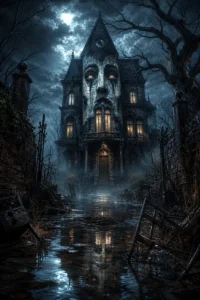
The corridors of Blackthorne House seemed longer that night. Candles burned in sconces along the walls though the electric lights hummed beneath their glass shades, the old and the new layered together until time itself felt uncertain. Portraits watched her pass—Blackthorne men with grave eyes, Blackthorne women with lips like secrets. Their painted faces seemed less dead than disapproving.
At the top of the grand staircase, Seraphina heard the murmur of voices rising from below.
Not many. A dozen, perhaps. Low laughter. The clink of crystal. A man’s voice, smooth and amused, followed by a woman’s response that cut the air cleanly in half. Beneath it all, the mansion seemed to hold its breath.
Lucian waited at the foot of the stairs.
He wore black as well, though on him it looked less like fashion and more like nature. His suit had been cut with ruthless precision, waistcoat dark as ink, shirt white enough to make his skin look carved from winter. No blood tonight. No visible weapon. Yet he stood with such stillness that Seraphina thought of knives resting in velvet-lined drawers.
His gaze rose as she descended.
It touched the diamond choker first.
Then her mouth.
Then the bare skin revealed at her back as she turned on the last step, and the faintest shadow crossed his face. Not surprise. Not appreciation, though his eyes darkened in a way that made her fingers tighten around the banister.
Possession.
It was there and gone so swiftly she might have imagined it.
“You chose an interesting dress,” Seraphina said when she reached him.
“You chose to wear it.”
“I was curious whether disobedience at dinner would result in imprisonment before or after dessert.”
His mouth almost curved. “After. I am not a savage.”
“How reassuring.”
He offered his arm.
For a moment she considered refusing that, too. Then one of the voices beyond the archway laughed—sharp, elegant, predatory—and Seraphina placed her gloved hand on Lucian’s sleeve.
His arm was warm beneath the fabric. Solid. The contact sent an unwelcome thread of memory through her: his hand closing around her wrist in the corridor, his breath near her temple, the scent of rain and iron.
“Who are they?” she asked quietly.
“People who believe themselves untouchable.”
“And are they?”
Lucian looked ahead. “Not by me.”
He led her beneath the archway into the west drawing room.
The room had been transformed. The long curtains were drawn against the rain, their velvet folds heavy as theater drapes. Fires roared in two marble hearths, gilding the dark paneled walls and the silver-framed portraits hung between them. A table had been set beyond the open doors of the dining room, visible in candlelit fragments—white linen, black roses, crystal catching flame. Servants moved silently with trays of champagne, their faces blank, their eyes lowered.
And the guests turned as one.
Seraphina had been raised among old money. She knew how power dressed for dinner. It never wore too many jewels. It never raised its voice. It smiled with its teeth hidden.
But this was different.
These people did not merely own banks, shipping routes, judges, newspapers. They looked as if they owned the right to decide who was remembered and who vanished. Their clothes whispered wealth so old it had forgotten it was wealth at all. Their jewels were not decorations but trophies. The women watched Seraphina with appraising eyes, taking in the choker at her throat. The men looked at Lucian first, then at her, as if measuring the distance between his hand and her spine.
Lucian’s fingers shifted lightly over her glove.
“Lady Blackthorne,” he said, his voice carrying without effort, “allow me to introduce our guests.”
Lady Blackthorne.
The title moved through the room like a match dropped into oil.
The first to step forward was a woman in silver, her hair a sleek white bob that made her look ageless rather than old. Diamonds glittered at her ears. Her smile was exquisite and empty.
“Marcelline Voss,” Lucian said. “Matriarch of House Voss.”
“Your Grace,” Marcelline said, taking Seraphina’s hand between fingers cold as polished bone. “At last. The city has been starving for a glimpse of you.”
“How unfortunate for the city,” Seraphina said. “I’m told starvation makes people unkind.”
A flicker of amusement passed through Marcelline’s eyes. “And here I feared you would be dull.”
“Give me an hour. I may yet disappoint you.”
Marcelline laughed, a soft jeweled sound. “Oh, Lucian. She has teeth.”
“I noticed,” Lucian said.
He moved her on before Seraphina could decide whether to feel complimented or inspected.
Next came Lord Alistair Crane, narrow and fox-faced, with a carnation the color of fresh meat tucked into his lapel. He bowed over her hand without touching it, his eyes lingering a fraction too long on the diamonds at her throat.
“A Vale in Blackthorne diamonds,” he murmured. “History does enjoy a costume.”
“History has always enjoyed making men believe they understand it,” Seraphina replied.
Crane’s smile tightened.
Beside him stood his wife, Isolde, all rose silk and bone-white shoulders. She kissed the air near Seraphina’s cheek. Her perfume was lilies and something rotten beneath.
“You poor darling,” Isolde whispered. “Such a whirlwind romance.”
“Tornadoes are whirlwinds too,” Seraphina said. “No one calls them romantic.”
Isolde blinked, then laughed too loudly.
There were others. The Ashcrofts, twins with identical golden hair and matching smiles that never reached their eyes. Ezra Pell, a financier whose grandfather had allegedly drowned three competitors in the canal and then funded a chapel in their names. Madame Solene Arkwright, who had once been an opera singer and now bought police commissioners as if selecting gloves. Her young nephew, Felix, beautiful and bored and watching Seraphina as if she were a puzzle with a missing piece.
And finally, a man by the fire who did not approach at once.
He stood with a glass of red wine in one hand, his dark green jacket cut from velvet, his silver hair brushed back from a face too handsome to be kind. He was perhaps in his sixties, though age had not softened him. It had only refined the cruelty in his features. A ruby ring gleamed on his finger, large enough to be vulgar had vulgarity not feared him.
Lucian’s grip on Seraphina’s hand changed.
Not tightened. Not visibly.
But every muscle in him went still.
“And this,” he said, “is Lord Octavian Mire.”
The name slid beneath Seraphina’s skin.
Mire. She had heard it in drawing rooms when she was too young to understand why mothers lowered their voices. Mire, whose family owned the city’s oldest private bank. Mire, whose charity galas funded hospitals with one hand while the other foreclosed on the homes of the dying. Mire, who had smiled at her father’s funeral and told Seraphina she had her mother’s eyes.
He came forward at last.
“Lady Blackthorne.” His voice was velvet stretched over wire. “How lovely to see you again.”
“Lord Mire.”
He raised her gloved hand and kissed the air above it. Not her knuckles. The space between. “The last time we met, you were in white.”
Her father’s funeral. Her white mourning coat, because she had refused black. Because black had felt too final, and she had still been stupid enough to believe ruin had a bottom.
“And you were offering condolences,” she said.
“Sincerely.”
Lucian’s silence beside her became a living thing.
Seraphina smiled. “How generous. Did you invoice my family afterward, or was the sincerity included in the existing debt?”
Someone behind them gave a soft cough that might have been a laugh strangled in its cradle.
Lord Mire’s eyes sharpened. “Your wit remains intact. A blessing, considering how much else was lost.”
Lucian spoke before Seraphina could.
“Dinner is served.”
It should have been nothing. A host’s cue. Yet the words fell with such finality that everyone turned toward the dining room as if pulled by leash.
Lucian placed his hand at the small of Seraphina’s back.
The glove and silk were barriers. They might as well have been smoke. His palm burned through them, steadying her, claiming her, reminding every eye in the room that she did not stand alone.
Seraphina hated how much she needed the pressure.
The dining room was a cathedral to appetite.
A long table stretched beneath three chandeliers, their crystal drops glittering like frozen tears. Black roses spilled from silver bowls down the center, their petals so dark they seemed bruised. Candles burned in tall holders shaped like branching antlers. The plates were bone china edged in gold; the knives, old silver, heavier than modern ones, their polished blades reflecting the faces of the guests in warped slivers.
Name cards marked each place. Seraphina found herself seated at Lucian’s right. Lord Mire sat across from her. Marcelline Voss sat to Lucian’s left, watching with the air of a woman attending a private execution.
The first course arrived in silence: oysters on crushed ice, black caviar, lemon wedges wrapped in muslin. Seraphina had eaten little since arriving at Blackthorne House, but hunger deserted her as the guests unfolded their napkins with ritual precision.
“You have improved the house,” Marcelline said, glancing around. “Or perhaps the presence of a bride has made even Blackthorne seem less haunted.”
“The ghosts have impeccable manners,” Lucian said. “They keep to themselves during dinner.”
“How unlike the living,” Seraphina murmured.
Marcelline’s eyes gleamed. “Indeed.”
Across the table, Lord Mire lifted his wine. “To the newlyweds, then. May their union be fruitful.”
The word scraped unpleasantly against the air.
“Fruitful?” Seraphina echoed.
“Strong families think in generations.” Mire’s gaze rested on the choker at her throat. “And both your lines have been… carefully preserved.”
Something flickered in Lucian’s face, gone before she could name it.
“Careful preservation can lead to rot,” Seraphina said.
Felix Arkwright laughed into his champagne. His aunt silenced him with a look.
Lord Crane leaned forward. “You speak boldly for someone newly seated among us.”
“I was under the impression this was dinner, not a coronation.”
“In this room, they are sometimes the same thing,” Isolde Crane said sweetly.
Servants removed the oyster plates. Soup followed, pale and fragrant with truffle, poured from silver tureens. The conversation shifted like a school of dark fish—charities, elections, an opera premiere, a judge’s sudden retirement, a dockworkers’ strike that had ended too conveniently after three men were found beaten beneath the south bridge. The guests spoke of all of it with polished indifference. No one said murder. No one said bribe. No one said fear.
They used prettier words.
“Stability,” Ezra Pell said, buttering bread.
“Necessary correction,” said Madame Arkwright.
“Private mediation,” Lord Crane added.
Seraphina listened and understood, with a coldness gathering in her stomach, that she had not married into a family. She had married onto a board.
A board that governed the city from candlelit rooms and left the bodies for the river.
Lucian barely spoke. When he did, the table listened. Not with respect alone. With caution. Men like Lord Crane watched him the way stable boys watched an unsettled stallion—admiring the strength, calculating the distance to the door. Women like Marcelline Voss smiled as though she and Lucian were old friends, but her fingers never strayed far from the emerald ring on her right hand, which she turned when certain names were mentioned.
Seraphina catalogued everything.
The way the Ashcroft twins avoided the word Blackthorne unless Lucian used it first.
The way Ezra Pell’s hand shook slightly whenever Lord Mire addressed him.
The way Madame Arkwright looked not at Seraphina’s face, but at her throat, her wrists, the pale skin above her glove—as though searching for a mark.
Halfway through the fish course, Lord Mire said, “Tell us, Lady Blackthorne. How do you find marriage?”
Every conversation thinned at once.
Seraphina set down her fork. “Recent.”
Marcelline hid a smile behind her glass.
“A diplomatic answer,” Mire said.
“I have few diplomatic talents. That was luck.”
“Surely you must have formed an impression of your husband by now.”
Lucian did not look at her. He cut into his fish with calm precision, as though Mire had asked about the weather.
Seraphina turned her wineglass by the stem. “He has excellent taste in prisons.”
The table froze.
Then Lucian laughed.
It was quiet, unexpected, and devastating.
The sound moved over Seraphina’s skin like the first flare of heat in a darkened room. She looked at him despite herself. His eyes were on her now, black and amused and unreadable. For one breath, the dining room, the wolves, the rain on the windows—all of it receded.
There was only Lucian’s mouth softened by laughter, and the dangerous knowledge that she had put it there.
“Do you find the accommodations lacking?” he asked.
“Only the locks.”
“There are many locks.”
“Exactly.”
His gaze dipped, almost imperceptibly, to the diamonds at her throat. “Perhaps I enjoy knowing what is worth keeping.”
Her pulse struck the choker.
Lord Mire watched them with mild interest, but his eyes had gone hard.
“How touching,” he said. “A love match after all.”
“Do not be sentimental, Octavian,” Marcelline said. “It ages you.”
“Everything ages us, my dear.” Mire smiled. “Except good breeding. That survives. Sometimes even bankruptcy cannot kill it.”
The word landed with a delicate click.
Bankruptcy.
Seraphina felt it pass through the room, invisible and scented with blood. The ruined Vale fortune. The estate sold in parcels. Her father’s name stripped from clubs he had founded, hospitals he had funded, newspapers he had rescued. Creditors circling before the body was cold. Her childhood home gutted by auctioneers who touched her mother’s piano with greedy hands.
She reached for her wine.
Lucian’s fingers closed around the stem before she could lift it.
Not to stop her, exactly. Just enough contact that her hand stilled beneath his shadow.
“Careful,” he said softly.
The word was for her alone. Or seemed to be.
Her cheeks burned. Not with embarrassment. With fury.
“Why, Lord Mire,” she said, withdrawing her hand from the glass and folding it in her lap. “If I had known my poverty was invited, I would have asked it to wear something nicer.”
A small silence. Then Felix Arkwright choked on his wine.
Madame Arkwright’s fan snapped open.
Lord Crane’s mouth twitched despite himself.
But Mire only leaned back, pleased to have drawn blood. “You misunderstand me. I admired your father greatly.”
Seraphina’s spine went straight.
“Did you?”
“Of course. Edmund Vale was a man of appetite. Vision. Risk.”
Lucian’s fork came to rest against his plate.
Softly.
Almost inaudibly.
Seraphina heard it like a gun being cocked.
“My father was many things,” she said.
“Indeed. A gambler in every room he entered.” Mire’s smile deepened. “Cards, markets, women, loyalty. Though one must admit, he had terrible instincts at the end. To stake everything on a losing hand—tragic. Or foolish. The line is so thin.”
The candlelight trembled.
Perhaps it was only the draft.
Perhaps not.


0 Comments