Chapter 2: A Groom Made of Shadows
by inkadminThe rain began before dawn and did not stop.
It crawled down the high arched windows of Vale House in silver veins, blurring the city beyond into a smear of black rooftops, gaslit streets, and the distant bruised glow of the harbor. The old mansion breathed damp through its stone bones. Every corridor smelled faintly of beeswax, wet wool, and lilies dying in crystal vases.
Seraphina had not slept.
She sat before the vanity in her dressing room while three maids moved around her like nervous ghosts, fastening buttons, smoothing fabric, pinning curls that wanted to fall loose. She watched them through the mirror, not really seeing them. Her own reflection stared back with a stillness she had learned from portraits: chin lifted, shoulders bare, mouth painted the exact shade of blood after it met air.
Her mother had once told her beauty was a language men could understand even when they understood nothing else.
Seraphina had learned to speak it fluently.
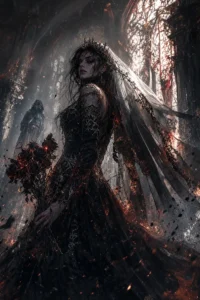
Today she wore ivory, because her father had commanded it. Not white—no one in Vale House pretended innocence survived past childhood—but ivory silk with a high collar of lace that climbed her throat like frost. The dress was modest enough to satisfy old laws and expensive enough to insult anyone who noticed the difference. Pearls rested at her ears. A thin gold bracelet hid the narrow underside of her left wrist.
The bracelet had belonged to her grandmother.
The scar beneath it belonged to no one.
“Too tight,” Seraphina said.
The maid behind her froze, fingers pinched around a row of pearl buttons. “My lady?”
“The collar.” Seraphina’s voice was soft. Soft was safer in a house built to listen. “I would like to breathe at least until noon.”
The maid flushed and loosened the clasp by a fraction.
“Better?”
“If I faint during contract inspection, I would hate for anyone to blame your needlework.”
The youngest maid made a strangled sound that might have been laughter before fear smothered it. The older one shot her a warning look.
Seraphina met the younger girl’s eyes in the mirror and allowed the smallest curve of a smile. It vanished before it could become dangerous.
Outside the dressing room door, footsteps passed. Heavy. Male. Not a servant. Vale men always walked as if the floor owed them apology.
Her father’s voice murmured beyond the wall, too low to make out the words, followed by another voice—Uncle Alistair’s rasp, likely—and then silence.
Vale House was never truly quiet. Even in the dead hours before morning, it whispered. Pipes groaned in the walls. Floorboards settled under invisible weight. Rain tapped coded messages against the glass. Somewhere below, guards shifted rifles against their shoulders. Somewhere deeper, in the cellar wing Seraphina had been forbidden to enter since she was twelve, machines hummed behind locked steel doors.
But this morning, the house held its breath.
Because Cassian Blackthorn was coming.
The name had moved through the servants faster than fever. By breakfast, two footmen had dropped silverware. Mrs. Wynn, the housekeeper, had changed the dining room flowers twice and still looked as if she expected them to bleed. The kitchen sent up untouched trays of tea and sugared bread. No one ate. Even the dogs in the east kennel had gone silent.
Seraphina had heard stories of Cassian since she was old enough to be told which names not to say in public.
Cassian Blackthorn, who inherited a dynasty at twenty-two after his father and two elder brothers died in the same fire that left half the western docks in ash.
Cassian Blackthorn, who wore mourning like a crown and turned grief into an empire.
Cassian Blackthorn, who did not shout, did not threaten, did not repeat himself.
Cassian Blackthorn, whose enemies disappeared so thoroughly their widows still set places for them at dinner.
And now Cassian Blackthorn, who would be her husband by the end of the week.
The brush in the maid’s hand snagged on a curl. Pain sparked across Seraphina’s scalp.
“Sorry, my lady.”
“Don’t be.” Seraphina leaned forward and took the brush from her. “Pain keeps one alert.”
The maid’s face went pale enough to match the curtains.
Seraphina almost apologized.
Almost.
A knock came at the door.
The three maids startled like birds.
“Enter,” Seraphina said.
Mrs. Wynn appeared, black dress severe, iron-gray hair scraped into a bun so tight it seemed an act of punishment. She looked at Seraphina in the mirror rather than directly, the way everyone did when news was unwelcome.
“Your father requests your presence in the west drawing room.”
“Requests?” Seraphina set the brush down. “How generous of him.”
Mrs. Wynn’s mouth compressed. “Lord Vale is with Mr. Blackthorn.”
At that, the room changed.
Not visibly. The fire did not gutter. The rain did not beat harder. The maids did not scream.
But the air altered, as if some great black carriage had rolled not into the courtyard but into Seraphina’s lungs.
She rose.
The ivory silk fell around her legs with a whisper. One maid bent to adjust the hem, but Seraphina stepped away before fingers could touch her. She fastened her bracelet herself, tugging it low until gold covered the thin pale line hidden beneath.
“How do I look?” she asked.
Mrs. Wynn studied her. Something almost tender flickered behind the woman’s eyes before discipline snuffed it out.
“Like a Vale.”
Seraphina smiled without warmth. “Then I must try harder.”
She walked out before Mrs. Wynn could answer.
The corridor beyond was lined with ancestral portraits, generations of Vales staring down from gilt frames with the same narrow eyes and sharpened mouths. Men in black coats. Women in pearls. Children posed beside hounds, beside horses, beside dead things they had been taught to claim as trophies.
Seraphina passed them all.
At the top of the grand staircase, she paused.
Below, Vale House unfurled in polished marble and old arrogance. The entrance hall was cavernous, its ceiling painted with angels who looked less divine than accusatory. Rain-dim light fell through stained glass, staining the floor crimson and blue. Armed men stood near the doors in formal black, their earpieces discreet, their hands not far from their jackets.
Her father had dressed for war and called it hospitality.
Lord Evander Vale stood at the bottom of the staircase, one hand resting on the silver head of his cane. He was fifty-eight and looked carved from old ivory: elegant, hard, faintly yellowed by vice no amount of money could polish away. His dark hair was threaded with silver at the temples, his suit immaculate, his smile reserved for enemies and investors.
Beside him stood a man Seraphina did not recognize.
She knew immediately that it was Cassian.
Not because he matched the rumors. Rumors, she realized, had been merciful.
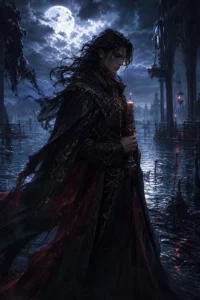
He was tall, dressed in black from throat to polished shoes, the cut of his coat severe enough to seem almost ecclesiastical. He carried no visible weapon. He did not need one. Stillness clung to him with the intimacy of a shadow. His hair was black, rain-damp at the ends, combed back from a face that belonged in a cathedral window dedicated to beautiful sins.
Sharp cheekbones. Pale skin. A mouth too finely shaped for kindness. Eyes the color of winter harbor water—gray, dark, and depthless.
He looked up before her father did.
Seraphina had the strange and immediate sensation that he had known precisely where she stood before she arrived.
Their gazes met across the vast hall.
The house fell away.
For one suspended second there was only rainlight, marble, and the unreadable attention of the man who had purchased her future in ink.
Then her father turned.
“Seraphina.”
Not daughter. Not child.
A summons dressed as a name.
She descended the staircase slowly, one hand gliding along the banister. The ivory silk whispered around her ankles. She felt every eye in the hall track her progress: servants, guards, her father, the Blackthorn men waiting near the open doors in coats damp from rain.
Cassian did not look away.
When she reached the bottom step, her father extended his hand toward her, not to help but to position her. She ignored it and came to stand beside him.
A faint tightening appeared at the corner of Lord Vale’s mouth.
Good.
“Mr. Blackthorn,” he said smoothly, “my daughter, Seraphina.”
Cassian inclined his head.
Not a bow. Not quite.
“Miss Vale.”
His voice was low and composed, with the faintest trace of smoke in it. It did not echo in the hall. It sank into the air and stayed there.
“Mr. Blackthorn,” Seraphina replied.
His eyes moved over her face, not rudely, not appreciatively, but with the terrible precision of a man reading a document he intended to use as evidence.
“You are exactly as described,” he said.
Her father chuckled. “I hope that is a compliment.”
“It was an observation.”
Seraphina felt something cold and bright unfurl behind her ribs.
“How disappointing,” she said. “I dressed for flattery.”
For the first time, Cassian’s gaze changed. Not softened. Never that. But something sharpened in it, like a blade catching candlelight.
Lord Vale’s fingers tightened on his cane. “Seraphina.”
“Father.” She kept her eyes on Cassian. “Would you like me silent for the negotiation, or merely decorative?”
A servant somewhere inhaled too quickly.
Cassian’s mouth did not smile. “Can you be either?”
The question was so quiet it took a heartbeat for its insult to bloom.
Seraphina’s pulse gave a single hard kick.
Her father laughed again, too loud this time. “You see what I have endured.”
“Endurance is often confused with ownership,” Cassian said.
The hall went very still.
Lord Vale’s expression remained pleasant. His eyes did not.
Seraphina looked at Cassian more carefully.
There it was, then—the cruelty people whispered about. Not the common kind, not anger or hunger or the clumsy brutality of men who needed bruises to feel powerful. Cassian’s cruelty was colder. Cleaner. He touched a nerve and watched whether you flinched.
She decided, suddenly, that she hated him.
It was a useful feeling. Hatred had edges. Fear was only a room with no doors.
“Shall we?” Lord Vale gestured toward the west wing. “The lawyers are waiting.”
“Let them wait another minute,” Cassian said.
He looked toward the open front doors.
Beyond them, rain sheeted across the courtyard. Three black cars idled in a line, their windows dark. Blackthorn men stood beneath umbrellas, faces blank, shoulders broad beneath wool coats. At the far end of the drive, wrought iron gates curled like thorn branches around the Vale crest.
Cassian removed his leather gloves one finger at a time. The movement was unhurried, almost intimate. Seraphina found herself watching the reveal of his hands: long fingers, pale knuckles, a silver signet ring carved with the Blackthorn emblem.
A thorn-wrapped crown.
He passed the gloves to a man behind him without turning. The man accepted them as if receiving scripture.
“I prefer to inspect the house first,” Cassian said.
Lord Vale’s smile thinned. “The house?”
“The bride leaves from here. I want to know what follows her.”
“My daughter is not cargo.”
“No,” Cassian said. “Cargo is insured honestly.”
The words landed with a soft, deadly weight.
Seraphina felt rather than saw her father’s anger. It moved through him like a draft through a sealed room.
“Vale House is secure,” Lord Vale said. “Its walls have stood for two hundred years.”
“Walls rarely betray anyone. People do.”
Cassian turned and began walking before permission could be granted or denied.
For a moment, no one moved.
Then Lord Vale followed, cane striking marble with measured force. Seraphina went after them because remaining behind would look like obedience, and she had very few luxuries left.
The west drawing room had been prepared with the full theater of dynasty. A long table stood near the hearth, polished to a dark mirror shine. On it lay stacks of cream paper, seals of red wax, fountain pens, ledgers bound in black calfskin. Two Vale attorneys sat on one side, narrow and nervous. Opposite them, one Blackthorn solicitor waited with a brass case and the relaxed posture of a man who had already memorized everyone’s obituary.
Fresh logs burned in the hearth, though the room remained cold.
Cassian stopped in the doorway.
His eyes passed over the lawyers, the contract, the decanters of amber liquor, the silver tray of untouched coffee.
“Who drafted the amendment concerning residences?” he asked.
One of the Vale attorneys blinked. “Sir?”
“Clause fourteen. Subsection three. Spousal residence after ceremonial union.”
The attorney shuffled papers with fingers gone clumsy. “That would be our office, under Lord Vale’s direction.”
“Remove it.”
Lord Vale entered behind him. “No.”
Cassian turned slightly.
He did not raise his voice. That made it worse.
“Your daughter will reside at Blackthorn House.”
“My daughter will maintain chambers here, as stipulated, for purposes of family obligation and public continuity.”
“Your daughter will not sleep under a roof controlled by men who profit from her vulnerability.”
Seraphina went still.
Her father’s cane stopped tapping.
Across the room, one of the lawyers lowered his gaze to the papers as if the ink might save him.
Lord Vale said, “Choose your next words carefully.”
“I always do.” Cassian’s eyes flicked to Seraphina. “That is why I have so few regrets.”
She should not have felt heat at that. It was not admiration. It was not protection. Cassian Blackthorn was not defending her; he was claiming jurisdiction. A prison did not become less a prison because the jailer disliked trespassers.
“How noble,” she said. “My future husband argues over where to keep me.”
“Would you prefer a kennel?” Cassian asked.
Her father’s face darkened. “Enough.”
Seraphina smiled before she could stop herself. It came sharp, genuine, and dangerous. “I suppose that depends on the company.”
This time, Cassian looked at her long enough for the room to fade at the edges.
“You are not afraid of me,” he said.
“I am extremely afraid of you.”
“No,” he said. “You are afraid of being seen afraid.”
The words slipped beneath her skin with surgical accuracy.
Seraphina’s smile remained. It cost her something.
“And you are afraid of silence,” she said, “or you would not fill it with amateur psychology.”
The Blackthorn solicitor coughed once into his hand. It may have been laughter. It may have been a prayer for survival.
Cassian’s gaze did not leave her.
Then he turned to the table. “The amendment goes.”
Lord Vale’s voice hardened. “The amendment stays.”
“Then the marriage waits.”
The hearth popped. A splinter of ember broke apart in the fire.
Seraphina looked at her father.
There. For less than a second, a crack appeared in his composure. Not fear—Lord Vale had killed too much of himself to fear easily—but alarm. Urgent, tightly leashed alarm.
The wedding could not wait.
Why?
She tucked the thought away like a stolen blade.
Her father recovered. “You know the arrangement benefits both houses.”
“I know exactly who benefits.” Cassian picked up the top page of the contract. “That is why I am reading it.”
He moved to the head of the table without invitation and began turning pages.
No one sat until he did.
Seraphina remained standing by the window, letting the cold seep through the glass into her spine. Beyond the rain-streaked panes lay the western garden, all black hedges and marble statues slick with water. A stone angel bowed beneath a yew tree, hands covering its face. As a child, Seraphina had thought it was crying. Now she knew better.
Even angels looked away in Vale House.
The contract review began.
It was not a negotiation so much as a dissection.
Cassian cut through clauses with infuriating calm. He questioned dowry transfers, security protocols, public appearance obligations, inheritance contingencies. He identified two redundancies, three traps, and one deliberate ambiguity before the Vale attorneys could finish pouring water.
“Clause twenty-two,” he said, tapping one page with the back of his pen. “Define ‘conduct unbecoming.’”
Lord Vale leaned back. “A standard morality clause.”
“Morality is not standard in this room.”
Seraphina lowered her eyes to hide the flicker of satisfaction that threatened to betray her.
Her father noticed anyway.
He always noticed amusement he had not authorized.
“It concerns public scandal,” Lord Vale said. “My daughter understands the obligations of her station.”
“Does she?”
Cassian glanced toward Seraphina.
She looked back over the rim of the coffee cup she had not drunk from. “I have had tutors since I could hold a spoon. I can embroider a crest, name every saint in the cathedral ruins, navigate fourteen forks at dinner, and smile while men discuss my price.”
“Useful talents.”
“I thought so.”
“Any others?”
Her fingers tightened around the cup.
For an instant, she saw another room. Not this one. A smaller one. Dark paneled walls. Rain that night too, harder than today. A broken glass in her palm. A man’s breath against her ear. Her own hand moving before thought. Red spreading over white marble in a shape like a flower opening.
She set the cup down.
“I play the piano poorly enough to irritate dinner guests,” she said. “A gift I hope to cultivate.”
Cassian watched her for one beat too long.
“We will add that to the contract.”
“My playing?”
“Your right to irritate my dinner guests.”
It should not have pulled a laugh from her.
It did not, quite. But breath escaped her nose before she could cage it.
Her father’s gaze snapped to her like a whip.
Seraphina turned back to the window.
Stupid. Dangerous. Do not let him make you forget what he is.
A groom made of shadows is still a groom. A cage lined in black silk is still a cage.
The review dragged into the morning. Rain darkened the garden paths. Servants came and went with fresh coffee, ink, and trays of untouched sandwiches trimmed of their crusts. The lawyers’ voices grew hoarse. Lord Vale’s politeness eroded grain by grain.
Cassian did not tire.
He sat with one ankle crossed over his knee, pen balanced between long fingers, and dismantled an entire generation of Vale entitlement without appearing to exert effort.
“No medical authority retained by the Vale family after the wedding,” he said.
“Absurd,” Lord Vale snapped. “Our physicians have served us for decades.”
“Then they are overdue for retirement.”
“My daughter’s health is not your opportunity to insult my household.”
“Your daughter’s health becomes my concern the moment your name stops protecting her.”
“My name has protected her since birth.”
Seraphina almost laughed then.
Protected her. Yes. Like glass protected a butterfly pinned in a collector’s case.
Cassian’s gaze shifted, not to her face, but to her hands.
She realized too late that her fingers had curled against her palm.
The bracelet slipped.
Only a fraction.
Enough for cold air to kiss the scar beneath.
She lowered her hand into the folds of her skirt.
Cassian’s eyes lifted again.
No expression. No sign he had noticed.
But she felt seen anyway, as surely as if he had reached across the room and turned her wrist beneath a lamp.
A knock interrupted them.
Mrs. Wynn opened the door and bent her head. “Lord Vale, Inspector Marrow has arrived at the south entrance.”
Seraphina’s father went very still.
The name pressed a thumb against the back of Seraphina’s neck.
Inspector Elias Marrow served the city’s official police in the way a knife served dinner. He had been in Vale House twice before. Once after a dockworker uprising. Once after the body in the east fountain.
And once, unofficially, three years ago, on the morning after Seraphina learned blood under fingernails was harder to hide than stories suggested.
“Tell him I am occupied,” Lord Vale said.
“He insists the matter is urgent.”
“I do not care if the cathedral itself has risen from its grave. He can wait.”
Mrs. Wynn’s gaze flicked, involuntarily, to Cassian.
Cassian noticed. Of course he did.
“By all means,” he said, closing the contract folder. “Attend to your policeman.”
Lord Vale’s eyes narrowed. “This will take only a moment.”
“I am patient with interruptions when they are revealing.”
For a second, Seraphina thought her father might strike him.
Instead, Lord Vale rose. “Seraphina, remain here.”
There it was again. The command beneath the name.
She inclined her head with enough grace to make the disobedience she was already planning feel ceremonial.
Her father left with Mrs. Wynn. One Vale attorney followed after gathering papers he did not need. The other remained, sweating discreetly into his collar. Cassian’s solicitor sat motionless as a tomb effigy.
The door closed.
The room exhaled.
Seraphina turned from the window. “Do you always enjoy provoking armed patriarchs in their own homes?”
“Only when they invite me.”
“My father did not invite you. He bargained with you.”
“There is a difference?”
“Invitations include the possibility of refusal.”
Cassian rose.
Every nerve in her body noticed.
He did not come toward her immediately. He walked to the mantel first, studying the portrait above it—a young woman in a blue gown, dark curls pinned with pearls, one hand resting on the shoulder of a little girl with solemn eyes.
Seraphina’s mother.
And Seraphina at six.
Before she learned that portraits lied more elegantly than people.
“Isabella Vale,” Cassian said.
Seraphina’s throat tightened before she could stop it. “You collect dead women as a hobby?”
“I collect causes of death.”
“How romantic.”
“Your mother drowned.”
“Yes.”
“In a locked conservatory.”
The room seemed to tilt.
Seraphina kept her face still.
The official story was simple. Isabella Vale had taken too much laudanum after a winter ball, wandered into the glass conservatory during a storm, slipped beside the indoor koi pond, and drowned in six inches of water before anyone found her.
Seraphina had been nine.
She remembered the smell of orchids. The wet hem of her nightdress. Her father’s hand gripping her shoulder hard enough to bruise as men carried her mother out beneath a sheet.
She remembered thinking six inches of water was not enough to drown a woman who wanted to live.
“You have been reading old newspapers,” she said.
“Among other things.”
“Then you know tragedy is a family tradition.”
Cassian looked away from the portrait. “Traditions can be broken.”
“Can they?” She crossed her arms. The bracelet slid again. She caught it with her thumb. “Tell me, Mr. Blackthorn, when your family burned, was that tradition or innovation?”
The remaining Vale attorney made a tiny choking sound.
Cassian’s solicitor finally moved, lifting his eyes with the mild interest of a man watching someone step onto cracked ice.
Cassian did not react at first.
Then he turned fully toward her.
The air between them went thin.
Seraphina’s pulse beat once at the base of her throat. She had gone too far. She knew it as one knew a railing had given way beneath the hand.
Good, said the reckless thing inside her. Fall, then.
He approached.
Slowly.
Seraphina refused to step back, though every instinct in her body unfolded claws against it.
He stopped close enough that she caught the scent of rain on wool, cedar smoke, and something darker beneath—metal, perhaps, or winter air over stone. His height forced her to tilt her chin if she wanted to meet his eyes. She did.
“My family burned,” Cassian said quietly, “because someone locked the doors from the outside.”
The words entered her like cold water.
No rumor had included that.
“I didn’t know,” she said.
“No. You chose the knife before checking the wound.”
Shame flared, hot and unwelcome.
She hated him more for making her feel it.
“A habit acquired in this house,” she said.
“Then leave the habit here.”
“Will you permit me luggage, husband-to-be, or only approved behaviors?”
His gaze lowered to her mouth. Not like a lover. Like a man noting where defiance lived.
“I will permit you more than your father ever has.”

0 Comments