Chapter 3: Silk, Steel, and Signatures
by inkadminRain stitched silver threads down the windows of the Ardent Hotel, turning the city beyond into a blurred cathedral of neon, spires, and hunger.
Inside, everything glittered.
The ballroom had been built for kings who never came and criminals who never left. Thirty-foot ceilings vanished into painted clouds darkened by age and candle smoke. Chandeliers hung like frozen explosions above the marble floor, each crystal catching the gold light and breaking it into shards. White roses climbed black iron trellises along the walls, their petals too perfect, their perfume too sweet, their thorns painted silver for the occasion.
Every dynasty in Veyr was there.
The Morellis gathered near the fountain of champagne with their diamond serpent pins and smiles sharp enough to open veins. The Eastwicks occupied the balcony, pale and watchful, dressed in mourning though no one had died in their family for months. Judges from the private courts drank beside dock kings, arms dealers, ministers, priests who had forgotten how to pray, and wives who knew exactly where their husbands buried inconvenient men.
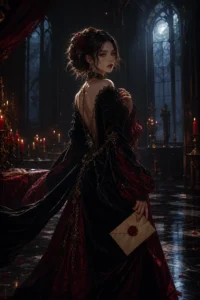
At the center of it all stood Seraphina Vale in a gown the color of wet garnets, smiling as though the corset ribs were not slowly teaching her lungs how to surrender.
Her mother had chosen the dress.
“Red makes a statement,” Ophelia Vale had said that afternoon, standing behind Seraphina in the mirror while two silent maids laced her tight enough to bruise. “It says confidence. Bloodline. Claim.”
Seraphina had stared at her reflection and watched the bodice swallow her waist. “How comforting. I was afraid it only said sacrificial lamb.”
Ophelia’s fingers had stilled at the clasp of a ruby necklace. Just for a breath. Then her mother had smiled in the mirror, lovely and dead-eyed. “Lambs bleat, darling. Vales do not.”
Now the rubies lay cold against Seraphina’s throat, each stone a drop of frozen blood. Her dark hair had been pinned back with pearl-tipped needles, exposing the line of her neck, the delicate bones of her shoulders, the expensive serenity bred into her like a family disease.
A waiter passed carrying a tray of champagne flutes. Seraphina took one and did not drink.
“You look like a woman contemplating murder,” murmured Althea Marrow at her side.
Seraphina glanced at her oldest friend. Althea wore black lace from collarbone to wrist, her blond curls pinned with jet combs, her mouth painted the exact red of scandal. There were women who entered rooms like music. Althea entered them like a knife slipped under a pillow.
“Only contemplating?” Seraphina said. “I must be losing my touch.”
Althea’s smile flickered, but concern hid beneath it. “Is it true?”
A pianist began a waltz at the far end of the ballroom. The notes drifted up through laughter and clinking glass, delicate as bones in a bowl.
Seraphina kept her gaze on the guests. “That depends on which rumor you prefer. I’ve heard I begged for the match, that I was caught in a compromising position, that Cassian Blackthorn bought my father’s debt, and that I’m already carrying his heir.”
“Seraphina.”
The name landed softly. That made it worse.
Her fingers tightened around the champagne stem. “Yes. It’s true.”
Althea looked past her, toward the dais being assembled beneath the largest chandelier. Blackthorn men in dark suits stood at every entry point. Vale guards stood opposite them, pretending not to glare. At the center, two lecterns had been placed side by side, the old-fashioned kind carved from black walnut and inlaid with brass.
Two families. Two signatures. One noose dressed as silk.
“Do you want me to make a scene?” Althea asked. “I can faint. I can accuse someone of poisoning me. I can start a fire in the powder room. I’ve been saving that one.”
Seraphina almost laughed. It hurt too much, so she raised her glass instead. “Save your arson. I may need it for the wedding.”
“There shouldn’t be a wedding.”
“No,” Seraphina said. “There should be a funeral. But we rarely get what we deserve.”
Althea touched her arm lightly, her gloved fingers warm through the silk. “What did your father say?”
Seraphina’s gaze found Lucien Vale across the ballroom.
Her father stood surrounded by men who had once bowed to her grandfather. Tall, silver-haired, immaculate in midnight blue, Lucien looked every inch the grieving widower of a better age, though his wife stood very much alive near the orchids, accepting compliments like tribute. He laughed at something Minister Calder said, his hand resting on his cane though he did not need it. A silver wolf’s head gleamed beneath his palm.
“He said the city requires peace,” Seraphina said.
“And what do you require?”
Seraphina watched her father’s smile widen. “Apparently, less than the city.”
A change moved through the ballroom before anyone announced it. Conversations softened, then thinned. Heads turned toward the grand staircase where the hotel’s twin marble flights descended from the upper gallery. Even the chandeliers seemed to hold their breath.
Cassian Blackthorn had arrived.
He did not rush. Men like him never did. The world made room before they reached it.
He descended the stairs in a black evening coat cut with vicious precision, his shirt white, his tie the deep green of bottle glass. No jewels except a signet ring on his right hand, onyx set in silver. His dark hair was brushed back from a face so beautiful it seemed less made than carved, all cruel lines and controlled shadows. A faint scar split one eyebrow, barely visible unless the light caught it. It caught now.
Seraphina hated that she noticed.
Beside him walked his sister, Evangeline Blackthorn, tall and fox-sleek in ivory silk. Her hair was a black river down her back, her smile full of secrets sold at a profit. Behind them came three men Seraphina did not know by name but recognized by reputation: Blackthorn lieutenants, wolves taught to stand upright.
Cassian’s gaze moved over the room once.
People lowered their eyes.
Seraphina did not.
His gaze found hers immediately, as if every glittering body in the ballroom had been arranged merely to draw a line between them. For a moment, the music, rain, perfume, and whispers all receded. There was only the distance between them and the memory of his fingers around her wrist in her father’s study, turning her hand just enough to reveal the pale hidden scar beneath the bracelet.
Who gave you that?
He had asked it like he already knew the answer.
She had pulled away before she could shake.
Now Cassian’s eyes dropped, not to her throat or gown like other men’s had all evening, but to her left wrist.
Seraphina had covered it with three strands of rubies.
His mouth curved slightly.
Not a smile. Recognition.
Althea inhaled beside her. “That man looks at people like he’s choosing where to cut first.”
“Then I hope he appreciates symmetry,” Seraphina said. “I’m told I have excellent bones.”
Cassian crossed the ballroom.
Every step drew attention. Every pause forced calculation. Women watched him with hunger carefully disguised as curiosity. Men watched him with resentment carefully disguised as respect. He accepted greetings with a cool inclination of his head, offered no hand unless it was owed, and left a wake of chilled conversation behind him.
When he reached Seraphina, the pianist faltered for half a note.
“Miss Vale,” Cassian said.
His voice was low enough that those nearby leaned closer without meaning to.
“Mr. Blackthorn,” she replied. “How generous of you to attend your own engagement announcement.”
His eyes warmed by a degree that did nothing to soften them. “I dislike disappointing crowds.”
“How fortunate for the crowd. I was under the impression you disliked most living things.”
“Only inefficient ones.”
Althea made a strangled sound that could have been a cough or delight.
Cassian glanced at her. “Miss Marrow.”
Althea lifted her glass. “Mr. Blackthorn. I would say I’ve heard so much about you, but my mother taught me not to repeat obscenities in public.”
“Lady Marrow has always been optimistic about public decency.”
“And you’ve always been pessimistic about witnesses, I hear.”
Seraphina saw the Blackthorn lieutenants stiffen behind him. Cassian did not. If anything, his expression eased into something almost amused.
“Your friend is loyal,” he said to Seraphina.
“My friend is armed,” Althea said sweetly.
“In that purse?” Cassian asked.
“In this room.”
For the first time that evening, Seraphina felt a true smile tug at her mouth.
Cassian noticed. Of course he did. His attention returned to her like a hand settling at the base of her throat.
“May I have this dance?” he asked.
It was not really a question. Around them, conversations had slowed again. Her father was watching. Her mother too. The Morellis. The Eastwicks. The ministers and murderers and wives with secret ledgers. The whole city waited to see whether the Vale heiress would place her hand in the Blackthorn heir’s.
Seraphina set her untouched champagne on a passing tray.
“You may survive it,” she said.
She placed her gloved hand in his.
The contact was slight. Polite. Ruinous.
His fingers closed around hers, cool and strong, and he led her to the center of the floor as the music shifted into a darker waltz. Couples retreated to make space. Silk whispered. Jewels flashed. Above them, the chandelier burned like a captured star.
Cassian’s other hand settled at her waist.
Not low. Not improper. Worse—exactly where it should be, with enough pressure to guide but not enough for anyone to accuse him of possession.
Seraphina hated that she could feel the heat of his palm through the gown.
They began to move.
He danced like he fought. She knew it within three turns. No wasted motion, no hesitation, no dependence on flourish. He led with quiet inevitability, making the crowded ballroom seem suddenly built around his will. Seraphina had been taught since childhood to dance with ambassadors, princes, drunk old men with wandering hands, young heirs too eager to impress. She knew how to become graceful furniture in a man’s arms.
Cassian did not let her disappear.
Every step demanded she answer him.
“You look displeased,” he said.
“I’m trying not to disappoint you with inefficiency.”
“You rarely disappoint me.”
“We’ve met twice.”
“Some people reveal themselves quickly.”
She tilted her head as they turned past a pillar wrapped in roses. “And what have I revealed?”
His thumb shifted once against the side of her hand. A small movement. Barely there. Her pulse still tripped.
“That you count exits before entrances. That you distrust compliments more than threats. That you would rather be underestimated than adored.”
The waltz carried them through a shaft of gold light. Seraphina kept her expression serene, though something cold slid between her ribs.
“How poetic,” she said. “Do you practice frightening women in mirrors, or does it come naturally?”
“You aren’t frightened.”
“That sounds like a dangerous assumption.”
“It is.”
His gaze did not leave her face. The room blurred behind him: red gowns, black coats, white flowers, silver thorns.
“My father says this marriage will save lives,” she said.
“Your father says many things.”
“Will it?”
Cassian guided her around a pair of elderly nobles moving too slowly. “Save lives?”
“Yes.”
“Perhaps.”
She laughed once, softly. “How reassuring. Shall we include that in the announcement? Perhaps peace, definitely a gown.”
“Peace is a costume people wear when war becomes expensive.”
“And this?” Seraphina asked. “What costume are we wearing tonight?”
His eyes dropped to her mouth, then returned to her eyes so quickly she might have imagined it if her breath had not changed.
“Bride and groom,” he said.
“Those are roles. Not costumes.”
“With us, they may be both.”
A burst of applause rose from the far side of the room as another important guest arrived. Seraphina barely heard it. Cassian’s hand at her waist felt like a brand, not because he gripped hard, but because he did not need to.
“You noticed my wrist,” she said.
Something shifted in him. Not surprise. Interest sharpened to a blade.
“Yes.”
“Most people don’t.”
“Most people see what they’re permitted to see.”
“And you?”
“I see what people hide.”
Seraphina’s smile held. “How exhausting for you.”
“Frequently.”
They turned again. Her father’s face passed in the crowd, smiling for someone else, eyes flat on her. Lucien looked from her to Cassian’s hand at her waist. A muscle ticked in his jaw.
Good, Seraphina thought. Let him wonder whether the lamb had teeth.
Cassian leaned closer, not enough to scandalize, enough that his words brushed the air near her ear.
“He’s angry.”
“My father?”
“You enjoy it.”
“Is that another revelation?”
“An observation.”
“Then observe something else.”
“Gladly.”
The simple word should not have sounded like a threat. Or a promise.
The music ended too soon.
Applause swept across the ballroom, bright and meaningless. Cassian released her waist but kept her hand a moment longer than necessary. His thumb passed over the rubies hiding her scar, and Seraphina’s lungs locked.
He bent over her hand, not quite kissing it.
“Try to look pleased during the announcement,” he murmured.
“Try to look human.”
His mouth curved. “For you, I’ll make an effort.”
Then he released her.
The absence of his touch was immediate and irritating.
Seraphina returned to Althea, who looked as if she had watched a duel fought in a language she did not understand but fully intended to learn.
“Well?” Althea whispered.
“He has two feet and a pulse,” Seraphina said. “Tragic.”
“Seraphina.”
“He’s dangerous.”
“That was evident when he walked in wearing a murder coat.”
Seraphina glanced toward Cassian. He stood with Evangeline now near the dais, listening while Lucien spoke. The two men faced each other like statues from rival tombs.
“No,” Seraphina said. “Not dangerous like they say.”
Althea’s brows drew together. “Then how?”
Seraphina touched the bracelets on her wrist.
“Like he’s already inside the locked room.”
A silver chime rang three times.
The hotel steward stepped onto the dais, his smile polished to a terrified gleam. “Honored guests, if I may have your attention.”
The ballroom quieted with the slow obedience of predators deciding to listen.
Lucien Vale ascended the dais first. Cassian followed, unhurried. Seraphina was summoned by her mother’s eyes alone and moved through the crowd beneath a thousand gazes. Each step sounded too loud inside her skull.
The parchment waited on the lectern.
Not the full marriage contract. That remained locked in her father’s study, heavy with clauses about holdings, territories, succession rights, and consequences. Tonight’s document was ceremonial, a public declaration of intention, old-fashioned and legally unnecessary.
Which meant, in Veyr, it was the only part that mattered.
Blood could be denied. Money hidden. Bodies lost.
But a signature made before witnesses became a cage no respectable criminal would pretend not to see.
Lucien lifted his glass.
“Friends,” he began, his voice carrying beautifully. He had always known how to fill a room without raising it. “Families. Allies old and new. For too long, our city has mistaken rivalry for strength. We have allowed history to sharpen us against one another until every household here has paid in coin, in trust, in blood.”
A murmur moved through the guests, approving and cynical in equal measure.
Seraphina stood to his left. Cassian stood to her right. Close enough that the sleeve of his coat nearly brushed her bare arm. She stared at the room and did not look at him.
“Tonight,” Lucien continued, “we choose another inheritance. One not written in vendetta, but in unity. My daughter, Seraphina Vale, and Cassian Blackthorn will join two great houses and bring peace to Veyr.”
Applause rose, elegant as a lie.
Seraphina smiled.
Somewhere beneath the ruined cathedrals of the old city, men in masks would hear the news by midnight. In docks slick with oil and rain, guns would be lowered but not unloaded. In private rooms, ledgers would be amended, alliances reconsidered, assassinations postponed. Her body had become a treaty, her name a locked gate.
Her father turned to her.
His eyes were bright. Not with affection. With warning.
“My dear.”
He handed her a fountain pen.
It was heavier than she expected. Black lacquer, gold nib, the Vale crest engraved near the cap. Her grandfather’s pen. She remembered seeing it on his desk when she was seven, beside a bowl of sugared almonds and a pistol with an ivory grip.
Seraphina leaned over the parchment.
For one strange second, her hand would not move.
The ballroom seemed to tilt around her. Perfume thickened. Candlelight trembled. The rubies on her wrist tightened like teeth over the scar.
A name is not a chain unless you kneel for it.
The thought came from nowhere and everywhere. A memory of her grandmother’s voice, smoke-rough and amused, on a balcony overlooking a burning warehouse the adults had told her was only fog.
Seraphina wrote her name.
Seraphina Elowen Vale.
The ink shone wetly, black as a fresh grave.
Lucien took the pen from her, his fingers brushing hers. “Beautifully done.”
Seraphina’s smile did not move. “I’ve had practice signing things I wasn’t allowed to read.”
His hand tightened around the pen.
Only Cassian was close enough to hear. She felt his attention like a spark near oil.
Lucien turned, smile restored, and offered the pen to Cassian.
Cassian did not take it immediately.
He looked at the parchment. Then at Seraphina’s signature. Then at her.
For the smallest moment, his face changed.
Not softened. Never that. But something passed through his eyes like recognition, or regret, or the shadow cast by a door opening where no door should be.
Then he took the pen and signed.
Cassian Rhys Blackthorn.
His handwriting was bold and controlled, the final stroke cutting beneath his name like a blade drawn across a throat.
The applause that followed was thunder.
Champagne erupted. The orchestra swelled. Lucien clasped Cassian’s shoulder for the crowd, and Cassian permitted the contact with the stillness of a man allowing a snake to cross his boot. Seraphina accepted kisses against her cheeks from women who hated her and congratulations from men who were already calculating how her marriage might profit them.
“You must be thrilled,” cooed Lady Eastwick, whose three sons had all proposed to Seraphina at different points and been refused with varying degrees of cruelty.
“I am overwhelmed,” Seraphina said.
“Of course. Such a powerful match.”
“Powerful things often are overwhelming. Storms. Fevers. Poorly trained dogs.”
Lady Eastwick’s smile curdled.
Seraphina slipped away before anyone could trap her in another circle of venom dressed as etiquette. The ballroom had grown hotter. The candles, the bodies, the roses breathing their cloying sweetness—it all pressed too close.
She needed air. Or a weapon. Air seemed more socially acceptable.
She moved toward the side corridor near the winter garden, nodding to acquaintances, letting her smile become a mask so polished no one noticed the woman beneath it making her escape.
The corridor beyond the ballroom was dimmer, lined with antique mirrors foxed at the edges. Rain tapped against tall windows. The music faded behind her, muffled by velvet drapes and distance. Her shoes whispered over the carpet.
She exhaled for the first time in what felt like hours.
Then she heard her father’s voice.
Not the public voice. Not the velvet one used for speeches and threats disguised as blessings.
This voice was low, harsh, and stripped of charm.
“You were told never to mention her here.”
Seraphina stopped.
The words had come from beyond a half-open door near the end of the corridor. The hotel’s private salon, if she remembered correctly. A room reserved for discreet negotiations, blackmail, and the kind of grief too expensive to display.
Another voice answered. Male. Older. Frightened enough to be angry.
“You think I wanted to come? After what was found?”
Seraphina’s fingers curled against her skirt.
She should have kept walking. She had been raised to understand that overheard conversations were either currency or death, and one had to be prepared to spend or suffer accordingly.
Instead, she moved closer.
The door stood open a finger’s width. Warm lamplight cut across the corridor. Through the gap she saw the edge of a desk, her father’s cane leaning beside it, and the hem of a gray coat.
“Lower your voice,” Lucien snapped.
“No. I have lowered it for six years. I have lowered it while you buried reports, bought magistrates, threatened my niece, and let that girl’s mother believe—”
A sharp sound cracked through the salon.


0 Comments