Chapter 6: Rules for a Beautiful Prison
by inkadminThe morning after her wedding, Seraphina Vale woke to the sound of rain dragging its nails down the glass.
For one suspended, foolish second, she did not remember where she was. The bed beneath her was too vast, the sheets too cold and fine against her bare legs, the ceiling lost high above in a canopy of carved black wood. The air smelled of salt, old stone, and the faintest trace of smoke, as if a fire had burned here years ago and the room had never quite stopped remembering it.
Then she turned her head and saw the rug.
The rug had been returned to its place before dawn.
Seraphina knew this because she had left it folded back the night before, its Persian edge curled like a tongue, exposing the dark brown stain soaked into the floorboards beneath. She had crouched there in her wedding dress, diamonds in her hair, and touched the mark with two fingers. Old blood. Not wine. Not varnish. Blood had a particular ugliness to it when time finished with it—an iron shadow that never truly left.
Now the rug lay flat and innocent, its crimson blossoms blooming over the secret as if nothing had happened.
Someone had come into her room while she slept.
Seraphina sat up slowly.
Her pulse did not race. It thickened. A slow, tar-black anger poured into her veins, coating fear before it could fully wake. She had grown up in a house where servants whispered outside doors and fathers lied with soft hands on their daughters’ heads. She knew the shape of intrusion. She knew what it meant when someone put a thing back exactly as it had been and expected her to accept the lie.
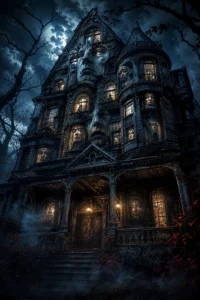
Blackthorn House had rules. The house had announced that on her arrival without speaking: in the locked corridors, in the portraits turned away from certain rooms, in the household staff whose eyes darted to the floor whenever Cassian Blackthorn passed. Rules lived in the walls here. Rules had teeth.
Seraphina swung her legs over the edge of the bed. The marble floor bit cold into the soles of her feet. A silver breakfast tray sat on the table near the balcony doors, covered in a cloche and accompanied by a vase of white camellias. A folded card leaned against the vase, heavy cream paper marked with a single black thorn embossed into the corner.
She crossed the room and lifted it.
Breakfast at nine. The east morning room.
Wear black.
—C.
She stared at the command until a laugh slipped out of her, quiet and humorless.
“Good morning to you too, husband.”
Her voice sounded strange in the enormous room. Too alive for it. Blackthorn House swallowed sound greedily, as if it had spent centuries feeding on secrets and found ordinary speech unsatisfying.
She bathed in a claw-foot tub large enough to drown a confession. Steam fogged the gilded mirror. Bruised light seeped through the frosted window, turning the bathwater pewter. Every object in the suite seemed chosen to remind her that luxury could still be a cage: silk towels warmed on brass rails, a wardrobe filled with dresses she had not packed, perfume bottles lined like obedient prisoners on a vanity.
She opened the wardrobe and found black.
Black silk. Black wool. Black lace. Black satin so dark it looked wet. Dresses hung in perfect order from morning severity to evening sin, all in her size. Beneath them waited shoes, gloves, stockings, even mourning veils.
For a moment, Seraphina simply stood there, fingers curled around the wardrobe door.
He had known her measurements.
Not guessed. Known.
The thought moved beneath her skin like a small knife.
She chose the least submissive of the garments: a high-necked black dress with long sleeves and a narrow waist, severe enough to be armor, beautiful enough to be an insult. She twisted her dark hair into a knot at the nape of her neck and secured it with two pearl pins she had brought from Vale House. Her mother’s pins. Tiny moons set into gold.
Before leaving, she crossed back to the rug.
She lowered herself, slid her fingers beneath its edge, and lifted.
The stain remained.
Not a nightmare. Not imagination. Not grief playing tricks on a bride too exhausted to trust her own eyes.
There was blood beneath the rug in the bridal suite of Blackthorn House, and Cassian’s people had covered it before morning.
Seraphina let the rug fall.
“I see you,” she whispered to the room.
The house, naturally, did not answer.
It merely watched.
In the corridor, a maid waited with gloved hands folded before her. She was young, perhaps Seraphina’s age, with copper hair hidden beneath a white cap and a smattering of freckles across her nose. Her eyes flicked once to Seraphina’s face, then to the rug visible through the open door, then down to the floor.
“Mrs. Blackthorn,” she said softly. “Mr. Blackthorn asked that I escort you.”
Mrs. Blackthorn.
The name slid over Seraphina like cold rain. She had worn it for less than a day and already it felt less like a title than a collar.
“What’s your name?” Seraphina asked.
The maid hesitated so briefly someone less practiced in fear might have missed it.
“Elian, ma’am.”
“Elian.” Seraphina stepped into the hallway. “Did you come into my room this morning?”
Color climbed the girl’s throat.
“Housekeeping begins at seven.”
“That wasn’t my question.”
Elian’s gaze darted toward the bend of the corridor, where shadows gathered despite the electric sconces. “No, ma’am.”
“Then who did?”
A door closed somewhere far away. The sound echoed like a verdict.
Elian’s face went still. Not blank. Still. The way prey went still when the hawk passed overhead.
“This way, ma’am.”
Seraphina smiled without warmth. “Of course.”
The east wing of Blackthorn House was a cathedral to inherited menace. They moved past vaulted windows streaming with rain, past oil portraits of dead Blackthorns whose pale eyes followed with proprietary disdain. The men in the paintings wore black frock coats, military medals, and expressions that suggested mercy had been bred out of the family line generations ago. The women looked worse. Beautiful, unsmiling creatures draped in diamonds, their hands resting on children’s shoulders like claims.
One portrait had been slashed across the face.
Seraphina slowed.
A woman in a green gown stood in the painted gloom, her red hair loose around her shoulders. Someone had taken a blade to her eyes. Two ragged cuts crossed the canvas, leaving the face mutilated but the mouth untouched. The painted lips seemed to know something.
“Who was she?” Seraphina asked.
Elian’s shoes whispered to a stop several paces ahead.
“No one, ma’am.”
Seraphina looked at the ruined portrait, then at the maid. “People don’t usually pay for oil portraits of no one.”
“I don’t know, ma’am.”
Another lie. Smaller than the rug, but born from the same house.
They continued.
The morning room waited at the end of a corridor lined with potted orange trees. Rain blurred the harbor beyond the tall windows, turning ships to black ghosts and cranes to skeletal arms. The room itself should have been cheerful. It had pale walls, a marble fireplace, blue porcelain bowls overflowing with fruit, and a ceiling painted with soft clouds that had never seen the city’s soot. Yet even here Blackthorn House found a way to sharpen beauty. The silverware gleamed like surgical instruments. The white roses in the center of the table had been cut too recently; beads of sap shone on the stems like tears.
Cassian Blackthorn stood by the windows with a cup of coffee in one hand.
He had not worn black because she had been ordered to. He wore charcoal, a three-piece suit fitted with cruel precision, a white shirt open at the throat, no tie. Morning light should have softened him. It did not. It traced the sharp line of his cheekbone, the faint scar near his mouth, the dark lashes lowered over eyes the color of winter sea. He looked less like a newly married man than an executioner taking appointments.
He turned as she entered.
His gaze moved over her dress, her pinned hair, her empty hands, and then—too quickly to be accidental—to her face, searching for the thing she refused to show.
“You found the wardrobe,” he said.
“I found your attempt at dressing me like a widow.”
His mouth barely moved. It was not a smile, but it knew how to become one if properly threatened. “Black suits you.”
“So does a knife, but I wasn’t given one.”
Elian made a small sound behind her. Cassian did not look away from Seraphina.
“You may go,” he said.
The maid disappeared with grateful speed.
Seraphina walked to the table and did not sit. Breakfast had been arranged for two: coffee, sliced pears, eggs in porcelain cups, bread still warm beneath linen, butter curled into perfect roses. It was domestic in the way a staged crime scene was domestic.
“Did you sleep?” Cassian asked.
“Did you have someone watch me to find out?”
At that, he set his coffee down.
The cup met saucer without a sound. That unsettled her more than if he had slammed it.
“If I wanted you watched while you slept, Seraphina, you would never know.”
Her name in his mouth was a locked door opening a fraction. Not Sera, as her father called her when he wanted obedience. Not Mrs. Blackthorn, as the staff called her when they wanted distance. Seraphina. Full. Deliberate. As if he had tasted each syllable before allowing it out.
She hated that she noticed.
“Comforting.”
“Accurate.”
“Then accuracy must be a Blackthorn virtue. Tell me accurately, who came into my room?”
His gaze did not flicker.
“Housekeeping.”
“Housekeeping moved the rug.”
“Housekeeping cleans.”
“Housekeeping hides blood?”
The rain thickened against the windows. For a moment, that was the only sound.
Cassian regarded her across the pale morning room, all hard lines and controlled breath. Something moved in his face—not surprise. Not guilt. Recognition, perhaps. The acknowledgement that she had placed a piece on the board and he could no longer pretend there was no game.
“Sit down,” he said.
“No.”
“This will be easier if you sit.”
“Most prisons are easier if the prisoner stops rattling the bars.”
“You aren’t a prisoner.”
Seraphina looked at the locked door behind him, then the windows bolted against the storm, then back at her husband. “No? Shall I take a walk through the front gates after breakfast and test the theory?”
“You may walk anywhere on the grounds with an escort.”
“How generous. Does the leash come in black as well?”
His eyes sharpened.
There it was. The faint, dangerous glint beneath the ice. Not anger exactly. Interest. She had seen men desire beauty, wealth, submission, fear. She had never seen one react to defiance as if it were a language he had been waiting for someone to speak fluently.
He pulled out a chair.
“Sit, Seraphina.”
His voice was quiet.
Her spine wanted to obey before her pride could strike it down. That angered her most of all.
She sat because remaining standing suddenly felt like letting him choose the battlefield. She sat slowly, smoothing her skirt as if the movement bored her. Cassian took the seat opposite, not at the head of the table. Deliberate again. Everything about him was deliberate.
He poured coffee into her cup without asking.
“Cream?”
“Poison.”
“Not before noon.”
Her hand paused on the cup.
He was amused. Barely, but enough to make her more aware of the space between them than she wished to be. The table was wide. It still seemed too small.
Cassian unfolded a sheet of paper beside his plate. The sight of it made Seraphina’s stomach tighten.
“If that is a schedule for my embroidery lessons, I’ll stab myself with the needle.”
“Rules,” he said.
“Of course.”
“You asked whether you are a prisoner. You are not. Prisoners have no choices.”
“And wives?”
“Wives survive by learning which doors not to open.”
The coffee smelled dark and bitter. Seraphina wrapped her fingers around the porcelain cup to hide the sudden chill in them.
“Is that advice or a threat?”
“At Blackthorn House, the two are often identical.”
He slid the paper toward her.
She did not look down.
“Read it to me,” she said.
One dark brow lifted. “You can read.”
“I know. It’s one of my more scandalous traits. But if you’re going to pretend this is civilized, I’d like to hear how civilization sounds in your voice.”
Cassian leaned back in his chair.
The room held its breath.
Then, to her surprise, he picked up the paper and began.
“One. You do not leave the property without informing me.”
“Informing. Not asking?”
“If I meant asking, I would have said asking.”
“How progressive of you.”
“Two. You do not meet with your father alone.”
That landed harder than she wanted it to. Her fingers tightened around the cup.
Cassian noticed. Of course he did.
“Why?”
“Because Elias Vale has spent twenty-two years turning you into a weapon he can sheathe in silk. I won’t give him privacy to sharpen you against me.”
Seraphina’s throat closed around a retort that came too slowly.
Her father’s name in the morning room felt like mud on white carpet. Elias Vale—smiling at the wedding, kissing her forehead, whispering that she was saving them all. Elias Vale, whose hands had trembled only once in her memory: the night he came home with blood on his cuff and told her never to speak of the woman in the east garden.
Cassian watched her the way a man watched a match flame near a powder keg.
“Three,” he continued. “You do not answer questions about Blackthorn business. Not from servants. Not from your family. Not from guests. If anyone asks, you tell me.”
“Am I expected to know Blackthorn business?”
“Eventually, everyone in this house knows enough to die for.”
“That should be on the family crest.”
“It is, if you read Latin.”
Against her will, something like laughter flickered in her chest. She crushed it.
Cassian’s eyes dropped briefly to her mouth, as if he had seen the almost-smile and marked it as evidence.
“Four. The west wing after midnight is forbidden.”
“Why?”
“Because I said so.”
“That works on dogs and frightened sons. I am neither.”
His jaw flexed once. “Because people with guns move through the west wing after midnight, and not all of them answer to me quickly enough for my comfort.”
“Your own men?”
“Some.”
“And the others?”
“That question breaks rule three.”
She smiled sweetly. “We’re married. Surely I’m allowed to break something.”
He continued as though she had not spoken.
“Five. The cellar levels are locked. You will not attempt to access them.”
“Wine cellars?”
“Among other things.”
“Bodies?”
“Not usually.”
“How reassuring.”
“Six. The chapel is closed.”
That surprised her.
Blackthorn House had been built around an old private chapel, she knew that much. Everyone in the city knew the Blackthorns buried their own beneath consecrated stone and made priests uncomfortable with donations too large to refuse. From her bedroom balcony, she had seen the chapel roof hunched against the rain, its stained-glass rose window dark as a blinded eye.
“Closed for repairs?”
“Closed.”
“To everyone?”
“To you.”
“Ah. So it’s personal.”
“Everything is personal here.”
He turned the paper slightly. “Seven. You do not enter my study unless invited.”
Seraphina glanced toward the corridor beyond the morning room. She had passed a set of double doors last night, black lacquer with brass handles, guarded by a man whose face bore the soft emptiness of someone paid not to think. Cassian’s study. Of course.
“Afraid I’ll rearrange your books?”
“Afraid you’ll find something that rearranges you.”
“You do have a talent for making concern sound like arrogance.”
“And you have a talent for mistaking arrogance for concern because it gives you something cleaner to hate.”
Her breath stopped.
For the first time since entering the room, she looked away.
The harbor churned beyond the glass, iron-gray water gnawing at the piers. A ferry horn groaned through the rain. Somewhere below, a gull screamed and was cut silent by distance.
She had expected cruelty from him. Cruelty was simple. Cruelty made men predictable. But Cassian did not strike where armor gleamed. He found seams she had not shown him, slipped words between them, and pressed.
“Continue,” she said.
His voice lowered a fraction, not gentler, but less sharp.
“Eight. There are names you do not speak in this house.”
The air changed.
Seraphina felt it before he said anything more. The servants beyond the door seemed suddenly absent. The rain seemed farther away. Even the white roses looked frozen in the vase.
“What names?” she asked.
Cassian placed the paper on the table.
“Octavia Blackthorn.”
The slashed portrait flashed through her mind: the red-haired woman in green, eyes cut from the canvas.
“Who was she?”
“A name you do not speak.”
Seraphina filed away the answer hidden inside the refusal. Was. Past tense. Important enough to forbid, dangerous enough to mutilate.
“Who else?”
“Mara Vey.”
Her hand went cold around the coffee cup.
She knew that name.
Not from drawing rooms. Not from society pages. From whispers. From the night rain hammered Vale House windows and her father came home with blood on his cuff. From the woman whose body had been found days later in the canal, bloated and nameless until the city decided her name did not matter. From the one sentence Seraphina had heard through a cracked library door when she was sixteen:
Mara Vey was going to talk.
Cassian watched the color drain from her face.
“You’ve heard it,” he said.
It was not a question.
Seraphina set down her cup before it could tremble visibly.
“This city is full of dead girls with pretty names.”
“Mara was not a girl.”
“No?”
“She was a match thrown into a room full of oil.”
“And who burned?”
“Not enough people.”
Something in his voice made her look at him more carefully. Hatred lived there, but not the hot vanity of a man insulted. This was older. Colder. A blade kept clean for years because the right throat had not yet presented itself.
“Why can’t I speak her name?” Seraphina asked.
“Because walls have ears, servants sell stories, and there are men in this city who would pay fortunes to know why my wife says the name Mara Vey at breakfast.”
My wife.
It should have repulsed her. Instead it settled into the air between them with the weight of a challenge.
“Any other ghosts I should avoid offending?”
“One more.”
He paused.
This time, she saw the hesitation. It was slight, buried beneath discipline, but it was there. Cassian Blackthorn, who spoke of guns in hallways and bodies in cellars with the same calm as coffee, hesitated before a name.
“The Ash Saint,” he said.
Seraphina’s pulse jumped.
The Ash Saint.
The masked rebel haunting the city’s underworld. A rumor in cathedral ruins. A black-hooded figure who appeared at illegal auctions and left the powerful bleeding and humiliated. A murderer to some, a savior to others. The city adored myths when the truth was too expensive to buy.
Her father had once called the Ash Saint a disease.
Her cousin Lucien had called him necessary.
Seraphina had never called him anything aloud.
“Afraid of saints, Cassian?”
“Only false ones.”
“What if he isn’t false?”
His eyes locked on hers.
“Then he’s even more dangerous.”
The words settled over the table like ash.
Seraphina reached for a slice of pear. Her hand was steady now. Good. Let him see composure. Let him wonder how deep it went.
“So I may not leave, may not meet my father, may not ask questions, may not enter the west wing, cellars, chapel, or study, and may not speak of your dead women or masked enemies.” She bit into the pear. Sweet juice burst over her tongue. “A beautiful prison indeed.”
Cassian leaned forward.
“You missed one.”
“How careless of me.”
“Nine. You do not lie to me.”
Seraphina swallowed.
“That hardly seems fair when you’ve built me a house out of lies.”
“I don’t need fairness from you.”
“No? What do you need?”
For a moment, the room narrowed to the space between their faces, to the rain on the glass, to the low burn of his gaze as it traveled over the parts of her she kept guarded: her lifted chin, her clenched hand beneath the table, the pulse betraying her at the side of her throat.
“The truth,” he said.
It was almost worse than if he had said obedience.
She laughed softly. “Men like you don’t want the truth. You want confession. There’s a difference.”
“I know the difference.”
“Do you?”
“Confession is what people give when they want forgiveness.” His voice dropped. “Truth is what remains after forgiveness is no longer possible.”
Her skin prickled.
Who had taught him to speak like that? What had this house done to its sons? What had the city carved from him before he became the man across from her, beautiful as a funeral and twice as final?
She hated the question as soon as it came. Curiosity was a crack in the wall. Sympathy was rot.
“Then let me offer a truth,” she said. “If you wanted a quiet wife, you should have married one.”
“I didn’t want a quiet wife.”
The answer came too quickly.
Seraphina’s breath caught before she could stop it.
Cassian rose. He did it gracefully, but the movement shifted the room’s balance. He came around the table, not close enough to touch, close enough to make her aware of how little protection polished wood provided. He took the paper of rules and placed it beside her plate.
“Memorize them.”
She looked up at him. “And if I don’t?”
“You will.”
“Because you’ll punish me?”
Something dark moved through his expression. Not desire, not quite. Not anger, not exactly. A warning he seemed to give himself before he gave it to her.
“Because if you break the wrong rule, punishment will be the least of what happens.”
“You expect me to be frightened.”
“No,” he said. “I expect you to be clever.”
He turned toward the door.
Seraphina watched him go, watched the straight line of his shoulders, the controlled economy of each step. At the threshold, he paused.
“One more thing.”
“A tenth rule? How decadent.”
He glanced back.
“If you find blood in this house, do not touch it again.”
Every nerve in her body went still.
His eyes held hers across the room.
“Some stains are not finished bleeding.”



0 Comments