Chapter 13: Zone Expansion: Civic Tier
by inkadminThe monster cores looked smaller after they came out.
Inside the things that had carried them, the cores had seemed like hearts stolen from a storm—glowing hard under translucent bone, pulsing with color no flashlight could explain, pushing heat through claw and tendon and diseased fur. In Caleb’s palm, after the blood cooled and the stink of ruptured stomachs settled into the alley, they were just ugly little stones slick with black fluid.
He stood behind the county records building with a plastic evidence tub at his feet and a fire axe in his hand, listening to the last of the harvest squad vomit into the gutter.
“Don’t waste water,” Caleb said.
Mara Shaw spat again, wiped her mouth on the sleeve of a paramedic jacket that had not been clean for three days, and gave him a look that would have curdled milk before the end of the world.
“I’m not exactly doing it for fun, Voss.”
“Didn’t say you were.”
He crouched beside the hulking carcass of what had once been a mule deer. Its legs had grown too long, joints bending in angles that made no agreement with nature. Velvet antlers had split into bone hooks, each still wet with arterial spray from the man it had pinned to the loading dock an hour earlier. Its flank was open from sternum to pelvis. The heat coming out of it made the winter air shimmer.
Caleb braced one boot against a cracked rib and drove the axe down.
The blade bit into cartilage with a sound like someone chopping wet rope. He levered, muscles in his shoulders pulling tight, and the rib cage popped wider. Steam poured out. The smell hit him again—copper, rot, ozone, old leaves decomposing in floodwater. One of the volunteers behind him gagged hard enough to make a strangled sound.
“There,” Mara said, voice pinched. She pointed with the barrel of her pistol. “Under that gray sac.”
Caleb set the axe down, took the butcher knife from the sterilized tray, and cut.
The sac wriggled.
“Jesus,” whispered Owen Pike.
Owen had been a city records clerk before the System. Twenty-six, thin, careful with his hands. He had spent the first day labeling survivors by medical priority on torn file folders. He had spent the last hour learning to pry value out of dead nightmares. His glasses were fogged. His face was green beneath the soot.
“Don’t invoke anyone you can’t produce,” Mara said.
The sac twitched again beneath Caleb’s knife. He kept cutting.
Steady voice. Give instructions. Keep them breathing. Keep them moving.
He hooked two fingers into the slit and pulled. The core came free with a reluctant tearing sound, veined in dark membranes, fist-sized and dense. Red light throbbed inside it like a warning lamp behind dirty glass.
At the edge of his vision, System text unfolded without a sound.
Core Acquired: Tier 1 Altered Cervid Alpha
Integrity: 71%
Authority Conversion Value: Moderate
Caleb dropped it into the evidence tub. It struck the other cores with a solid clack that made everyone flinch.
There were seventeen in the tub now.
Seventeen cores for fourteen dead outside the east barricade, three wounded who might not make morning, and one child who had screamed herself mute after watching her father disappear beneath a carpet of things that looked like raccoons with human fingers.
A brutal harvest, System said somewhere behind his eyes.
Caleb called it accounting.
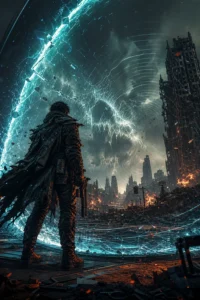
The alley behind the records building had become their slaughterhouse because it was close to the loading dock and far enough from the main hall that the children inside only heard muffled chopping if the wind shifted wrong. Snow had fallen early in the evening, thin and mean, but it could not cling to the concrete where monster blood steamed. The safe zone’s boundary shimmered twenty yards away, a faint distortion between the alley and the ruined street beyond, like heat over asphalt except colder to look at.
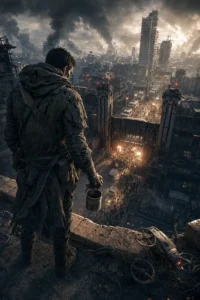
Beyond it, Denver was black.
No grid. No traffic glow. No office towers glittering with sleepless ambition. Just the dark shapes of downtown and the occasional flare of something burning where people had failed to hold a line.
Inside the boundary, the records building hummed.
Caleb felt it in the fillings of his teeth. Felt it in the soles of his boots, a constant low vibration from whatever impossible mechanism the System had nested beneath old concrete, county archives, and probate files. The building had been a shelter by accident before it became his domain by violence. Its marble lobby, cracked plaster corridors, windowless basement stacks, and steel security shutters had become a place where people came to beg the walls not to let them die.
The walls had listened because Caleb had made them.
“Last one,” Mara said.
The final carcass was not large. It had been a dog once, maybe a Labrador, judging by the ragged yellow fur still clinging to one side of its body. The other side had opened into plated black growths, each seam sprouting cilia that still waved though the head had been removed. It had gotten through the hedge gap by flattening itself like spilled tar. It had bitten Rosa Medina’s calf before Mara put six rounds through its skull.
Rosa was in isolation now with the infected family from earlier.
Caleb did not let his eyes drift toward the boarded basement windows where the quarantine room lay beyond layers of plastic sheeting and prayer.
“Move,” he said.
Owen swallowed. “Mr. Voss—Caleb—I can do this one.”
Caleb looked at him.
The young clerk’s hands shook around the short crowbar. His knuckles were blood-speckled. There was a smear of bile on one shoe. But he did not look away from the carcass.
“You sure?” Caleb asked.
“No.” Owen took a breath through his mouth, regretted it immediately, and coughed. “But I’m doing it anyway.”
Mara’s expression softened for half a second, then armored itself again. “Aim under the sternum. Don’t go deep until you find resistance.”
Owen knelt. He slipped in the crowbar. The carcass convulsed.
He screamed and fell backward. Mara fired once into the twitching chest, the shot slamming off the alley walls. Someone on the loading dock cursed. The cilia stopped waving.
“Reflex,” Caleb said, though he had nearly brought the axe down on Owen’s wrist.
Owen was breathing in sharp, whistling pulls. “Reflex. Right. Of course. Dead monster reflexes. That’s a category now.”
“Everything’s a category now,” Mara said.
Caleb stepped in, opened the thing, found the core embedded near the spine. This one was smaller, cloudy-white with black threads crawling inside it like worms in milk.
Core Acquired: Tier 1 Aberrant Canid Larval Carrier
Integrity: 48%
Authority Conversion Value: Low
Contaminant Detected: Spore-Parasitic Trace
Caleb went still.
Mara noticed. “What?”
He read the text twice. The words did not change.
“Contaminant.”
“In the core?” Owen asked.
“Spore-parasitic trace.”
Mara’s jaw flexed. “Like the family.”
The family had arrived at dusk, three adults and two children wrapped in blankets stiff with frozen blood. The youngest had a fever and black threads under her eyelids. The mother had bitten her own tongue half off to keep from screaming while Caleb decided whether they were refugees or an outbreak wearing human skin.
He had let them in.
Under quarantine. Under guard. Under a rule he wrote with his own hand and felt carve itself into the air above the building.
No untreated infection beyond containment.
A compassionate sentence with a knife inside it.
“Bag it separately,” Caleb said.
Mara took an evidence pouch, held it open without touching the core. “We still feeding it to the building?”
“Not until I know what it does.”
“The building talks to you now?”
“The building charges me interest.”
That got half a laugh from someone. It broke apart quickly.
Caleb straightened. The alley tilted for a second, fatigue creeping up his spine with cold fingers. He had not slept more than forty minutes at a stretch since the first alert. His voice had guided callers through domestic murders, building fires, childbirth in stalled elevators, and then through the impossible twelve minutes when the System’s first wave turned emergency dispatch into a confessional for the dying.
He still heard them when things got quiet.
Sir, my husband’s face is opening.
There’s something in the hallway pretending to be my son.
Tell my mom I didn’t run.
Caleb picked up the evidence tub. It was heavier than it should have been, pulling at his shoulders, warm through the plastic.
“Clean blades,” he said. “Burn scraps. Anything that twitches gets shot. Anyone with broken skin reports to triage before they go back inside.”
One of the volunteers, a retired bus driver named Ken, raised a hand. “We’re not getting paid enough for this.”
Mara snorted. “You’re getting paid in not being eaten.”
“Benefits package sucks.”
Caleb carried the cores toward the loading dock, boots sliding in slush and gore. The safe zone boundary brightened as he approached, recognizing him. The air inside tasted different—less burnt, less metallic. Not clean. The records building held too many unwashed bodies for clean. But filtered somehow, as if the worst of the outside could not quite get past the line unless invited.
Inside, the building breathed around him.
The loading dock opened into a rear processing area where county employees had once received boxes of forms, marriage licenses, and water-damaged property maps. Now blankets hung from pallet racks. A teenager in a ski mask slept curled around a baseball bat. Two women argued in whispers over a can of peaches. A man with a splinted arm sat against a copier, staring at nothing while someone else changed the dressing on his thigh.
All conversation thinned when Caleb entered with the tub.
People looked at the cores the way starving men looked at bread and the way villagers looked at tribute being carried to a dragon. They had learned enough to know those stones meant barriers, heat, locks, water pressure if miracles remained cheap. They had learned enough to know every glow in the tub had been paid for by someone not standing here anymore.
Priya Nayar waited by the freight elevator with a clipboard clutched to her chest like body armor. She had been an urban planning consultant before Denver became a board game played by gods with teeth. Now she mapped territory, rationed floor space, and challenged Caleb in front of people often enough that they trusted her not to flatter him.
Her dark hair was twisted into a knot. A smear of ash marked her cheek. Her eyes dropped to the tub.
“How many?”
“Seventeen usable. One quarantined.”
“Enough?”
Caleb shifted his grip. His fingers had begun to cramp. “We’ll find out.”
Priya walked with him toward the freight elevator. “Before we do this, there’s something you need to hear.”
“If it’s another petition to remove the quarantine family, I’ve heard it.”
“It’s not a petition. It’s David Bell.”
Caleb stopped.
Priya lowered her voice. “He’s telling people the System marked you because you’re willing to sacrifice anyone. He says the safe zone isn’t protection. It’s a pen.”
From the main hall came the layered murmur of two hundred survivors pretending they were not listening to every word spoken near Caleb Voss.
David Bell had been a deputy district attorney. Slick hair, expensive watch, voice trained to make juries feel ashamed of doubting him. He had arrived yesterday with twenty-three people from the courthouse and immediately started counting who listened when he spoke. Caleb had disliked him before the man finished introducing himself.
“Is he wrong?” Caleb asked.
Priya stared at him. “That’s not funny.”
“Wasn’t trying to be.”
“Caleb.” Her fingers tightened around the clipboard. “People are scared. Scared people want someone to blame before they want a solution. If you go down there and touch whatever glowing throne the System built in the basement while Bell is saying you’re turning the building into your personal kingdom—”
“It’s not a throne.”
“That is aggressively not the point.”
The freight elevator dinged, an absurdly normal sound. Its doors opened on manual backup power that the System had restored without wiring. The interior lights glowed amber.
Caleb stepped in. “Then come with me.”
Priya hesitated.
He met her eyes. “You want oversight? Oversee.”
The elevator doors began to close. Priya swore under her breath and slipped in beside him.
The descent took too long.
The old elevator rattled past the first basement, then the second. Officially, the records building had only two underground levels. Unofficially, the safe zone had grown roots.
Concrete gave way to something that looked like concrete if concrete remembered being bone. The walls beyond the elevator gate were ribbed and pale, veined with dull gold lines that pulsed in time with Caleb’s heartbeat. The air was colder here. Dry. It smelled of paper dust, stone after lightning, and the faint sweet scent of flowers left too long in a funeral parlor.
Priya stepped out slowly.
“You didn’t mention the basement became a cathedral for tax law demons.”
“It was smaller yesterday.”
“That does not help.”
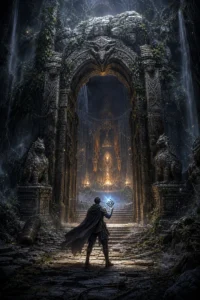
At the end of the corridor stood the Authority Node.
It had begun as a black metal plaque on the wall of the security office. Then a column. Now it rose from the floor like an altar built from interlocked municipal filing cabinets, obsidian glass, and roots of translucent circuitry. Names moved beneath its surface—citizens, guests, deceased, denied entry, missing. Each one flickered with status indicators Caleb could understand if he focused too long and paid the price in headaches.
The tub of cores grew warmer in his hands.
Priya approached the node with the expression of a woman inspecting a bridge she had to cross while suspecting it wanted sacrifices.
“Can it hear us?” she asked.
“It doesn’t answer unless I touch it.”
“That isn’t a no.”
“No.”
Caleb set the tub on the floor. One by one, the cores began to vibrate.
The node unfolded.
Not physically, not exactly. Its surface peeled back in layers of black light, revealing a hollow inside that had no depth Caleb could judge. A pressure settled over the room. Priya flinched and raised the clipboard between herself and the impossible like paper might negotiate.
Authority Node Active
Current Designation: Records Shelter Safe Zone
Tier: Emergency Civic Fragment
Administrator: Caleb Voss, Authority of the Last Gate
Population: 246 Registered, 39 Provisional, 8 Quarantined, 17 Unregistered Intrusions Detected Since Last Cycle
Core Reserve: Insufficient for Stable Expansion
“Seventeen intrusions?” Priya said sharply.
Caleb’s attention snapped to the line. “Since when?”
Intrusion classification includes vermin breach, spectral probe, larval scout, unauthorized human entry attempt, and boundary stress manifestations.
“Spectral probe,” Priya repeated. “That’s a phrase I hate.”
Caleb touched the nearest core.
It dissolved.
Light ran up his arm beneath the skin, red-white and cold enough to burn. He locked his knees before they buckled. The node drank. One core after another lifted from the tub, spinning in the air as membranes burned away. Their colors stretched into threads and were pulled into the hollow.
With each one, Caleb saw flashes.
The alley from above. The deer-thing leaping over cars. Mara firing until her slide locked back. A dead man’s hand still clutched around a crowbar. The safe zone boundary rippling as claws struck it. Children under tables. Bell whispering to a half circle of frightened adults near the west stairwell. Rosa Medina sweating through a sheet while black lines crept along her veins.
He tasted blood that was not in his mouth.
Priya grabbed his elbow. “Caleb?”
“Fine.” His voice came out rough. “Don’t touch the cores.”
“I had shockingly little desire to.”
The last of the usable cores vanished. The quarantined white core remained in its pouch, lying still and wrong.
The node’s glow intensified until every ribbed wall shone. Deep in the building, something unlocked with a sound like a city-sized bolt sliding free.
Core Threshold Reached
Emergency Civic Fragment eligible for Zone Expansion.
Available Upgrade Path: Civic Tier I
Projected Effects: Boundary stabilization, administrative function expansion, population registry enhancement, limited infrastructure synthesis, law enforcement schema activation.
Warning: Civic Tier transition will formalize Administrator obligations under Shelter Authority Doctrine.
Priya went very still. “Obligations.”
Caleb read the word until it cut.
“Define.”
Shelter Authority Doctrine: A Civic Administrator assumes codified responsibility for the survival, regulation, and utility of registered population within declared bounds. Authority strength scales with compliance, territory integrity, resource conversion, and crisis adjudication.
“Utility,” Priya said.
The single word filled the chamber.
Caleb could hear the people above them. Not with his ears. Through the node. Footsteps. Breathing. A baby coughing. A man whispering that Bell made sense, that nobody elected Voss, that maybe the walls would listen to someone else. A woman praying in Spanish over a feverish child. Mara shouting for bleach. The building knew them as heat signatures, names, statuses, liabilities.
Utility.
He thought of the infected family. The way the mother had looked at him when he ordered them behind plastic. Not grateful. Not angry. Worse. Understanding. She had known the calculation because any parent would make it for everyone else until the numbers turned on their child.
“If I refuse?” Caleb asked.
Core reserve will decay at 9.4% per cycle. Boundary stress projections exceed current capacity within 31 hours. Population attrition probability: 62–81% before next major event.
Priya closed her eyes.
“There it is,” she murmured. “The gun on the table.”
Caleb almost laughed. It would have sounded ugly.
He placed his hand on the node.
The System did not ask again. It opened him.
The floor dropped away.
He was above the building, above the city, above the ragged wound of Denver’s dark streets. The records building glowed below him like an ember cupped in ash. Its boundary formed an uneven oval across half a block, enclosing the main structure, loading dock, alley, part of the parking lot, and the first ring of barricades. Beyond it crawled signatures—red, amber, ultraviolet black—moving through streets and sewers and gutted office lobbies.
Some were animals changed wrong.
Some were dead things wearing movement.
Some were human groups clustered around fire, guns, and fear.
Lines appeared.
Potential expansion vectors ran outward from the safe zone in ghostly blue: west across the parking lot to the old courthouse annex; north to the public library maintenance entrance; east to the RTD bus terminal choked with abandoned vehicles; down into storm drains; up through fiber conduits that no longer carried data but could carry System jurisdiction.
Each line had cost. Risk. Population gain. Resource load. Monster density. Strategic value.
Caleb’s dispatcher mind, trained on maps, units, response times, triage codes, seized the information like a drowning man catching a ladder.
The courthouse annex had walls and old security screening equipment. Also Bell’s people would call it symbolic if Caleb claimed it.
The library maintenance entrance connected to underground tunnels and possible water access. Also unknown entities nested below.
The bus terminal gave vehicle parts and sightlines. Also too exposed.
He could not take everything.
He could not save everyone.
The old truth arrived wearing new clothes.
“Caleb,” Priya’s voice echoed from a distance. “Your nose is bleeding.”
He tasted salt. System text burned across the sky.
Select Civic Expansion Parameters
Current Authority Radius: 82 meters irregular
Maximum Stable Radius after Upgrade: 193 meters irregular
Choose Primary Anchor: [Courthouse Annex] [Library Sublevel Access] [Bus Terminal] [Storm Drain Junction] [Custom]
Caleb looked at the map of their deaths and futures.
The bus terminal was tempting. Space meant tents, vehicle salvage, maybe fuel. But open ground killed. The courthouse annex could house another hundred if cleared, but it was politically poisonous and likely full of desperate survivors who would not appreciate being absorbed by a man with glowing walls.
The library sublevel access pulsed faintly. Blue line, low surface exposure, moderate infrastructure potential. Unknown underground threat.
Unknown threat meant a threat already waiting.
But water mattered more than optics.
“Library sublevel,” he said.
Priya, far below, sucked in a breath. “What did you pick?”
“Water access. Maybe tunnels.”
“Maybe monsters.”
“Definitely monsters if we stay thirsty.”
The selection locked.
Primary Anchor Selected: Library Sublevel Access
Secondary Stabilization Options Available:
1. Reinforce Physical Boundary
2. Establish Administrative Storage
3. Activate Surveillance Lattice
4. Activate Enforcement Schema
Core Budget permits selection of three.
Caleb read the list.
Only three.
The System always left a missing limb.
“Read them aloud,” Priya said, closer now, her hand still gripping his arm.
He did.
Her answer came immediately. “Boundary, storage, surveillance.”
“No enforcement?”
“You’re asking the haunted municipal building to invent cops.”
“We already have violence. Enforcement might control it.”
“Or sanctify it.”
The word struck harder than she intended. Caleb saw Bell in the hall. Saw hungry men staring at ration crates. Saw Mara holding the line with twelve bullets and a limp. Rules without force were suggestions. Force without rules was the shape the outside wanted them to become.
“What does enforcement do?” Caleb asked.
Enforcement Schema: Enables designation of Wardens, infraction tagging, zone-assisted restraint, limited compulsion within codified laws, and punitive resource modulation. Efficiency depends on law clarity and Administrator resolve.
Priya let go of his arm. “Punitive resource modulation?”
Caleb’s stomach turned. “Reduced rations. Access denial. Maybe worse.”
“No.”
“Priya—”
“No. Caleb, listen to me. The second people know the building can starve them for breaking rules, Bell wins. Everyone who’s afraid of you becomes right.”
Above them, in the main hall, someone shouted. The sound traveled through concrete and System sense alike. Bell’s voice followed, smooth and raised for a crowd.
“—not saying we abandon order. I am saying order must not be one man’s private hallucination!”
Priya’s face hardened. “He picked his timing.”
The System map flickered. Boundary stress pulsed red along the north edge. Something outside tested the line.
Caleb looked at the choices.
Storage meant food would not spoil as quickly, medicine could be protected, ammunition could be tracked. Surveillance meant no more discovering intrusions after the blood. Boundary meant living long enough to regret everything else.
Enforcement meant the ability to stop Bell if his words became a stampede. It meant the ability to restrain infected without asking exhausted volunteers to hold doors shut with their bodies. It meant he could make rules bite.
0 Comments