Chapter 23: Dungeon Under the Courthouse
by inkadminThe anomaly above the courthouse had begun as a bruise in the morning sky.
By noon, it had teeth.
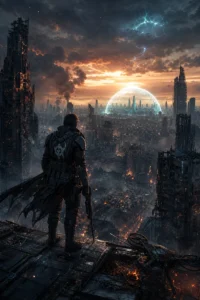
Caleb watched it from the cracked steps of the old Denver City and County Building, one hand resting on the butt of his borrowed revolver, the other curled around the cold iron token that marked his authority over the Civic Center safe zone. The building behind him had been a monument once—columns, carved stone, flags, the old architecture of a civilization that believed permanence could be achieved with granite and procedure. Now the upper floors were open to the weather. Smoke-stained windows stared blind over a plaza choked with ash, abandoned tents, overturned barriers, and the bones of cars crushed flat by something that had come through on the third night.
The courthouse across the plaza was worse.
Half its façade had folded inward during the Quake Event. The bronze doors hung crooked. The words carved above them—equal justice under law—were split by a lightning-shaped crack that ran from roofline to foundation. For days, a black shimmer had seeped from that crack after sundown, curling through the rubble like oil smoke. Patrols gave it a wide berth. Scavengers stopped cutting through the plaza. Even the dogs refused to cross the street.
Then, at dawn, the shimmer had risen.
It had collected over the courthouse dome in a slow spiral, sucking dust, cinders, and loose paper into itself. Pages from old case files circled in the air like dead birds. Ash drifted upward instead of down. Anyone who looked too long said they heard gavels striking in the backs of their skulls.
Now the air above the ruin had compressed into a wound. A vertical slit hung twenty feet above the collapsed stairs, black at the center and rimmed in a dull, judicial gold. Shapes moved behind it: bars, chains, rows of benches, something enormous turning its head.
Caleb’s interface pulsed at the edge of his vision.
CITY-CENTER ANOMALY STABILIZING
Local Reality Anchor Detected: Former Seat of Civic Judgment
Environmental Theme: Law / Trespass / Sentence
Dungeon Classification: Stable Instance
Recommended Entry: 5–8 Classified Survivors
Failure Condition: Instance Expansion
Reward Profile: Authority-Compatible Materials, Civic Cores, Binding Components
Caleb read the last line twice.
Civic cores. Binding components.
On the far side of the plaza, the Civic Center enclave was eating itself by inches. Its barricades had grown from overturned buses and police cruisers into walls plated with monster bone, rebar, sheet metal, and System-treated concrete. But expansion cost. The safe zone wanted cores the way lungs wanted air. Every new warding post, every perimeter lantern, every reinforcement charm hammered into a doorway burned resources they did not have. The last breach had chewed through three blocks of refugee housing before they sealed it. The next one would be worse.
Caleb could still smell the burned hair from that night.
Behind him, Mira Solano spat into the ash and tightened the strap of her shield harness. The shield had started life as a riot slab. Since then, she had bolted it with plates of scavenged elevator metal and the chitin of a bus-sized centipede from Speer Boulevard. Thin blue lines of System reinforcement crawled along the edges whenever she shifted her grip.
“I hate buildings that decide they’re hungry,” she said.
“Technically it’s under the building,” said Nia Park, crouched beside a broken bollard with a coil of copper wire looped across one shoulder. She had a mechanic’s eyes—quick, irritated, always measuring tolerances no one else could see. A strip of cloth held her black hair back from her face. Her class, Circuit Witch, had made her half engineer, half arsonist. The little brass spiders she called picks crawled over her knuckles, clicking their legs together. “The anomaly is just the sign. The actual structure is probably spatially displaced into the foundation level.”
Mira looked at her.
“Hungry basement,” Nia amended.
Jax Rourke laughed without humor. He leaned on a spear made from a street sign pole and a blade taken from the jaw of a glass wolf. His grin was easy. His eyes were not. “Basements are where cities keep all the things they don’t want people to see. Files. Bodies. Budget fraud.”
“You’d know,” Mira said. “Didn’t you steal from City Hall before the world ended?”
“I liberated misallocated funds from an inefficient bureaucracy.”
“You mugged a parking meter.”
“Several,” Jax said. “And they had it coming.”
Caleb let them talk. People talked before bad doors. It was one of the things he had learned in dispatch and had relearned harder after the System descended. Silence made fear loud. Banter made it keep its head down.
Dr. Samir Ghosh stood slightly apart from the others, hands tucked into the sleeves of his smoke-gray coat. The coat had once been white. Nothing stayed white anymore. He was staring at the anomaly with the exhausted fascination of a man who had spent the last month cutting open monsters and would gladly cut open reality if someone held it down. His lenses were cracked; the System had turned the cracks into thin silver script that helped him see what wounds meant.
“If this is a stable instance,” Samir said, “then its interior rules will be coherent. Not fair. Coherent.”
Caleb glanced at him. “That was supposed to make me feel better?”
“No. It was supposed to make you stop expecting fairness.”
Fairness.
The word sat badly in his chest.
Across the plaza, people had gathered behind the perimeter tape. Refugees, fighters off shift, children perched on barricades despite shouted orders. Word had spread faster than any official notice. Denver’s first real dungeon had appeared under the courthouse. The Authority was going in.
And at the edge of the crowd, beneath the skeletal remains of a traffic light, stood Brother Elias Vale.
The preacher from Parking Garage Nine wore a charcoal suit too clean for the apocalypse and a coat lined with pale fur that had not come from any animal Caleb recognized. His congregation clustered around him in quiet rings, hundreds of faces turned toward the courthouse with soft, empty calm. Their fear had been smoothed away. Not conquered. Suppressed. Caleb had seen the effect during the siege two nights before: panic draining out of screaming people like water from a cut pipe, leaving them pliant, obedient, grateful.
He had also seen what happened afterward.
The old woman who could not remember her grandson’s name. The teenager whose hands kept bleeding from under the nails while he whispered hymns in a language he did not know. The three men who had walked into a breach without orders because Brother Elias said courage was a door.
Elias lifted two fingers in blessing when Caleb looked his way.
Caleb did not return it.
“He offered to send ten of his faithful,” Mira muttered.
“I know.”
“You said no.”
“I know.”
“Good,” she said. “Because if one of his glassy-eyed choir boys starts smiling while getting eaten, I’m using him as bait.”
Nia made a small noise. “That’s morally troubling.”
“So is smiling while getting eaten.”
A figure pushed through the crowd behind the barricade. Lieutenant Mara Keene—former Denver PD, current head of Caleb’s wall rotations—moved like a woman who expected the world to disobey and planned to correct it with her baton. Her left arm was in a sling. She had taken a spine fragment from a bonecrawler last week and insisted it was “just shoulder drama.”
She stopped in front of Caleb and held out a folded map, though they both knew the streets on it no longer mattered.
“Perimeter teams are set,” Keene said. “If that thing spits anything out, we delay and fall back to Bannock. I put Thompson on south approach, Imani on east. No one follows you in unless your token goes black.”
“If my token goes black, do not send a rescue,” Caleb said.
Keene’s jaw tightened.
“Mara.”
“I heard you.”
“Say it.”
For a second, the only sound was the anomaly’s low hum and the whisper of paper circling overhead.
“If your token goes black,” she said, each word bitten off, “we seal the courthouse and hold the zone.”
Caleb nodded.
“You’re a bastard,” she added.
“That’s why you let me make the orders you hate.”
“I let you make them because when the first sky-mouth opened, you talked six hundred people through hell without raising your voice.” Keene stepped closer, lowering her tone. “Doesn’t mean you get to throw yourself into a grinder every time the System dangles a shiny rock.”
He looked past her at the walls. At the people pressed behind them. At the ration line winding beside Civic Center Park, where breakfast had been boiled oats thinned with melted snow and powdered protein scraped from military survival kits. At the southern barricade, where a child in a red hoodie was carefully painting warding sigils onto concrete while her mother watched with hollow eyes.
“It’s not a shiny rock,” Caleb said. “It’s the difference between the wall holding and the wall becoming a suggestion.”
Keene followed his gaze. Her mouth closed.
The System pulsed again.
STABLE INSTANCE ACCESS POINT FORMING
Ingress Window: 00:04:59
Authority of the Last Gate detected.
Instance will adjust trial weighting.
Samir sucked in a breath. “Adjust how?”
The System did not answer.
Caleb hated when it did that.
He turned to the team. Five people. Mira for the line. Nia for mechanisms. Jax for speed, scouting, and surviving things that should have killed him. Samir for wounds and analysis. Caleb for doors, laws, and decisions nobody else should have to make.
Too few.
Too many.
He lifted his voice. The crowd quieted by degrees, people leaning in as if sound itself had become rationed.
“We’re going in for cores and structural materials,” Caleb said. “No one crosses the perimeter. No one approaches the courthouse without Keene’s order. If we don’t return before sunset, the enclave shifts to Siege Law Seven. Rations centralized. Curfew at dusk. All nonessential power goes to wards.”
A murmur rippled through the crowd.
Caleb let it. Then he said, “The dungeon wants attention. Don’t give it civilians.”
Brother Elias smiled faintly from the back.
“And prayers?” the preacher called. His voice carried too well. “Shall we give it those?”
Every head turned.
Caleb looked at him across the ash-choked plaza. “Pray if you want. Just don’t spend anyone who didn’t consent.”
The preacher’s smile did not move, but something behind his eyes did.
“A ruler must spend,” Elias said softly. “The only question is whether he admits the coin.”
Caleb felt the crowd shift, felt the words slide into ears already made tender by hunger and fear. He could answer. He could cut. He could accuse. But the anomaly groaned, and the black slit above the courthouse pulled itself downward like a blade sinking into water.
The ruined bronze doors opened inward.
There had been rubble behind them yesterday. Caleb had seen it himself: collapsed beams, shattered marble, daylight pouring through holes in the ceiling. Now a staircase descended where the lobby should have been, broad and steep, carved from stone the color of old verdicts. Lanterns burned along the walls with cold blue flame. The air breathed out of the opening, carrying dust, wet iron, and the faint sour stink of old fear.
Jax twirled his spear once. “Court is in session.”
Mira shoved him forward with her shield. “Then stop flirting with the judge.”
They entered.
The first step stole the sound of the plaza.
By the fifth, Caleb could no longer hear the crowd, the wind, the groan of the broken city. Only their boots on stone. Only their breathing. The blue lanterns guttered as they passed, relighting behind them with a whisper like paper sliding across a desk.
The staircase should have ended after twenty feet. It did not. It descended beneath the courthouse into a space Denver had never had room to contain.
The walls changed as they went. Marble gave way to concrete. Concrete to black stone veined with gold. Names appeared on the walls, carved in columns from floor to ceiling. Some were familiar: old judges, district attorneys, governors, police chiefs. Others made Caleb’s stomach tighten.
Leah Simmons.
He stopped.
Mira nearly bumped into him. “What?”
The name was carved at shoulder height, fresh as a cut.
Leah Simmons had been the first civilian Caleb denied entry during the West Colfax breach. Forty-seven years old. Diabetic. No family. The ward gate had been down to two percent charge and there had been a group of children behind her. He had ordered the gate shut with her on the outside. She had pounded on reinforced glass until the things in the fog reached her.
He had not known her name until afterward.
“Caleb?” Samir asked.
“Keep moving.”
More names appeared.
Derrick Holt. Angela Mireles. Tomás Vu. Henry Bracken. Names attached to calls, choices, bodies, ration denials, quarantine orders, condemned buildings. Not all dead. Some exiled. Some imprisoned. Some simply people he had weighed against others and found too expensive to save.
Jax’s grin had vanished. “Anyone else seeing their greatest hits?”
“Yes,” Mira said.
Nia swallowed. “Mine are machine serial numbers.”
Samir glanced at her.
“Don’t look at me like that,” she snapped. “The ventilators failed. I picked which ones got battery patches.”
No one answered.
The staircase ended in a hallway lined with doors.
There were no handles. Each door was marked with a symbol burned into dark wood: an eye, a chain, a scale, a keyhole, a gavel. At the far end stood a pair of iron gates. Beyond them, Caleb could hear something moving. Heavy. Patient.
A system window unfolded across the air.
INSTANCE: DUNGEON UNDER THE COURTHOUSE
Trial Sequence Initiated
Theme: Judgment / Trespass / Rule
Party Authority Present
Special Condition: Laws Spoken Here Have Weight
Clear Condition: Render Verdict at the Lower Bench
Optional Rewards: Civic Core Cache, Writ-Iron, Jurisdictional Seal Fragment
Warning: Unlawful Entry Creates Debt
Nia’s brass spiders froze on her hand.
“What counts as unlawful entry?” she whispered.
Caleb looked at the doors. The symbols. The gates. The empty hallway that felt crowded with unseen witnesses.
“We find out before we open anything,” he said.
Jax took one slow step toward the door marked with the keyhole. The symbol flared red.
He froze.
A voice spoke from the walls.
It was not loud. It did not need to be. It arrived inside bone.
TRESPASS INTENT RECORDED.
The floor beneath Jax’s boot cracked open.
Hands burst out.
Not human hands. Not anymore. They were long and parchment-skinned, with black nails and wrists bound in rusted cuffs trailing broken chain. They grabbed his ankle and yanked hard enough to slam him flat. Jax cursed, spear clattering from his grip as more hands erupted around him, clawing up his legs, his coat, his belt.
Mira moved first. Her shield came down like a guillotine, smashing wrists into gray paste. Nia flicked her fingers and two brass spiders leapt, igniting with violet sparks as they bit into the chains. Samir shouted something about not letting the cuffs close.
Caleb stepped forward and felt the dungeon lean toward him.
The token in his hand heated.
He did not draw his gun. Instead, he raised the token and spoke the way he had spoken over dead radio channels and screaming lines and barricade disputes with rifles aimed at his chest.
“Hold.”
The word struck the hallway.
Blue light rippled out from him in a ring. The hands froze. Not stopped entirely—the fingers trembled, nails scraping at fabric, wrists straining against an invisible command—but held.
AUTHORITY ASSERTION ACCEPTED
Temporary Injunction: 00:00:11
Cost: 3 Civic Charge
“Eleven seconds!” Caleb barked.
Mira wedged her shield beneath Jax’s chest and heaved. Jax twisted, grabbed his spear, and sliced through the last chain binding his boot. They stumbled back as the injunction expired.
The hands collapsed inward, dragging their own severed fingers into the floor. The stone sealed without a seam.
Jax sat up breathing hard. A black handprint smoked around his ankle.
“I was going to knock,” he said weakly.
“You were going to pick the lock with your face,” Mira snapped.
Caleb crouched and looked at the mark. It pulsed in time with Jax’s heartbeat.
Samir knelt beside him, expression grim. “Debt marker. Probably cumulative.”
“Can you remove it?”
“In here? I would rather not conduct experimental metaphysical surgery under a courthouse haunted by due process.”
Nia stared down the hall. “Then how do we enter lawfully?”
Caleb looked back at the system notice.
Special Condition: Laws Spoken Here Have Weight.
The hallway waited.
He stood slowly.
“We ask permission,” he said.
Mira glanced at the doors. “From who?”
Caleb turned to the iron gates at the far end. “The court.”
He walked down the corridor, ignoring the way every door seemed to watch him pass. At the gates, the darkness beyond shifted. A chamber waited on the other side—huge, circular, tiered like an old courtroom built by someone who had seen one through a nightmare and improved it with cruelty. Benches rose in rings. Empty witness stands clung to the walls. Chains hung from the ceiling, each ending in a hook or a scale pan. At the center stood a judge’s bench carved from black stone and human paperwork, pages layered and compressed until they formed something like wood.
Behind the bench sat a figure in robes.
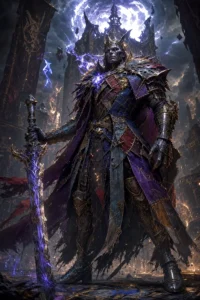
It was at least nine feet tall. Its face was hidden beneath a white mask shaped like a courthouse façade, blank except for a vertical crack down the center. Antlers of rusted keys rose from its head. One enormous hand rested on a gavel made from bone. The other held a quill that dripped black ink onto a ledger bound in skin.
Caleb stopped at the gate.
“We petition for lawful entry,” he said.
The masked head tilted.
The gate opened.
Mira exhaled behind him. “That worked?”
“Don’t sound disappointed.”
They entered the courtroom.
The air changed at once, heavy with old paper, mildew, and blood dried so long it had become part of the wood. Every step echoed from benches filled with absence. Caleb felt watched by things that had not bothered to manifest because the idea of watching was enough.
The judge-thing raised its quill.
THE COURT RECOGNIZES TRESPASSERS WHO SEEK STATUS.
STATE YOUR CLAIM.
Caleb’s interface flickered, as if struggling to translate the pressure in the room.
He stepped forward. “I am Caleb Voss, Authority of the Last Gate, acting warden of the Civic Center safe zone. We enter to clear this instance, prevent expansion into civilian territory, and claim materials necessary for defense.”
The quill scratched.
DEFENSE CLAIMED.
RESOURCE CLAIMED.
DOMINION IMPLIED.
“Implied?” Nia muttered.
The judge struck the gavel.
The sound hit Caleb’s knees. Around the chamber, benches unfolded into shapes. Not people. Not exactly. Silhouettes made of ash, paper, and faint gold light. A jury without faces. Hundreds of them.
TRIAL ONE: WITNESS OF THE EYE.
TO RULE, SEE WHAT ENTERS.
The courtroom dissolved.
Caleb stood in the 911 dispatch center.
For one impossible heartbeat, the world before the System returned so perfectly that his mind rejected it. Fluorescent lights hummed overhead. Monitors glowed in rows. Coffee burned in the break room. Rain tapped against dark windows. The old Denver city map filled the wall, dotted with unit markers and traffic incidents. He sat in his chair with his headset on, hands poised over the keyboard.
Lines blinked red.
All of them.
Then the first call connected.
A woman sobbed into his ear. “There’s someone in my house.”
He knew this call.
Before the System. Three years ago. Domestic violence. Husband violating a restraining order. Units twenty-two minutes out because of a pileup on I-25. Caleb had kept her whispering in a closet while the man moved through the house calling her name. The recording had been subpoenaed. He had testified. She had survived.
This time, the map showed no units.
Another line opened over the first. “My baby isn’t breathing.”
A third. “They’re climbing the fence—Jesus, they’re not people—”
A fourth. “Dispatcher? Dispatcher, my dad shot my mom and he’s in the hallway.”
The room filled with voices. Every call he had ever carried. Every stranger who had poured the worst moment of their life into his ear and trusted him to make it smaller.
He tried to stand and found himself wired into the desk by black cords that pierced his wrists.
A system prompt burned across the main monitor.
WITNESS TRIAL
Select Five Calls to Answer.
Unanswered Calls Will Be Entered Into Record.
Time Remaining: 00:02:00
His breath shortened.
No.
He had done this already. For years. With too few units, too many emergencies, too much need and not enough city to meet it. He had ranked screams by survivability until he could hear death hiding in tone. He had sent help to one address knowing another would go cold.
The calls multiplied.
A boy trapped under rubble after the first Quake Event.
Keene bleeding behind a cruiser.
Leah Simmons outside the gate.
His mother’s number, disconnected since before the apocalypse, blinking with impossible persistence.
He clenched his fists. The cords cut deeper.
Then he heard Mira shouting somewhere far away.
“Caleb! Don’t chase ghosts!”
The dispatch center flickered. Through the monitors, he saw the courtroom. Mira stood locked behind a witness stand, shield raised against a swarm of paper-faced bailiffs. Nia was tearing at copper cuffs around her wrists while legal forms crawled up her legs. Jax fought three ash silhouettes wearing his face. Samir pressed both hands to his ears, blood running between his fingers as voices poured into him.
The trial was not private.
It was making each of them answer.
Caleb looked at the monitor timer.
01:14.
Five calls.
0 Comments