Chapter 9: The Pastor of Parking Garage Nine
by inkadminThe rumors reached Caleb in pieces, the way all important things did now—carried by limping mouths and fever-bright eyes, passed from hand to hand with the frantic urgency of people who believed secrets could keep them alive.
By dawn, three different refugees had mentioned the same place in the same breath: Parking Garage Nine. A preacher there. A sanctuary. Heat. Food. Healing that didn’t come from medicine or luck but from prayer spoken under concrete and rebar while the world above went rotten.
At first Caleb had dismissed it as desperation dressed up in sermon clothes. Then a woman with a split scalp and bandaged wrist said the preacher had made her fever break in twenty minutes. Then a teenager with a yellowed hoodie swore the garage lights had come on by themselves when the pastor raised his hands. Then one of Caleb’s own runners came back with a look on his face like he’d seen a miracle and a knife.
“People are leaving,” the runner said. “Not all of them. But enough.”
Caleb sat at the edge of the loading bay, a clipboard balanced on one knee, and stared at the list of names he’d been trying to turn into order. Entry requirements. Labor assignments. Supply counts. Shelter rotations. He had written laws into the shape of a crumbling grocery store and tried to make a future out of panic.
And some man in a parking garage was winning hearts faster than Caleb could nail plywood over a broken window.
Of course he was.
The thought came with the sour taste of sleep deprivation. People did not fall in love with spreadsheets. They did not bleed loyalty for ration charts. They did not tell stories about a man who told them where to stand when the monsters came and how many hours of work purchased one extra can of beans.
They fell for voices. For certainty. For the promise that someone, somewhere, had already decided what suffering meant.
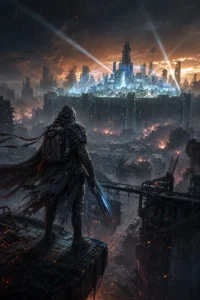
He stood, the old muscles in his back arguing with him, and looked out through the cracked opening of the bay doors. Denver lay under a sky the color of ash and old bruises. Smoke hung in strips over the street. In the distance, buildings leaned like broken teeth, their windows black or glittering with movement that never stayed human for long.
“I’m going to look at this garage,” Caleb said.
One of the guards—an ex-campus cop named Harlan with a bent nose and a shotgun he handled too gently for comfort—lifted his chin. “You want company?”
“No.” Caleb tucked the clipboard under his arm. “If I don’t come back, it’s because I found something worse than you.”
Harlan snorted once. “That’s reassuring.”
Caleb nearly smiled. It didn’t happen much anymore, and when it did it felt like a bruise being pressed. He checked his sidearm, clipped a crowbar to his belt, and stepped out into the street with the morning wind carrying the stink of wet concrete, garbage, and the sweet copper tang that always seemed to come before a body was found.
The road to Parking Garage Nine cut through three blocks of ruined commerce and one open stretch where the System had apparently decided to get creative. The asphalt there was split by pale veins, and when Caleb crossed them he felt the hairs on his arms rise, as if the pavement itself had become charged. He’d learned not to trust anything the System marked with a shimmer.
He kept to the shadows of damaged storefronts. Somewhere to his left, glass tinkled. Somewhere ahead, a shriek rose and vanished in a wet crunch. He didn’t stop. The city had become a machine that ground itself and anything living inside it, and every interruption cost blood.
Near the old civic center, he found the first sign that the rumors were true.
A line of people moved down the boulevard in silence, too orderly to be a refugee stream and too reverent to be a patrol. They walked with heads bowed, hands wrapped around small objects—candles, prayer cards, ammunition clips, a child’s stuffed rabbit with one ear gone. Some wore strips of white cloth tied around wrists or foreheads. One man limped on a splinted leg, and every few steps the woman beside him murmured something under her breath and touched his shoulder.
Not a prayer. A response.
Caleb watched them pass behind a burned-out bus and listened.
“…deliver us from the devourer…”
“…amen.”
“…grant us shelter in the hollow place…”
“…amen.”
He had heard religious language before the fall, of course. Denver was full of churches, storefront chapels, nonprofits with mission statements painted in bright optimism. But this was different. There was a cadence to it, stripped of theater and made hard by necessity. It sounded like people reciting procedures.
The line turned into an alley that led toward the garage. Caleb followed at a distance, keeping his hands visible when they glanced back. They did not look scared of him. That was worse.
Parking Garage Nine rose from the block like a concrete fortress. Someone had welded corrugated steel to the lower levels, turning open ramps into narrow choke points. Sheets of tarpaulin draped across the exterior in overlapping layers, painted with symbols and verses in black and red. Crosses, yes, but also circles broken by a vertical line, and the repeated image of an open gate.
Someone had made a theology out of architecture.
At the entrance, two women in motorcycle helmets stood guard with machetes and prayer beads looped around their wrists. Behind them, a waist-high barricade of cars, rebar, and shopping carts sealed the first level. Lanterns burned in metal cages, their flames steady despite the wind. The smell hit Caleb as he approached: incense, frying grease, sweat, antiseptic, and beneath it all the musky damp of trapped bodies living too close together.
One of the guards lifted her machete by an inch. “Purpose?”
“Looking for the pastor.”
Her eyes flicked over him. “That so?”
“That so.”
“Name?”
He hesitated. Not because he lacked one, but because names had started to feel like liabilities. “Caleb Voss.”
The woman’s expression changed, just a little. Recognition. Good. Someone had been talking.
“He’s expected,” she said, and stepped aside.
That was not the answer Caleb had wanted.
Inside, the garage had been transformed into a stacked city of scavenged order. Tents and tarps occupied parking stalls. Stairs had been swept clean. Hand-painted signs pointed toward “SHELTER,” “MED BAY,” “KITCHEN,” “SERVICE,” and “CONFESSION.” The last one sat under a strip of string lights that gave the concrete a sepulchral glow. Voices echoed everywhere—low prayer, argument, laughter that sounded practiced, children crying, someone singing in a cracked baritone from one of the upper ramps.
Caleb slowed as he climbed a ramp toward the second level. He could feel something in the air, a pressure he could only think of as attention. The people here were not just gathered. They were directed. Their fear had a shape. Their hope had a shape. It all pointed inward, toward a central point he had not yet seen.
Then the System lit up in the corner of his vision.
[ZONE ANOMALY DETECTED]
[Local reinforcement effect present: Collective Devotion]
[Blessing efficiency +21% within radius]
[Unknown class interaction: Faith, ritual, and intent producing measurable systemic variance]
Caleb stopped dead on the ramp.
Measurable variance.
He read the message twice, then a third time. His mouth went dry.
So the rumor wasn’t just rumor. The garage had become a machine too, but one built from belief instead of walls. It was absurd. It was impossible. It was exactly the kind of loophole the System would reward if enough people leaned hard enough into the same lie or truth.
A man in a gray work shirt approached, carrying a tray of cups that smelled like broth. He was middle-aged, bald, and had the serene face of someone who’d surrendered a long time ago and discovered it felt a lot like peace.
“You’re the man from the block shelter,” he said. Not a question.
“One of them.”
“Pastor Vale said you’d come. He said you’d want to see for yourself.”
Caleb folded his hands behind his back so he wouldn’t look like he was reaching for a weapon. “Pastor Vale’s very certain.”
The man smiled faintly. “He says certainty is a tool. Like a hammer. Or a sermon.”
“That makes two things I don’t trust.”
The man laughed, and the sound bounced through the garage like it belonged there.
He led Caleb deeper in, past a row of cots and pallets where injured people lay under blankets stitched from rescue tarps. A teenage boy with a shattered arm sat upright while an older woman pressed both palms over the break and whispered steadily. Caleb watched, half expecting some stage trick. Then the air above the boy’s arm shimmered, and the swelling visibly eased.
[Blessing applied: Steady Flesh]
Caleb’s stomach tightened.
“How many can do that?” he asked.
The bald man glanced back. “Depends on how many believe.”
“That’s not an answer.”
“It’s the only one we’ve got.”
They passed a kitchen where steam rose from blackened pots. Women portioned rice into bowls with careful hands. A wall nearby had been covered in names, each written in the same dark paint: the living and the dead, those who had joined the congregation and those who had “gone before the Gate.” Caleb couldn’t tell if the list was memorial or inventory. Maybe both.
At the center of the second level, beneath a gap in the concrete ceiling where daylight speared through, a crowd had gathered.
Pastor Vale stood on the hood of a stripped sedan with a Bible in one hand and a crowbar in the other.
He was younger than Caleb expected, maybe mid-forties, with close-cropped silvering hair and a preacher’s face—open, capable of tenderness, capable of lying without blinking. He wore a dust-stained clerical collar over body armor, and on his chest hung a pendant made from a brass key wrapped in wire. His eyes swept the crowd with a kind of hunger that had learned to disguise itself as care.
He was speaking, but he paused when he saw Caleb, and the crowd followed his gaze.
“Brother Voss,” Vale said warmly. “I was hoping the stories would bring you in before the evening service.”
Caleb stepped into the edge of the circle. “I’m not here for service.”
“No,” Vale said. “You’re here because people are leaving your shelter and coming to mine.”
A few in the crowd shifted. A murmur ran through them, not hostile, but interested.
Caleb looked up at the preacher. “Your humility is overwhelming.”
Vale smiled, and it was a weapon wrapped in charm. “I would never claim to be humble. I am merely useful.”
“That’s usually how cults start.”
“Cults have bad sound systems.” Vale spread his arms slightly. “We have candles, a soup line, and a very nervous choir. I think we’re still in the safe zone between sect and survival.”
Someone in the crowd snorted. Vale heard it and nodded as though the sound pleased him.
Caleb studied him. The man had charisma in the same way a wildfire had heat. It wasn’t subtle. It didn’t need to be. People were drawn to him because he made their terror feel organized.
“I heard you had blessings,” Caleb said.
“You heard correctly.”
“From where?”
“From God, if you want the short version. From the System, if you want the practical one.”
That answer should have been flippant. Instead it landed with uncomfortable precision.
Vale stepped down from the car hood. Up close, Caleb could see the fatigue behind the polish. The man’s knuckles were raw. His collar was frayed. The eyes were bright, but not from health. From pressure. The kind that came from carrying too many people’s expectations without letting anyone see the weight.
“You built this in how long?” Caleb asked.
“Eight days.”
“With what?”
“Faith. Labor. A few pickup trucks. Four generators. Several hundred pounds of stolen lumber. And, before you ask, a great deal of prayer.”
“Prayer doesn’t pour concrete.”
“No,” Vale said. “But people do, when they believe the pouring matters.”
He gestured to the crowd, and Caleb looked again. There were rules here, he realized. Not written on paper, but etched into behavior. People waited their turn. They spoke softly in certain spaces. They touched two fingers to their forehead before entering the med bay. Children carried messages without being told. Everything had a pattern. Everything served the sanctuary.
“You’re running a kingdom,” Caleb said.
“So are you.”
“Mine has walls.”
“Walls are expensive,” Vale replied. “I prefer liturgy.”
That almost got a reaction out of Caleb. Almost.
He let silence hang between them while a choir upstairs began a low, wordless hum. The sound traveled through the concrete and made the air feel alive. Caleb hated that part of himself noticed it—the way the pitch subtly settled people, the way shoulders eased and breathing slowed. It was manipulation by atmosphere. Efficient. Elegant. Infuriating.
“Show me a blessing,” he said.
Vale glanced at the crowd and then at a woman standing near the stairwell. She was young, maybe twenty, with a bandage wrapped around one calf and a rifle slung awkwardly over one shoulder. She looked terrified and honored at the same time.
“Mara,” Vale called. “The traveler would like a demonstration.”
The woman approached. Up close, Caleb could see blood crusted through the bandage and the tremor in her hands. Vale handed her the Bible, and she held it like it might bite.
“What happened?” Caleb asked.
“Runner got me in the leg.” Her mouth tightened. “Not intentionally.”
“Did the blessing close it?”
“No. Not closed.” She glanced at Vale, then back to Caleb. “But it stopped hurting enough for me to finish the walk back.”
Vale rested a hand on her shoulder. “Focus on what you need, Mara.”



0 Comments