Chapter 26: The People He Turned Away
by inkadminThe first banner of the Ash Ward went up crooked.
It had been cut from a sheet stolen out of a hotel laundry room, dyed with soot, rust, and the last of a child’s red watercolor paint. Someone had stenciled the symbol on it during the night: an open gate beneath a falling ember. Simple. Ugly. Impossible to mistake.
At dawn, they raised it over the intersection where three shelters met.
The wind caught the cloth and snapped it sideways like a wound reopening.
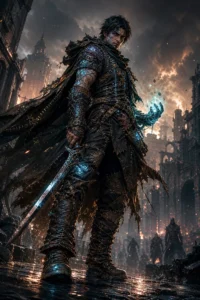
Caleb Voss watched from the steps of the old rec center while fifty-seven people pretended not to stare at him. Some stood with bowls of hot grain in their hands. Some wore mismatched armor scavenged from sporting goods stores and dead police. Some had slept in shifts along the barricades and had the hollow, glassy look of people who had learned not to dream too deeply. A girl no older than six had painted the Ash Ward symbol on her forehead with charcoal and was trying to get her little brother to hold still so she could mark him too.
Hope had a smell now. Woodsmoke, boiled oats, damp wool, gun oil, and human bodies packed too close behind walls they all prayed would hold.
Caleb pulled his coat tighter around himself and felt the safe zone pulse beneath his boots.
It wasn’t a metaphor. Not anymore.
The Authority inside him had sunk hooks into the earth beneath the neighborhood. Every barricade, every ward-post, every reinforced door and chalked threshold hummed faintly in the back of his skull. He could feel the outline of the territory the way a man might feel the edges of his own bruised skin. The Ash Ward was still small by the measurements that mattered—barely eight consolidated blocks, three shelters, two water points, one converted clinic, and a half-repaired generator shrine that Mara swore was not a shrine even though people had started leaving coins and dog tags beside it.
But it had a name now.
Names changed things.
[Faction Established: Ash Ward]
[Authority Recognition: Provisional]
[Population Under Law: 214]
[Boundary Integrity: 72%]
[Public Morale: Unstable / Rising]
[External Attention: Increasing]
The last line had not gone away.
It hung in the corner of Caleb’s vision like a blood smear on glass.
“You look like you’re watching a funeral,” said Mara Lintz.
She leaned against the cracked handrail two steps below him, hair tied back with insulated wire, one cheek smudged black from some argument she had lost with the generator. She had a wrench through her belt, a pistol under her arm, and that permanent expression of someone who considered sleep a rumor spread by cowards.
“I’ve watched a lot of funerals,” Caleb said.
“Yeah, well, banners are supposed to be cheerful.”
“It’s crooked.”
“So are we.”
That almost got a smile out of him.
Across the intersection, Grace was organizing the breakfast line with the terrifying efficiency of a woman who had spent the old world managing hospital intake and now applied the same moral fury to porridge distribution. She had a clipboard, a bloodstained parka, and three teenagers obeying her with the obedience of conscripts under artillery.
Beyond her, Rafiq stood at the east barricade, rifle slung low, talking quietly to two watchmen. He had wrapped a scarf around his lower face against the cold, but Caleb could see his eyes. They were fixed beyond the buses and welded rebar, toward Colfax, where the morning fog made the ruined street look drowned.
Caleb had learned Rafiq’s silences. This one meant trouble.
He descended the steps.
People shifted as he passed. Not away. Not exactly. But space opened around him with a kind of instinctive pressure, like he carried heat. He hated it. He needed it. Both truths lived in him now, grinding their teeth.
“Report,” Caleb said when he reached the barricade.
Rafiq did not look away from the fog. “Movement east. Slow. Organized.”
“Monsters?”
“If so, they learned to walk in a line and carry a white flag.”
Caleb climbed onto the side of an overturned delivery van. The metal creaked under him. Past the barricade, the street ran between the husks of apartment buildings and storefronts with their windows boarded or smashed. Snowmelt had refrozen in the potholes, and ash from last night’s burning drifted in gray skins along the gutters.
At first, he saw only fog.
Then figures emerged.
Not a crowd. A column.
Twenty, maybe twenty-five people walked down the center of the street. They kept formation with an ease that raised the hair on Caleb’s arms. Their coats were patched with hide and rubber plating. Their boots were wrapped for silence. Several carried spears tipped with blackened bone or sharpened street signs. Others had rifles, not held like scavenged miracles but like tools they had cleaned and used and trusted.
At the front came a woman holding a white flag tied to a crowbar.
Caleb knew her before his mind found her name.
The scar helped. It ran from the left corner of her mouth to her ear, a puckered ridge that twisted her face into a permanent half-smile. She had been thinner when he’d last seen her. Frightened. Filthy. Holding a boy against her chest with one arm and pounding on the north service gate with the other until her knuckles bled.
Please. My son’s burning up. Please, I know you have room. I can see you have room.
Back then the safe zone had been three buildings and a ring of laws Caleb barely understood. The breach sirens had been screaming. The gate had been failing. Inside, thirty-two people had been pressed shoulder to shoulder, and two of them were infected with something that made their shadows twitch the wrong way.
He had looked through the narrow gap in the barricade.
He had seen her son’s eyes rolled back white.
He had seen the other twelve behind her. Three armed men. One coughing blood. A woman clutching a bundle that had not moved.
He had felt the System waiting for his answer.
And he had said no.
“Lena Harrow,” Caleb murmured.
Mara swore softly beside him. “You know them?”
“I turned them away.”
The words were quiet, but they hit the nearest defenders harder than a shout. One of the teens on watch looked at Caleb, then quickly looked back out, as if the fog had become safer than his face.
Rafiq’s jaw flexed under his scarf. “How many?”
“Thirteen.”
“I count twenty-four.”
“Somebody picked them up.”
“Or they picked somebody else up.”
The column stopped thirty yards from the barricade. Not close enough for spears. Close enough for bullets. The woman—Lena—planted the crowbar flag in a crack in the asphalt and lifted both hands.
“Caleb Voss!” Her voice carried clean in the cold. Stronger than memory. “Authority of the Last Gate. Founder of the Ash Ward. Man of laws. Man of walls.”
A murmur passed through the people behind Caleb.
Mara’s hand dropped near her pistol. “That’s a lot of titles for someone outside our gate.”
Caleb did not answer. His tongue felt too large in his mouth.
Lena smiled with the half of her face that still obeyed her. “Do you remember me?”
Every instinct Caleb possessed told him to lie. To make himself larger. Colder. To leave no opening.
But the old dispatcher in him, the part that had survived on voice and truth and carefully measured calm, answered before the ruler could stop it.
“Yes.”
The scar on her cheek whitened as her smile tightened. “Say my name.”
“Lena Harrow.”
Something shifted in her people. Satisfaction. Hunger. A ripple of shared anticipation.
“Good,” Lena said. “I was worried you’d forgotten. Powerful men have so many dead to remember.”
Behind Caleb, Grace had abandoned the breakfast line. She approached with two of the older guards flanking her, lips pressed thin. “Who are they?”
“People from the first week,” Mara said.
Grace’s eyes flicked to Caleb. She didn’t ask. That was worse.
Lena reached into her coat.
Rafiq’s rifle came up. So did six others.
“Easy!” Lena called. “Just a memory.”
She drew out a child’s mitten. Blue. Charred at the fingertips.
Caleb’s breath went shallow.
“His name was Eli,” Lena said. “Seven years old. He liked dinosaurs, hated carrots, and thought sirens meant superheroes were coming. He was alive when we reached your gate.” She held the mitten high. “He was alive when you looked at him.”
The safe zone throbbed under Caleb’s feet.
Not now. Not here.
[Public Sentiment Shift Detected]
[Trust Stressor: Prior Exclusion Event]
[Authority Stability: -2%]
Caleb blinked the message away.
“What do you want?” he asked.
Lena laughed once. It had no warmth. “Listen to him. The same voice. Like dispatch. Like God on a phone line. What is your emergency? Stay calm. Help is not coming.”
Her people chuckled. Not all of them. A few watched the barricades with flat eyes. Caleb picked out details because details kept him from drowning: a man with a necklace of polished monster teeth; a woman whose right arm had been replaced below the elbow by a chitinous black growth bound in copper wire; a teenager wearing a hockey mask painted with a red handprint. Predatory faction, the brief had called? No, he didn’t have brief. Need in story. Caleb noticed branded emblem: coyote skull ring? Outskirts.
On their shoulders, burned into leather patches or painted on armor, was a mark Caleb had only heard described by scavengers who came back from the outer belt shaking: a pale jawbone open around a black sun.
The Carrion Court.
Rafiq saw it too. “Caleb.”
“I know.”
The Carrion Court had risen somewhere beyond Aurora, in the dead logistics yards where the highways knotted together and the warehouses stretched for miles. They did not build shelters. They followed them. They found groups too small to defend themselves and offered protection from the things outside. Then they took food, fighters, children with useful classes, cores, secrets. Sometimes they left the walls standing. Sometimes they nailed the leaders to them.
A faction built on the principle that safety was weakness someone else had not yet eaten.
And now their mark stood thirty yards from Ash Ward’s east barricade.
Lena saw recognition pass across his face and seemed to savor it. “I want to talk.”
“You’re talking.”
“No. I’m performing.” She gestured to the barricade, to the windows crowded with pale faces, to the watchers on rooftops. “You understand the difference. You built a kingdom; now everything is theater.”
Mara snorted. “Kingdom’s got better plumbing.”
Lena’s gaze moved to her. “You’re the mechanic.”
“Depends who’s asking.”
“Mara Lintz. Generator keyholder. Power vein attunement after the substation breach. You have a daughter at the south shelter with asthma and a fondness for hiding under tables.”
Mara went still.
The air on the barricade changed.
“Careful,” Caleb said.
Lena’s eyes returned to him. “Careful was what we were, outside your gate. Quiet. Begging. We didn’t even try to force our way in.”
“There was an active breach.”
“There is always a breach.”
“The gate wouldn’t hold.”
“Your gate held for the people you chose.”
He felt the sentence find the old wound and slide in between the ribs.
The worst thing about guilt was that it did not need lies to become a weapon. Truth worked better. Truth had weight. Truth could be sharpened and fitted with a handle.
Grace stepped closer to Caleb, voice low. “Do not debate her in front of everyone.”
“Too late,” he murmured.
Lena lowered the mitten. “I came to offer you a chance. The same chance you denied us.”
“Entry?” Rafiq asked.
The laugh came from the man with the monster-tooth necklace this time. It was wet and ugly. “We don’t crawl behind baby walls.”
Lena lifted one hand and he fell silent. That obedience told Caleb more than the laugh had.
She had not merely survived. She had risen.
“The Court recognizes strength,” Lena said. “We recognize that the Ash Ward has teeth enough to hurt anyone stupid enough to swallow it whole. My patron admires that.”
“Your patron?” Caleb asked.
“Magistrate Rusk.”
Several people behind the barricade muttered. The name had traveled ahead of its owner like smoke before wildfire. Rusk the Flayer, some called him. Rusk of the Outer Lots. A former corrections officer, if rumors could be trusted, now classed into something that let him bind contracts with pain and fear. Caleb had dismissed half the stories as campfire infection. The other half had been bad enough.
Lena’s smile widened. “He sends terms.”
“No.”
The answer came so fast that even Mara glanced at him.
Lena tilted her head. “You haven’t heard them.”
“I heard the name attached.”
“Terms can save lives, Caleb.”
“That your sales pitch?”
“It was yours.”
A child began crying somewhere behind him. A mother hushed him too quickly, the sound smothered against cloth.
Lena paced in front of her column, boots crunching frost. “The Carrion Court offers recognition of Ash Ward borders. No raids. No recruitment within your walls. Trade access to outer-belt salvage, fuel, ammunition, livestock from the plains settlements that still have livestock. In exchange, Ash Ward pays tithe.”
“Cores?” Grace asked before Caleb could stop her.
“Cores. Medicine. Skilled labor rotations. Names and classes of all combat-capable residents above level five.”
“Absolutely not,” Mara said.
“And,” Lena continued, looking only at Caleb now, “extradition of selected individuals wanted by the Court.”
Caleb’s fingers curled against the cold metal of the van.
“Say what you mean.”
“Three people under your protection killed Court scouts last week near the old pharmacy depot.”
Rafiq’s eyes narrowed. “Scouts shot first.”
“Perhaps.”
“They were dragging a wounded man behind them on a chain.”
“Property disputes are complicated these days.”
Mara spat over the barricade. “You people are sick.”
The woman with the chitin arm grinned, showing teeth filed into neat little points. “And yet, breathing.”
Lena raised the mitten again, swinging it gently from two fingers. “We adapt. That is what you told yourself, isn’t it? When you closed the gate. You adapted to scarcity. You made a hard call. Everyone praised you later because they lived. Did anyone ask about us?”
Caleb heard it then—the murmurs behind him changing flavor. Not betrayal. Not yet. But unease, curiosity, the first soft scrape of people reevaluating the foundation under their feet.
He could have invoked a law. Silence Beyond the Gate. Emergency suppression. He could force order inside the boundary if he paid the cost. The Authority offered the shapes to him, legal and sharp.
[Available Edict: Quell Panic]
[Cost: 1 Minor Core / 3 Authority Strain]
[Effect: Suppresses hostile public reaction for 10 minutes]
[Warning: Repeated use may alter civic temperament]
He dismissed it.
If the Ash Ward became obedient because he pressed his thumb on their fear, then Lena had already won.
Caleb climbed down from the van and walked to the barricade gate.
“Caleb,” Grace warned.
He lifted one hand without looking back.
The gate was a bus turned sideways, its windows plated with sheet metal, its emergency exit converted into a narrow speaking hatch. Caleb stopped at the hatch and opened it himself. Cold air knifed through the gap.
Lena watched him approach with bright, hungry eyes.



0 Comments