Chapter 22: Siege Weather
by inkadminThe storm arrived without thunder.
One hour before it swallowed the airport, the western sky changed color. Not the bruised purple of normal weather, not the copper haze that had hung over Denver since the world cracked open, but a deep, diseased black threaded with orange light, as if a furnace door had opened somewhere beyond the mountains and the smoke had learned to crawl.
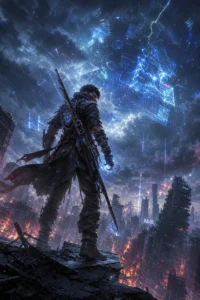
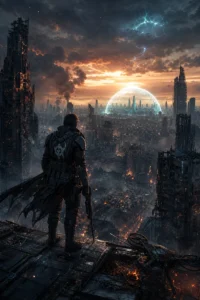
Caleb Voss stood atop the shell of Concourse C with one boot braced against a broken parapet and watched the horizon erase itself.
Below him, Denver International Airport had become a fortress by accident and desperation. Jet bridges hung like severed limbs. Burned-out baggage carts formed barricades across service roads. The fuselage of a United aircraft lay on its belly near Gate C39, its windows painted over with mud and ash to hide the lamplight within. People moved through the ruin in slow, purposeful currents—hauling water drums, stacking rebar stakes, dragging sheets of torn aluminum into windbreaks. Their voices were thin beneath the moan of the approaching storm.
Caleb tasted iron on the air.
Not blood. Not yet.
Something electrical.
His left hand tightened around the dead man’s radio clipped to his vest. Its casing was cracked. Dried blood still darkened the grooves around the speaker. It had belonged to a firefighter named Pike, and Pike had died before the first System message finished crawling across the sky. Caleb kept it because some part of him believed tools deserved to outlive the hands that had used them.
The radio hissed softly.
It had been hissing for three minutes.
That was wrong.
“Jun,” Caleb said.
A voice crackled in his earpiece. “Already seeing it.”
“Seeing what?”
“That’s the fun part.” Jun’s voice tried for sarcasm and landed somewhere near fear. “I’m seeing too much and then nothing. Drone twelve just gave me a beautiful shot of a black wall eating Peña Boulevard, then it started screaming in binary and dropped out of the sky.”
Caleb looked toward the old access road. Peña was mostly invisible behind wrecks and improvised tank traps, but beyond them the storm advanced with animal patience. It had shape. Layers. A ground-hugging front of ash rolled ahead of the main cloud, low and fast, skimming over dead grass and overturned cars. Above it came the boiling dark, tall enough to swallow the control tower, with strands of amber lightning flickering inside like veins.
“Wind speed?” Caleb asked.
“Bad.”
“Jun.”
“Fine. Gusts at sixty and climbing. But the instruments are lying now. Barometer’s doing a little tap dance. Compass on drone six spun until it died. My cameras are blooming with static. The spores are charged.”
Caleb had learned to hate any sentence that included the word spores.
“How long?”
“Ten minutes before outer perimeter gets kissed. Twenty before we’re blind. Maybe less if the storm’s feeling emotionally unavailable.”
Behind Caleb, boots scraped over concrete. Captain Mara Vale climbed through the hatch access with a rifle slung across her chest and her dark hair tied tight against the wind. The former National Guard captain carried herself like she expected every floor to collapse and every person to disappoint her. A scar crossed the bridge of her nose, pale against skin smudged with soot.
“The south line is asking whether we pull people inside,” she said.
“We pull noncombatants now,” Caleb said. “Fighters stay until visibility drops under thirty feet.”
Mara came to stand beside him. She looked at the storm once and did not waste a curse on it.
“That’s not weather,” she said.
“No.”
“System event?”
As if summoned, blue-white text slid across Caleb’s vision. It did not blink. It did not care that his teeth clenched hard enough to hurt.
REGIONAL HAZARD DETECTED: ASH STORM — STATIC SPORE FRONT
Visibility degradation: severe.
Unshielded electronics: failure likely.
Respiratory contamination: progressive.
Aerial predator migration: imminent.
Recommended response: shelter, filtration, silence.
Caleb exhaled through his nose.
“It’s a hazard,” he said.
Mara’s eyes moved to him, sharp. “You got a message?”
He nodded.
“And?”
He told her.
Her expression hardened by fractions. “Aerial predators. Of course. Because the sky was feeling left out.”
Jun cut in. “Did someone say aerial predators? Because drone nine just caught silhouettes riding the upper shear.”
Caleb turned toward the storm. The orange flickers inside it stuttered, illuminating shapes in the cloud. Wings. Long, crooked wings. Too many joints. They were distant and half-hidden, but the motion was unmistakable: creatures circling in the ash like vultures over a battlefield.
His throat tightened, not with fear but with memory.
Smoke column over Wyoming. Red trees. Men shouting through masks. The sky full of embers. A rookie named Danvers vanishing in a crown fire because the wind shifted and God forgot to warn them.
Caleb swallowed ash that wasn’t there.
Not again.
The thought had teeth.
“Mara,” he said. “Get everyone under hard cover. No roofs. No glass rooms. Move the children to baggage claim and the injured into the rail tunnel. Double cloth masks with wet layers. Anything with filters goes to sentries and medics.”
“Already on half of that.”
“Do the other half faster.”
She looked at him then, really looked, and he knew what she saw. The black veining at the edges of his irises. The faint gray light where his pupils should have been. The way his voice had begun to carry another note beneath it since the upgrade—low, rough, almost doubled, like someone speaking from the bottom of a grave.
For one heartbeat, Mara’s fingers flexed near her rifle strap.
Then she turned away. “You heard him,” she barked into her comm. “Storm protocol. Move.”
Caleb pretended he had not seen the hesitation.
The radio on his vest hissed louder.
Jun swore. “Uh. Caleb?”
“Talk.”
“My perimeter pings are dropping.”
“Because of the storm?”
“Some. Not all. East cargo fence just lost three motion eyes before the spore front reached them.”
Caleb went still.
The wind dragged at his coat, snapping the hem against his thigh. Far below, a woman shouted for someone named Ellis. Metal banged. A baby cried once, then was muffled against a shoulder.
“Say that again,” Caleb said.
“East cargo fence,” Jun replied. The humor had drained out of him. Now he sounded like the seventeen-year-old he was, scared and furious about it. “Three sensors cut off clean. Not static bloom. Not signal decay. They were physically killed.”
Mara stopped at the hatch.
Caleb met her eyes.
Enemy scouts.
The thought moved through both of them without needing a voice.
The airport had made enemies by surviving. The Burnt Antler cult to the northwest, who painted System sigils on their skin and fed captives to dungeon mouths. The Redmark militia, ex-contractors from the Tech Center who had tried to buy water with bullets. The polished men from Helix Arcology, who wore clean armor and smiled while measuring everyone like livestock.
Any one of them could have waited for weather.
Smart predators hunted in confusion.
“Jun,” Caleb said. “Can you get eyes?”
“I can launch a drone, but the storm will chew it.”
“How long would it last?”
“Maybe ninety seconds.”
“Do it.”
Jun’s reply was a whisper of keys, then a strained little laugh. “Sending baby bird to its death. Again. I’m naming this one Caleb, by the way.”
“Cruel.”
“Accurate.”
Caleb moved for the hatch. “Mara, east cargo. Take Kline and two fire teams. Quiet approach.”
“You?”
“I’m going to wake the dead.”
She disliked that. He saw it in the pinch of her mouth.
He disliked it too.
But beneath the airport, beneath layers of concrete and carpet and spilled jet fuel, the dead waited. Not ghosts. Not souls, he hoped. Remnants. Echoes pressed into bone and blood and violent ending. His class had words for them: anchors, shades, battlefield residue. Caleb had worse words, but the System never used those.
The hatch ladder shuddered under his descent. Inside the concourse, the air was warmer and fouler. Hundreds of people had taken shelter behind shuttered storefronts and ticket counters. Emergency lanterns cast yellow pools over faces turned toward him as he passed. The storm warning had moved faster than boots. Mothers tied damp cloth over children’s mouths. Old men dragged vending machines against glass doors. Someone had painted a crude map of the airport on a wall in marker, with red Xs over breached zones and green circles over wells, food caches, med bays.
When Caleb entered, conversations died in little ripples.
He heard what they did not say.
Look at his eyes.
Did you hear his voice yesterday?
He killed those things outside Hangar Two without touching them.
Maybe monsters can protect people too.
That last thought might have been his own.
A hand caught his sleeve.
He looked down and found Nora Jain beside him, paramedic, butcher-surgeon, miracle worker if you defined miracles broadly enough to include stitching a man’s abdomen closed with boiled sinew from a dog-sized insect. Her hair was tucked under a blue surgical cap gone gray with ash, and a smear of green-black ichor marked one cheek.
“You’re bleeding,” she said.
Caleb glanced at his wrist. The skin there had split where a dark vein pulsed beneath, not blood exactly, but something sluggish and smoke-colored. He closed his fist.
“Later.”
“That’s become your entire medical philosophy.”
“It saves time.”
“It kills patients.”
“Only the slow ones.”
Her eyes narrowed, but worry softened the anger beneath. “Storm spores get in cuts. We don’t know what happens when they mix with System-altered tissue.”
“I can guess.”
“That is not a treatment plan.”
The building shuddered as the first gust hit the outer walls. Dust sifted from ceiling panels. Somewhere a child screamed. The lights flickered, steadied, flickered again.
Jun’s voice snapped into Caleb’s earpiece. “Drone up. East cargo feed going to your tablet, Mara. Caleb, I’m patching audio because video’s already vomiting.”
Static shredded the channel. Beneath it came the thin whine of drone rotors, then wind, then Jun breathing too close to his mic.
“I see fence. Cut section. Not torn—cut. Thermal is useless. Ash is reflecting heat like a disco ball from hell. Wait. Movement. Three—no, four figures near container stack. Low profile. Cloaks or thermal shrouds. They’re inside.”
Mara’s voice came next, hushed and hard. “Visual from my side in two minutes.”
“Negative,” Jun said. “You’ve got more than four. Drone’s turning—shit. There’s another group by the fuel farm.”
Caleb stopped walking.
The fuel farm sat south of the cargo buildings, ringed by fences and concrete berms. Most tanks were empty or useless, but one still held enough treated fuel to power generators for weeks. Enough to run pumps. Radios. Lights.
Enough to burn half the airport if someone knew where to place a charge.
“Mara,” Caleb said.
“Changing route,” she answered.
Jun’s voice rose. “Drone Caleb is experiencing personal growth in the form of catastrophic static interference. Oh, that’s bad. That’s very bad.”
“What?” Caleb demanded.
For half a second, the channel carried only wind.
Then a shriek tore through the speakers.
It was metallic and wet and huge.
The lights died.
The concourse plunged into emergency red.
People cried out. The storm struck the building like a moving wall. Glass panels boomed inward but held beneath layers of mesh and scavenged plating. Ash blasted through seams in the barricades, fine as flour, black as cremains. It filled the air in swirling ribbons. Caleb yanked his scarf over his nose and mouth.
Above the concourse roof, something heavy landed.
Claws screeched across metal.
Once.
Twice.
Then many times.
0 Comments