Chapter 8: Blackout District
by inkadminThe city changed by degrees.
That was what made Denver dangerous.
It did not become hell all at once. One block still looked almost normal—glass-fronted offices reflecting a dirty orange sky, abandoned cars stalled in neat lanes, a bus ad peeling in the heat—then the next block would be ribbed with black crystal growing out of the asphalt like the bones of something trying to surface. One intersection would smell like burst sewer mains and gasoline, and the next would smell like a butcher shop left in the sun. The apocalypse had not fallen evenly. It had pooled.
The district ahead looked like a stain.
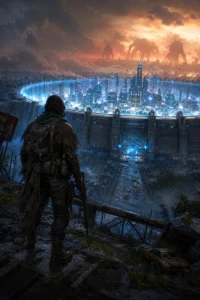
Caleb stood in the lee of an overturned FedEx truck and watched the darkness gathered between buildings two streets over. It was still afternoon. The rest of the city sat under the usual bruised light of ash-thick clouds, but that section of downtown swallowed light whole. Streetlamps along its edge flickered white and then went out one by one, as if some patient hand pinched each filament dead. Beyond them, towers became silhouettes and windows disappeared. The blackness wasn’t empty. It had texture. It moved in slow undercurrents, like smoke trapped underwater.
Mara adjusted the straps of the medic pack on her shoulders and stared at the same thing with a surgeon’s focus, not fear. That worried Caleb more than if she’d looked terrified.
“That’s not just bad lighting,” she said.
“No,” Caleb said.
The radio clipped to his vest hissed with old static. Not live. It never was. The dead man’s radio had become a kind of weather vane for the impossible; the closer they came to something touched by the System, the more it muttered in the spaces between channels. Right now, beneath the crackle, he could hear a voice that might have been dispatch chatter or prayer.
Beside him, Captain Elena Ortega crouched near the curb and studied the street through binoculars with one cracked lens. Her dark hair was tied back hard enough to sharpen the angles of her face. Even at rest, she looked like she expected someone to put a round through the center of her forehead.
“Entry points?” she asked.
“Three obvious,” Caleb said. “Which means none of them are good.”
Ortega lowered the binoculars. “You volunteering for optimism now?”
“Trying something new.”
She gave him a flat look. “Don’t.”
Mara snorted softly.
They’d left the fault-line safe zone before dawn with a list of needs and too little food to support another delay. The airport stronghold they were trying to build out on the eastern side of the city needed batteries, cable, solar inverters, antibiotics, sealed fuel, and anything else not nailed down by a world that no longer cared about ownership. Downtown still had all of that in chunks. It also had nests, rogue survivors, territorial classes, and System anomalies that chewed up scouting parties and spat back gear stripped of blood.
The Blackout District was on the route because everything else had become worse.
A cluster of figures huddled in the doorway of a pharmacy half a block behind them—three civilians and the child Mara had stitched together the day before using translucent ligament harvested from a crawler. The girl slept now on a bed of coats, her breathing thin but steady. Her mother watched Mara the way people watched a saint or a loaded gun, unable to decide whether gratitude or fear should come first.
Caleb had told them to stay put until sundown and move only if the screaming started.
No one had laughed.
A notification trembled at the edge of his vision, pale blue text floating in the dirty air.
Regional Hazard Identified: UMBRAL VEIL
Common Name (Human Consensus): Blackout District
Environmental Effects: Light suppression. Acoustic displacement. Predator amplification.
Advisory: Do not separate. Do not trust line of sight. Do not pursue familiar voices.
Mara read it too. Her mouth tightened.
“That last one’s lovely,” she said.
Ortega rose into a crouch. “We can circle east and lose three hours.”
“We don’t have three hours,” Caleb said. “Not if we want the substation before dark.”
“Dark?” Mara looked back at the pooled blackness. “That’s cute.”
Caleb kept his gaze on the district. His class prickled under his skin like cold cinders blown into old scars. Gravewarden had started as something simple—anchor the dead, hold the line, turn corpses into obstacles and allies—but the more he used it, the more the world around bodies felt less fixed. He could sense absence now, pressure where death had passed through and left a shape behind. The Blackout District pulsed with it. Not with corpses. With consumed space. As if something had taught the dark to eat the memory of where things belonged.
Bad ground.
Which, as always, meant he’d be leading people into it.
“We move slow,” he said. “No one goes more than ten feet from me. If you hear somebody you know calling your name, assume it wants your throat open.”
Mara rolled one shoulder. “What if it’s you calling my name?”
“Especially then.”
Ortega checked the magazine in her rifle and slammed it back in. “That almost sounded like a joke.”
“Don’t get used to it.”
He started across the street.
The transition came in a single step.
One moment the world was ash-light, hot wind, the distant groan of collapsing steel. The next, the air turned cool enough to pebble his skin beneath his sleeves. Light flattened. The edges of everything smeared, not blurry exactly but uncertain, as if the buildings around them had been sketched and then rubbed with a thumb. The sound of their own movement arrived half a beat late. Caleb’s boot scraped pavement; the scrape answered from somewhere behind his left shoulder.
Mara stopped so suddenly he almost ran into her. “Nope,” she said quietly. “I hate this.”
“Move,” Ortega said.
But her voice came from farther down the street than she stood, stretched thin and echoing against facades Caleb could barely see.
They pressed on.
Cars sat abandoned at wrong angles, windows blind with soot. A delivery van had plowed through a bus stop and frozen there, its front end wrapped in strips of something dark and fibrous that looked almost organic. Black growth crawled up the sides of buildings like mold drawn by a careful hand. It swallowed graffiti and signage alike. Here and there, Caleb saw outlines in the dark where shapes had once blocked the spread—human silhouettes crisp against walls, not burned in, but excluded. Places the black had gone around.
He did not point those out.
The radio hissed louder. A man’s voice whispered through the static, urgent and cracked.
“—copy, Engine Nine, we have entrapment on the north face—”
Caleb’s jaw locked.
He knew better than to listen. Some days the radio dredged up nonsense. Some days it dragged old pieces of his life up from ash. Fireline jargon. Air attack call signs. The final chaos from mountainside burns where wind shifted and men died under trees exploding into sparks. The System had found every hook inside him and was not above pulling.
He thumbed the radio volume down until the voice dissolved.
“Caleb.” Mara’s tone had sharpened.
He followed her line of sight.
There were shadows in the alley to their right. Not darkness—shadows. Moving independent of any body, long and low across brick and pavement. There were five of them at first glance, then seven, then three. They slipped over one another in silence. One climbed the wall like spilled ink and paused upside down beneath a fire escape.
Ortega lifted her rifle.
“Don’t shoot unless they commit,” Caleb said.
“Those things are already committed.”
“Sound draws them.”
“They’re already here.”
“Then let’s not invite the cousins.”
The shadows flowed parallel to them for half a block, weaving in and out of doorways. Caleb could feel their attention the way he felt heat off a live fire. Predatory. Testing. Not mindless, which was worse.
A can rolled across the street somewhere ahead.
The tiny metallic rattle came from the left, then the right, then from directly above.
Mara flinched. “That’s obscene.”
Caleb raised a fist and they halted beneath the jutting skeleton of an office overhang. The soundscape of the district shifted around them like a deck settling at sea. The distant can-clatter repeated, then became footsteps. Running footsteps. Small. Fast.
“Help!” a young voice shouted.
From behind them.
Caleb didn’t turn.
“Please! Please, they’re coming—”
The scream cut off into a wet choking noise.
Mara’s fingers clenched around the bone-handled scalpel strapped to her wrist. “That’s a kid.”
“No,” Caleb said.
“You don’t know that.”
“I know the advisory.”
Ortega kept her rifle trained on the alley shadows. “You go after that voice, you die.”
The running footsteps circled them. Caleb could hear them slapping asphalt, splashing through puddles that weren’t there, darting from one side street to another. Once, a shape like a child’s silhouette flashed at the edge of his vision and flattened itself against a newspaper box. It had no depth. Just outline.
Then the shadows in the alley stopped moving.
Every one of them turned its head toward the sound.
“Down,” Caleb hissed.
The pack erupted.
They came low and fast, not as creatures emerging from darkness but as darkness given claws. One peeled off the wall and flew at Ortega’s face. She fired once on instinct. The muzzle flash burst white in the black and the entire street answered with skittering movement.
The shot hit something; a shape convulsed midair and splashed across a parked sedan like spilled oil. But the noise woke the district.
Caleb drove his palm into the pavement.
Skill Used: Grave Pin
Anchor established.
The street groaned.
From beneath the sedan, from inside storm drains, from the shallow dark under bumpers and curbs, pale hands pushed up—not living hands, not exactly dead ones either, but battlefield remnants dragged into shape by his will. Skeletal fingers hooked shadow-bodies and nailed them to the asphalt. The first wave of creatures hit that unseen wall and shrieked. The sound came out wrong, stretched and layered, like a dozen voices screaming underwater.
Mara moved through the chaos with ugly precision. Her subclass made surgery out of violence. She slashed at a thing pinned half-solid by grave-hands, and the blade flashed green-white as it bit. Tendon-like black fibers spilled out instead of blood. They smoked where they touched the ground. Mara caught one between gloved fingers, yanked it free, and wrapped it around another lunging shape. The fiber tightened like living wire and cut the thing in half.
“That,” Ortega snapped between bursts, “is still disturbing.”
“Thank you,” Mara said.
More movement poured from the street ahead. The district had heard the rifle and come hungry. Shapes detached from awnings, spilled from windows, unglued themselves from the undersides of abandoned vehicles. A pack hunter leaped over the hood of a taxi and landed on one of Caleb’s dead anchors, trying to tear through the pale grip with jaws that opened sideways.
Caleb stepped in, swung the pry bar he carried in place of something fancier, and felt it connect with brittle resistance. The creature burst apart into strips of black haze. Those strips did not vanish. They wriggled on the pavement, trying to reform.
Kill the center.
He saw it then—a pearl of dim violet light deep inside the writhing dark, like an eye staring through oil. He stamped down hard. The pearl popped. The haze went flat.
“Eyes!” he shouted. “They’ve got cores. Violet.”
“Fantastic,” Mara said, ducking a claw. “Murder the tiny lights in the murder smoke.”
Something laughed from a second-story window.
Caleb looked up in time to see a human shape standing behind fractured glass, one hand braced against the pane. Thin shoulders. Hood up. Face hidden. Then the figure vanished.
A moment later a drone dropped out of the black overhead with a mosquito whine and slammed into one of the shadow-creatures coming for Mara. It detonated in a burst of blue static instead of flame. The creature seized up, limbs spread, its violet core blazing bright through its chest.
Ortega put a round through it.
Then another drone came. Then three more.
They poured between the buildings like a school of metal fish, each one no bigger than a dinner plate, scavenged rotors whining softly. Their casings were mismatched—consumer quadcopters, hobby shells, parts from warehouse inventory—but every one of them carried the same glyph burnt into the side in silver paint: an open eye with wires for lashes. They moved with unnerving coordination. Two harried the pack’s flanks. One flashed a strobe pattern that made the shadow-things recoil. Another projected a cone of pale green light on the pavement, and for one impossible second Caleb saw the district as if under x-ray: the shadows crowded in dozens, the building interiors webbed with black growth, the entire block threaded with acoustic distortions like stretched tendons humming in the air.
“Who the hell—” Ortega began.
A voice dropped from above. “The hell says move, unless you want the whole litter on you.”
Caleb looked up.
A kid crouched on the bent railing of the fire escape three floors above them, balanced lightly as a bird. Maybe fifteen. Maybe sixteen. Small in the dangerous underfed way that made age hard to pin down. Oversized utility jacket. Kneepads. A tangle of black hair hacked short with something dull. Goggles pushed up onto the forehead. The face beneath was sharp and watchful and filthy with city grit, but the eyes were alive—quick, bright, and entirely unimpressed.

0 Comments