Chapter 6: Class Trial: Gravewarden
by inkadminPain came back in pieces.
First the taste of dirt, wet and metallic, packed against Caleb’s tongue like somebody had shoved a fistful of grave soil into his mouth.
Then the smell—burned wax, ruptured sewage, old blood, and the sweet-sour reek of consecrated earth turned inside out. After that came sound: distant screaming, the crack of rifle fire from somewhere beyond the church walls, and under it all a low droning hum that made his molars ache. It reminded him of a saw line biting into green timber. It reminded him of helicopters idling above a fireline while men waited to jump.
He tried to move and felt every nerve in his body light up.
Something had punched through him. Something long and jointed and cold as rebar had gone in under his ribs during the breach, and while the wound was closed now—mostly—his body still remembered being opened.
“Easy.”
The voice came from far away, then snapped close as if somebody had reeled it in on a cord.
Caleb forced his eyes open.
The church ceiling was gone.
For one vertigo-tilted second he thought the building had finally collapsed, that the roof had been torn off and the black-red sky over Denver was staring down at him through drifting ash. But what hung above him wasn’t sky. It was too low, too vast, too wrong. Clouds like bruised flesh rolled overhead, lit from within by pale artillery flashes. Threads of green fire crawled across them in branching veins.
He was lying on his back in a trench.
Not the church nave. Not the parking lot. A trench cut through clay and chalk and broken bone, its walls shored up with splintered planks and rusted corrugated metal. Mud sucked at his shoulders. Water stood in the bottom in black gleaming pools. Sandbags, rotten and leaking pale grains, sagged beside his head.
He lurched upright too fast and nearly blacked out.
There was no church.
There was no city.
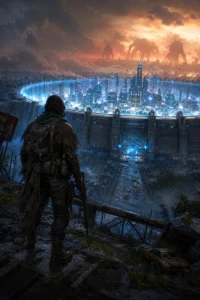
Or rather, the city was there in layers, buried under something older and more patient. Through gaps in the trenchline he saw Denver’s jagged skyline as if viewed through smoked glass—high-rises ghosted against the horizon, half dissolved into drifting ash—but over it lay another landscape entirely. Cratered fields. Tangled wire. Acres of churned earth littered with helmets, femurs, snapped rifles, and things that had once been men.
A battle had happened here for so long that the ground had forgotten how to be anything else.
Caleb put a hand to his side. Blood. Too much of it. But the wound had crusted shut under a lattice of blackened threads that looked disturbingly like roots.
His radio was still clipped to his vest.
The dead man’s radio looked almost absurdly ordinary in this place—scuffed plastic, cracked screen, duct tape around the battery pack. Yet when his fingers brushed it, a pulse moved through the trench, subtle as a heartbeat.
CLASS TRIAL DETECTED.
PRIVATE EVOLUTION PATH AVAILABLE.
CLASS: GRAVEWARDEN
TRIAL DESIGNATION: THE HELD LINE
PRIMARY DIRECTIVE: MAINTAIN THE TRENCH
FAILURE CONDITION: DEATH / FLIGHT / ABANDONMENT OF THE DEAD
REWARD: CLASS ADVANCEMENT
PENALTY: PARTIAL IDENTITY EROSION
BEGIN?
The words burned in the air in front of him, pale white letters shedding ash.
Caleb stared at the last line until the trench seemed to narrow around him.
Partial identity erosion.
Not stat loss. Not injury. Not death.
Something colder.
“Yeah,” he rasped to nobody. “That’s reassuring.”
A laugh answered him.
He turned hard, hand already reaching for the hatchet at his belt.
An old man sat on an ammunition crate three yards down the trench, as if he’d been there all along.
He wore no uniform Caleb recognized. Long dark coat. Grave soil ground into the seams. A pair of leather gloves split at the fingertips. His hair was white and close-cropped against a skull too sharp for his skin, and one side of his face was webbed with old scars that looked less cut than burned inward. His eyes were pale enough to seem colorless, like river stones under winter water.
He held a shovel across his knees.
Not a weapon. A gravedigger’s shovel, blade polished bright by impossible use.
“If reassurance is what you want,” the old man said, “you’ve chosen a class with rotten manners.”
Caleb rose into a crouch. His legs shook. “Who are you?”
“An answer.”
“That’s not one.”
“No.” The old man looked faintly pleased. “It isn’t.”
Artillery boomed somewhere beyond the trenchline. The mud shivered. Far off, voices lifted in a ragged scream that sounded too numerous to belong to the living.
Caleb kept his hand on the hatchet. “Are you the System?”
The old man spat into the mud. “God, no.”
That, somehow, was the most human thing Caleb had heard since the sky broke.
He drew a slow breath and regretted it. The air here tasted like opened crypts and cordite. “Then what are you?”
“What your class remembers.” The old man tapped the shovel blade against the trench wall. Mud slid down in a wet hiss. “Every class has a root. Yours was born where men stacked their dead faster than they could bury them and still stood the line anyway. It keeps echoes. Habits. Hungers.”
His pale eyes lifted to Caleb’s side, to the black rootwork sealing his wound.
“You’ve already felt that.”
Caleb did not answer.
He had felt it. Every time he used the Gravewarden abilities, there was a drag under the skin, a sinking sense that something in him was settling deeper than it should. When he anchored corpses, when he bound battlefield remnants, when he made the dead stay where gravity and decay said they shouldn’t—there was power, yes, but also recognition. Like a lock turning from the inside.
“I’m unconscious,” Caleb said. “Bleeding out in a church while my people fight for their lives.”
“Likely.”
“Then I don’t have time for riddles.”
“You never did.” The old man stood. He wasn’t tall, but the trench seemed to bend around him all the same. “That’s the point of the trial.”
He drove the shovel blade into the trench floor. The sound cracked like a rifle shot.
Every corpse in sight twitched.
Beyond the lip of the trench, the dead rose in rows.
Not all at once. That would have been simpler. Easier. Instead they unfolded from the battlefield in ugly stages, shoulders jerking, necks grinding, fingers clawing up through the churned mud. Soldiers in uniforms from different wars and centuries. Some wore steel helmets. Some wore modern body armor split by rot. One stumbled upright with half a cavalry saber embedded in his spine. Another dragged a tangle of barbed wire around his legs like entrails.
They came without hurry.
That was the horror of it. No animal lunge. No berserk frenzy. Just certainty. A tide that had crossed this ground so many times that it no longer recognized resistance as a meaningful category.
TRIAL BEGINNING.
OBJECTIVE: HOLD.
The old man stepped back until his outline blurred with the trench shadows.
“Wait,” Caleb snapped. “That’s it?”
“No,” the old man said. “There’s the lesson.”
The first of the dead hit the wire.
The trench erupted.
Caleb moved before thought caught up.
He ripped the hatchet free, planted a boot on the firing step, and buried the blade in the skull of a soldier whose face had sloughed down to yellow teeth and a single rolling eye. The impact jarred his shoulder to the spine. He kicked the corpse backward into two more climbing over the parapet.
A rifle lay in the mud at his feet, long wood stock dark with old oil. He snatched it up and found the bayonet still fixed. The first thrust punched through a throat that should not have had enough flesh left to resist. The second rammed into an open mouth and cracked through palate into brain matter dried black as peat.
He had fought fires, not wars, but violence had its own ugly physics. Balance. Commitment. Follow-through.
The trench narrowed the angles. That helped.
It also trapped the dead with him when they got inside.
A corpse in modern camouflage dropped from the parapet onto his back, fingers hooking under his chin. Caleb slammed himself into the trench wall. Rot-softened teeth scraped his ear. He felt the thing’s jaw working, frantic and mechanical, trying to find meat. He jammed the rifle backward one-handed, felt bayonet hit cloth, ribs, then stick.
Cold hands closed on his wounded side.
He turned with a sound that barely qualified as human and drove the hatchet into a kneeling soldier’s wrist. The hand came off at the joint and kept clawing in the mud.
There were too many.
They poured over the trench lip in dozens now, boots sliding on muck, helmets knocking together, empty sockets fixed on him with the blank dedication of a job being done.
Caleb stumbled back two paces, breath tearing in his chest.
His class answered the panic.
Not with words. With instinct.
Anchor the dead. Hold the line.
He slammed the butt of the rifle into the trench floor.
“Stay down,” he snarled.
Grave-cold rushed out from him in a ring.
The mud blackened. Corpses already fallen in the trench jerked once, then seized in place as if buried under sudden tons of earth. Two incoming dead hit that anchored mass and pitched forward, tangled. Caleb stepped into them and hacked fast, efficient, ugly. Head. Neck. Temple. When the hatchet stuck in bone, he left it, seized the bayonet rifle in both hands, and rammed it through the faceplate of a gas mask worn by something in a shredded greatcoat.
SKILL USE RECOGNIZED: SEPULCHRAL ANCHOR
ENVIRONMENTAL SYNERGY: HIGH
“Environmental synergy,” Caleb gasped, spitting mud. “Go to hell.”
“You are standing in one of its annexes,” the old man called from nowhere visible.
Caleb might have laughed if a dead soldier hadn’t landed on him at that exact second.
They went down hard into black water. The corpse smelled like wet leather and opened crypts. Caleb elbowed its jaw sideways, felt teeth shear skin from his forearm, then drove both thumbs into its eyes and pushed until something gave. It didn’t stop moving. He snarled, grabbed the broken bayonet still fixed to the rifle, and sawed at the neck until vertebrae parted.
When he staggered up again, the trench looked different.
Longer.
Occupied.
Men stood shoulder to shoulder along the firing step where there had been nothing but shadow before. Some were little more than silhouettes under helmets. Some were clear enough to show faces gray with exhaustion, uniforms caked in mud, hands blistered raw around old rifles. A woman with half her throat missing braced a machine gun over sandbags. A young Black soldier missing his lower jaw calmly fed ammunition into the belt. A man in a firefighter’s yellow wildland shirt, twenty years out of place and burned black from collarbone to scalp, rested a Pulaski over one shoulder and looked at Caleb with eyes full of banked coals.
None of them were alive.
All of them were watching him.
“What the hell—” Caleb began.
The dead beyond the trench surged again, and the ghosts moved with them.
The woman with the missing throat opened up with the machine gun. Muzzle flash strobed across her ruined face. The young soldier beside her laughed soundlessly as bodies came apart under the burst. The burned smokejumper leaped the trench line entirely, swung the Pulaski in a glittering arc, and split a corpse from clavicle to sternum before dissolving into a stream of ash.
Caleb stared one heartbeat too long.
A hand closed around his wrist.
The old man was suddenly beside him, fingers iron-hard.
“Pay attention.”
He shoved Caleb toward the center of the trench as something shrieked overhead.
It landed in the mud with enough force to splash black water to the parapet.
This was no soldier.


0 Comments