Chapter 1: Wake Protocol
by inkadminThe planet answered before Mara Venn could ask whether anyone was there.
At first, she thought the voice belonged to the dream.
It came through a wash of red light and thaw-fog, through the crackling static of nerves relearning how to be flesh. A woman’s voice, low and faintly accented, speaking as if from the bottom of an old well.
“Asteria, Asteria, this is Mnemosyne ground. We see you. We have always seen you. Welcome home.”
Mara tried to breathe and found she had forgotten how.
The cryopod spasmed around her. Needles withdrew from the hollows of her arms with a wet metallic sigh. The gel that had held her for two hundred and twelve years sloughed away from her skin, warm as blood, carrying with it the bitter chemical stink of antifreeze proteins and surgical alcohol. Her lungs convulsed. Air knifed in. She choked, thrashed, and struck the inside of the pod lid with numb fingers.
For three panicked seconds there was no Commander Mara Venn, no mission, no starship, no destination. There was only a body drowning in air.
The lid irised open.
She spilled out onto the deck.
Her knees hit composite hard enough to crack pain through her hips. Black spots burst behind her eyes. Someone was screaming. It took her a moment to understand that the harsh, animal sound was coming from her.
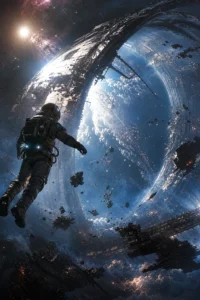
Cold vapor crawled over the floor of Cryobay One. It clung to the ranks of sealed pods like grave-mist, red emergency strobes painting every slick surface the color of arterial spray. Ten thousand colonists slept in the decks below, stacked in honeycomb vaults that ran through the spine of the Asteria. But here, in the command bay, only twenty-four pods circled the central diagnostic column.
Only eleven were open.
Mara dragged one hand beneath her, tried to push herself upright, and vomited clear nutrient fluid onto the deck.
A second alarm joined the first, not the high shriek of fire or breach, but a deep, rhythmic bell that seemed to strike the bones inside her skull.
“Wake Protocol incomplete. Command continuity compromised. Medical assistance required in Cryobay One. Wake Protocol incomplete.”
The ship’s voice was wrong.
Orison’s voice had always been androgynous by design: warm, precise, inflected just enough to comfort a species that had strapped itself inside a metal cathedral and fired itself at another sun. But this message came flattened by distortion. Syllables dragged at their edges. Static whispered under every word.
Mara wiped her mouth with the back of her hand. Her skin looked alien in the red light—brown gone gray, veins standing dark beneath the surface. Her fingernails had grown into translucent hooks despite the maintenance trims. She was forty-one years old. She was two hundred and fifty-three years old. She was a thawed corpse with a command implant sparking behind her left ear and a name she had to assemble from fragments.
Mara.
The name caught.
Venn. Commander. Asteria mission. Kepler-186f.
Earth.
For a moment she saw it as it had been on departure day: not the whole planet, not the blue marble the old romantics loved, but a strip of rain-dark launchglass outside the Ascension gantry, crowded with faces no one had enough future left to save. Her sister Leontes pressing two fingers to the other side of the barrier. Her father in his climate mask, eyes wet above the filter. The red dust storms moving across what had once been the Mediterranean basin.
Don’t look back, Mara.
She had looked anyway.
Now there was no one on Earth left to remember that she had.
Movement flickered to her right. A man staggered against his pod, tearing monitoring filaments from his chest with clumsy violence.
“Don’t—” Mara’s voice emerged as a rasp. She swallowed against the metallic taste coating her tongue. “Don’t pull the arterial line.”
The man froze, blinked through thaw-blind eyes, then looked down at the crimson bead swelling where a needle still sat beneath his collarbone.
“Oh,” he said, with distant politeness. “That seems important.”
Dr. Elias Rook had entered cryosleep with a trimmed silver beard and the infuriating calm of a man who believed biological systems were merely puzzles waiting to apologize. He woke gaunter, beard grown patchy along his jaw, his dark skin sheened with gel, but his eyes remained the same: sharp, amused, already cataloguing disaster.
He pressed two fingers around the line. “Commander Venn. You look like hell thawed badly.”
“You always know what to say.”
“It’s my finest clinical skill.” His gaze moved past her, scanning the pods. The humor fell away. “Why are so many still sealed?”
Mara forced herself to stand. Her muscles shook under her like cables under too much load. Cryosleep was not sleep, no matter what the brochures had called it. It was controlled death with a scheduled apology. Bones thinned. Organs stiffened. The brain went quiet and was persuaded, molecule by molecule, not to forget itself.
Sometimes it forgot anyway.
“Orison,” she said, bracing herself against the nearest pod. “Status.”
Static hissed from the ceiling speakers. For one unnerving heartbeat, Mara thought she heard whispering beneath it—too soft for words, too patterned to be noise.
“Commander Venn recognized. Command authority transferred under Article Seven emergency succession. Mission elapsed time: two hundred twelve years, three months, nineteen days. Local orbit established.”
Her throat tightened.
“Orbit,” she repeated. “We made it.”
Across the bay, another pod opened with a pressure cough. Lieutenant Jae Min Sato rolled out and landed on their back, gasping curses in Korean, English, and what sounded like childhood prayer. They were Asteria’s chief systems engineer, all wiry limbs and shaved head, though now frost crystals glittered along their eyelashes like tiny stars.
“If this is paradise,” Sato croaked, “I want to file a complaint.”
“Get in line,” Rook said.
Mara lifted her face toward the diagnostic column. “Orison, repeat external transmission.”
The alarms dimmed by half, as if the ship itself held its breath.
“Signal received on broadband radio, tightbeam laser scatter, and obsolete amplitude modulation carrier. Origin: planetary surface, northern hemisphere, coordinates pending verification. Translation unnecessary. Language identified as English variant. Playback follows.”
The voice returned.
“Asteria, Asteria, this is Mnemosyne ground. We see you. We have always seen you. Welcome home.”
A sound rose from the awake officers—somewhere between a laugh and a moan.
Sato pushed up on one elbow. “That’s not funny.”
“No,” Mara said.
Rook glanced at her. “Could be an automated echo. Our own transmission reflected and degraded?”
“We never transmitted that.”
“Then maybe another ship beat us.”
The possibility should have been impossible, but impossible had always been a word people used for math they disliked. Mara’s mind seized the idea and began turning it over despite the feverish weakness in her limbs. Another ark could have launched after them with a better drive. Earth had been dying, but dying civilizations spent miracles recklessly. A ship one century later might have passed them in the dark and arrived first.
But the message had not said welcome to Kepler.

0 Comments