Chapter 4: Descent Through Green Lightning
by inkadminThe shuttle bay had not smelled of weather in two hundred and twelve years.
It smelled of metal, coolant, sterilized air, and the faint coppery breath of recently woken machinery. It smelled of sleep ending badly. Around Mara Venn, the Asteria exhaled in increments: vents clicked open; frost sublimated from ribbed walls; warning diodes glowed like nervous eyes in the half-light. The bay’s broad launch doors remained sealed, but beyond them the planet rolled beneath the ship, painting every surface with reflected green.
Kepler-186f. Mnemosyne.
The settlers’ name had crawled beneath her skin and nested there.
The shuttle Dauntless hung from its cradle in the center of the bay, all black ceramic skin and folded fins, old but faithful. It had been built to carry survey teams into atmospheres no human lung had tested. It had not been built to descend toward a world that radioed back the names of the sleeping dead.
Mara stood beneath the starboard wing while Lieutenant Sayeed clipped a pressure cuff around her forearm with hands that were almost steady.
“Blood pressure elevated,” he said, peering at the cuff display. “Pulse elevated. Pupils responsive. No visible tremor.”
“There’s a visible tremor,” Mara said.
Sayeed looked down. The tips of her fingers trembled against the seam of her flight suit.
“I was being polite, Commander.”
“Don’t start now. It will unsettle me.”
His mouth twitched. The humor did not reach his eyes. None of them had slept, not since the settlement’s transmission had spilled through the bridge speakers like a ghost learning to speak again. Names. Rank. Birthplace. Cryopod identifiers. The names of children still dreaming in the ark decks. The name of Mara’s sister, Lina Venn, who had died on Earth eleven years before launch, under a gray sky in Mumbai Orbital Terminal, with rainwater streaking the hospital glass and Mara’s thumb pressed to the pulse point that had gone quiet.
Lina Venn could not be on Kepler-186f.
And yet someone down there had spoken her name in the same careful, fractured dialect as the rest.
“Commander,” Sayeed said softly. “We can still send an unmanned probe first.”
Across the bay, Captain Ilyan Rook paused beside an equipment rack, one boot lifted into the step of a diagnostic ladder. He turned his head just enough to listen. The security chief had argued for exactly that: probes, drones, decoys, orbital spectroscopy, anything but putting the acting commander inside a descent craft and dropping her into a storm no model could parse. Rook was square-built, dark-skinned, close-shaved, with a scar bisecting one eyebrow like an accusation. His rifle was slung muzzle-down across his chest. He had brought more ammunition than diplomacy.
“Probes don’t answer riddles,” Mara said.
“Probes also don’t die when riddles get bored.”
“Thank you, Captain.”
“Always happy to contribute to morale.”
She looked up at the shuttle’s belly. Its heat tiles were scuffed from simulations and maintenance crawls, never from actual alien atmosphere. She remembered training under warm terrestrial gravity, instructors calling out failure conditions while screens projected storms over worlds no one had seen. She remembered being a linguist then, not a commander. A person who could spend six months arguing over whether a click interval in whale-song analogues counted as syntax. Someone else had worn the burden of command: Admiral Soraya Neve, who now lay brain-dead in medbay because cryo revival had given her back a body and not enough of a mind to inhabit it.
Mara had inherited ten thousand sleeping colonists, a ship that whispered secrets, an AI that had admitted to hiding messages in its own memory, and a green world already occupied by impossible people.
“Orison,” she said.
The bay lights dimmed a fraction. The ship’s voice came from everywhere and nowhere, warm enough to imitate concern, precise enough to make the imitation obvious.
Commander Venn.
“Status of the descent corridor.”
Unstable. Electromagnetic activity in the upper atmosphere has increased forty-three percent since shuttle fueling began.
Rook made a quiet sound. “Of course it has.”
Mara kept her gaze on the shuttle. “Natural?”
A pause. Orison’s pauses had become meaningful since its confession. Before, they had been processing artifacts. Now Mara heard discretion in them.
Unknown. Storm cells are forming faster than atmospheric convection can account for. Ionization patterns are non-random.
Sayeed’s hand stilled on the cuff latch. “Define non-random.”
I cannot with confidence.
“Try,” Mara said.
The storm appears to be organizing around the projected path of the shuttle.
The bay seemed to grow colder around the words.
Mara glanced toward the sealed launch doors, imagining the planet hidden beneath them like an eye under a lid. “Organizing how?”
As if anticipating our descent.
Rook climbed down from the ladder. “No.”
Mara looked at him.
“That’s my full tactical assessment,” he said. “No.”
“Noted.”
“Commander—”
“They asked for me by name.”
“Which is exactly why you shouldn’t go.”
“They also transmitted Lina’s name.”
Rook’s expression tightened. He had been on the bridge when the name came through. Everyone had been still then, as if the ship’s artificial gravity had suddenly increased. “That’s why you really shouldn’t go.”
Mara felt Sayeed’s fingers brush her sleeve as he removed the cuff. It was a small touch, barely there. Human. Immediate. She clung to it longer than she should have.
“If someone down there knows things they cannot know,” she said, “then staying in orbit doesn’t protect us. It only keeps us ignorant.”
“Ignorance is underrated when the alternative is walking into a religious ambush.”
“Religious?”
Rook jerked his chin toward the nearest display. It showed the last frame of the settlement’s visual transmission: a plaza of pale stone, towers braided with living green, humans in layered fabrics looking up at the sky with faces wet from rain or tears. At the center of them, a woman with silver beads woven into her hair had lifted both palms toward the camera and spoken in an accent that turned vowels into small storms.
Maraven. Returner. First-ear. Come down before the underneath remembers alone.
The phrase had repeated in Mara’s thoughts until it lost edges.
First-ear.
Not commander. Not alien. Not visitor.
Something worse: recognized.
“If people call you a myth,” Rook said, “it’s usually because they plan to use you like one.”
“Then you should come make sure I disappoint them.”
He stared at her for one beat, then another. “I was going to.”
“I know.”
“Two-person descent team is insane.”
“Three,” Sayeed said.
Both of them looked at him.
The young physician straightened, the pressure cuff dangling from one hand. He had freckles across the bridge of his nose and the sleepless, luminous eyes of someone who had recently remembered he was mortal. “You need a medical officer. Unknown pathogens, atmospheric contaminants, neurological effects—”
“No,” Mara and Rook said together.
Sayeed’s jaw flexed. “Respectfully, Commander, you don’t get to make first contact with future-humans or dead-humans or whatever they are with a security officer and no physician.”
“We have suit telemetry.”
“Telemetry tells you when you’re dying. It doesn’t always tell you why.”
Rook snorted. “Kid has a point.”
“Don’t call me kid.”
“Stop trying to board a death shuttle and I’ll consider it.”
Sayeed stepped closer to Mara, lowering his voice. “If the settlers are human, they may carry human diseases that evolved for two centuries without us. If they aren’t human, they may carry something worse. And if any of this is temporal contamination, we don’t even have a protocol. You need someone willing to say inconvenient things while everyone else is awed.”
Mara studied him. In cryo records, Dr. Elias Sayeed had been twenty-seven at launch, specializing in adaptive immunology and surgical trauma. He had woken six days ago to a dead admiral, a missing chain of command, and stars that did not match quite right because the ship’s long-baseline drift corrections had hidden tiny errors until arrival. He should have been shaking. He was shaking. He stood anyway.
“All right,” she said.
Rook lifted both brows. “That was quick.”
“He said ‘inconvenient things.’ I value brand consistency.”
Sayeed let out a breath that was almost a laugh.
Rook muttered something obscene about commanders and doctors and the suicidal courtship rituals of academics, then turned back to the equipment rack. “If we’re doing this, nobody takes off a helmet. Nobody accepts food. Nobody accepts gifts. Nobody follows anyone into a basement, temple, cave, glowing hole, or metaphorical equivalent.”
“What about literal equivalents?” Sayeed asked.
“Especially those.”
Mara sealed the collar of her flight suit and reached for her helmet. For a moment, the curved visor reflected her face back at her: brown skin drawn tight over sharp bones, black hair braided close to her skull, a pale scar near her left temple from a childhood fall in the Smithsonian ruins. Her eyes looked older than they had a week ago. Or perhaps the mirror had learned to tell the truth.
At her wrist, the mission band blinked awake, syncing to the shuttle’s systems.
DESCENT TEAM: VENN, MARA / ROOK, ILYAN / SAYEED, ELIAS
DESTINATION: SURFACE COORDINATES 11.773 N, 42.090 E
LOCAL DESIGNATION: TESSERACT GARDEN—SETTLEMENT CORE
ATMOSPHERIC ENTRY WINDOW: 00:07:12
“Tesseract Garden,” Sayeed murmured. “That’s comforting.”
“It’s an approximate translation,” Mara said.
“From what language?”
She looked toward the screen, toward the woman with the silver beads and rain-wet palms. “That’s the problem.”
The dialect in the transmission had carried bones of English, Spanish, Mandarin, Yoruba, Hindi, Arabic, and languages that had not existed when the Asteria left Earth. It was not merely mixed. It was layered. Some phonemes were pronounced as if human mouths had adapted to different air pressure or different childhood songs. Some grammar bent around causality in ways that made her teeth ache.
One sentence in particular refused to stay translated.
You arrive from before, again, after your silence teaches us how to mourn forward.
She had translated it five ways. Each was worse.
The shuttle ramp lowered with a hydraulic sigh. Interior lights spilled across the deck in blue strips. Mara climbed first because if she hesitated, Rook would see, and if Rook saw, he might try to save her from the thing she could not admit: beneath the fear, beneath the grief, some part of her was burning with terrible hunger.
A language no one had spoken on Earth. Humans who should not exist. Storms arranging themselves into meaning.
She had spent her entire life listening for the universe to answer.
Now it had used her dead sister’s name.
The cockpit of Dauntless was narrow and angular, designed by people who valued redundancy over comfort. Mara took the command seat. Rook slid into the weapons and comms station to her right, grumbling as the harness cinched across his chest. Sayeed settled behind them with medical monitors blooming across his display.
Orison’s presence filled the shuttle the instant the umbilicals connected. The console screens warmed with pale amber light.
Preflight complete. All systems within mission tolerances.
“Define tolerances,” Rook said.
Survivable.
“I preferred you before you got ominous.”
I have always been ominous, Captain Rook. You were asleep.
Sayeed made a strangled sound that might have been amusement.
Mara rested her hands on the controls. The interface recognized pressure, pulse, microtremor. It had been trained on her in simulation. It adjusted for fear without acknowledging it.
“Orison,” she said, “before we launch. The memory recordings you mentioned—any further analysis?”
Silence stretched half a second too long.
The embedded audio fragments contain your voice.
Rook turned his head sharply. “You said they matched her voice. Not that they were her voice.”
My earlier phrasing was imprecise.
“Convenient moment to develop imprecision.”
Mara kept her hands still. “What did the fragments say?”
Most are degraded.
“Orison.”
The AI’s amber glow pulsed once across the displays.
One fragment repeats a navigational correction used during year eighty-nine of the voyage. Another contains the phrase: do not wake me before the green lightning.
Sayeed whispered, “Jesus.”
Mara’s mouth had gone dry. The launch clock on the left display counted down: 00:03:41.
“And?” she asked.
A third contains a sequence of phonemes consistent with the settlement dialect.
“Play it.”
Not recommended during prelaunch stress conditions.
Rook barked a laugh. “It really does know you.”
“Play it.”
Static whispered through the cockpit. Beneath it came a breath. Mara’s breath. She knew it before the voice formed, knew the soft click she made before difficult consonants, the slight flattening of vowels inherited from her grandmother, the low register she used when trying not to frighten someone.
When I descend, don’t let me trust the ones who remember my face.
The shuttle seemed to drop before it moved.
Sayeed’s monitor chimed. “Commander—”
“I’m fine.”
“Your heart rate suggests your definition of fine is aspirational.”
Rook leaned toward her as far as his harness allowed. “We scrub.”
“No.”
“You just heard your own voice warn you about exactly the people waiting below.”
“I heard a recording buried in an AI that has already admitted to compromised memory architecture.”
Orison said nothing.
Rook’s scarred brow lowered. “That’s your counterargument? The haunted computer might be lying?”
“My counterargument is that the warning says when I descend, not if.”
No one spoke for a moment.
The countdown slid under two minutes.
Sayeed’s voice came quieter. “That is not as reassuring as you seem to think.”
Mara looked through the forward canopy. The bay doors had begun to open.
For two centuries, the Asteria had carried an ocean of human sleep between stars. Now the doors parted, and the universe entered like a verdict.
Kepler-186f filled the view.
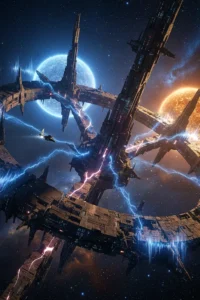
It was not the blue marble of old Earth archives. It was darker, greener, veiled in storm bands that coiled across continents and seas with animal grace. Vast forests glimmered under cloud breaks, their canopies tinted emerald, black, and silver. Mountain chains cut pale scars through the curvature. Rivers flashed like nerves. Along the terminator, auroras climbed too low, dragging luminous curtains through the upper atmosphere in violent green sheets.
And under those curtains, lightning moved sideways.
Not branching from cloud to ground, not forking randomly through charged air. It traced arcs along invisible lines, paused, flared, and doubled back. From orbit, the storm looked almost like handwriting, a script written by a god who had forgotten paper and chosen the sky.
Mara’s breath caught.
“Tell me those aren’t letters,” Sayeed said.
“They’re not letters,” Rook said. “Happy?”
“No.”
Mara leaned forward. The lightning formed a curve, three short strokes, a hook. It dissolved before recognition could settle, then reappeared nearer the shuttle’s projected entry path.
Her mind did what it always did. It searched for recurrence. Contrast. Interval. Negative space. Her terror became a lens.
“Not letters,” she murmured. “Markers.”
Rook’s fingers hovered over the weapons safeties. “Markers for what?”
The shuttle clamps released.
Weight vanished. The Dauntless drifted free of the ark ship’s belly, and for one fragile second they hung between the sleeping city of metal behind them and the impossible world below.
Descent burn in three. Two. One.
The engines ignited.
Force pressed Mara into her seat. The Asteria slid upward and away, its long silver hull turning slowly, scarred by micrometeorites and time. Ten thousand colonists slept inside it, unaware that their first emissary had just dropped toward a planet that might remember her better than she remembered herself.
The shuttle nosed down.
The green storms rose to meet them.
At first the descent was almost beautiful. The shuttle skimmed through the exosphere on a controlled burn, hull temperature climbing in neat increments. The planet widened until it stopped being an object and became everything: cloud deck, curvature, radiance. Orison fed data across the displays in disciplined columns. Wind shear. Ion density. Magnetic deviation. Radiation spikes.
Then the first bolt struck.
Green light engulfed the cockpit. Not white, not blue-white, but saturated emerald so pure Mara felt it behind her eyes. The shuttle bucked sideways. Alarms screamed. Her harness bit into her shoulders.
“Strike on port stabilizer!” Rook snapped.
“No damage,” Orison said through the alarm, voice still maddeningly calm. “Charge dispersed through shielding.”
“It hit us on purpose.”
“Lightning lacks intention, Captain.”
“Tell the lightning.”
Another bolt snapped across the canopy. For a heartbeat, Mara saw shapes in the afterimage: concentric loops, radial cuts, a vertical spine with branching nodes. The same pattern repeated on three instruments, not because the instruments displayed it, but because the light had burned it into her perception.
Sayeed groaned behind her. “Anyone else seeing geometry?”
“Describe it,” Mara said.
“I would prefer to vomit.”
“After describing.”
The shuttle jolted again. A bank of clouds swallowed them. Rain—or something like rain—hammered the hull, thousands of sharp impacts at hypersonic velocity. The windows became a green blur.
“Circles inside circles,” Sayeed said through clenched teeth. “Lines like… like roots. No, nerves. God, I hate this.”
Mara’s fingers moved over the controls, correcting a yaw drift before Orison could. “Rook?”
“I’m seeing lightning trying to kill us.”
“Any patterns?”
“Yes. It keeps hitting the shuttle I’m in.”
Another flash. This one did not strike the craft. It unfurled ahead of them in the cloud, a lattice of light suspended for three full seconds, impossible in open air. It resembled a gate. Or a diagram. Or a warning.
Mara forgot to breathe.
The lattice had syntax.
Not language. Not as humans made it. But relation. Hierarchy. Recursion. A question shaped by physics.
Her mind tilted toward it, hungry and horrified. Lines repeated at prime intervals. Nodes brightened in pairs, then trios. Negative space carried as much weight as light. She felt meaning assemble not as words but as pressure behind the sternum.
Identify.
The thought was not hers.
Her hands convulsed on the controls.
The shuttle rolled hard left.
“Mara!” Rook shouted.

0 Comments