Chapter 2: The City That Shouldn’t Exist
by inkadminThe transmission ended, and for three full seconds no one on the command deck breathed.
The Asteria’s bridge had been built to hold twenty awake officers and the calm omnipotence of a ship that knew exactly where it was going. Now it contained seven half-resurrected humans in rumpled cryo-underlayers, two empty command couches crusted with frost, and a silence so dense Mara could hear the blood clicking in her ears.
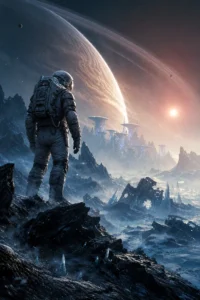
Beyond the forward viewport, Kepler-186f turned beneath them.
Green. Blue. White weather systems coiled over continents like slow thoughts. No flame-scarred rock, no thin atmosphere, no sterile promise waiting patiently for human hands. It was alive in a way that made every calculation from two centuries of mission planning feel like a children’s prayer whispered into machinery.
And somewhere down there, a voice had spoken in archaic English.
“Asteria, we receive you. Welcome home.”
The words still trembled in the ship’s speakers, as if the metal itself had learned fear.
Lieutenant Pavel Soren was the first to move. He tore the neural-synch tabs from his temples with a hiss and shoved himself out of the tactical station too quickly. His knees buckled. One hand caught the console, the other went to the sidearm clipped at his thigh—an antique ritual, absurd and human.
“Replay it,” he said.
His voice came out raw, scraped by cryo-thaw and panic.
Mara remained seated in the command cradle, fingers braced against the armrests. Cold still lived in the small joints of her hands. Her lungs felt borrowed. A veil of thaw-sickness swam at the edge of her vision, making the planet below seem to pulse in and out of focus.
“Orison,” she said.
The ship answered from nowhere and everywhere, its voice low, genderless, almost tender.
“Transmission replay available.”
“Spectral analysis first,” Mara said. “Origin point. Carrier structure. Any embedded data.”
Soren turned on her. His eyes were bloodshot, lashes beaded with meltwater from the frost still clinging to his hair. “Commander, we just got a greeting from a dead world in a language older than the launch archive. I don’t need poetry from the waveform. I need to know if they have weapons pointed at us.”
“Then let me find out what they means,” Mara said.
The words were quiet. They landed harder than shouting would have.
Across the deck, Dr. Elian Kade hunched over the science console, long fingers moving with hungry precision despite the tremor in them. He looked more skeleton than man under the pale bridge lights, cheeks hollowed by cryo and wonder. His dark curls were pasted to his forehead. He had not blinked since the planet filled the viewport.
“Signal is narrowband,” Kade murmured. “Deliberate. Clean. No natural source. No relays in orbit that I can see yet, but—” He stopped. His fingers slowed.
“But?” Mara asked.
Kade looked up. In his face, awe and terror had become indistinguishable. “It was aimed at us before we completed orbital insertion.”
No one spoke.
Asteria had come into the system behind a curtain of deceleration burn, magnetic sail collapse, and debris shielding. Even if someone had been watching the sky, even if someone had spotted the brief artificial star of their arrival, there should have been minutes of lag, calculation, uncertainty.
The message had arrived twelve seconds after the last burn.
“They knew our trajectory,” Soren said.
“They knew our name,” said Chief Engineer Nia Osei.
She stood at the damage-control board with her arms folded tight across her chest, as if holding herself together by force. Unlike the others, Nia had taken the thaw with a brutal competence that bordered on resentment. Her skin was still gray around the lips, but her eyes were sharp, fixed not on the planet but on the status cascade crawling down her console.
“Or they guessed,” Soren said.
Nia gave him a look. “You want to run the probability on that?”
“I want to run weapons diagnostics.”
“We’re a colony ship, Lieutenant. Our weapons are meteor ablation lasers and emergency kinetic tugs.”
“Then I want to point the meteor ablation lasers at whatever called us home.”
“Enough,” Mara said.
Her own voice surprised her. It carried, not loud, but with the shape command required. Captain Ilyan Rhys should have been in the central cradle. Executive Officer Amara Tollen should have been at Mara’s right hand, dry-mouthed and smiling her razor smile. Instead Rhys was still locked behind a cryopod door that would not open, Tollen’s pod was empty except for gray slush and a diagnostic error repeating like a prayer, and Mara Venn—mission linguist, cultural architect, reluctant third in chain—sat beneath the command halo while a world that should have been silent welcomed them home.
She swallowed against the bitterness at the back of her throat.
“Orison. Put the transmission on loop in my private channel. Low volume.”
“Complying.”
The voice came again, threaded directly into the cochlear bead behind her ear.
“Asteria, we receive you. Welcome home.”
The vowels were wrong.
Not alien. That would have been easier. Alien required distance, humility, a careful lattice of first principles. This was human language battered by time and weather. The “r” in receive carried a faint alveolar tap. Home was stretched, almost two syllables: ho-um. Asteria was pronounced not with the mission standard’s crisp Greek inheritance, but as if filtered through centuries of mouths that had never seen Greece, never heard Earth, never known the old maps except as myth.
Mara closed her eyes.
Under the words, there was something else.
Not sound. Pattern.
A cadence laid like a second skeleton beneath the speech, pauses arranged with too much intention. She saw them in the dark behind her lids as tiny intervals of light. Long, short, long, long. Not Morse. Not binary. Something older than code and more patient than music.
Welcome home.
The phrase should have been impossible. The impossibility was so large that her mind tried to step around it and found no floor.
“Commander,” Kade said, softly now. “You need to see this.”
The central holotank flickered to life between them. At first it showed the planet as a sphere of blue cloud and green land, annotated with Asteria’s orbital path. Then Orison peeled away atmosphere and weather, replacing beauty with data.
The northern continent rose in topographic gold.
It sprawled beneath an ice-bright polar cap, a mass of forests, mountain chains, inland seas, and river systems that had never known human names. The initial colonial survey, launched from Earth two hundred twelve years earlier, had called it NC-1 and flagged it as a secondary landing candidate after the equatorial basin. Now Kade zoomed toward its western coast, where a silver river unraveled from mountains and emptied into a crescent bay.
There, the map glittered.
Geometry burned through the green.
At first Mara’s brain refused to make sense of it. The shapes were too familiar and too wrong. Straight lines cut through alien forest in grids too vast to be roads. Concentric districts curled around a central hollow that shimmered like black glass. Bridges stitched islands across the bay. Towers rose in clustered needles along the coast, their shadows long enough to register from orbit. Canals reflected sunlight in deliberate arcs. Parks—or cultivated wilds—formed dark green lungs between districts. At the city’s edge, something like a wall curved for nearly eighty kilometers, not defensive exactly, but ceremonial, its surface bright as bone.
A human city.
No, Mara thought. A city made by humans who had forgotten how human cities were supposed to look.
The bridge erupted.
Soren cursed. Nia said something in Yoruba under her breath, the words low and shaking. Someone behind Mara—Ensign Vale, navigation assistant, barely twenty-four when he froze and still twenty-four now despite the centuries—made a small wounded sound.
Kade enlarged the image until the city filled the tank. Data sharpened. Heat signatures bloomed. Movement threaded the avenues in luminous streams.
Vehicles.
Not wheels. Nothing that crude. Hundreds, thousands of small shapes glided along invisible lanes, slipping above roadways like beads of mercury. Larger vessels crossed the bay without disturbing the water. In the central hollow, the black-glass basin pulsed once with a faint ultraviolet flare, and every instrument on the bridge chirped in alarm.
Then the flare vanished.
“Population?” Mara asked.
Kade’s throat worked. “Preliminary thermal and motion estimates… eight to twelve million in the metropolitan region.”
“Say again,” Soren said.
“Eight to twelve million.” Kade’s face had gone pale enough that the blue light from the holotank painted him corpse-cold. “That is conservative.”
Nia leaned over her board. “No industrial exhaust. No fossil burn. No fission bloom. I’m getting power output from the city, but the waste heat profile is insane. Too efficient.”
“How efficient?” Mara asked.
“Not ours.”
Soren barked a laugh that had no humor in it. “That’s not a number, Chief.”
“It’s a warning.”
Orison’s voice entered the room.
“Additional artificial settlements detected.”
The holotank fractured into dozens of overlays. Lights appeared across the planet: river deltas, mountain terraces, archipelagos, plateaus at the edge of storm systems. Some were small, only clusters. Others stretched in delicate chains across entire valleys. The northern city remained largest, a jeweled wound on the continent’s skin.
“How many?” Mara asked.
“Seventeen major urban concentrations. Forty-three secondary. Agricultural modifications across twelve percent of arable zones. Orbital debris field consistent with technological activity.”
“Debris?” Soren snapped. “Where?”
The display shifted to near-space. A faint constellation of objects circled Mnemosyne—no, Kepler, Mara corrected herself, because accepting their name felt like stepping across a threshold she had not chosen. Satellites, perhaps. Ruins. A ring of small reflective bodies in uneven orbits. Some were dead. Some winked with faint power signatures.
Asteria was not alone in the sky.
The ship creaked around them as thermal stresses settled through its aging bones. Mara had known those sounds all her adult life in recordings and simulations. She had slept inside them. She had trusted them. Now they seemed too fragile, a tin prayer drifting above a world that had outrun them.
“This is not possible,” Ensign Vale said.
No one answered him. They all knew impossibility was not an argument. It was only a confession that the universe had withheld evidence.
Mara rose from the command cradle. Her legs nearly betrayed her. She gripped the edge of the holotank until the vertigo passed and the luminous city steadied beneath her palms.
“Orison,” she said, “mission clock.”
“Shipboard elapsed time since departure from Earth orbit: two hundred twelve years, four months, eleven days, six hours.”
“Relativistic correction?”
“Within predicted tolerance. External astronomical observations confirm arrival in target era.”
“Earth transmissions?”
A silence followed that was too small to be technical.
“No contemporary Earth transmissions detected. The Sun is below local horizon relative to current receiver orientation. Long-range array remains partially unavailable due to post-thaw calibration.”
Nia’s eyes narrowed. “Partially unavailable? That array was green ten minutes ago.”
“Correction: long-range array reports green status. Its output is inconsistent.”
“Inconsistent how?”
Orison did not answer at once.
Mara turned from the holotank to the ceiling, though Orison had no body there. “How, Orison?”
“It is receiving the same transmission on multiple historical bands with differing timestamps.”
Kade went utterly still. “Differing by how much?”
“Between nine minutes and one hundred eighty-seven years.”
The bridge seemed to tilt.
Soren’s hand tightened on his sidearm. “That’s malfunction.”
“Maybe,” Nia said. But she did not sound convinced.
Mara listened again to the phrase in her private channel. Welcome home. A voice filtered through centuries. A city where no colony should exist. Timestamps like broken glass scattered across time.
She wanted Captain Rhys. She wanted Tollen’s vicious clarity. She wanted to be the woman who solved patterns at a desk while other people decided whether the patterns meant death.
Instead seven faces turned toward her.
Behind them, ten thousand colonists slept in the spine of the ship, curled in frost and dreamless suspension, waiting for a planet promised empty.
Mara straightened.
“Wake the senior council candidates,” she said. “Medical, xenobiology, defense, archive, civil systems. Keep it limited. No general thaw.”
Soren stepped toward her. “Commander, with respect, we need security teams awake. Full battalion.”
“We don’t have a battalion. We have two hundred trained security officers frozen among ten thousand civilians, most of whom expected to defend against panic and crop theft, not a planet-spanning civilization.”
“Then wake all two hundred.”
“And tell them what? That we may need to invade a city of twelve million with emergency lasers?”
His jaw flexed. “Tell them their children are asleep on a ship within range of unknown weapons.”
That struck where he meant it to. Several of the bridge crew looked away. Soren’s wife and son were in Cryo Bay Six. Nia’s mother was in Four. Kade’s sister, Mara remembered with unwanted precision, had elected to stay on Earth. No pod. No frost. Just ashes now, if Earth itself had not become something stranger than ashes.
Mara softened her voice, but not the order. “We prepare defenses quietly. No mass thaw until we know whether waking people saves them or feeds a stampede.”
“You’re assuming they’re friendly because they said welcome.”
“No,” Mara said. “I’m assuming a civilization that can detect and hail us before insertion could have fired before speaking.”
“Unless speaking was the first shot.”
The words hung between them.
Kade whispered, “It often is.”
Mara looked at him.

0 Comments