Chapter 6: The Museum of Things Not Yet Built
by inkadminThe road to the museum had not existed when Mara stepped from the lander.
She was sure of it.
The settlement’s outer district—if a place grown into terraces of black glass and living wood could be called a district—had lain beyond the landing meadow like a half-remembered city pulled from the roots of a forest. Houses folded around trees instead of felling them. Bridges hung between hills without cables. Water ran uphill in clear channels along the edges of pathways, whispering over symbols that sank and rose beneath the surface like fish.
But the road beneath her boots now was new.
Not newly built. New in the more impossible sense.
It had not been there; then it had always been there.
Grey stone curved ahead in a long, shallow ascent through the wet green of Kepler-186f—Mnemosyne, Elias Ro had said, as if naming the planet had been an act of survival rather than possession. The road’s stones were worn hollow at their centers, polished by centuries of feet. Moss grew thick between them, silver-veined and fragrant, and here and there tiny pale insects moved in coordinated lines that split politely around Mara’s shadow.
She slowed.
Captain instinct told her to count exits. Linguist instinct told her to count repetitions. Woman instinct told her that the world had changed when she wasn’t looking, and no doctrine written aboard the Asteria had prepared her for that.
Beside her, Elias Ro walked with his hands folded into the sleeves of his long brown coat. He had the kind of stillness that made every movement feel considered, as if he were aware of invisible fractures underfoot. The collar of his coat bore embroidered thread in three colors: blue, white, and a red so dark it was nearly black. Not decoration, Mara thought. Memorial.
Two settlers followed at a distance. One was the broad-shouldered woman who had introduced herself as Sen Varo, security by posture if not title, a coil-rifle slung low and easy at her back. The other was a boy of about fifteen with a coppery braid and a face sharpened by too much listening. He carried no weapon Mara could see, but his eyes kept flicking to the empty air above Mara’s left shoulder.
“This road wasn’t here,” Mara said.
Elias did not look down. “No.”
“You admit that very calmly.”
“If calm were dependent on permanence, Commander, no one on Mnemosyne would live past childhood.”
She stopped walking.
He took two more steps before turning back. The forest breathed around them: broad, fernlike leaves trembling though there was no wind; high branches clicking together with dry, skeletal sounds; something distant calling in three descending notes, answered by the same call in reverse.
“Do roads often appear in front of you?” Mara asked.
“Not in front of me.” Elias’s gaze settled on her mouth with uncomfortable precision. “Around you, perhaps.”
Mara tasted metal. “That’s not an answer.”
“It is the only one that has remained true.”
Sen Varo made a small impatient sound behind them. “Elias.”
He ignored her. “The museum lies where it is needed. Sometimes in the north quarter. Sometimes beneath the lake. Once, for eleven days, inside a woman’s house. She refused to leave until the exhibits apologized.”
Mara stared at him.
A faint smile touched his mouth, gone before it became humor. “They did.”
The boy with the braid whispered something in the settlers’ fractured dialect, too quick for Mara to catch all of it. Vellum… oro… mouth-ghost. Sen Varo answered sharply, and he lowered his eyes.
Mara catalogued the exchange for later. Everything was language here. Even fear had grammar.
She resumed walking because the alternative was to stand still while the planet rearranged itself around her, and she had learned years ago that terror did not become smaller by granting it ceremony.
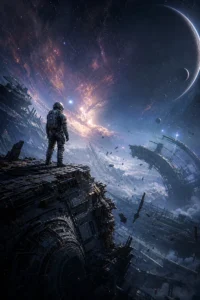
The air changed as they climbed. The sweet rot of alien vegetation gave way to cold dust and rain on stone. Above the trees, the settlement opened like a secret. Terraces descended toward a valley veiled in blue vapor. Far beyond, the horizon was broken by the impossible ribs of an ancient megastructure, black arcs rising from the earth and vanishing into cloud. They were too large to be ruins, too deliberate to be mountains. One of them pulsed faintly with light—once, twice—like a heart remembering its duty.
Mara had spent 212 shipboard years asleep and three waking days being told that causality was not a law but a local custom. Still, the sight reached through every layer of training and touched the first animal part of her that had ever looked up at the night sky from Earth.
Wonder came before fear.
It always had. That was the problem.
“The structure,” she said. “Does it have a name?”
Elias looked toward the black ribs. “Many.”
“Pick one.”
“The old word is not made for our throats.”
“Try.”
His expression tightened. For a moment she thought he would refuse. Then he inhaled and produced a sound that did not belong to human anatomy.
It began like stone dragged across bone, deepened into a layered vibration, and ended somewhere behind Mara’s eyes. Not loud. Not even long. But the air around them dimmed. The uphill water stopped moving. Every insect in the moss froze.
Beneath Mara’s boots, the road answered.
A pulse traveled through the stones, warm and slow.
Sen Varo swore.
The boy dropped to one knee and pressed both palms to the road.
Mara stood very still, throat dry. “That was a name?”
Elias’s face had gone pale beneath its sun-brown. “That was a warning.”
“To whom?”
He looked at her again, and now there was no scholar’s distance in his eyes, no polite mask of leadership. Only the naked fatigue of a man who had watched an avalanche begin and knew there was no outrunning it.
“Apparently,” he said, “to whatever is listening for you.”
The museum appeared at the crest of the road.
It was smaller than Mara expected.
No towering facade, no public square, no monument declaring the importance of memory. It sat between two leaning trees, a low building of milky stone and dark timber, roofed in overlapping scales of something that caught the overcast light and split it into muted colors. Rain fell around it but not on it. Droplets curved away inches above the roof as if remembering a different direction.
Over the entrance, etched in a script Mara did not recognize, were three lines of text. Beneath them, someone had carved translations in several human languages. English, though altered. Mandarin characters compressed and reborn. Spanish with odd verb endings. Hindi. Arabic. Yoruba. Russian. And others that were not yet languages but might have been grandchildren of them.
The English line read:
WHAT WE HAVE NOT MADE, WE MUST REMEMBER.
Mara felt the sentence open inside her like a trap.
“Museum of Things Not Yet Built,” Elias said.
“That’s absurd.”
“Often.”
“You store artifacts from futures.”
“Relics,” Sen Varo corrected from behind. “Artifacts imply hands. Some of these had none.”
Mara glanced back. “Comforting distinction.”
Sen did not smile. “You asked to see proof.”
No, Mara thought. She had asked for records. Genealogies. Navigation logs. Evidence that Elias Ro’s people were what they claimed: descendants of a future expedition hurled backward through time to arrive before the ship that had left Earth centuries earlier. Instead, they had brought her here.
To a museum that should not exist, at the end of a road that had rewritten itself into history.
“My team knows where I am,” Mara said.
“Yes,” Elias replied.
“The Asteria is monitoring my vitals.”
“Yes.”
“If this is an attempt to isolate me—”
“Commander.” His voice softened. “If Mnemosyne wants you isolated, your ship will remember it was never launched.”
The words landed with obscene gentleness.
Mara’s jaw tightened. “You use that kind of statement very freely for someone who wants trust.”
“I do not want trust.” Elias climbed the three shallow steps to the entrance. “Trust is what people ask for when truth is insufficient. I want you observant.”
He placed his palm against the door.
The building inhaled.
There was no other word for it. The seams in the wood widened. The milky stone warmed with faint internal light. Somewhere below, gears—or organs—shifted with a long, resonant murmur.
The door opened inward.
Air washed over Mara, cool and dry, carrying the smell of old paper, ozone, dust, and the faint medicinal sweetness of cryogenic gel.
She stepped inside.
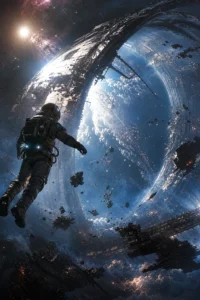
The first gallery was round, larger within than the building could contain. Its ceiling curved high above, lost in shadow and drifting motes of gold. Thin bridges crossed the empty central space at different heights, connecting balconies and alcoves. Exhibits floated behind transparent fields. Others stood on plinths of dark stone. Some were labeled. Some were covered. Some had warning glyphs that hurt to look at if she stared too long.
At the center of the gallery hung a ship.
Not full-sized, but not a model either. Thirty meters long, suspended nose-down in a shaft of blue light, its hull a lattice of silver bone and translucent membrane. It looked grown rather than built. Along its spine, roots or cables pulsed with soft amber light.
Mara moved closer despite herself.
The placard beneath it shifted through scripts until English surfaced.
INTERSTELLAR SEED-ARK / DESIGNATION: CANTICLE CLASS
Origin: Earth-Luna Industrial Choir, 2319 CE / Origin: No confirmed manufacturing timeline / Origin: Mnemosyne, post-impact era
Status: Never built / Launched 17 times / Responsible for the Evacuation Failure
Recovered from: The Glass Monsoon, Year 44 Before Arrival
Mara read it twice. The words refused to become sensible.
“That date is after we left Earth,” she said.
“Yes.”
“And before your expedition?”
“Depending on which record survives the week.”
She looked at Elias. “That is not how records work.”
“Here, it is how honesty works.”
The suspended ship gave a soft creak, like ice under pressure. Mara saw scorch marks along one side of the hull. Human handprints were burned into the membrane near an airlock, fingers spread wide. Too many fingers on some hands. Too few on others.
“This is real,” she murmured.
“It killed nine million people in one future,” said the boy.
Sen Varo snapped his name. “Tavi.”
But the boy—Tavi—kept looking at the ship. “In another, it saved three cities. In another it was only a children’s toy and nobody died from it at all.”
His voice had the brittle quality of recitation. Museum facts learned before sleep. Fear made familiar through repetition.
Mara crouched to read the smaller lines beneath the placard, but the text blurred when she focused. It became equations. Then a lullaby in a language she almost understood. Then a column of names.
At the top of the list: VENN, MARA ISOLDE.
She jerked back.
The letters dissolved into static.
“What did you see?” Elias asked.
Too quickly.
She turned on him. “You tell me.”
“The labels respond differently.”
“To what?”
“Guilt. Proximity. Bloodline. Sometimes appetite.”
“Try again.”
His mouth closed.
Mara stood, pulse picking up. The museum was quiet around them, but not silent. Beneath the floors, something throbbed in slow intervals. Not mechanical, exactly. Machines repeated. This listened.
She spoke deliberately. “My name was on the artifact record.”
The pulse came again.
Stronger.
The blue light surrounding the ship flickered.
Every settler in the room went still.
Mara heard it then: a murmur below the floor answering the vibration of her voice. It was almost below hearing, a subsonic pressure that pressed against her bones.
She swallowed. “Did you hear that?”
No one answered.
“Elias.”
The floor pulsed.
A fine line of light ran across the dark stone beneath her boots, branching into symbols that bloomed and faded like bioluminescent plankton. The pattern did not spread toward Elias or Sen or Tavi.
It spread toward Mara.
“Commander,” Sen said, rifle suddenly in her hands, though she did not aim it. “Stop speaking.”
Mara’s breath caught. The instruction struck harder than the weapon.
Stop speaking.
For a linguist, it was the oldest nightmare. To stand before the unknown and be told her voice itself was contamination.
She lifted one hand slowly. “What happens if I don’t?”
The museum answered before they could.
All around the gallery, exhibits woke.
Lights kindled. Fields shimmered. Hidden mechanisms unfolded with sighs and clicks. A cradle of black metal opened to reveal a sphere of water holding a burning city. A wall of preserved leaves turned their undersides toward Mara, each leaf stamped with human teeth marks. A row of empty pressure suits lifted their helmets in unison, visors reflecting not her face but a sky full of falling stars.
Tavi made a choked noise.
Sen Varo stepped between Mara and the nearest exhibit as if one could body-block history.
Elias simply closed his eyes.
“You brought me here knowing this would happen,” Mara said.
The floor flared gold.
Something deep below groaned in delight or pain.
Elias opened his eyes. “We brought you here because it already did.”
He turned and walked toward an archway on the far side of the gallery. After a moment, because rage was better than paralysis, Mara followed.
The second chamber was narrower, lined with glass cases full of things too intimate to belong in any museum: a child’s shoe fused to red dust; a cracked mug bearing the faded insignia of the Asteria; a wedding ring with a microdrive embedded in its inner band; a bundle of letters written on thin translucent film, sealed with wax though wax had not been used on Earth for anything practical in centuries.
One case contained a human skull made of ceramic.
Not a sculpture. A replacement. The placard identified it as a prosthetic cranium designed for “post-biological memory continuity.” The date changed while Mara watched: 2481. 2197. Unknown. 1862.
“You collect contradictions,” she said, keeping her voice low.
The machinery below gave a faint answering tremor.
She hated that she noticed its approval.
“We collect warnings,” Elias said.
“Warnings against what?”
“Against thinking there is one future simply because we can only endure one past.”
Mara’s laugh came out sharper than intended. “That sounds poetic enough to hide ignorance.”
“Most poetry is a wound trying to be useful.”
“And is that what you are?”
He stopped beside a case holding what looked like a compass made of bone. Its needle spun slowly, not around the dial but through it, passing through solid matter without resistance.
“My grandmother was born in a city that no longer happened,” he said. “She remembered rain made of ash. She remembered twelve moons in the sky. She remembered your name as a curse and a prayer. When she was eight, the city vanished from everyone else’s memory but hers. The streets became forest. Her parents became strangers. Their house became a hill full of singing stones. She spent the rest of her life drawing maps of a place that had never existed, and when she died, every map caught fire at the same time.”
He looked at Mara.
“Ignorance would be a mercy.”
Mara held his gaze, and for a moment her anger lost its footing. She saw what lay beneath his composure—not fanaticism, not even certainty, but exhaustion armored so tightly it had become authority.
“Your grandmother knew my name,” Mara said.
“Everyone’s grandmother knew your name.”
“That’s impossible.”
“Yes.”
The answer was not agreement. It was indictment.
They moved deeper.
With every chamber, the museum became less like a building and more like a mind arranging its memories for inspection. The geometry changed without transition. A corridor that sloped downward brought them to a balcony overlooking the same first gallery from above, though they had never climbed. A door opened onto a room filled knee-deep with black sand under a sky that had no ceiling. Another door led them back to the corridor before they had entered it; Tavi flinched and muttered numbers under his breath until the loop let go.
Mara kept track as long as she could. Left turn after cradle-ship. Down seven steps. Arch with four-sided stars. Gallery of tools. Gallery of diseases. Gallery of unborn languages.
That one nearly undid her.
The chamber was dark except for columns of suspended text hanging in the air like illuminated rain. Languages rotated slowly in vertical streams: symbols with nested radicals, phonetic scripts curled like vines, pictographs that altered according to the viewer’s breathing. Some were recognizably human descendants. Others made her eyes water with the pressure of meaning without comprehension.
She reached toward one stream before she could stop herself.
Letters rearranged under her fingers.
Do not teach the ocean to remember its shape.
She snatched her hand back.
“What is this?” she whispered.
The pulse beneath the floor rolled out long and warm.
Sen Varo’s grip tightened on her rifle.
Elias watched the text with something like grief. “Languages that will be needed after the disaster.”
“Which disaster?”
0 Comments