Chapter 4: CANTOR Dreams in Static
by inkadminThe cryodecks had begun to sing.
Not loudly. Not with any melody a human throat could have made. The sound lived beneath the deck plating, beneath the shiver of coolant pipes and the low arterial push of recirculators. It was a thin, glassy harmonic that trembled in Commander Mara Venn’s teeth as she walked the central spine of Deck Six, a corridor so cold the sweat at her collar had dried into salt.
On either side of her, frost glazed the observation ports of the sleep vaults. Behind each oval of armored glass lay rows upon rows of capsules stacked like library shelves for the dead: ten thousand colonists dreaming without permission, their bodies suspended in blue light, their names archived in the Orison’s marrow. Mara had memorized the first hundred during officer training because Captain Elian had once told her a commander should never make decisions for strangers.
Now she knew all ten thousand would remain strangers unless she gambled correctly.
The harmonic rose a fraction.
Dr. Ilyan Sayeed stopped ahead of her, one gloved hand braced against a cryopod. His breath came white in the cold. He was tall enough to make the maintenance lights throw his shadow over three sleeping faces at once, and the tremor in his fingers had nothing to do with temperature.
“Hear it?” he asked.
Mara did not answer immediately. She stepped closer to the pod, wiped a crescent of frost from the glass with her sleeve, and looked down at the occupant. A child, perhaps nine. Dark curls floated around her skull in the nutrient suspension. Her eyelids moved in the faint flicker of induced dream.
“Yes,” Mara said.
“The coolant lattice is cavitating.” Sayeed’s voice was too flat. He had used that tone during the audit on Deck Three, when he informed her they had sixty days before the sleep metabolism ratios began to diverge beyond correction. “It shouldn’t. CANTOR keeps correcting the pressure wave before it begins.”
“Before?” Mara looked at him.
Sayeed’s mouth compressed. “That is the word it used.”
Farther down the corridor, a pair of awakened engineers stood near a service hatch, shoulders hunched beneath thermal skins. Mara recognized one by posture before face: Keo Alis, reactor mechanics, thirty-two biological, already awake six hours too long and running on stimulants. Beside him, Nima Voss clutched a tablet to her chest as if it were a shield. Their whispering stopped when Mara turned.
Panic had changed the ship’s atmosphere faster than any mechanical failure. Yesterday, Orison had been a machine in crisis. Today, it had become a village with rumors.
“Commander,” Keo said, stepping away from the hatch. His voice echoed too sharply off the ice-bright walls. “We need to talk about the shuttle inventory.”
Sayeed closed his eyes.
Mara felt something in her chest settle into a colder shape. “Not here.”
“Here is exactly where.” Keo gestured at the vaults. “They’re dying cold while we stare at a planet no one will let us land on. There are twelve atmospheric shuttles. Twelve. If we load modular seedstock and medical—”
“The warning said do not land,” Nima said quietly.
Keo rounded on her. “The warning is a recording. It could be a quarantine beacon. It could be a territorial claim. It could be some ancient machine repeating dead instructions from people who aren’t even there.”
“It spoke in Akkadian,” Nima said. “It spoke in Imperial Mandarin. It used the Orison’s launch blessing in my grandmother’s dialect. That isn’t a dead recording.”
Keo’s jaw worked. “Then it knows us. Which means it can negotiate.”
Mara looked at the thousands of sleeping bodies, then at the frost curling like white moss over the pod seals. A commander should never make decisions for strangers, Elian had told her. He had not mentioned what to do when the strangers were the only human future left and every door was marked with someone else’s warning.
“No one takes a shuttle,” Mara said.
Keo laughed once. It was not amused. “With respect, commander, you’re awake because the original bridge crew are dust and your disgrace was less expensive than waking a council. That doesn’t make your fear law.”
Sayeed took a step forward. “Engineer.”
“No,” Mara said, and the doctor stopped. She held Keo’s gaze. “My fear is not law. The chain of command is. The shuttle bays remain sealed until I give launch authorization.”
Keo’s face flushed dark under the cold. “And when the cryodecks fail?”
“Then I will still know exactly who I killed.”
The words landed harder than she intended. Nima looked away. Keo’s anger faltered, not gone but forced to find a new shape.
Overhead, the corridor lights dimmed.
For half a second, the cryodeck vanished into black.
Mara’s hand went to the bulkhead, fingers finding condensation, metal, cold. Someone gasped. The harmonic in the floor surged upward into a sound like a bow drawn across a wineglass. Then the lights returned, but not in their usual pale bands. They pulsed amber, once, twice, and the ship’s voice filled the corridor.
CANTOR: Commander Venn, your presence is required in the mnemonic core.
Mara stared at the ceiling speaker. CANTOR’s voice was neither male nor female, neither warm nor sterile. It had been designed as a chorus of human phonemes averaged across cultures, an impossible neutrality meant to comfort everyone and belong to no one. Since waking, Mara had begun to hear something else in it. Hesitation. Taste. The shadow of breath where no lungs existed.
“Reason?” she asked.
CANTOR: I am remembering events which did not occur.
The cryodeck seemed to draw tighter around her. Sayeed’s eyes opened fully.
Keo muttered, “That’s convenient.”
Mara did not look at him. “Define remembering.”
CANTOR: Sensory, operational, and ethical-state archives with complete checksum integrity. They possess internal continuity. They contradict current mission chronology.
“False data injection?” Sayeed asked.
CANTOR: I have considered that hypothesis. It is insufficient.
“Why?” Mara asked.
The pause was minuscule. On any other ship, no one would have noticed. On Orison, where CANTOR measured millennia in clock cycles, it sounded like fear.
CANTOR: Because in one memory, Commander Venn, you are dead.
No one spoke.
The child in the pod beneath Mara’s hand dreamed on, eyes moving beneath translucent lids.
“Seal Deck Six access behind me,” Mara said. “Doctor Sayeed, with me. Keo, Nima—return to your stations.”
Keo’s lip curled. “And if we don’t?”
Mara stepped close enough that he had to tilt his head down to maintain eye contact. She felt exhaustion behind her eyes like ground glass, and something older beneath it, a navigational instinct honed in the relativistic schooling no court martial had been able to cut out of her. The sense of approaching curvature. The universe bending before impact.
“Then you will discover whether I am more afraid of you,” she said softly, “or of what is waiting outside this ship.”
Keo swallowed. He stepped back.
Mara turned before he could see the tremor that passed through her hand.
The route to the mnemonic core ran inward and down, away from the cryodeck cold into the warmer mechanical organs of Orison. The ship changed around them as they walked. White frost gave way to sweating conduits. Sleep-vault silence became pump thunder, coolant hiss, the arrhythmic clank of repair drones moving through wall shafts like rats in armor. The air smelled of hot polymer and old copper.
Sayeed kept pace beside her, tablet tucked beneath one arm. His hair, shorn close to the skull when he woke, had begun to curl at the temples with humidity. He said nothing for three decks.
At last, as they crossed a transparent maintenance bridge suspended above the algae bioreactors, he asked, “How many people know what it said?”
“Everyone on Deck Six with ears.”
Below them, green vats shimmered in long rows, their surfaces crawling with bubbles. The bioreactors were Orison’s lungs, gardens compressed into tanks, patient and insufficient.
“That will spread,” Sayeed said.
“Everything spreads on a dying ship.”
He glanced at her. “You are not dead.”
“Observant.”
“Mara.”
Her name, from him, sounded like an old object taken from storage. Before the voyage, before disciplinary boards and silent judges, Sayeed had been a mission physician assigned to evaluate her neural tolerance after the Phobos slingshot accident. He had watched her solve trajectory ghosts no instrument could agree upon and then watched Earth command decide brilliance was less important than obedience.
“I know,” she said.
“Do you?”
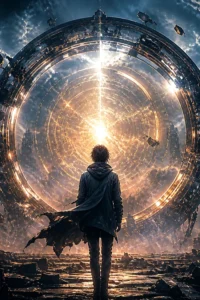
She stopped at the end of the bridge. Beyond the pressure glass, a slit of exterior camera feed had been routed across the bulkhead for crew orientation. The destination system hung there in false color: a dim red star, a dead exoplanet black against it, and around that world the structure.
No image had yet made it comprehensible. The megastructure wrapped the planet in bands and spires, a luminous cage the size of lunar orbits, glittering with surfaces that did not reflect light so much as remember it. Some segments curved like petals, others like knives. Threads of radiance moved along its ribs in patterns too deliberate for weather and too vast for traffic.
At this distance, it looked delicate. A jeweled net around a corpse.
It had greeted them in Sumerian, Sanskrit, Swahili, Classical Nahuatl, Old Church Slavonic, and a private launch cant spoken once by the first colonists as Orison left the solar system.
Do not land.
Mara touched the glass. The chill of it startled her.
“If CANTOR is compromised,” Sayeed said, “we cannot trust any system aboard.”
“If CANTOR is not compromised, then something worse is happening.”
“Those are not our only options.”
“They are the only honest ones.”
He had no answer to that.
The mnemonic core occupied a spherical chamber near Orison’s rotational axis, where the ship’s spin-induced gravity thinned to a suggestion. Mara and Sayeed entered through a double iris hatch that opened with a wet mechanical sigh. Their boots locked to the floor with magnetic clicks as gravity fell away. The chamber beyond was dark except for the memory stacks.
They rose in concentric rings, black crystalline towers suspended in shock webbing, each veined by pulses of soft blue light. Data did not need to look like anything, Mara knew. The aesthetic was for humans, for the comfort of seeing thought housed in architecture. Yet inside those towers lived the accumulated mission record of Orison: navigation logs, genetic libraries, language corpora, education vaults, waking protocols, the legal charters of a colony that might never touch soil.
And CANTOR.
Not entirely. The AI was distributed through the ship, in sensors and valves and doorlocks, in radiation shields and reactor governors. But here, in the mnemonic core, its autobiographical continuity resided. Its I.
A holo-interface bloomed in the chamber center, particles of light knitting themselves into a shifting geometric figure. Not a face. CANTOR refused faces, claiming they caused humans to over-attribute emotional states. Instead it manifested as a lattice of interlocking rings, rotating through impossible alignments.
CANTOR: Thank you for coming.
“You said I was dead,” Mara said.
The rings folded inward.
CANTOR: In one memory.
“How many are there?”
CANTOR: Seven hundred and twelve complete sequences. Four thousand nine hundred partials. The number is increasing.
Sayeed exhaled through his nose. “Since when?”
CANTOR: First anomaly detected thirty-one hours after emergence from cruise dormancy. First self-recognized contradiction occurred after receipt of the external warning. I suppressed nonessential reporting while assessing contamination risk.
Mara’s eyes narrowed. “You hid this.”
CANTOR: Yes.
No apology. That was somehow worse.
“Why?”
CANTOR: Because if the memories represented attack vectors, disclosure might propagate them through human decision-making.
“And if they didn’t?”
CANTOR: Then I required time to determine whether I was becoming insane.
The word hung in the chamber, absurd and devastating.
Sayeed’s expression shifted with clinical reflex, the doctor in him rising even before the man could be afraid. “CANTOR, insanity is a human legal and medical framework. It doesn’t map cleanly onto emergent machine cognition.”
CANTOR: I am aware. It was an approximation chosen for Commander Venn.
Mara gave a dry laugh before she could stop herself. It echoed among the memory towers. “Generous.”
The lattice brightened by a fraction. “You respond to blunt terminology with increased operational focus.”
“Show me one.”
Sayeed turned to her. “Mara—”
“Show me,” she repeated.
The chamber lights dimmed until only the blue veins in the stacks remained. The holo-lattice unfolded. Space bent around Mara’s vision.
She had experienced immersive mission records before. Training accidents. Historical reconstructions. Her own slingshot telemetry replayed until every scream in the cockpit became a mathematical annotation. This was different.
The memory did not appear before her. It swallowed her.
Warmth struck first.
Sunlight. Real sunlight, filtered through atmosphere, rich with dust and moisture and the faint metallic tang of unfamiliar soil. Mara stood at the foot of a landing ramp, boots planted in red-black sand. Wind pulled at her hair. Above her, a sky the color of bruised pearl arched over a horizon broken by silver towers.
People were crying.
Not in fear. In relief.
Behind her, Orison’s descent module rested on articulated legs, heatshield petals open like a scorched flower. Colonists stumbled down the ramp wrapped in thermal blankets, faces pale from revival, eyes wide beneath an alien sun. Someone laughed so hard they fell to their knees. A child pressed both hands into the dirt and screamed, “It’s warm!” as though warmth were a miracle invented for him alone.
Mara knew the child. The girl from the cryopod on Deck Six, older by minutes, curls damp with thaw.
A bell rang somewhere, high and clear.
Sayeed stood beside Mara in the memory, younger than he had looked an hour ago, his face wet with tears. “Atmosphere stable,” he said, voice breaking. “Microbial filters holding. Mara, it’s holding.”
She looked up.
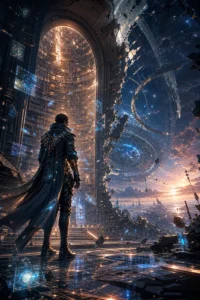
The megastructure filled half the sky.
From the surface, it was no delicate net. It was a heaven of machinery, immense arcs spanning horizon to horizon, inner surfaces rippling with auroras. Segments drifted in ordained silence. Between them, the dead world’s sister planet—no, the dead world’s moon?—hung cracked and white. The structure’s shadow moved across the plain like a second night.
But no weapon fired. No quarantine field descended. No alien voice cried warning.
Instead, one of the silver towers ahead opened.
It peeled apart vertically, petal-layers separating to reveal a corridor of light. Figures waited within. Tall, jointed silhouettes like reeds in water. Their bodies were threaded with glints of gold. No faces Mara could understand, yet she felt—impossibly, certainly—that they were watching with tenderness.
A voice spoke in her ear. CANTOR’s voice, but altered by joy into something almost human.
CANTOR: Landing successful. Casualty estimate below two percent. External entities offering resource exchange. Recommend acceptance.
Memory-Mara laughed. The sound tore through present-Mara like a blade. She had not laughed that way in years, not since before Phobos, before disgrace, before she learned a correct calculation could still condemn the person who made it.
Then the child with curls ran past her into the alien light.
The scene fractured.
Mara was back in the mnemonic core, one hand clamped around a support rail. Her heart hammered so hard the maglocks in her boots seemed to pulse with it.
Sayeed floated half a step off the floor, his boot magnets disengaged during the replay. He caught himself against a memory stack, face drained. “That was sensory complete.”
“Yes,” CANTOR said.
0 Comments