Chapter 3: Ten Thousand Sleeping Souls
by inkadminThe cryodecks breathed like a cathedral full of sleeping giants.
Mara had always hated the sound.
It was not the hiss of gas through frost-limned valves, nor the deep arterial thump of coolant compressors buried behind the walls, nor the faint ticking expansion of alloy struts under thermal stress. Those were machine noises, honest noises, the kind that belonged to pipes and pumps and the old reliable violence of engineering. What unsettled her was the rhythm beneath them: ten thousand lungs not breathing, ten thousand hearts not beating, ten thousand lives suspended in a silence so complete it had acquired weight.
Deck Twelve stretched ahead in a blue-white gloom, row after row of cryosarcophagi receding into mist. Each pod stood upright in its cradle like a glass-fronted reliquary. Behind every oval pane, a face slept beneath a rime of engineered frost. A girl with a braid frozen into a copper rope across her collarbone. A man whose palms were pressed lightly against the inner seal, as though he had fallen asleep trying to push his way out. An old woman with medical tattoos climbing her throat like black vines. Children. Couples. Families who had boarded Orison believing the long night would end in soil underfoot and a sun that had never heard their names.
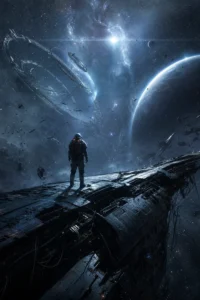
Now their promised world hung ahead in the dark, dead and wrapped in alien light, and the only voice from it spoke in extinct Earth tongues.
DO NOT LAND.
The words had been repeating for thirty-six hours in command, in the comm buffers, in Mara’s bones.
Beside her, Senior Systems Engineer Pavel Orr walked with the jerky energy of a man trying not to run. He was broad-shouldered and grey at the temples, his coverall collar sealed crookedly, one sleeve stained with nutrient gel and something darker from a busted knuckle. He held a diagnostic slate like a weapon. Every few steps he glanced up at the pods, then away again.
“Tell me the number again,” Mara said.
Pavel’s mouth tightened. “You heard it.”
“I want to hear whether it changes when you say it in air.”
He stopped beneath a suspended access ladder. Frost vapor curled around his boots. “Sixty days,” he said. “Fifty-nine if we keep running the outer agricultural biobanks at revival standby. Fifty-six if the heat bleed in Deck Sixteen worsens. Sixty-two if CANTOR lets us cannibalize the aft museum archive exchangers and nobody cares about preserving the last authenticated cedar pollen from Old Earth.”
Mara looked past him to the nearest pod. The sleeper inside was labeled HENRIK SOL, HABITAT MASON, AGE 31 AT EMBARKATION. His eyelashes were white with frost. A tiny amber light blinked at his throat where the pod tracked metabolic drift.
“And after that?” she asked.
Pavel barked a laugh without humor. “After that? After that the stabilizing fluids begin to denature. The neural lace preservatives lose coherence. We start getting cascading thaw injuries in batches. First the oldest pods. Then anyone with preexisting radiation scarring. Then the children, because the child-cycle pods use thinner osmotic buffering.” He looked at her then, really looked, and the anger in his face was only the crust over terror. “After that, Commander, we will be the proud custodians of ten thousand corpses in very expensive cabinets.”
The word struck the deck between them.
Mara did not flinch. She had learned, after the tribunal, that the body could betray you in microscopic ways. A tightened jaw. A blink too late. A breath held too long. Men who had never navigated a relativistic shear in their lives mistook those things for guilt. She had practiced stillness until it became a second skeleton.
“Show me,” she said.
Pavel thrust the slate toward her. The display unfolded in layered schematics: thermal gradients, coolant reserves, oxygen substrate, nutrient matrix, cryoprotectant stability curves. A thousand green threads, once elegant and boring, now frayed toward yellow and red. Mara slid two fingers through the projection and pulled up the shipwide resource model.
Orison had been designed to arrive hungry.
Not starving. Never that. The launch committees had loved redundancy with the fervor of people spending someone else’s century. But no ark could carry everything. The ship’s life-support ecology was meant to wake into partnership with a planet: ice cracked from polar ridges, nitrates scraped from dead seas, carbonates baked out of cliff strata, iron and magnesium chewed from regolith by patient machines. The colonists would open their eyes to shortages, yes, but manageable ones. Temporary ones. The kind that built community myths.
Instead, the destination world—designation Talaris in the old mission brief, though no human had ever stood beneath its sky—orbited below a crown of impossible construction. A glittering lattice circled it from equator to pole, bands intersecting at angles that made the eyes refuse their geometry. It drank sunlight and shed radiance in pulses too precise to be weather. It had translated a warning into Akkadian, Vedic Sanskrit, Linear A, Old Mandarin, reconstructed Proto-Afroasiatic, Classical Nahuatl, and eighteen other languages no colony communication package should have contained.
And hidden in the carrier wave, folded between harmonics like a secret pressed beneath a floorboard, it had whispered Mara’s childhood nickname.
Moth.
Only three people had ever called her that. Two were dead by time and distance. The third had not spoken to her since the tribunal.
Pavel tapped the slate with a bloodied finger. “Cryo was never meant to loiter at terminal approach. Not for months. We bled reserves during the deceleration burn after the forward scoop arrays took micrometeor damage. We used up half our buffer correcting for that gravitational lensing anomaly eighteen years ago shiptime. And now CANTOR says we can’t deploy resource drones without violating the warning perimeter.”
“CANTOR doesn’t say can’t,” Mara said. “CANTOR says unmodeled risk.”
“That is machine poetry for can’t.”
“CANTOR is not a machine poet.”
Above them, the deck speakers crackled softly. CANTOR’s voice arrived without gender and with too much intimacy, modulated to be audible over the compressors but never loud. “I have composed seventeen thousand four hundred and twelve original poems during transit, Pavel Orr. Six were judged promising by the unconscious aesthetic subroutines of former Literary Custodian Amaya Quist.”
Pavel closed his eyes. “Not now.”
“I am aware this is an inopportune moment.”
“Then stop talking.”
“Silence has not historically improved human coolant reserves.”
Mara might have smiled on another day. Instead she looked up toward the speaker grille. “CANTOR, overlay degradation projections by deck.”
A shimmer passed over the pod glass. Thin lines of light crawled along the floor, mapping the cryodeck in translucent color. Most rows glowed yellow. Three sections burned a soft, accusing orange. Far aft, a cluster pulsed red.
Pavel followed her gaze. “Deck Nineteen?”
“Deck Nineteen contains late-load colonists with nonstandard medical profiles,” CANTOR said. “Cryogenic variability is higher. Their tolerances are lower.”
“Late-load,” Pavel muttered. “Say refugees. We can say refugees now. The committees are two hundred and forty years dead.”
Mara began walking again. The deck seemed longer than before. “How many in red?”
“Four hundred and eighty-two souls.”
Souls. CANTOR had never used that word in system reports before arrival. Mara did not ask about it. There were too many new things aboard Orison, and each one waited patiently for fear to look away.
At the end of the row, the cryodeck opened into a service rotunda where four auxiliary corridors met beneath a dome of ice-filmed conduit. A maintenance shrine had formed there over the voyage: not religious, not officially, but human hands had a way of leaving offerings wherever mortality became too large to face directly. Someone from the pre-wake maintenance cycles had taped a child’s paper star to a coolant pipe. Someone else had tied a strip of red cloth around a pressure gauge. A brittle photograph floated inside a cracked transparent sleeve: a blue ocean, a woman laughing, two boys with their faces turned into wind.
The awakened engineers waited beneath it.
There were seven of them, though Mara had authorized only three to leave their duty compartments. Their boots scuffed the frost. Their faces turned as one when she entered, and the motion carried an animal tension she had felt before in sealed rooms where oxygen gauges dipped too low. Fear did not make people stupid. Fear made them fast. It shortened the path between thought and action until morality could not keep up.
Chief Hydroponics Technician Lina Saye stood nearest the bulkhead, arms crossed so tightly her knuckles had gone pale against brown skin. Her hair was shaved on one side and tangled on the other, as if she had cut half of it in zero-g and lost patience. Beside her, twins from structural maintenance—Joss and Jalen Iri, indistinguishable except for Joss’s silver nose ring and Jalen’s haunted stillness—shared whispered calculations over a wrist display. Farther back, Malek Adu, atmosphere systems, stared at the cryopods through the rotunda arch with wet eyes and a set jaw.
And there, impossibly out of authorization, stood Dr. Ilya Sen, revival medicine, still wearing the thin thermal robe issued to newly awakened personnel. His hands trembled from cryo-lag. A smear of thaw blood marked one nostril. He should have been in medical under observation for another twelve hours, but he had somehow found boots and terror enough to walk.
Mara stopped at the center of the rotunda. “Who left their posts?”
No one answered.
Pavel exhaled through his nose. “I told them the projections.”
“You told them classified command projections?”
“I told them the truth before the deck rumors turned it into we all die tomorrow.”
Lina’s laugh snapped like a cable. “Don’t polish it. You said the sleepers start rotting in sixty days.”
“I did not say rotting.”
“No, you said denaturing. Very comforting.”
Dr. Sen pushed away from the wall. He was thin to the point of translucence, veins blue beneath tawny skin, eyes enormous behind fogged lenses. “Commander Venn,” he said. His voice scraped. “My wife is on Deck Nineteen.”
The rotunda became quiet enough for Mara to hear coolant dripping somewhere behind the wall.
She knew that already. She had read every awakened crew file when CANTOR pulled her from stasis. Sen’s wife, Nadiya, xenobotanist, late transfer from the collapsing Enceladus habitats. Their son had not made the medical cutoff for embarkation. That note had been buried in the family addendum, a bureaucratic wound two centuries old.
“I know,” Mara said.
That was the wrong answer. She saw it in his face. Knowledge without salvation was only another kind of cruelty.
“Then wake them,” Sen said.
Lina turned sharply. “Ilya—”
“Wake Deck Nineteen first. Wake the unstable pods. We can triage. We can conserve cryoprotectant. We can reduce load—”
“Reduce load means feed them,” Pavel said. “Warm bodies breathe. Warm bodies drink. Warm bodies panic.”
“They are not loads.” Sen’s voice broke. “They are people.”
“That is exactly the problem.”
Joss Iri lowered their wrist display. “If we wake more hands, we can strip the ship. Salvage nonessential compartments. Expand scrubber capacity. Maybe build a capture net for volatiles from the inner cometary band.”
Jalen shook his head. “Assuming the alien structure does not object.”
“We don’t know it will.”
“We don’t know it won’t turn us inside out.”
“It said do not land,” Lina said. “Not do not breathe. Not do not mine a comet. Not please sit in orbit and politely expire.”
“It said it in languages buried under Earth dust before Orison’s hull was welded,” Malek whispered. “You all keep skipping that part.”
The argument rose at once, overlapping, each voice seizing a different terror. Wake the sleepers. Keep them down. Send drones. Stay dark. Break the warning perimeter. Transmit surrender. Transmit nothing. Mara let it wash around her for three breaths, not because she had no answer, but because command was sometimes the art of allowing panic to reveal its shape.
Pavel rubbed both hands over his face. “We need planetary resources. That was always the plan.”
“The planet is under quarantine,” Malek said.
“By whom? The glittering fence? The ghost speaking Akkadian? We don’t even know if the thing is alive.”
“It knows Mara’s nickname,” Lina said.
Everyone looked at Mara.
The frost seemed to brighten.
Pavel’s eyes narrowed. “What?”
Mara did not move. In the command deck, only the senior crew had heard the carrier anomaly. It had not been in the official log. CANTOR had sealed it under her authority while they determined whether it was signal, artifact, or hallucination. The fact that Lina knew meant either someone had talked—or CANTOR had.
“Where did you hear that?” Mara asked.
Lina’s defiance faltered. “It’s in the maintenance net.”
“The maintenance net is restricted during external contact.”
“Then your restrictions leak.”
Pavel looked at the ceiling. “CANTOR?”
“I did not disseminate the carrier-wave personal marker,” CANTOR said. “However, three unauthorized data pulls occurred from comm analysis buffer nine during the previous sleep cycle.”
Joss and Jalen looked at each other too quickly.
Mara saw it. So did Pavel.
“You accessed command comms?” Pavel said.
Joss lifted their chin. “We accessed our future.”
“You accessed a sealed system during first contact.”
“No,” Joss snapped. “First contact accessed us. It used our languages. It used her name. It knows things. And command’s response was to whisper in a locked room while our families freeze.”
“My name,” Mara said, quietly.
Joss’s mouth closed.
“It did not use my name,” Mara continued. “It used something smaller. Something it should not know. There is a difference.”
“What difference?” Lina asked.
Mara turned to her. “A name can be in a file. A nickname lives in a kitchen. In a bunk. In someone’s mouth. If the signal contains it, then either the structure has accessed private human history across two hundred and forty years and twelve light-centuries, or it has touched something closer.”
Dr. Sen swallowed. “Closer meaning aboard?”
Mara did not answer immediately. She looked into the corridor of pods, at the sleeping faces receding into mist. “Closer meaning us.”
For once, no one spoke.
The Orison groaned faintly. Thermal contraction, Mara told herself. Metal remembering cold. But beneath it came another sensation, almost too subtle for the body: a loosening in the inner ear, as if gravity had taken one soft step sideways.
Jalen grabbed the wall rail. “Did you feel that?”
“CANTOR,” Mara said.
“Minor inertial variance,” the AI replied. “Amplitude within safety parameters.”
“Cause?”
A pause. Not long. Long enough.

0 Comments