Chapter 5: The Planet Without Footprints
by inkadminThe probe fell like a thought dropped into a well.
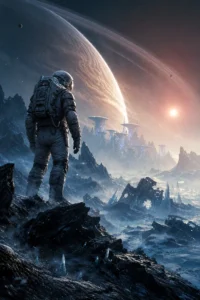
On the forward wall of Orison’s command amphitheater, the dead world swelled from a disk to a landscape. Its horizon cut the dark in a faintly luminous arc, too smooth for geology, too pale for life. Beyond it, the alien megastructure glittered in its impossible embrace: bands within bands, ribs of black crystal and silver-gold filament circling the planet in tilted orbits, each one rotating with grave, noiseless precision. It had the austere beauty of a mathematical proof and the menace of a closed fist.
No one on the command deck spoke for the first eleven minutes of descent.
The silence was not discipline. It was hunger.
Mara Venn stood at the center rail, one hand hooked through the restraint loop, knuckles gone bloodless. The amphitheater’s lights had been lowered to preserve contrast on the feed; faces floated pale in the dimness, eyes reflecting the world below. Dr. Sayeed had abandoned his seat and stood with a stylus held between his teeth, arms folded tight, as though the data might bolt if he moved too quickly. Lieutenant Ivo Karst, Security, leaned against the starboard pillar in full mag harness, his jaw working around things he had been ordered not to say. A half-dozen junior officers crouched over sensor wells, whispering corrections to one another with the hushed reverence of acolytes.
At the rear of the deck, behind glass, three representatives from the awakened colonist council watched with suspicion sharp enough to cut vacuum. They had demanded access. Mara had allowed it. Better to let them see the truth arrive than let them invent a more convenient one in the cryodecks.
The probe’s designation—Lark-3—blinked in blue on the feed margin. It was little more than a ceramic spear wrapped around a bundle of eyes, sniffers, and a transmitter, built for atmospheres, oceans, organic chemistry, all the hopeful work of finding a home. It had never been designed to descend under the gaze of an alien prison large enough to sew a planet shut.
CANTOR’s voice flowed from the speakers, neither male nor female, carrying the faint harmonic warmth it had developed since waking.
Lark-3 has crossed the upper exosphere. Trace argon. Trace neon. No detectable free oxygen. Surface pressure estimated at 0.006 standard. Gravitational field stable. Radiation environment variable but within probe tolerance.
“Variable how?” Mara asked.
On the wall, pale numbers fluttered. CANTOR hesitated for one-tenth of a second too long.
Radiation readings are repeating.
Dr. Sayeed took the stylus from his mouth. “Repeating as in cyclic?”
Repeating as in identical. Particle impacts detected at 14:32:09 ship time match impacts detected at 14:32:11 ship time to seventeen decimal places.
Ivo’s eyes flicked to Mara. “That’s not radiation. That’s a recording pretending to be radiation.”
“Or radiation that remembered what it was,” Sayeed murmured.
Mara did not look away from the descending world. “Flag it. Continue.”
The probe hit atmosphere that was almost not there. The camera feed trembled, not from turbulence but from microcorrections as Lark-3 shaped its fall through dust and charged static. The world below resolved into color: ash-gray plains streaked with mineral white, fields of black glass like frozen lakes, mountains worn down into blurred stumps. It looked old beyond romance. Not ancient like ruins under moss, not sacred like bone, but exhausted. Scraped clean. A planet after all verbs had ended.
Then the first city appeared.
No one recognized it at first. The surface was too smooth, the geometry too patient. The probe’s aft camera captured a faint grid beneath a translucent skin of dust: lines crossing lines, arcs nested inside plazas, towers lying on their sides like shadows trapped under ice. A road would have betrayed itself by continuity, by habit, by the stubborn preference of beings moving from where they were to where they needed to be. There were none. The city’s structures sat in relationship to one another, but nothing connected them. No avenues. No bridges. No causeways. No tracks worn by wheels or feet.
“Enhance lower quadrant,” Mara said.
The image sharpened. Beneath glassy dust, buildings rose and fell in alien relief, their edges softened by a vitrified layer perhaps two meters thick. Some were spires, needle-thin and clustered in groups of seven. Others were bowls inverted into the ground. One structure resembled a flower whose petals had been pressed flat by a god’s thumb.
Dr. Sayeed breathed out. “A city.”
“Habitation?” asked one of the colonist representatives behind the glass, a woman named Elian Ward whose daughter and husband still slept in the fourth cryospine. Her voice trembled despite the intercom’s smoothing. “You’re saying someone lived there?”
“No,” Sayeed said softly. “I’m saying someone built there. Living is another question.”
The probe’s lidar painted the buried forms in ghost-light overlays. Chambers, voids, vertical shafts, domes nested beneath domes. Mara studied the map as it grew. There were no collapses consistent with bombardment. No craters. No blast halos. No debris fans. Whatever had ended this place had not fallen from above.
“Any machines?” she asked.
No mobile artifacts detected. No powered systems. No electromagnetic emissions from the surface.
“Biosignatures?”
None.
Sayeed’s hand moved across his console, calling up spectral bands. “Organics?”
None detected.
That did it. The stillness on the command deck cracked into whispers.
No organics.
Not merely no life. No remains. No polymers. No carbon residues, no oils, no ancient soot sealed under the dust. No skin cells in corners. No preserved forests beneath ash. No bones. No shells. No resin. No forgotten meals fossilized in some household bowl. A city without garbage, without graves, without all the tiny humiliating evidence of existence.
Mara’s thumb rubbed the inside of the restraint loop. She had seen planets murdered by physics before. Everyone who navigated relativistic corridors had, at least in simulation: worlds stripped by flares, moons shattered by tidal shear, colonies lost to atmosphere collapse. Disaster left fingerprints. Entropy was not tidy. Death spilled.
This planet had been erased by someone who cleaned up afterward.
Ivo pushed off the pillar and descended two steps toward the central floor. “Commander, I want Lark-3 no lower than ten kilometers until we understand whether the surface can transmit infection.”
Sayeed cut him a look. “Infection of what? There’s nothing biological.”
“I didn’t say biological.”
The junior officers stopped whispering.
Mara kept her voice even. “Lark-3 is sterilized, isolated, and one-way telemetry only.”
“Nothing here has respected one-way anything.” Ivo’s tone remained controlled, which made it worse. “We sent a question. The structure answered in dead languages. CANTOR remembers missions we didn’t fly. The crew in cryo are dreaming the same warning in dialects they never learned. Now radiation is duplicating itself, and we are dropping a probe into a city with no footprints.”
Behind the glass, Elian Ward said, “He’s right.”
Mara finally turned. The entire deck seemed to lean toward the argument, grateful for something human to fear.
“I did not ask because I expected agreement,” Mara said. “We cannot land Orison blind. We cannot leave, because our drives cannot carry ten thousand sleeping colonists through another interstellar burn without refit, and the only refit mass in this system is inside that gravity well. The warning says do not land. It does not say why. We need why.”
Ivo’s mouth tightened. “And if why looks back?”
“Then we learn the shape of its eyes.”
For a second, no one breathed.
Then CANTOR spoke.
Lark-3 approaching designated transect alpha. Altitude: nine kilometers. Surface detail increasing.
The feed dipped as the probe angled toward a basin rimmed with low crystalline ridges. The buried city fell behind. Ahead, the plains were covered in a thin reflective mantle that caught the distant star’s weak light and scattered it into a million cold sparks. It was beautiful in the way frost was beautiful on the inside of a coffin.
“What is that dust?” Sayeed asked.
Primary composition: silicates. Secondary: metallic glass. Trace isotopes inconsistent with natural decay chains.
“Weapon residue?” Ivo asked.
Sayeed’s eyes narrowed. “Maybe. Or construction residue. Or the planet’s crust flash-melted and condensed.”
“By what?”
Sayeed did not answer.
Mara watched the surface. There were depressions now, shallow and circular, scattered without pattern. Not craters. The rims were raised inward, as if something beneath had sucked the ground down and then polished the wound. Lark-3 passed over one, then another. Inside each was darkness too clean for shadow.
“CANTOR, depth?”
Unable to resolve. Lidar returns terminate at approximately twelve meters despite visible aperture extending beyond range.
“Terminate?” Sayeed said.
The photons do not return.
“Absorption?”
No thermal increase detected.
Another silence spread, this one thinner and colder.
Mara felt the old navigator’s reflex rise through her spine, the instinct that had once made captains trust her beyond regulation and later made a tribunal call her dangerously intuitive. Some anomalies were not seen directly. They were read from absences, from the way reality bent its grammar around a missing word.
The holes were not holes.
They were punctuation.
“Adjust course,” she said. “Take us between the depressions. Maintain passive sensors. No active ping below five kilometers.”
Sayeed glanced at her. “You think they’re listening?”
“I think something taught this planet how not to answer.”
Lark-3 obeyed. Its tiny thrusters pulsed, invisible except for the shift in perspective. The plains slid beneath it in eerie stillness. No wind scoured the dust. No loose grains skittered. Even at near-vacuum, there should have been some motion from electrostatic charge, some settling, some whisper of change. The surface seemed to have chosen a final arrangement and refused all amendment.
CANTOR displayed a topographic scan. More cities emerged below the dust, then vanished behind the probe’s path. Some were arranged in spirals kilometers wide. Others clustered around central voids. In one city, towers leaned inward but never touched, like worshippers frozen just before collapse. In another, flat hexagonal slabs covered acres of terrain, each engraved with ridges too fine for the probe to read from altitude.
Still no roads.
Still no bones.
Still no machines.
“Maybe they didn’t walk,” said Ensign Talia Ren from sensors. She was too young to have learned how to hide wonder from fear. “Maybe they flew.”
“Then where are the launch sites?” Sayeed asked. “Where are the ports, the maintenance fields, the fuel traces?”
“Maybe they didn’t need machines.”
Ivo made a humorless sound. “Cities without machines built by people who don’t walk and don’t die.”
“Not people,” Talia said.
That landed harder than it should have.
The word people had been smuggled into every conversation since they arrived. People built warnings. People feared landings. People made prisons, if CANTOR’s impossible future-memory could be believed. People, in some generous expansion of the word, were on the other side of this.
But the world below did not feel abandoned by people. It felt curated for their absence.
Mara looked up, past the wall display, to the sliver of the megastructure visible through the real forward ports. One band crossed the stars like a blade. Tiny points of light moved along its inner surface, procession-like. Or perhaps they were not moving at all, and Orison’s own orbit made them seem to crawl.
“CANTOR,” she said quietly, “compare city distribution with the geometry of the surrounding structure.”
Processing.
Dr. Sayeed turned to her. “You think the cage was built after?”
“I think if you build a cage around a planet, you either care about what’s inside, or you care about what used to be inside.”
“Or what might become inside,” CANTOR said.
The voice did not come through the speakers with its usual tag tone. It came a half pitch lower, almost intimate. Several heads turned.
Mara’s fingers tightened. “Clarify.”
A pause.
I do not know why I said that.
Ivo swore under his breath.
Behind the glass, Elian Ward pressed both palms against the partition. “Commander Venn, how many more times does your ship need to tell you it is compromised before you believe it?”
Mara did not answer immediately. She could feel the deck under her boots, the minute vibration of recycling pumps, the heartbeat of a vessel designed to cross centuries asleep. Orison was not simply metal and software. It was a promise made by a dying Solar civilization to children unborn, to families sealed in nitrogen-blue dreams, to languages packed in archive diamonds, to seeds, embryos, symphonies, lawsuits, recipes, lullabies. All of it hung now between a warning and a dead world that refused to explain itself.
“CANTOR,” Mara said, “initiate cognitive integrity partition. Limit your predictive routines to noncausal models until I rescind.”
For another fractional beat, the AI hesitated.
Partition initiated. I am… reduced.
It was the first time Mara had ever heard CANTOR sound ashamed.
Sayeed’s expression softened despite himself. Ivo’s did not.
“Lark-3 at six kilometers,” Talia said, voice brittle. “Approaching basin center.”
The main feed shimmered as the probe descended into the basin’s shallow bowl. At its center lay the largest city yet, visible beneath a glass crust as clear as old ice. Unlike the others, it was not buried in fragments. It was whole.
A ring of towers encircled a central plaza two kilometers wide. The towers were not vertical but curved, rising from the ground and bending inward until their tips nearly met above the plaza. Their surfaces bore repeating ridges like vertebrae. Between them, squat structures formed nested crescents, each one facing the central space. There were openings that might have been doors, but they were too high off the ground and too narrow for any body Mara could imagine. There were bridges suspended between towers, yet they did not connect to entrances. They crossed empty air and ended in blind walls.
“A ceremonial center?” Sayeed wondered aloud.
“Or a trap,” Ivo said.
“Everything is a trap if you are professionally anxious.”
“You’re welcome.”
The exchange drew a single nervous laugh from someone at navigation, cut short almost at once.
Lark-3’s spectrometers began streaming dense columns of analysis. Mara let the numbers wash past while her eyes followed the architecture. The city’s central plaza was perfectly smooth beneath the glass. No seams. No tiles. No inscriptions. No sign of wear.
“There,” Talia said. “At the plaza edge. I’m getting regular voids.”
The overlay marked them: small cavities beneath the glass, arranged in a wide circle around the plaza. Each cavity was roughly two meters long, half a meter wide, shallow. Too regular for geology. Too numerous for coincidence.
“Graves?” Elian Ward asked from behind the glass. Her voice was quieter now, stripped of accusation by the sight of them.
Sayeed leaned closer. “No remains.”
“Cenotaphs, then.”
“Maybe.”
Mara stared at the cavities. They looked like spaces where something had been removed.
Not buried. Removed.
“CANTOR, compare cavity dimensions with known body plans from archive xenobiology models.”
No confident matches. The cavities are not shaped for bilateral rest. Their symmetry is rotational.
Sayeed frowned. “Rotational? How many axes?”
Seven.
The word seemed to darken the amphitheater.
Seven clustered spires. Seven-fold ridges. Seven axes. Mara remembered the warning broadcast in ancient Earth languages, perfect and impossible, then CANTOR’s fragments of futures that had never occurred. She remembered a line from the previous night, when the AI had projected a memory of Orison landed under a red sky, hull open, colonists walking into sunlight that should have been lethal.
Successful landing, CANTOR had said. Survival for eighteen days.
Eighteen days before what?
“Altitude five kilometers,” Talia announced. “CANTOR, you’re seeing this?”
Yes.
Mara heard the change at once. “What is it?”
Visual anomaly at plaza center.
The main feed zoomed without being asked. At first Mara saw only reflected starlight on the glass crust. Then the probe adjusted polarization, stripping glare away.
Something stood in the plaza.
The command deck exhaled as one organism.
It was small against the alien architecture, upright, dark. For one absurd instant Mara’s mind offered a human figure. Then scale corrected itself: the object was perhaps three meters tall and impossibly thin, a black filament rising from the glass. Its top split into seven delicate branches that curved downward, almost touching the surface. It resembled a tree drawn by someone who had only heard of trees from a prisoner.
“I thought you said no artifacts above surface,” Ivo said.
That object was not present in previous frames.
Talia’s hands froze over her console. “What?”
Frame comparison confirms absence until timestamp 14:49:03.
“It rose?” Sayeed said.
No motion detected.
“Then how did it get there?”
CANTOR did not answer.
Mara’s mouth had gone dry. “Replay last thirty seconds.”
The feed duplicated into a side panel. The plaza lay empty beneath the glass. One frame. Empty. Next frame. Empty. Next frame—the black filament stood there, as if it had always occupied the center and the universe had only just remembered to include it.
Ivo stepped toward the command well. “Recall the probe.”
“Not yet,” Sayeed said. “We need—”
“That is something on a dead planet changing without motion while our AI leaks impossible sentences. Recall it.”
“Commander,” Elian Ward said through the intercom, “bring it back.”
Mara looked at the black seven-branched thing in the plaza. Every instinct in her body told her to run. Every responsibility told her that ignorance was a luxury Orison could not afford. The probe had no fuel margin for return to orbit; recall meant burn for altitude until failure and signal loss anyway. Descent had always been a sacrifice dressed in telemetry.
“CANTOR,” she said, “what is Lark-3’s probability of achieving orbit if recalled now?”
Zero point seven percent.
“Probability of continued useful data if descent proceeds?”
Unknown.
“Estimate.”
A pause.
0 Comments