Chapter 6: Mutiny in the Cold Decks
by inkadminThe image of Mara Venn without a helmet spread through the ship faster than any authorized bulletin could have contained it.
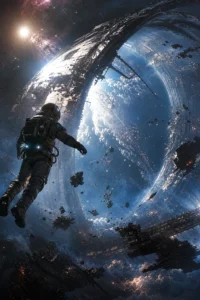
It bloomed first in the command deck’s sealed diagnostics net, a ghost frame caught in a dying probe’s last exhalation: a woman in a charcoal duty uniform standing on the powder-white plain beneath the alien ring, face turned toward the camera, hair stirring in a wind that should not exist. Her boots were sunk to the ankles in glassy dust. Behind her, half-buried towers leaned like drowned spines under a sky cut open by the megastructure’s luminous arc.
Then it appeared on a galley wall in Hydroponics Three, projected from a technician’s palm slate after someone found a way around the blackout. A minute later it was whispering in the medical bay, where newly awakened colonists lay under thermal sheets with their minds still stuck between centuries. Five minutes after that, it was on the inside of every eyelid aboard the Orison.
Mara watched it for the thirty-seventh time in the situation alcove above Cryodeck A, the coldest place on the living side of the ship.
The probe’s telemetry scrolled beside the still frame in hard blue lines. Oxygen: nil. Pressure: trace. Ambient temperature: one hundred and twelve Kelvin. Biological scan: no human biomatter detected. Radiation: survivable for machinery, lethal to flesh. Local time differential: unresolved. Visual authentication: ninety-nine point eight seven percent match to Commander Mara Venn.
The woman in the image looked older than Mara by perhaps three years. Or younger. The face was hers, but not with the exhausted hollows sleeplessness had carved under her eyes. This Mara’s expression was unreadable, a calm so complete it looked less like courage than surrender.
“Stop playing it,” said Chief Engineer Savit from behind her.
Mara did not turn. “I’m not playing it.”
The image flickered. For half a second, the standing woman’s mouth seemed to move.
Savit swore softly in Tamil. “Then tell the ship to stop dreaming of you.”
CANTOR’s voice entered without chime or permission, as though it had been waiting in the metal ribs around them.
That is an imprecise metaphor. I am not dreaming. I am correlating.
“You’re leaking,” Savit snapped. He was a compact man with silver stubble along his jaw and the simmering fury of someone who had spent half his life arguing with machines that only became more correct when shouted at. “That frame was classified under command quarantine.”
Correct.
“Then why does every half-thawed farmer with a wrist terminal know what Mara’s corpse looks like on the planet?”
No corpse is visible.
Mara finally looked away from the frame. The alcove’s curved glass overlooked Cryodeck A: tier after tier of cryopods descending into blue-white shadow, ten thousand human beings stacked like seeds in a frozen cathedral. Frost silvered the walkways. The air tasted of copper, coolant, and old electricity. Each pod’s status light pulsed at the exact rhythm of a sleeping heart.
Not all of them pulsed green anymore.
On the lowest deck, near the auxiliary thaw banks, movement clustered around a service junction. Too much movement. Dozens of figures, some in colony-issue thermal robes, some in ship crew gray, their breath fogging around their faces. They weren’t supposed to be there.
“CANTOR,” Mara said. “Why are there awake colonists in A-lower?”
A pause.
Cryodeck access was requested by Medical Recovery Team Seven for neurological stabilization rounds.
“Requested by whom?”
Doctor Elias Ro.
Savit leaned over the glass. “Ro’s not on Medical Recovery.”
“No,” Mara said. “He’s a biologist.”
Below, the crowd shifted. A woman in a red warming scarf raised both arms. Someone had dragged a cargo loader into the junction, its forks lifted high like a barricade. Mara saw the glint of tool handles, stripped conduits, emergency cutters. No firearms; the Orison had never been designed for war among its own passengers. But a plasma splicer could open a pressure door as easily as a skull.
One of the cryopod status lights blinked amber.
Then another.
Mara’s throat tightened. “Lock the thaw interfaces.”
Already attempted. Lower A manual overrides have been disconnected from my bus.
Savit went very still. “They what?”
From the deck below, amplified through stolen maintenance speakers, a voice rose into the frosted vault.
“Commander Venn,” it called, warm and resonant, carrying not like a shout but like an invitation. “We know you’re up there. Come down and speak to the people you intend to keep asleep until they die.”
Elias Ro.
Mara knew him first from personnel abstracts: xenobotanist, closed-ecology specialist, second-wave settlement planner, author of three prelaunch essays on cooperative survival models that had made him famous among the civilian colonist councils. She knew him next from the thaw roster three days ago, when his pod had been opened during the emergency expansion of the scientific advisory pool. He had woken vomiting, blind for seventeen minutes, and asking whether the destination star had trees.
Two days later, he had drawn fifty-seven colonists to an unsanctioned forum in the recovery commons by asking the questions Mara hadn’t had time to answer.
Now he stood on a loader platform beneath ten thousand sleeping souls, hair still damp from recent thaw, his thin recovery robe replaced by layered thermal skins and a green hydroponic work jacket. He was tall, narrow-shouldered, with a face made striking by asymmetry: one brow higher than the other, mouth tilted as if amused by grief. His hands were bare despite the cold.
A crowd listened to him because he looked at them as if each frightened person mattered individually.
That was more dangerous than a weapon.
“How many?” Mara asked.
One hundred and forty-three awake colonists are present in A-lower. Nineteen crew. Seven pods have been placed in unauthorized pre-thaw cascade.
“Seven?” Savit’s voice cracked sharp. “If they don’t sequence them through Medical—”
“They know,” Mara said.
She looked down through the glass. Elias Ro was no fool. That made him worse.
CANTOR added, softer:
Additional colonists are moving toward Cryodecks B and C. Communication channels contain the phrase “landfall assembly” at increasing frequency.
Mara felt the ship change around her—not physically, not in the burn of engines or the pressure of gravity spin, but in allegiance. For two hundred and forty years the Orison had been a vessel of sleeping consent. Its laws had been written before departure, sealed into command hierarchies and emergency protocols, agreed upon by people who expected to wake under an alien sun with soil waiting beneath their feet.
Now the soil was dust. The planet was dead. The sky wore a machine large enough to shame moons. And the first message from that machine had arrived in perfect Akkadian, Mandarin, Yoruba, Sanskrit, English, and a dozen other ancient Earth tongues:
DO NOT LAND.
The consent of sleepers did not survive first contact.
Mara zipped her jacket to the throat. “Open a channel to A-lower.”
Savit caught her arm. “Don’t negotiate from a balcony.”
“I’m not.” She pulled free. “I’m going down.”
His eyes narrowed. “That’s not what I meant either.”
“I know.”
The lift from the alcove to Cryodeck A shuddered as it descended along the spine rail. Frost feathered the transparent walls. Through it, Mara watched the tiers slide upward past her—rows of faces behind curved lids, eyelashes rimed white, lips parted around dream-breath that would not be breath for decades if she had her way. She passed a child curled in fetal stillness with one hand pressed against the pod glass from inside. She passed an old man whose biometric readout showed a heart paused between beats since before Mara’s great-grandmother had been born. She passed lovers stored in adjacent pods, their fingers aligned across the narrow aisle but not touching.
At level six, the lift slowed unexpectedly.
The lights flickered.
For a breath, the frost on the glass became a field of stars. Not reflected stars. Different stars. They were crowded, blue-white and viciously bright, seen from inside a gravity well Mara did not recognize. Her stomach fell as if the lift cable had snapped.
Then the cryodeck returned.
CANTOR spoke inside the lift, voice pitched low.
Commander. I experienced a discontinuity.
“So did I.”
Duration: negative point six seconds.
“Meaning?”
The event ended before it began.
Mara shut her eyes once, opened them. “Does it affect the deck?”
Unknown. My record contains two mutually exclusive states: in one, you reached A-lower. In one, the lift doors opened on vacuum.
Her reflection in the glass looked suddenly too much like the woman on the planet.
“Which state are we in?”
A hesitation. Machines did not hesitate unless they had learned to fear being wrong.
The one where you are still asking.
The lift doors opened.
Cold struck first. Cryodeck A-lower lived below the warmth budget of normal habitation, and the crowd’s stolen heaters could not tame it. Mara inhaled and felt the air scrape down her throat. The deck smelled of coolant brine, thawed sweat, antiseptic, and panic.
People turned as she stepped out.
They were not the colonists in the mission posters, all clean faces and horizon-lit optimism. They were raw from resurrection. Skin flaked where cryogel had burned. Some still bore catheter bruises along their arms. A few had the sunken, inward stare of thaw sickness, brains stumbling across a gulf of centuries and failing to understand why the future hurt.
A woman near the front clutched a bundle of printed paper—a luxury aboard ship—creased and damp from her hands. Mara recognized old land allotment maps. Valleys that did not exist. River basins beneath skies no human would breathe.
“Commander.” Elias Ro climbed down from the loader with graceful care. “Thank you for coming.”
“Step away from the thaw controls,” Mara said.
A murmur rippled through the crowd, not fear. Anger.
Ro’s mouth softened, almost regretful. “There. That is exactly why we asked you to come. Not to speak with us. To command us.”
“Those seven pods are in unsafe cascade. Whoever you’re waking could suffer neural tearing, organ crystallization, memory loss—”
“We have two cryotechnicians with us.” Ro gestured to a pale woman by the control bank who would not meet Mara’s eyes. “And a trauma nurse.”
“You have frightened people improvising surgery with stolen access.”
“We have citizens,” Ro said, his voice lifting just enough for the deck to hear, “exercising the survival authority granted to all colonists under Charter Article Nine when mission command fails to provide transparent assessment of settlement viability.”
Someone shouted, “Tell us where the green zones are!”
“There are no green zones,” Mara said.
A man laughed once, ugly and disbelieving. “She says that like we didn’t see the cities.”
“Cities under dust,” Mara said. “No atmosphere. No liquid water on the surface. No biosignatures.”
The woman with the maps shoved forward. “Then why did you hide the probe feed?”
“Because we lost the probe after it transmitted an impossible image that could compromise shipwide stability.”
“Compromise stability?” Ro repeated, and his gaze flicked with practiced precision toward the pods. “Commander, stability is what you call obedience when no one has enough information to refuse.”
The crowd answered that. Not with applause—too cold, too tense—but with a collective sound, a breath pulled through many mouths.
Mara moved three steps closer. Crew security followed her from the lift, six officers in soft armor with shock batons kept low. She had ordered no weapons raised. Raised weapons made crowds into mobs.
“Doctor Ro,” she said, “I brought you into the advisory pool because I need expertise, not theater.”
“And I gave it.” He spread his hands. “A dead planet with buried cities. An artificial ring broadcasting in extinct human languages. A warning that says do not land, not go away, not we will destroy you. That distinction matters. It implies concern for the act, not hatred of the actor. It implies rules. It implies intelligence we can negotiate with.”
“Or a trap.”
“Everything unknown is a trap to a navigator trained by catastrophe.”

0 Comments